Assignment 4
Camera
shots, angles, movements, c
omposition
CAMERA SHOTS!
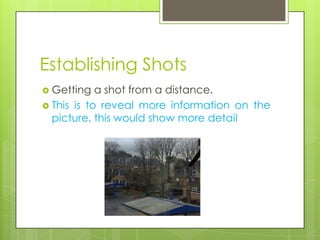
Establishing Shots
 Getting   a shot from a distance.
 This is to reveal more information on the
  picture, this would show more detail
Wide shots
A   wide shot would be wide enough to see
  enough information in the picture.
 Its like panoramic, detail of the place
  where enough information would be
  seen. This would be used in wedding, to
  show the bride and groom to what’s
  around them.
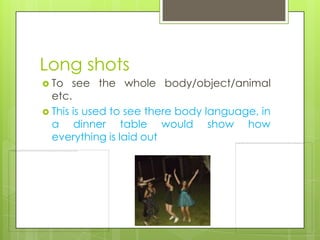
Long shots
 To   see the whole body/object/animal
  etc.
 This is used to see there body language, in
  a dinner table would show how
  everything is laid out
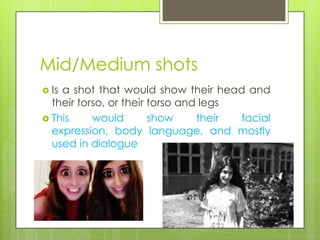
Mid/Medium shots
 Isa shot that would show their head and
  their torso, or their torso and legs
 This     would        show     their facial
  expression, body language, and mostly
  used in dialogue
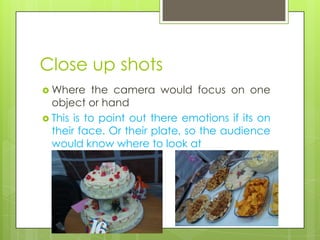
Close up shots
 Where     the camera would focus on one
  object or hand
 This is to point out there emotions if its on
  their face. Or their plate, so the audience
  would know where to look at
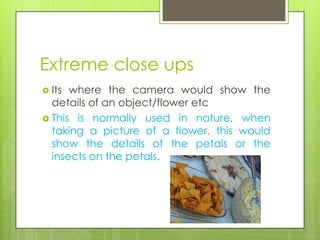
Extreme close ups
 Its where the camera would show the
  details of an object/flower etc
 This is normally used in nature, when
  taking a picture of a flower, this would
  show the details of the petals or the
  insects on the petals.
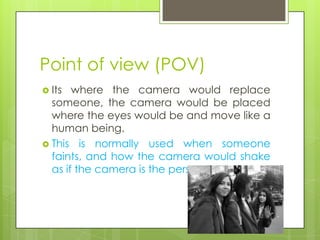
Point of view (POV)
 Its  where the camera would replace
  someone, the camera would be placed
  where the eyes would be and move like a
  human being.
 This is normally used when someone
  faints, and how the camera would shake
  as if the camera is the person
Over the shoulder
 When     the camera is placed back of the
  characters shoulder.
 This is used especially when we are meant
  to focus on one character for example
  when talking, and would see there facial
  expression.
Two shots
 When    two human beings/object/animal is
  in one shot
 This is when for example 2 human beings
  interact for example talking or having
  dinner together. Best friends shopping etc.
Ariel shots
A  shot taken from a helicopter would see
  everything.
 This is used to aware the audience where
  the location would be
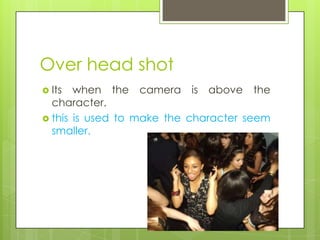
Over head shot
 Its  when the camera is above the
  character.
 this is used to make the character seem
  smaller.
CAMERA ANGLES!
Low angle
 When   the camera would be lower than
  the character/object etc.
 It would enhance their roles, make them
  more powerful and also make them look
  big.
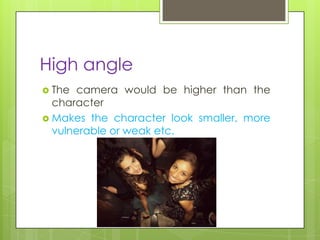
High angle
 The camera would be higher than the
  character
 Makes the character look smaller, more
  vulnerable or weak etc.
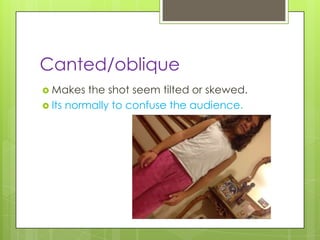
Canted/oblique
 Makes   the shot seem tilted or skewed.
 Its normally to confuse the audience.
CAMERA MOVEMENT!
Pan
 When     the       camera       would     pivot
  horizontally, left to right/right to left
 This is normally used to show more
  information.


      http://www.youtube.com/watch?v=Hh
      yXtWjN-uw&feature=g-upl
Tilt
 The   camera would go low to high or high
  to low.
 This is also used to get more information


        http://www.youtube.com/watch?v=nZ
        OaMCThtH0&feature=g-upl
Track
 The   camera would move side to side
  without pivoting
 This is used to follow a character or an
  object with smooth movements that’s
  either side to side, back to front or curved
  movements.
Zooming
 When     the camera is still but zooms in to
  get closer to a character or an object
 This is to create intensity


      http://www.youtube.com/watch?v=4t
      q9gWUdrRs&feature=g-upl
Reverse zooming
 This is the same as zooming but comes out
  from the character/object back to
  normal.
 This is used to reveal more detail, might be
  the location or to show their body
  language.
         http://www.youtube.com/watch?v=Az
         xFO2zJL0M&feature=g-upl
Dolly
 When    the camera would move in and
 out, backwards or forwards on a track
 and can move in different angles. (this
 isn’t track or zoom)

     http://www.youtube.com/watch?v=lXF
     Z7OlycAY&feature=g-upl
Crane
 When    the camera is on the crane whilst
  the crane is moving
 This is used normally in action films for
  example racing.
Stedicam
 When      the camera is stable on a
  human, so it doesn't shake, but moves
  smoothly while the person is moving.
 This is used when filming a football match
Vertigo
A    movement which is zooming and
  dolling at the same time. If it dolling in
  zoom out. If its dolling out zoom in.
 This is normally used in dramatic scenes.
COMPOSITION!
Balance
 The  way that the image balances the
 shape, size. The way we place the objects
 in a frame to show balance
Symmetry
 To  show order, and its the same on both
  sides.
 This is used to show normalness and
  organization
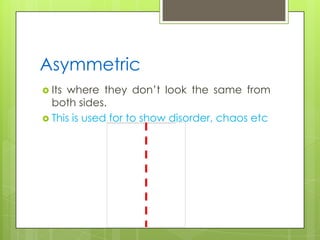
Asymmetric
 Itswhere they don’t look the same from
  both sides.
 This is used for to show disorder, chaos etc
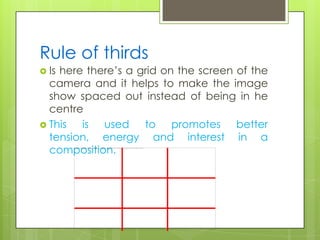
Rule of thirds
 Ishere there’s a grid on the screen of the
  camera and it helps to make the image
  show spaced out instead of being in he
  centre
 This  is used to promotes better
  tension, energy and interest in a
  composition.
Depth of field
 Itsthe difference between the nearest
  and farthest objects. A distance of what
  would be focussed. A the camera can
  only look at one object/character.
Shallow focus
 Emphasises       and     highlights     one
  object/character and the rest is blurry.
 This is used to aware the audience where
  to look, directs us where we should look
  the most.
Deep focus
 Its the opposite of shallow focus, the
  entire image is in focus. And there's
  foreground (FG), middle ground (MG)
  and back ground (BG). (when there's a
  character in from of the camera (FG), the
  second person is the middle (MG) and
  the there's a third furthest away from the
  camera then the background(BG))
Focus pulls
 When one object is clear and behind that
 object is blurry or the other way round.

Assignment 4 section a , coursework

  • 1.
    Assignment 4 Camera shots, angles,movements, c omposition
  • 2.
  • 3.
    Establishing Shots  Getting a shot from a distance.  This is to reveal more information on the picture, this would show more detail
  • 4.
    Wide shots A wide shot would be wide enough to see enough information in the picture.  Its like panoramic, detail of the place where enough information would be seen. This would be used in wedding, to show the bride and groom to what’s around them.
  • 5.
    Long shots  To see the whole body/object/animal etc.  This is used to see there body language, in a dinner table would show how everything is laid out
  • 6.
    Mid/Medium shots  Isashot that would show their head and their torso, or their torso and legs  This would show their facial expression, body language, and mostly used in dialogue
  • 7.
    Close up shots Where the camera would focus on one object or hand  This is to point out there emotions if its on their face. Or their plate, so the audience would know where to look at
  • 8.
    Extreme close ups Its where the camera would show the details of an object/flower etc  This is normally used in nature, when taking a picture of a flower, this would show the details of the petals or the insects on the petals.
  • 9.
    Point of view(POV)  Its where the camera would replace someone, the camera would be placed where the eyes would be and move like a human being.  This is normally used when someone faints, and how the camera would shake as if the camera is the person
  • 10.
    Over the shoulder When the camera is placed back of the characters shoulder.  This is used especially when we are meant to focus on one character for example when talking, and would see there facial expression.
  • 11.
    Two shots  When two human beings/object/animal is in one shot  This is when for example 2 human beings interact for example talking or having dinner together. Best friends shopping etc.
  • 12.
    Ariel shots A shot taken from a helicopter would see everything.  This is used to aware the audience where the location would be
  • 13.
    Over head shot Its when the camera is above the character.  this is used to make the character seem smaller.
  • 14.
  • 15.
    Low angle  When the camera would be lower than the character/object etc.  It would enhance their roles, make them more powerful and also make them look big.
  • 16.
    High angle  Thecamera would be higher than the character  Makes the character look smaller, more vulnerable or weak etc.
  • 17.
    Canted/oblique  Makes the shot seem tilted or skewed.  Its normally to confuse the audience.
  • 18.
  • 19.
    Pan  When the camera would pivot horizontally, left to right/right to left  This is normally used to show more information. http://www.youtube.com/watch?v=Hh yXtWjN-uw&feature=g-upl
  • 20.
    Tilt  The camera would go low to high or high to low.  This is also used to get more information http://www.youtube.com/watch?v=nZ OaMCThtH0&feature=g-upl
  • 21.
    Track  The camera would move side to side without pivoting  This is used to follow a character or an object with smooth movements that’s either side to side, back to front or curved movements.
  • 22.
    Zooming  When the camera is still but zooms in to get closer to a character or an object  This is to create intensity http://www.youtube.com/watch?v=4t q9gWUdrRs&feature=g-upl
  • 23.
    Reverse zooming  Thisis the same as zooming but comes out from the character/object back to normal.  This is used to reveal more detail, might be the location or to show their body language. http://www.youtube.com/watch?v=Az xFO2zJL0M&feature=g-upl
  • 24.
    Dolly  When the camera would move in and out, backwards or forwards on a track and can move in different angles. (this isn’t track or zoom) http://www.youtube.com/watch?v=lXF Z7OlycAY&feature=g-upl
  • 25.
    Crane  When the camera is on the crane whilst the crane is moving  This is used normally in action films for example racing.
  • 26.
    Stedicam  When the camera is stable on a human, so it doesn't shake, but moves smoothly while the person is moving.  This is used when filming a football match
  • 27.
    Vertigo A movement which is zooming and dolling at the same time. If it dolling in zoom out. If its dolling out zoom in.  This is normally used in dramatic scenes.
  • 28.
  • 29.
    Balance  The way that the image balances the shape, size. The way we place the objects in a frame to show balance
  • 30.
    Symmetry  To show order, and its the same on both sides.  This is used to show normalness and organization
  • 31.
    Asymmetric  Itswhere theydon’t look the same from both sides.  This is used for to show disorder, chaos etc
  • 32.
    Rule of thirds Ishere there’s a grid on the screen of the camera and it helps to make the image show spaced out instead of being in he centre  This is used to promotes better tension, energy and interest in a composition.
  • 33.
    Depth of field Itsthe difference between the nearest and farthest objects. A distance of what would be focussed. A the camera can only look at one object/character.
  • 34.
    Shallow focus  Emphasises and highlights one object/character and the rest is blurry.  This is used to aware the audience where to look, directs us where we should look the most.
  • 35.
    Deep focus  Itsthe opposite of shallow focus, the entire image is in focus. And there's foreground (FG), middle ground (MG) and back ground (BG). (when there's a character in from of the camera (FG), the second person is the middle (MG) and the there's a third furthest away from the camera then the background(BG))
  • 36.
    Focus pulls  Whenone object is clear and behind that object is blurry or the other way round.