Who would be the audience
for your media product?
By Chloe-Ann Dorward
Evaluation Question 4
My Intro
 The media product I completed was categorised into the
genre of social realism.
 Social realism is seen to be more niche then other
genres, such as sci-fi and horror, which are mainstream
as they gather a greater audience then social realism.
 From my quantitative research, I found that only a minor
amount of people had an awareness of the social
realism genre.
Key Questions
 There are two key questions that I have to take into
consideration when looking into who would be my
audience;
 What genre does your film belong to?
 Who consumes films from this genre?
Theatrical
 There is not a great amount of cinemas that screen
social realism films. Multiplex cinemas, such as Odeon
and Empire, only show mainstream Hollywood films,
such as thriller and comedy.
 The target demographic for multiplex cinemas are
younger people (e.g. teenagers) who prefer mainstream
genres as this is what is made known to them in
everyday media.
 As people are consumed by mainstream films, there is a
lesser request for social realism films. Since this is the
case, specialised cinemas regularly show independent
social realism films. These tend to be aimed towards an
audience that is more educated.
Examples
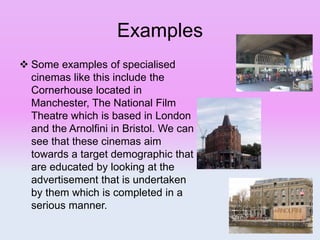
 Some examples of specialised
cinemas like this include the
Cornerhouse located in
Manchester, The National Film
Theatre which is based in London
and the Arnolfini in Bristol. We can
see that these cinemas aim
towards a target demographic that
are educated by looking at the
advertisement that is undertaken
by them which is completed in a
serious manner.
Online
 As technology is advancing and evolving, streaming
films becomes easier every day. There are many
companies that allow members of the public to excess
films through paying a subscription. Examples of these
companies are Netflix, LoveFilm and MUBI.
Mubi
 Mubi are aimed towards a more intellectual audience,
Mubi offers a variety of independent films.
 The layout of their site conveys that their target
demographic is a more serious audience. There is a lack
of bright colours, which contrasts other sites such as
Netflix. Netflix uses red colour to stand out and attract
their audience.
 Members of Mubi are able to use Mubi social to discuss
the in depth field of film and reviews. These members
have a passion to research movies further.
Television
 BBC Four are permitted to show a variety of content
when it is on the air, this contains drama and current
affairs. It also must premiere 20 new international films,
publish 100 hours of new art and music programmes and
110 hours of factual programmes.
 The demographic that BBC Four is aiming at is more
intellectual and serious. This is also similar to social
realism when considering their demographic.
Another example of television
Film 4:
 Film 4 currently broadcasts a variety of
genres. Some may be more mainstream
genres as they do show a great amount
of Hollywood films. However, they do
also have special themed nights in which
they will focus on a theme, actor,
director, genre etc.
 They also have a production company
called Film4 Productions. The way that
they gain recognition and publicity is
through showing these films made by
this production company on this channel.
 Therefore there is a mix of regular users
and non users of social realism in the
demographic.
Radio
 Radio stations, such as BBC Radio 3, regularly
exhibit shows that are to do with social realism.
 Examples of things that are aired on radio 3 is the
Arts culture and media.
 The target demographic of this station is more
intellectual and creatively minded people, which is
similar to that of BBC 4.
 Many people feel that radio 3 is not of great
importance, however the listeners to think that it is
very important. These viewers tend to be of the
older generation and of the male gender.
Another example of radio
Radio 4:
 Radio 4 doesn’t air any music, instead it
is based on intellectual discussions and
reviews.
 The station also holds a variety of
interviews with actors and directors to
do with the social realism genre. An
example of one of these interviews was
with Olivia Colman, the actress starring
in the social realism film Tyrannosaur.
 The audience once again is aimed at
the elder generation.
Print
 An example of a serious film
magazine aimed at more
intellectual readers is Sight and
Sound. The layout of the
magazine is that the films get a
small paragraph describing
them, the
actors/director/producers get
credited and a few screen
shots.
 We can create the assumption
that Sight and Sound are trying
to appeal to the more
thoughtful, intellectual people
that care about what is in the
films content, rather then just
watching the film for enjoyment.
My Research
• I gathered a number of people to take part in both
quantitative questionnaire and also a qualitative
questionnaire.
• Both my qualitative and quantitative research, showed
me younger people do not tend to consume as much
social realism films as older and more intelligent people
do. This tells me that the people I should be aiming my
film at is older people who are or who have been in high
education such as university students that are studying
media.
• I also found that not many people know of independent
film cinemas which will not be beneficial to me as it would
mean that my film would not be viewed by many people.

Evaluation q4

  • 1.
    Who would bethe audience for your media product? By Chloe-Ann Dorward Evaluation Question 4
  • 2.
    My Intro  Themedia product I completed was categorised into the genre of social realism.  Social realism is seen to be more niche then other genres, such as sci-fi and horror, which are mainstream as they gather a greater audience then social realism.  From my quantitative research, I found that only a minor amount of people had an awareness of the social realism genre.
  • 3.
    Key Questions  Thereare two key questions that I have to take into consideration when looking into who would be my audience;  What genre does your film belong to?  Who consumes films from this genre?
  • 4.
    Theatrical  There isnot a great amount of cinemas that screen social realism films. Multiplex cinemas, such as Odeon and Empire, only show mainstream Hollywood films, such as thriller and comedy.  The target demographic for multiplex cinemas are younger people (e.g. teenagers) who prefer mainstream genres as this is what is made known to them in everyday media.  As people are consumed by mainstream films, there is a lesser request for social realism films. Since this is the case, specialised cinemas regularly show independent social realism films. These tend to be aimed towards an audience that is more educated.
  • 5.
    Examples  Some examplesof specialised cinemas like this include the Cornerhouse located in Manchester, The National Film Theatre which is based in London and the Arnolfini in Bristol. We can see that these cinemas aim towards a target demographic that are educated by looking at the advertisement that is undertaken by them which is completed in a serious manner.
  • 6.
    Online  As technologyis advancing and evolving, streaming films becomes easier every day. There are many companies that allow members of the public to excess films through paying a subscription. Examples of these companies are Netflix, LoveFilm and MUBI.
  • 7.
    Mubi  Mubi areaimed towards a more intellectual audience, Mubi offers a variety of independent films.  The layout of their site conveys that their target demographic is a more serious audience. There is a lack of bright colours, which contrasts other sites such as Netflix. Netflix uses red colour to stand out and attract their audience.  Members of Mubi are able to use Mubi social to discuss the in depth field of film and reviews. These members have a passion to research movies further.
  • 8.
    Television  BBC Fourare permitted to show a variety of content when it is on the air, this contains drama and current affairs. It also must premiere 20 new international films, publish 100 hours of new art and music programmes and 110 hours of factual programmes.  The demographic that BBC Four is aiming at is more intellectual and serious. This is also similar to social realism when considering their demographic.
  • 9.
    Another example oftelevision Film 4:  Film 4 currently broadcasts a variety of genres. Some may be more mainstream genres as they do show a great amount of Hollywood films. However, they do also have special themed nights in which they will focus on a theme, actor, director, genre etc.  They also have a production company called Film4 Productions. The way that they gain recognition and publicity is through showing these films made by this production company on this channel.  Therefore there is a mix of regular users and non users of social realism in the demographic.
  • 10.
    Radio  Radio stations,such as BBC Radio 3, regularly exhibit shows that are to do with social realism.  Examples of things that are aired on radio 3 is the Arts culture and media.  The target demographic of this station is more intellectual and creatively minded people, which is similar to that of BBC 4.  Many people feel that radio 3 is not of great importance, however the listeners to think that it is very important. These viewers tend to be of the older generation and of the male gender.
  • 11.
    Another example ofradio Radio 4:  Radio 4 doesn’t air any music, instead it is based on intellectual discussions and reviews.  The station also holds a variety of interviews with actors and directors to do with the social realism genre. An example of one of these interviews was with Olivia Colman, the actress starring in the social realism film Tyrannosaur.  The audience once again is aimed at the elder generation.
  • 12.
    Print  An exampleof a serious film magazine aimed at more intellectual readers is Sight and Sound. The layout of the magazine is that the films get a small paragraph describing them, the actors/director/producers get credited and a few screen shots.  We can create the assumption that Sight and Sound are trying to appeal to the more thoughtful, intellectual people that care about what is in the films content, rather then just watching the film for enjoyment.
  • 13.
    My Research • Igathered a number of people to take part in both quantitative questionnaire and also a qualitative questionnaire. • Both my qualitative and quantitative research, showed me younger people do not tend to consume as much social realism films as older and more intelligent people do. This tells me that the people I should be aiming my film at is older people who are or who have been in high education such as university students that are studying media. • I also found that not many people know of independent film cinemas which will not be beneficial to me as it would mean that my film would not be viewed by many people.