Different shots
establishing 
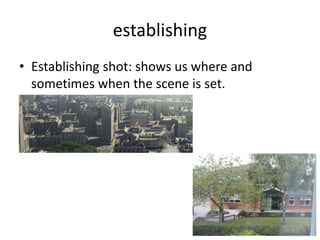
• Establishing shot: shows us where and 
sometimes when the scene is set.
Wide shot/Long shot 
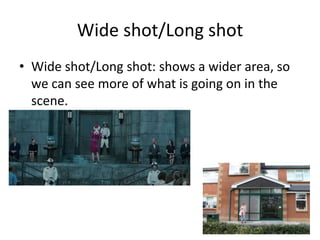
• Wide shot/Long shot: shows a wider area, so 
we can see more of what is going on in the 
scene.
Medium shot 
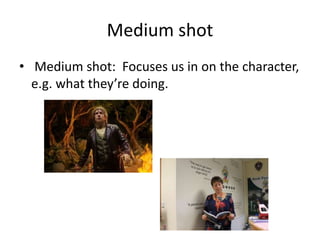
• Medium shot: Focuses us in on the character, 
e.g. what they’re doing.
Point of view 
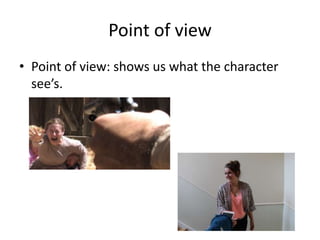
• Point of view: shows us what the character 
see’s.
Over the shoulder 
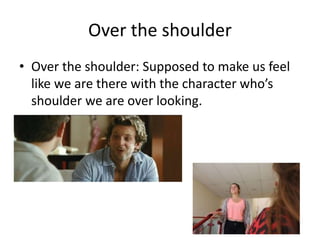
• Over the shoulder: Supposed to make us feel 
like we are there with the character who’s 
shoulder we are over looking.
Two shot 
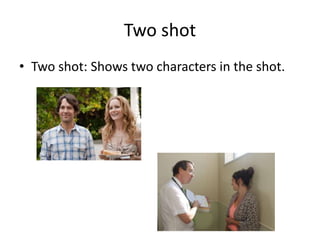
• Two shot: Shows two characters in the shot.
Close up 
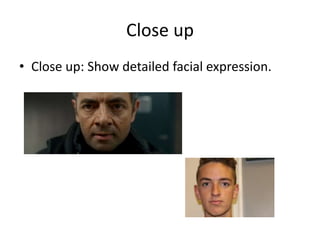
• Close up: Show detailed facial expression.
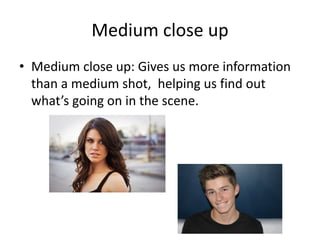
Medium close up 
• Medium close up: Gives us more information 
than a medium shot, helping us find out 
what’s going on in the scene.
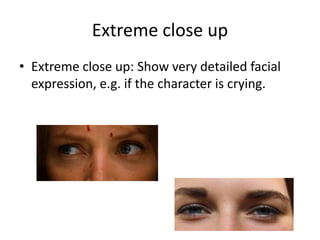
Extreme close up 
• Extreme close up: Show very detailed facial 
expression, e.g. if the character is crying.
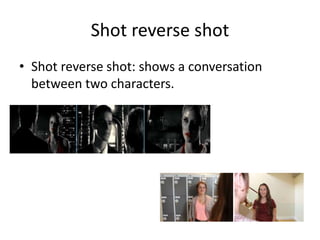
Shot reverse shot 
• Shot reverse shot: shows a conversation 
between two characters.
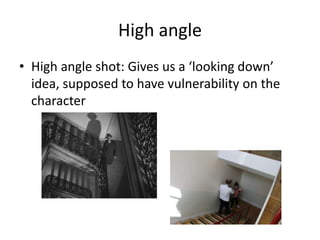
High angle 
• High angle shot: Gives us a ‘looking down’ 
idea, supposed to have vulnerability on the 
character
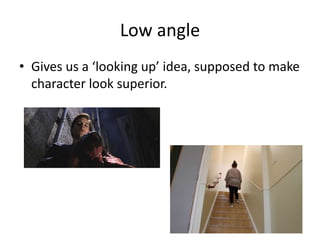
Low angle 
• Gives us a ‘looking up’ idea, supposed to make 
character look superior.

Different types of shots

  • 1.
  • 2.
    establishing • Establishingshot: shows us where and sometimes when the scene is set.
  • 3.
    Wide shot/Long shot • Wide shot/Long shot: shows a wider area, so we can see more of what is going on in the scene.
  • 4.
    Medium shot •Medium shot: Focuses us in on the character, e.g. what they’re doing.
  • 5.
    Point of view • Point of view: shows us what the character see’s.
  • 6.
    Over the shoulder • Over the shoulder: Supposed to make us feel like we are there with the character who’s shoulder we are over looking.
  • 7.
    Two shot •Two shot: Shows two characters in the shot.
  • 8.
    Close up •Close up: Show detailed facial expression.
  • 9.
    Medium close up • Medium close up: Gives us more information than a medium shot, helping us find out what’s going on in the scene.
  • 10.
    Extreme close up • Extreme close up: Show very detailed facial expression, e.g. if the character is crying.
  • 11.
    Shot reverse shot • Shot reverse shot: shows a conversation between two characters.
  • 12.
    High angle •High angle shot: Gives us a ‘looking down’ idea, supposed to have vulnerability on the character
  • 13.
    Low angle •Gives us a ‘looking up’ idea, supposed to make character look superior.