How to analyze a Tv drama.
Sophie Bennett.
Section A.
For section one you will be asked to watch 4-5 minute clip of a Tv drama.
Then you will need to complete a textual analysis for the the following below:
- Gender
- Age
- Ethnicity
- Sexuality
- Class and status
- Physical ability/disability
- Regional identity
After this you will use the following areas:
• Camera shots, angles, movement and composition
• Editing
• Sound
• Mise-en-scene
Camera shots, angle, movement and
composition.
Shots.
• Establishing shot: shows where the scene will be set.
• Master shot: shows the limit of the action.
• Close up: concentrates on one character, makes the reader learn more about this specific character.
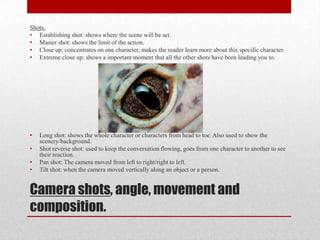
• Extreme close up: shows a important moment that all the other shots have been leading you to.
• Long shot: shows the whole character or characters from head to toe. Also used to show the
scenery/background.
• Shot reverse shot: used to keep the conversation flowing, goes from one character to another to see
their reaction.
• Pan shot: The camera moved from left to right/right to left.
• Tilt shot: when the camera moved vertically along an object or a person.
Camera shots, angles, movement and
composition.
Angles.
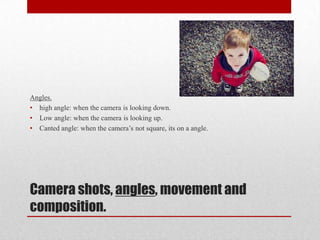
• high angle: when the camera is looking down.
• Low angle: when the camera is looking up.
• Canted angle: when the camera’s not square, its on a angle.
Editing.
Examples of editing.
Includes transition of image and sound – continuity and non-continuity.
Cutting:
• shot/reverse shot,
• eye line match,
• graphic match,
• action match,
• jump cut, crosscutting,
• parallel editing,
• cutaway; insert.
Transitions:
• dissolve,
• fade-in, fade-out,
• wipe,
• superimposition,
• long take, short take,
• slow motion,
• ellipsis and expansion of time.
Sounds.
Sounds used in a clip.
• Diegetic and non-diegetic sound
• synchronous/asynchronous sound,
• sound effects,
• sound motif,
• sound bridge,
• dialogue,
• voiceover,
• mode of address/direct address,
• sound mixing,
• sound perspective.
Mise-en scene.
What we can tell/learn from the clip.
Production design:
• location,
• studio,
• set design,
• costume and make-up,
• properties.
Lighting:
• colour design.

Photography section a powerpoint

  • 1.
    How to analyzea Tv drama. Sophie Bennett.
  • 2.
    Section A. For sectionone you will be asked to watch 4-5 minute clip of a Tv drama. Then you will need to complete a textual analysis for the the following below: - Gender - Age - Ethnicity - Sexuality - Class and status - Physical ability/disability - Regional identity After this you will use the following areas: • Camera shots, angles, movement and composition • Editing • Sound • Mise-en-scene
  • 3.
    Camera shots, angle,movement and composition. Shots. • Establishing shot: shows where the scene will be set. • Master shot: shows the limit of the action. • Close up: concentrates on one character, makes the reader learn more about this specific character. • Extreme close up: shows a important moment that all the other shots have been leading you to. • Long shot: shows the whole character or characters from head to toe. Also used to show the scenery/background. • Shot reverse shot: used to keep the conversation flowing, goes from one character to another to see their reaction. • Pan shot: The camera moved from left to right/right to left. • Tilt shot: when the camera moved vertically along an object or a person.
  • 4.
    Camera shots, angles,movement and composition. Angles. • high angle: when the camera is looking down. • Low angle: when the camera is looking up. • Canted angle: when the camera’s not square, its on a angle.
  • 5.
    Editing. Examples of editing. Includestransition of image and sound – continuity and non-continuity. Cutting: • shot/reverse shot, • eye line match, • graphic match, • action match, • jump cut, crosscutting, • parallel editing, • cutaway; insert. Transitions: • dissolve, • fade-in, fade-out, • wipe, • superimposition, • long take, short take, • slow motion, • ellipsis and expansion of time.
  • 6.
    Sounds. Sounds used ina clip. • Diegetic and non-diegetic sound • synchronous/asynchronous sound, • sound effects, • sound motif, • sound bridge, • dialogue, • voiceover, • mode of address/direct address, • sound mixing, • sound perspective.
  • 7.
    Mise-en scene. What wecan tell/learn from the clip. Production design: • location, • studio, • set design, • costume and make-up, • properties. Lighting: • colour design.