Section A
By using the following
area:
• Camera Shots,
Angle, Movement
and Composition
• Sound
• Mise-en-Scène
• Editing
Section one will have you watch a 4 – 5 minute
piece of TV drama. You will be asked then to
complete a textual analysis of it to discuss how it
constructs a representation of one of these
• Age
• Ethnicity
• Sexuality
• Class and status
• Physical ability/disability
• Regional identity
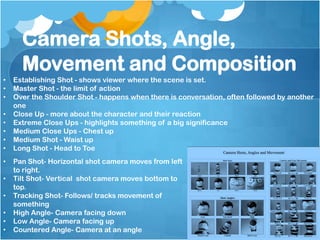
Camera Shots, Angle,
Movement and Composition
• Establishing Shot - shows viewer where the scene is set.
• Master Shot - the limit of action
• Over the Shoulder Shot - happens when there is conversation, often followed by another
one
• Close Up - more about the character and their reaction
• Extreme Close Ups - highlights something of a big significance
• Medium Close Ups - Chest up
• Medium Shot - Waist up
• Long Shot - Head to Toe
• Pan Shot- Horizontal shot camera moves from left
to right.
• Tilt Shot- Vertical shot camera moves bottom to
top.
• Tracking Shot- Follows/ tracks movement of
something
• High Angle- Camera facing down
• Low Angle- Camera facing up
• Countered Angle- Camera at an angle
Sound
• Diegetic Sound: is any sound that naturally
occurs in the story. Weather on screen or
not. e.g seagulls
• Non-diegetic Sound: is sound that isn't
natural sound in the story. e.g mood music,
sound effects
• Synchronous Sound: is sound that occurs
on the screen
• Asynchronous Sound: is sound that occurs
off the screen
There are 4 different types of sound: Diegetic sound, Non-diegetic
sound, Synchronous sounds and Asynchronous sound.
Mise-en-Scène
Editing

Presentation1

  • 2.
    Section A By usingthe following area: • Camera Shots, Angle, Movement and Composition • Sound • Mise-en-Scène • Editing Section one will have you watch a 4 – 5 minute piece of TV drama. You will be asked then to complete a textual analysis of it to discuss how it constructs a representation of one of these • Age • Ethnicity • Sexuality • Class and status • Physical ability/disability • Regional identity
  • 3.
    Camera Shots, Angle, Movementand Composition • Establishing Shot - shows viewer where the scene is set. • Master Shot - the limit of action • Over the Shoulder Shot - happens when there is conversation, often followed by another one • Close Up - more about the character and their reaction • Extreme Close Ups - highlights something of a big significance • Medium Close Ups - Chest up • Medium Shot - Waist up • Long Shot - Head to Toe • Pan Shot- Horizontal shot camera moves from left to right. • Tilt Shot- Vertical shot camera moves bottom to top. • Tracking Shot- Follows/ tracks movement of something • High Angle- Camera facing down • Low Angle- Camera facing up • Countered Angle- Camera at an angle
  • 4.
    Sound • Diegetic Sound:is any sound that naturally occurs in the story. Weather on screen or not. e.g seagulls • Non-diegetic Sound: is sound that isn't natural sound in the story. e.g mood music, sound effects • Synchronous Sound: is sound that occurs on the screen • Asynchronous Sound: is sound that occurs off the screen There are 4 different types of sound: Diegetic sound, Non-diegetic sound, Synchronous sounds and Asynchronous sound.
  • 5.
  • 6.