Presented By:-
RAJANISH KUMAWAT
10ESOEC092
4TH YEAR, VIITH SEM
A
PRACTICAL TRAINING
AT
DOORDARSHAN KENDRA, JAIPUR
Topic Covered:-
KEY ASPECTS:-
 Doordarshan is an Indian public service broadcaster.
 It is owned and operated by Prasar Bharati Broadcasting
Corporation.
 It is one of the largest broadcasting organisations in India in terms
of the studio and transmitter infrastructure.
 It was started in Delhi on 15 September 1959 as experimental,
and its regular transmission started in 1965.
 Its Head office is located in New Delhi, India.
 The DD provides television, radio, online and mobile services
throughout India.
 Presently, Doordarshan operates 21 channels including DD
National, DD News and DD Sports.
 The network features some original programming, such as
dramas, comedy-series, talk shows and re-runs of popular TV
shows from other Indian television channels.
 Live Coverage of national events like Independence Day,
Republic Day Celebrations, Budget Presentation and other
happenings of national and international importance are
regularly carried on this channel.
KEY ASPECTS:-
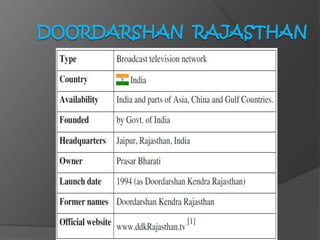
 DD Rajasthan is a state owned TV channel telecasting from
Doordarshan Kendra Rajasthan.
 On 1 August 1975, the first television broadcast was viewed
by the people of Rajasthan under the Satellite
 Doordarshan Kendra in Jaipur was set up on 1 June 1987 at
Jhalana Doongri and transmission started on 6 July 1987.
 Initially only 30 minutes of programming produced by this
Kendra and this was gradually increased. Presently the
Kendra originates about four hours of programming daily.
 The channel covers 79% by population and 72% by area of
Rajasthan.
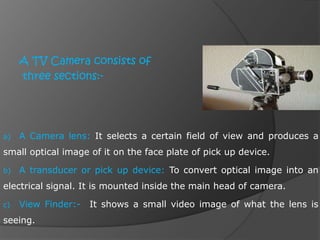
A TV Camera consists of
three sections:-
a) A Camera lens: It selects a certain field of view and produces a
small optical image of it on the face plate of pick up device.
b) A transducer or pick up device: To convert optical image into an
electrical signal. It is mounted inside the main head of camera.
c) View Finder:- It shows a small video image of what the lens is
seeing.
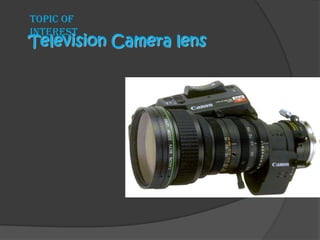
Television Camera lens
Topic of
interest
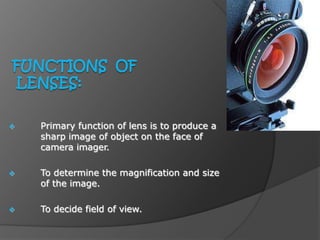
 Primary function of lens is to produce a
sharp image of object on the face of
camera imager.
 To determine the magnification and size
of the image.
 To decide field of view.
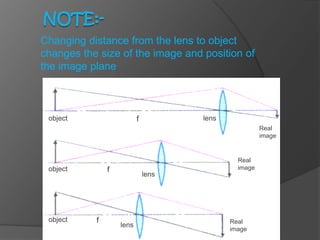
Changing distance from the lens to object
changes the size of the image and position of
the image plane
object
o
object
o
object
o
Real
image
Real
image
Real
image
lens
lens
lens
f
f
f
 Focal length is the distance between optical
center of the lens (and not the physical center)
and the focal point.
 Focal point is the point at which the light rays
converge at the rear of the lens to produce
perfectly focused image.
 In a video camera it is the distance between
face of the pick device and optical center of the
lens.
 Focal length will decide the amount of image
magnification and field of view.
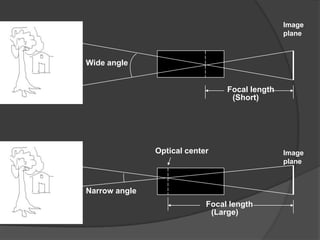
Wide angle
Narrow angle
Optical center
Image
plane
Image
plane
Focal length
Focal length
(Short)
(Large)
Resolution: Number of pixels captured by image sensor.
Focus: To focus objects at various distances
3,4,5,7,10,15,30, infinity, in feet
Zoom: To take long(lowest focal length) and tight shot
(Highest focal length)
Aperture: To control the amount of light entering
camera
F-stop: 1.4, 2.0, 2.8, 4, 5.6, 8, 11, 16, 22,
Back Focus: To keep long shot in focus while
zooming out.
Macro: To focus an object lying within Minimum Object
Distance.
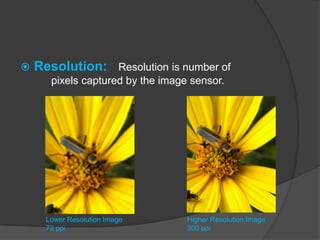
 Resolution: Resolution is number of
pixels captured by the image sensor.
Higher Resolution Image
300 ppi
Lower Resolution Image
72 ppi
All cameras have a shutter between the lenses at the
front and the film at the back.
The shutter is mostly closed so that light cannot get
to the film.
When you press the button to take the photo, the
shutter opens briefly and then closes again.
The time for which the shutter is open is called the
shutter speed. The shorter the time, the less light
gets in.
So, a shutter speed of 1/60th of a second
lets in half the amount of light than a speed of
1/30th of a second.
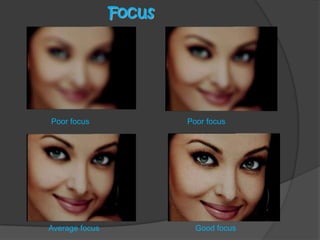
Focus
Poor focus Poor focus
Average focus Good focus
Variable Focal Length Lens or
Zoom lens
 Zoom lens has variable focal length and changes focal
length continuously without losing focusing . Typical
zoom range from 12-72mm.
 Zoom Ratio 6:1 can also be expressed as 6x. The
zoom ratio can be 10x, 12x, 15x, 19x etc.
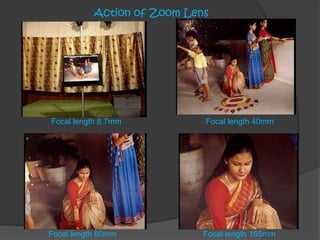
 The greater the focal length, the narrower will be the
field of view and the narrower the depth of field.
Action of Zoom Lens
Focal length 165mmFocal length 80mm
Focal length 40mmFocal length 8.7mm
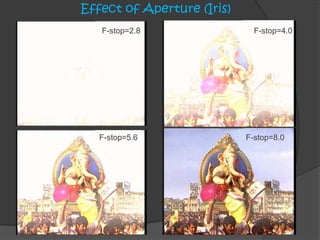
 Aperture is required to control the amount of light
entering the camera.
 The amount of light is specified by F-number (=f/D).
 The stop ring of the lens is marked with series of
numbers with a ratio of under-root of 2:
1.4, 2, 2.8, 4, 5.6, 8, 11, 16, 22
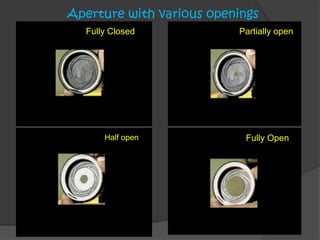
Aperture with various openings
Fully Closed
Fully Open
Partially open
Half open
F-stop=2.8 F-stop=4.0
F-stop=5.6 F-stop=8.0
Effect of Aperture (Iris)
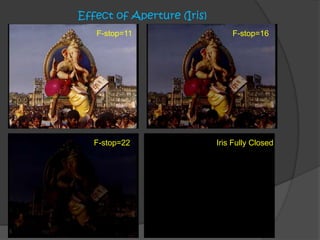
F-stop=11 F-stop=16
F-stop=22 Iris Fully Closed
Effect of Aperture (Iris)
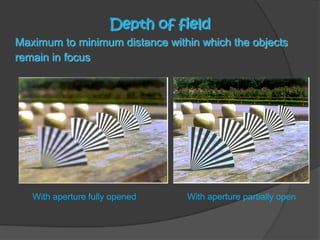
Maximum to minimum distance within which the objects
remain in focus
With aperture fully opened With aperture partially open
Depth of field
 Lens Aperture: Smaller the aperture or larger the
f-stop number, more the depth of field. It is because
with less aperture opening the light rays from the
outer edges of lens are cut off, narrowing the
maximum convergence angle at the focal point.
 Camera to subject distance: Larger the
distance of the subject from the camera, greater is
the depth of the field
 Focal length of the lens: As you increase the
focal length of the lens (i.e. narrowing it’s angle of
view), the image size increases, but the relative
depth of field decreases. Lens stop and focusing
distance remaining constant.
Factor Affecting Depth of Field
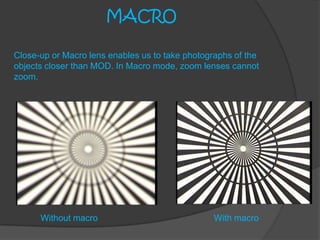
Close-up or Macro lens enables us to take photographs of the
objects closer than MOD. In Macro mode, zoom lenses cannot
zoom.
MACRO
Without macro With macro
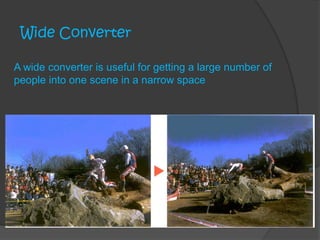
Wide Converter
A wide converter is useful for getting a large number of
people into one scene in a narrow space
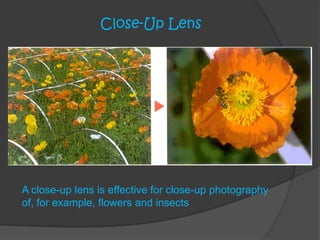
Close-Up Lens
A close-up lens is effective for close-up photography
of, for example, flowers and insects.
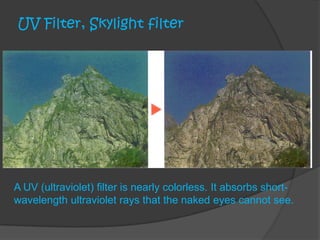
UV Filter, Skylight filter
A UV (ultraviolet) filter is nearly colorless. It absorbs short-
wavelength ultraviolet rays that the naked eyes cannot see.
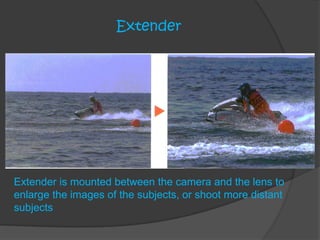
Extender
Extender is mounted between the camera and the lens to
enlarge the images of the subjects, or shoot more distant
subjects
Camera Lens

Camera Lens

  • 1.
    Presented By:- RAJANISH KUMAWAT 10ESOEC092 4THYEAR, VIITH SEM A PRACTICAL TRAINING AT DOORDARSHAN KENDRA, JAIPUR Topic Covered:-
  • 2.
    KEY ASPECTS:-  Doordarshanis an Indian public service broadcaster.  It is owned and operated by Prasar Bharati Broadcasting Corporation.  It is one of the largest broadcasting organisations in India in terms of the studio and transmitter infrastructure.  It was started in Delhi on 15 September 1959 as experimental, and its regular transmission started in 1965.  Its Head office is located in New Delhi, India.
  • 3.
     The DDprovides television, radio, online and mobile services throughout India.  Presently, Doordarshan operates 21 channels including DD National, DD News and DD Sports.  The network features some original programming, such as dramas, comedy-series, talk shows and re-runs of popular TV shows from other Indian television channels.  Live Coverage of national events like Independence Day, Republic Day Celebrations, Budget Presentation and other happenings of national and international importance are regularly carried on this channel.
  • 4.
    KEY ASPECTS:-  DDRajasthan is a state owned TV channel telecasting from Doordarshan Kendra Rajasthan.  On 1 August 1975, the first television broadcast was viewed by the people of Rajasthan under the Satellite  Doordarshan Kendra in Jaipur was set up on 1 June 1987 at Jhalana Doongri and transmission started on 6 July 1987.  Initially only 30 minutes of programming produced by this Kendra and this was gradually increased. Presently the Kendra originates about four hours of programming daily.  The channel covers 79% by population and 72% by area of Rajasthan.
  • 6.
    A TV Cameraconsists of three sections:- a) A Camera lens: It selects a certain field of view and produces a small optical image of it on the face plate of pick up device. b) A transducer or pick up device: To convert optical image into an electrical signal. It is mounted inside the main head of camera. c) View Finder:- It shows a small video image of what the lens is seeing.
  • 7.
  • 8.
     Primary functionof lens is to produce a sharp image of object on the face of camera imager.  To determine the magnification and size of the image.  To decide field of view.
  • 9.
    Changing distance fromthe lens to object changes the size of the image and position of the image plane object o object o object o Real image Real image Real image lens lens lens f f f
  • 10.
     Focal lengthis the distance between optical center of the lens (and not the physical center) and the focal point.  Focal point is the point at which the light rays converge at the rear of the lens to produce perfectly focused image.  In a video camera it is the distance between face of the pick device and optical center of the lens.  Focal length will decide the amount of image magnification and field of view.
  • 11.
    Wide angle Narrow angle Opticalcenter Image plane Image plane Focal length Focal length (Short) (Large)
  • 12.
    Resolution: Number ofpixels captured by image sensor. Focus: To focus objects at various distances 3,4,5,7,10,15,30, infinity, in feet Zoom: To take long(lowest focal length) and tight shot (Highest focal length) Aperture: To control the amount of light entering camera F-stop: 1.4, 2.0, 2.8, 4, 5.6, 8, 11, 16, 22, Back Focus: To keep long shot in focus while zooming out. Macro: To focus an object lying within Minimum Object Distance.
  • 13.
     Resolution: Resolutionis number of pixels captured by the image sensor. Higher Resolution Image 300 ppi Lower Resolution Image 72 ppi
  • 14.
    All cameras havea shutter between the lenses at the front and the film at the back. The shutter is mostly closed so that light cannot get to the film. When you press the button to take the photo, the shutter opens briefly and then closes again. The time for which the shutter is open is called the shutter speed. The shorter the time, the less light gets in. So, a shutter speed of 1/60th of a second lets in half the amount of light than a speed of 1/30th of a second.
  • 15.
    Focus Poor focus Poorfocus Average focus Good focus
  • 16.
    Variable Focal LengthLens or Zoom lens  Zoom lens has variable focal length and changes focal length continuously without losing focusing . Typical zoom range from 12-72mm.  Zoom Ratio 6:1 can also be expressed as 6x. The zoom ratio can be 10x, 12x, 15x, 19x etc.  The greater the focal length, the narrower will be the field of view and the narrower the depth of field.
  • 17.
    Action of ZoomLens Focal length 165mmFocal length 80mm Focal length 40mmFocal length 8.7mm
  • 18.
     Aperture isrequired to control the amount of light entering the camera.  The amount of light is specified by F-number (=f/D).  The stop ring of the lens is marked with series of numbers with a ratio of under-root of 2: 1.4, 2, 2.8, 4, 5.6, 8, 11, 16, 22
  • 19.
    Aperture with variousopenings Fully Closed Fully Open Partially open Half open
  • 20.
  • 21.
    F-stop=11 F-stop=16 F-stop=22 IrisFully Closed Effect of Aperture (Iris)
  • 22.
    Maximum to minimumdistance within which the objects remain in focus With aperture fully opened With aperture partially open Depth of field
  • 23.
     Lens Aperture:Smaller the aperture or larger the f-stop number, more the depth of field. It is because with less aperture opening the light rays from the outer edges of lens are cut off, narrowing the maximum convergence angle at the focal point.  Camera to subject distance: Larger the distance of the subject from the camera, greater is the depth of the field  Focal length of the lens: As you increase the focal length of the lens (i.e. narrowing it’s angle of view), the image size increases, but the relative depth of field decreases. Lens stop and focusing distance remaining constant. Factor Affecting Depth of Field
  • 24.
    Close-up or Macrolens enables us to take photographs of the objects closer than MOD. In Macro mode, zoom lenses cannot zoom. MACRO Without macro With macro
  • 25.
    Wide Converter A wideconverter is useful for getting a large number of people into one scene in a narrow space
  • 26.
    Close-Up Lens A close-uplens is effective for close-up photography of, for example, flowers and insects.
  • 27.
    UV Filter, Skylightfilter A UV (ultraviolet) filter is nearly colorless. It absorbs short- wavelength ultraviolet rays that the naked eyes cannot see.
  • 28.
    Extender Extender is mountedbetween the camera and the lens to enlarge the images of the subjects, or shoot more distant subjects

Editor's Notes

  • #14 Note the differences in the clarity of the higher resolution image versus the lower resolution image.