PRINCIPLES
OF
EDITING
JAKE KEMP
JOINING IMAGES
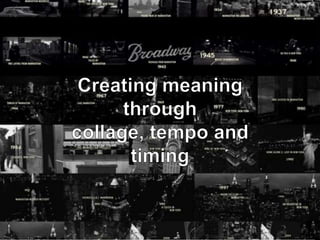
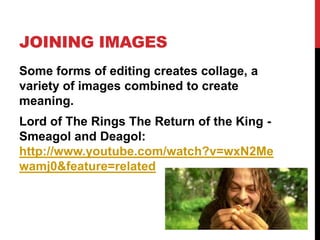
Some forms of editing creates collage, a
variety of images combined to create
meaning.
Lord of The Rings The Return of the King -
Smeagol and Deagol:
http://www.youtube.com/watch?v=wxN2Me
wamj0&feature=related
TEMPO #1
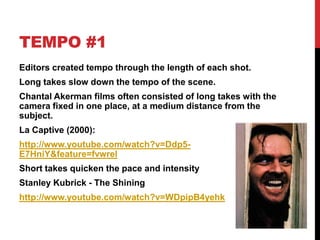
Editors created tempo through the length of each shot.
Long takes slow down the tempo of the scene.
Chantal Akerman films often consisted of long takes with the
camera fixed in one place, at a medium distance from the
subject.
La Captive (2000):
http://www.youtube.com/watch?v=Ddp5-
E7HniY&feature=fvwrel
Short takes quicken the pace and intensity
Stanley Kubrick - The Shining
http://www.youtube.com/watch?v=WDpipB4yehk
TEMPO #2
Studies suggest that shots are gaining pace in comparison to
The Golden age of Hollywood.
The average shot length was 5.15 seconds it is now 4.75
seconds.
The change of length can be seen when you compare La
Captive and The Shining.
This is due to the fact that films are now electronically cut
and not hand cut.
PROBLEMS WITH
TEMPO
It takes the average person 3 seconds to adjust to a shot
change. Brandt has argued
“…..if the audience takes 3 seconds to adjust to a
 new scene, what happens when the average shot
length is so short that the audience is never given
               a chance to catch up”
The tendency to rely on such rapid editing in recent films
may explain why younger audience are not interested to
older films.
SHOT TRANSITIONS
Another way editors adjust the tempo is shot transitions
Cut from A to B, Fade in/fade out and Dissolve (overlapping) are
all common shot transitions.
Cut for A to B is seen in most films to this day. It is simply a cut
from one thing to another:
http://www.youtube.com/watch?feature=endscreen&NR=1&v=A3
ZbnfXEuyc
Fade in/fade out are known fading in or out from black or white
where as dissolve is a fade out into another shot. Sam
Peckinpah’s Pat Garrett and Billy the Kid is a good example:
http://www.youtube.com/watch?v=OuZLRoUn5Bc&feature=relat
ed
FADES
Fades alter the pace of the film as pause the action.
Fades rarely occur in films. When they do it is to present
memory or fantasy.
Sam Peckinpah’s Pat Garrett and Billy the Kid is again a
good example:
http://www.youtube.com/watch?v=OuZLRoUn5Bc&feature=re
lated
TIMING OF A SHOT
Another editing technique is timing of shots
Cut away to emphasis a persons reaction or response for
example
Cut away to a newspaper on the table when presented in
narrative
Cutting from a two shot to a close up for reaction or a close
up to a long shot for landscape effect
NAPOLEON DYNAMITE
HTTP://WWW.YOUTUBE.COM/WATCH?V=PMMAW5A7POU
Attributes to editing:                Techniques Used:

•   Collage              • Medium two shot (friendship/companionship)
                                 vs. Close up (disappointment)


•   Tempo                • The takes in the sequence vary therefore the
                             tempo being unbalanced and constantly
                           changing but they are long enough not to be
                                          action packed.


•   Timing                 • The timing and continuity of the shots is
                            flowing and the shots are long but well timed
                                          to not get bored.
EDITING AND TIMING
Narrative sequencing is either linear or medias res.
In linear editing the story is told as it happens whereas
‘Medias res’ is the term used when narrative is jumbled up (Fight
Club for example)


Linear: Apocalypse now -
http://www.youtube.com/watch?v=njfbVrYn4CU In this example
we see the story being told as it is no flashbacks or jumbling up of the
scenes.
Medias res: Fight club - http://www.youtube.com/watch?v=Ze9-
wg9k7AU In this example at the start your watching the end and at
the end your watching the start but told in a different way because of
what's gone on in the film.
CONDENSING /
EXPANDING TIME
Collages condense time
Rocky uses ‘condensed editing’ when training for his fight
speeding up hours, days or years in the characters lives.
http://www.youtube.com/watch?v=IwvoTDoO9Hg
Expanding – overlapping shots of a single action
Example: Someone pressing a button shot from 3 angles and
shown after each other to portray time but also nerves in the
person pressing it
ARRANGING THE
ORDER OF EVENTS
Media Res
Events taking place in the present are interrupted by images that
have taken place in the past.


Flashbacks
Rare occasions there are flash-forward's
By their nature ‘flash forwards’ can be confusing as they can only
be understood once the event has occurred on scene.
          Easy Rider – Captain America is interrupted as he
talks by a shot of burning debris on the side of the road. Only
      later will viewers realise that the debris is from CA
            motorcycle crash at the end of the film
TIME AND SPACE
            Editing draws the viewers attention to the detail


Close up (example of the very first ‘close up’ used in film
           http://www.youtube.com/watch?v=Q2X_BZpnWFc


Establishing
Example: Return of the King
http://www.youtube.com/watch?v=wVXIVtIBMnA&feature=fvwrel
Gandalf is riding with Pippin to Minas Tirith
This drawers the viewers attention to a number of things; be it the
emotional tenor of a conversation, the object of a characters gaze,
important detail in the mise en scene and the group dynamics of a
scene
SHOT REVERSE SHOT
Shot reverse shot can be a conversation between two people or
one speaks to the other listening.
The rule is: the actors will never speak directly to the viewer as
this destroys the illusion of a naturally unfolding story
Cameras are normally slightly angles to the side rather than
using point of view shots
http://www.youtube.com/watch?v=cvof8mI6pXk
EYE LINE MATCH
The match cut uses the characters line of sight.
Powerful storytelling devise as it draws the viewers into a
characters thought process and emotional state.
http://www.youtube.com/watch?v=OGyFPbNg03w
Cutaways
Unlike eye line match a cut away is not character centered, the on
screen appearance of an object does not depend on the character
having to ‘see it’ in the previous shot.
CREATING MEANING
OUTSIDE THE STORY
Continuity
Continuity is a film term that suggests that a series of shots should be physically
continuous, as if the camera simply changed angles in the course of a single
event. For instance, if in one shot a beer glass is empty, it should not be full in the
next shot.
The 180° Rule
Media College say the rule of line-crossing is sometimes called the 180° rule. This
refers to keeping the camera position within a field of 180°.
Soviet Montage
Film110 says Soviet montage is a type of film theory focused on understanding
and creating cinema using specific film editing techniques. The theory was
conceived in the Soviet Union during the 1920's and was pioneered by such Soviet
directors as Alexander Dovzhenko and Sergei Eisenstein. Though many of these
directors disagreed about montage, Eisenstein's thinking was eventually viewed as
"soviet montage." Eisenstein's essays on film form and film theory revolutionized
the view of film from simple entertainment to intellectual artwork. However, they
were a hybrid of the theories collectively established by several Soviet directors.

Principles of Editing

  • 1.
  • 3.
    JOINING IMAGES Some formsof editing creates collage, a variety of images combined to create meaning. Lord of The Rings The Return of the King - Smeagol and Deagol: http://www.youtube.com/watch?v=wxN2Me wamj0&feature=related
  • 4.
    TEMPO #1 Editors createdtempo through the length of each shot. Long takes slow down the tempo of the scene. Chantal Akerman films often consisted of long takes with the camera fixed in one place, at a medium distance from the subject. La Captive (2000): http://www.youtube.com/watch?v=Ddp5- E7HniY&feature=fvwrel Short takes quicken the pace and intensity Stanley Kubrick - The Shining http://www.youtube.com/watch?v=WDpipB4yehk
  • 5.
    TEMPO #2 Studies suggestthat shots are gaining pace in comparison to The Golden age of Hollywood. The average shot length was 5.15 seconds it is now 4.75 seconds. The change of length can be seen when you compare La Captive and The Shining. This is due to the fact that films are now electronically cut and not hand cut.
  • 6.
    PROBLEMS WITH TEMPO It takesthe average person 3 seconds to adjust to a shot change. Brandt has argued “…..if the audience takes 3 seconds to adjust to a new scene, what happens when the average shot length is so short that the audience is never given a chance to catch up” The tendency to rely on such rapid editing in recent films may explain why younger audience are not interested to older films.
  • 7.
    SHOT TRANSITIONS Another wayeditors adjust the tempo is shot transitions Cut from A to B, Fade in/fade out and Dissolve (overlapping) are all common shot transitions. Cut for A to B is seen in most films to this day. It is simply a cut from one thing to another: http://www.youtube.com/watch?feature=endscreen&NR=1&v=A3 ZbnfXEuyc Fade in/fade out are known fading in or out from black or white where as dissolve is a fade out into another shot. Sam Peckinpah’s Pat Garrett and Billy the Kid is a good example: http://www.youtube.com/watch?v=OuZLRoUn5Bc&feature=relat ed
  • 8.
    FADES Fades alter thepace of the film as pause the action. Fades rarely occur in films. When they do it is to present memory or fantasy. Sam Peckinpah’s Pat Garrett and Billy the Kid is again a good example: http://www.youtube.com/watch?v=OuZLRoUn5Bc&feature=re lated
  • 9.
    TIMING OF ASHOT Another editing technique is timing of shots Cut away to emphasis a persons reaction or response for example Cut away to a newspaper on the table when presented in narrative Cutting from a two shot to a close up for reaction or a close up to a long shot for landscape effect
  • 10.
    NAPOLEON DYNAMITE HTTP://WWW.YOUTUBE.COM/WATCH?V=PMMAW5A7POU Attributes toediting: Techniques Used: • Collage • Medium two shot (friendship/companionship) vs. Close up (disappointment) • Tempo • The takes in the sequence vary therefore the tempo being unbalanced and constantly changing but they are long enough not to be action packed. • Timing • The timing and continuity of the shots is flowing and the shots are long but well timed to not get bored.
  • 12.
    EDITING AND TIMING Narrativesequencing is either linear or medias res. In linear editing the story is told as it happens whereas ‘Medias res’ is the term used when narrative is jumbled up (Fight Club for example) Linear: Apocalypse now - http://www.youtube.com/watch?v=njfbVrYn4CU In this example we see the story being told as it is no flashbacks or jumbling up of the scenes. Medias res: Fight club - http://www.youtube.com/watch?v=Ze9- wg9k7AU In this example at the start your watching the end and at the end your watching the start but told in a different way because of what's gone on in the film.
  • 13.
    CONDENSING / EXPANDING TIME Collagescondense time Rocky uses ‘condensed editing’ when training for his fight speeding up hours, days or years in the characters lives. http://www.youtube.com/watch?v=IwvoTDoO9Hg Expanding – overlapping shots of a single action Example: Someone pressing a button shot from 3 angles and shown after each other to portray time but also nerves in the person pressing it
  • 14.
    ARRANGING THE ORDER OFEVENTS Media Res Events taking place in the present are interrupted by images that have taken place in the past. Flashbacks Rare occasions there are flash-forward's By their nature ‘flash forwards’ can be confusing as they can only be understood once the event has occurred on scene. Easy Rider – Captain America is interrupted as he talks by a shot of burning debris on the side of the road. Only later will viewers realise that the debris is from CA motorcycle crash at the end of the film
  • 15.
    TIME AND SPACE Editing draws the viewers attention to the detail Close up (example of the very first ‘close up’ used in film http://www.youtube.com/watch?v=Q2X_BZpnWFc Establishing Example: Return of the King http://www.youtube.com/watch?v=wVXIVtIBMnA&feature=fvwrel Gandalf is riding with Pippin to Minas Tirith This drawers the viewers attention to a number of things; be it the emotional tenor of a conversation, the object of a characters gaze, important detail in the mise en scene and the group dynamics of a scene
  • 16.
    SHOT REVERSE SHOT Shotreverse shot can be a conversation between two people or one speaks to the other listening. The rule is: the actors will never speak directly to the viewer as this destroys the illusion of a naturally unfolding story Cameras are normally slightly angles to the side rather than using point of view shots http://www.youtube.com/watch?v=cvof8mI6pXk
  • 17.
    EYE LINE MATCH Thematch cut uses the characters line of sight. Powerful storytelling devise as it draws the viewers into a characters thought process and emotional state. http://www.youtube.com/watch?v=OGyFPbNg03w Cutaways Unlike eye line match a cut away is not character centered, the on screen appearance of an object does not depend on the character having to ‘see it’ in the previous shot.
  • 18.
    CREATING MEANING OUTSIDE THESTORY Continuity Continuity is a film term that suggests that a series of shots should be physically continuous, as if the camera simply changed angles in the course of a single event. For instance, if in one shot a beer glass is empty, it should not be full in the next shot. The 180° Rule Media College say the rule of line-crossing is sometimes called the 180° rule. This refers to keeping the camera position within a field of 180°. Soviet Montage Film110 says Soviet montage is a type of film theory focused on understanding and creating cinema using specific film editing techniques. The theory was conceived in the Soviet Union during the 1920's and was pioneered by such Soviet directors as Alexander Dovzhenko and Sergei Eisenstein. Though many of these directors disagreed about montage, Eisenstein's thinking was eventually viewed as "soviet montage." Eisenstein's essays on film form and film theory revolutionized the view of film from simple entertainment to intellectual artwork. However, they were a hybrid of the theories collectively established by several Soviet directors.