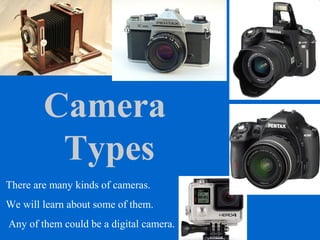

Camera
Types
There are many kinds of cameras.
We will learn about some of them.
Any of them could be a digital camera.
Copyright Notice
• Attribution-NonCommercial-ShareAlike CC BY-NC-SA
• This presentation is for educational purposes only. No money is being made and
is provided with similar allowances for other educators
to use for non-profit, educational purposes.
• Images are from various sources, including many of my own. If you would like
copies of the high res images I have used, please visit www.DrewLoker.com
for various work online.
• If you are the original author of any of the samples, pictures, text, etc. please let
me know if you object to the usage and I will
remove your material promptly.
oto by
ew Loker
Camera
Types
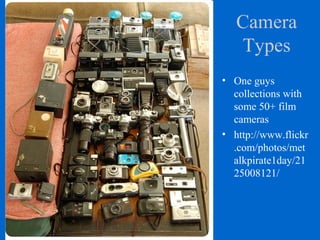
• One guys
collections with
some 50+ film
cameras
• http://www.flickr
.com/photos/met
alkpirate1day/21
25008121/
Why So
Many
Different
Types??
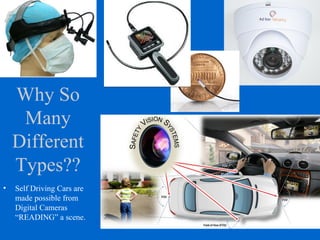
• Self Driving Cars are
made possible from
Digital Cameras
“READING” a scene.
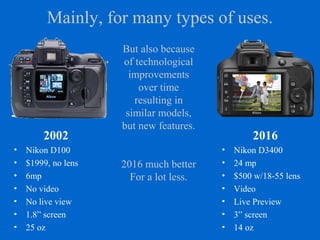
Mainly, for many types of uses.
2016
• Nikon D3400
• 24 mp
• $500 w/18-55 lens
• Video
• Live Preview
• 3” screen
• 14 oz
2002
• Nikon D100
• $1999, no lens
• 6mp
• No video
• No live view
• 1.8” screen
• 25 oz
But also because
of technological
improvements
over time
resulting in
similar models,
but new features.
2016 much better
For a lot less.
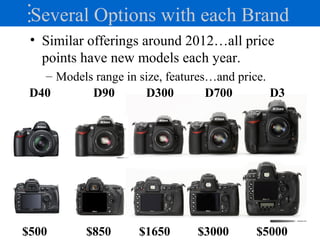
Several Options with each Brand
• Similar offerings around 2012…all price
points have new models each year.
– Models range in size, features…and price.
$500 $850 $1650 $3000 $5000
D40 D90 D300 D700 D3
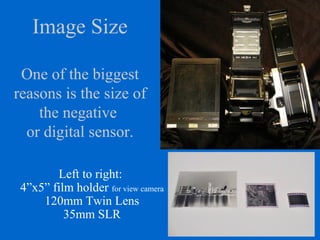
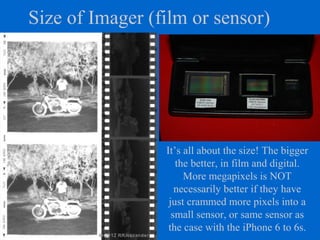
Image Size
One of the biggest
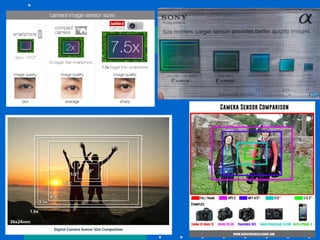
reasons is the size of
the negative
or digital sensor.
Left to right:
4”x5” film holder for view camera
120mm Twin Lens
35mm SLR
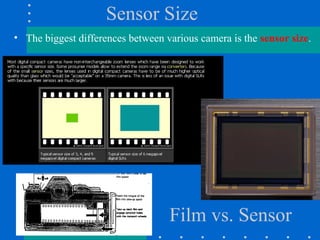
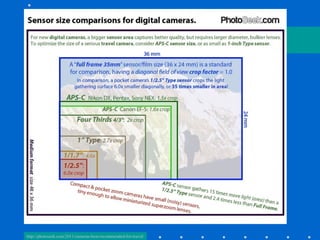
Sensor Size
• The biggest differences between various camera is the sensor size.
Film vs. Sensor
http://photoseek.com/2011/cameras-best-recommended-for-travel/
Main Camera Types
(there are others)
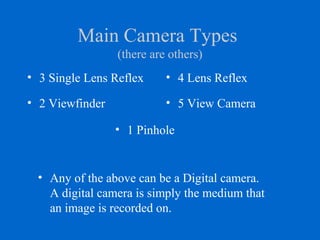
• 3 Single Lens Reflex • 4 Lens Reflex
• 2 Viewfinder • 5 View Camera
• 1 Pinhole
• Any of the above can be a Digital camera.
A digital camera is simply the medium that
an image is recorded on.
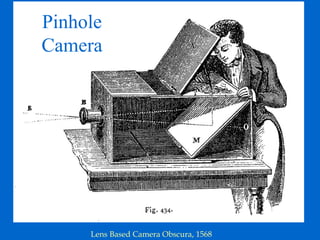
Lens Based Camera Obscura, 1568
Pinhole
Camera
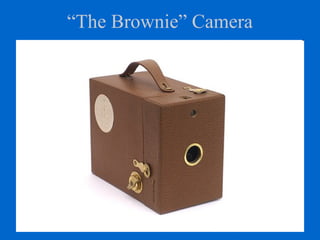
“The Brownie” Camera
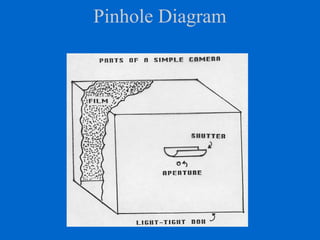
Pinhole Diagram
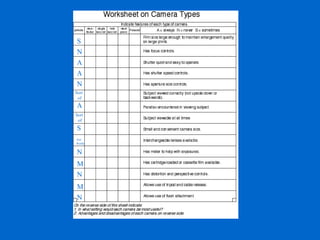
I am going to quickly cover the
main details of all
5 Types of Cameras.
Then, as time permits over the
next week, or homework.
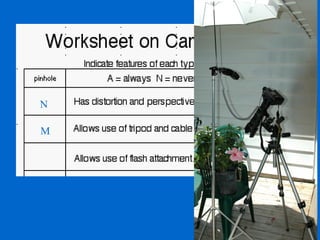
• List the advantages of each camera type
• List the disadvantages of each camera type
S
N
A
A
N
A
Sort
of
S
Not
Really
N
M
N
M
N
Sort
of
N
Sort of
S
Not
Really
N
M
N
M
Usages of Pinhole Cameras
• Learn how light works
• Learn how cameras work
• Artsy photos
Advantages of Pinhole Camera
• Very inexpensive
• Easy to make one…materials can be found
from existing household items: oatmeal
container (or similar item), aluminum foil
and tape.
• Artistic impression
• Maximum depth of field (area in focus)
Disadvantages of Pinhole
Camera
• No controls
• Long exposures
• Can NOT view what the camera sees
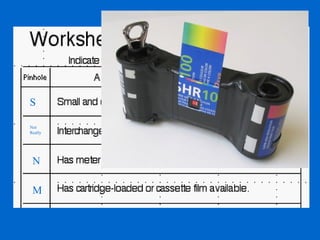
1. Pinhole Camera
• this is like the Camera Obscura…just a light
tight box with a hole and cover as a shutter.
Matchbox Pinhole Camera
• a. Advantages: Easy to use, inexpensive…
can make from home materials, Artsy view of
subjects (impressionistic)
• b. Disadvantages: No controls, low pictures
quality
Types of Cameras
–5 Main Types (there are others)
•Pinhole
•View
•Single Lens Reflex
•Twin Lens Reflex
•Viewfinder
*All of the above can be a digital camera
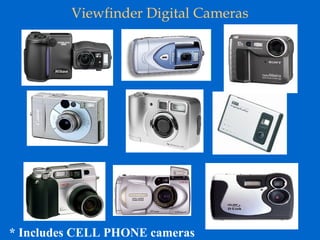
Viewfinder Digital Cameras
* Includes CELL PHONE cameras
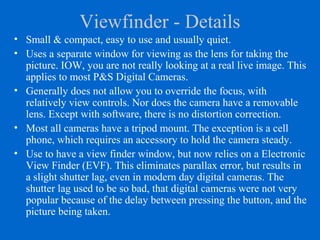
Viewfinder - Details
• Small & compact, easy to use and usually quiet.
• Uses a separate window for viewing as the lens for taking the
picture. IOW, you are not really looking at a real live image. This
applies to most P&S Digital Cameras.
• Generally does not allow you to override the focus, with
relatively view controls. Nor does the camera have a removable
lens. Except with software, there is no distortion correction.
• Most all cameras have a tripod mount. The exception is a cell
phone, which requires an accessory to hold the camera steady.
• Use to have a view finder window, but now relies on a Electronic
View Finder (EVF). This eliminates parallax error, but results in
a slight shutter lag, even in modern day digital cameras. The
shutter lag used to be so bad, that digital cameras were not very
popular because of the delay between pressing the button, and the
picture being taken.
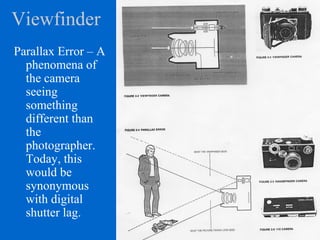
Viewfinder
Parallax Error – A
phenomena of
the camera
seeing
something
different than
the
photographer.
Today, this
would be
synonymous
with digital
shutter lag.
Viewfinder –
Advantages & Disadvantages
a. Advantages: Easy to use, “point and shoot”
cameras, easy to focus…or even focus free, small
compact cameras
b. Disadvantages: Few controls…no creative picture
control, low picture quality with the cheaper cameras
(especially disposable cameras with plastic parts). In
the case of cell phones, low quality because of small
sensor size.
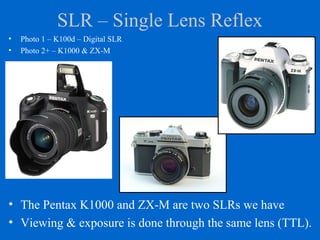
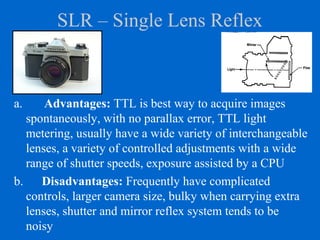
SLR – Single Lens Reflex
• The Pentax K1000 and ZX-M are two SLRs we have
• Viewing & exposure is done through the same lens (TTL).
• Photo 1 – K100d – Digital SLR
• Photo 2+ – K1000 & ZX-M
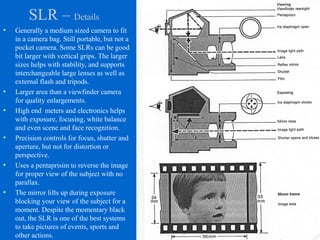
SLR – Details
• Generally a medium sized camera to fit
in a camera bag. Still portable, but not a
pocket camera. Some SLRs can be good
bit larger with vertical grips. The larger
sizes helps with stability, and supports
interchangeable large lenses as well as
external flash and tripods.
• Larger area than a viewfinder camera
for quality enlargements.
• High end meters and electronics helps
with exposure, focusing, white balance
and even scene and face recognition.
• Precision controls for focus, shutter and
aperture, but not for distortion or
perspective.
• Uses a pentaprisim to reverse the image
for proper view of the subject with no
parallax.
• The mirror lifts up during exposure
blocking your view of the subject for a
moment. Despite the momentary black
out, the SLR is one of the best systems
to take pictures of events, sports and
other actions.
SLR – Single Lens Reflex
a. Advantages: TTL is best way to acquire images
spontaneously, with no parallax error, TTL light
metering, usually have a wide variety of interchangeable
lenses, a variety of controlled adjustments with a wide
range of shutter speeds, exposure assisted by a CPU
b. Disadvantages: Frequently have complicated
controls, larger camera size, bulky when carrying extra
lenses, shutter and mirror reflex system tends to be
noisy
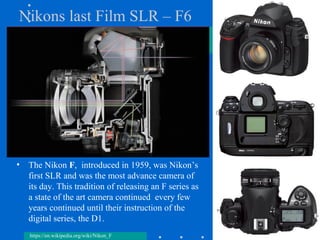
Nikons last Film SLR – F6
• The Nikon F, introduced in 1959, was Nikon’s
first SLR and was the most advance camera of
its day. This tradition of releasing an F series as
a state of the art camera continued every few
years continued until their instruction of the
digital series, the D1.
https://en.wikipedia.org/wiki/Nikon_F
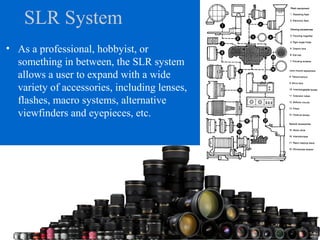
SLR System
• As a professional, hobbyist, or
something in between, the SLR system
allows a user to expand with a wide
variety of accessories, including lenses,
flashes, macro systems, alternative
viewfinders and eyepieces, etc.
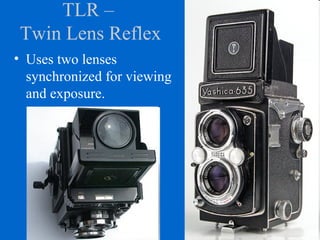
TLR –
Twin Lens Reflex
• Uses two lenses
synchronized for viewing
and exposure.
Size of Imager (film or sensor)
It’s all about the size! The bigger
the better, in film and digital.
More megapixels is NOT
necessarily better if they have
just crammed more pixels into a
small sensor, or same sensor as
the case with the iPhone 6 to 6s.
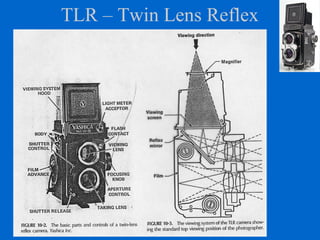
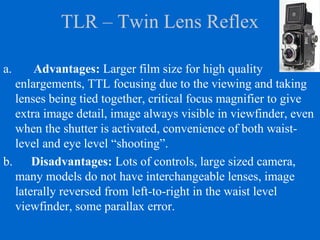
TLR – Twin Lens Reflex
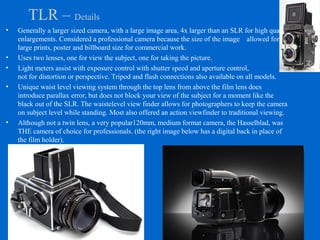
TLR – Details
• Generally a larger sized camera, with a large image area, 4x larger than an SLR for high quality
enlargements. Considered a professional camera because the size of the image allowed for
large prints, poster and billboard size for commercial work.
• Uses two lenses, one for view the subject, one for taking the picture.
• Light meters assist with exposure control with shutter speed and aperture control, but
not for distortion or perspective. Tripod and flash connections also available on all models.
• Unique waist level viewing system through the top lens from above the film lens does
introduce parallax error, but does not block your view of the subject for a moment like the
black out of the SLR. The waistelevel view finder allows for photographers to keep the camera
on subject level while standing. Most also offered an action viewfinder to traditional viewing.
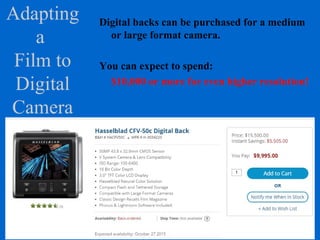
• Although not a twin lens, a very popular120mm, medium format camera, the Hasselblad, was
THE camera of choice for professionals. (the right image below has a digital back in place of
the film holder).
TLR – Twin Lens Reflex
a. Advantages: Larger film size for high quality
enlargements, TTL focusing due to the viewing and taking
lenses being tied together, critical focus magnifier to give
extra image detail, image always visible in viewfinder, even
when the shutter is activated, convenience of both waist-
level and eye level “shooting”.
b. Disadvantages: Lots of controls, large sized camera,
many models do not have interchangeable lenses, image
laterally reversed from left-to-right in the waist level
viewfinder, some parallax error.
Adapting
a
Film to
Digital
Camera
Digital backs can be purchased for a medium
or large format camera.
You can expect to spend:
$10,000 or more for even higher resolution!
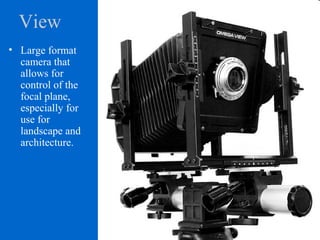
View
• Large format
camera that
allows for
control of the
focal plane,
especially for
use for
landscape and
architecture.
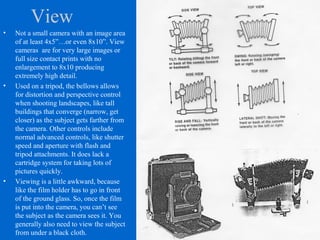
View
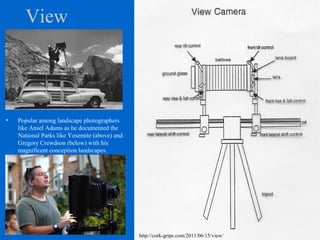
• Not a small camera with an image area
of at least 4x5”…or even 8x10”. View
cameras are for very large images or
full size contact prints with no
enlargement to 8x10 producing
extremely high detail.
• Used on a tripod, the bellows allows
for distortion and perspective control
when shooting landscapes, like tall
buildings that converge (narrow, get
closer) as the subject gets farther from
the camera. Other controls include
normal advanced controls, like shutter
speed and aperture with flash and
tripod attachments. It does lack a
cartridge system for taking lots of
pictures quickly.
• Viewing is a little awkward, because
like the film holder has to go in front
of the ground glass. So, once the film
is put into the camera, you can’t see
the subject as the camera sees it. You
generally also need to view the subject
from under a black cloth.
View
• Popular among landscape photographers
like Ansel Adams as he documented the
National Parks like Yosemite (above) and
Gregory Crewdson (below) with his
magnificent conception landscapes.
http://cork-grips.com/2011/06/15/view/
View
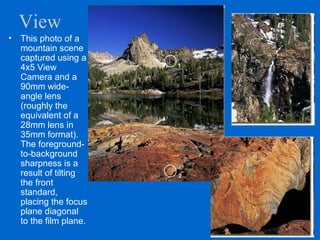
• This photo of a
mountain scene
captured using a
4x5 View
Camera and a
90mm wide-
angle lens
(roughly the
equivalent of a
28mm lens in
35mm format).
The foreground-
to-background
sharpness is a
result of tilting
the front
standard,
placing the focus
plane diagonal
to the film plane.
View
a. Advantages: Allows for perspective and distortion control of
landscapes and architecture, large film size allows for very large
prints (poster sized), variety of special-use attachments, directly
viewing of the image TTL, wide selection of lenses
b. Disadvantages: Lots of controls, VERY large sized and heavy
camera, most models require the use of a tripod, image difficult to
see on viewing glass, takes considerable time to set up and use,
image lost on viewing glass after film holder is inserted,
photographer needs to know when and how to use the four
standard movements.
View
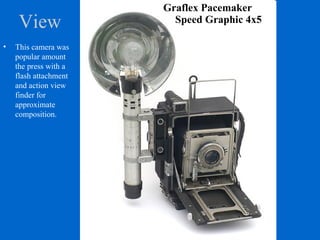
Graflex Pacemaker
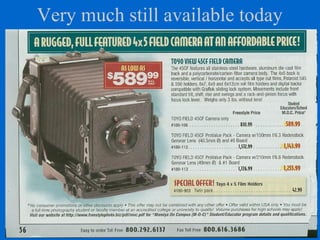
Speed Graphic 4x5
• This camera was
popular amount
the press with a
flash attachment
and action view
finder for
approximate
composition.
Very much still available today
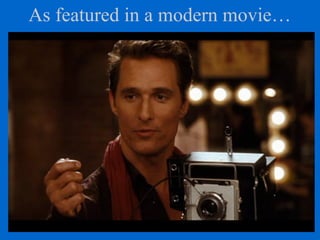
As featured in a modern movie…
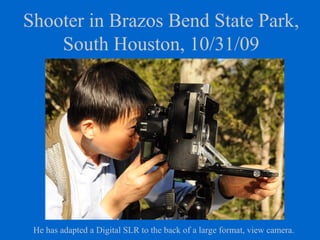
Shooter in Brazos Bend State Park,
South Houston, 10/31/09
He has adapted a Digital SLR to the back of a large format, view camera.
View
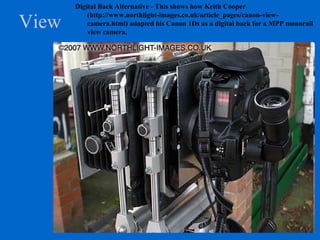
Digital Back Alternative - This shows how Keith Cooper
(http://www.northlight-images.co.uk/article_pages/canon-view-
camera.html) adapted his Canon 1Ds as a digital back for a MPP monorail
view camera.

Camera Types

  • 1.
    Camera Types There are manykinds of cameras. We will learn about some of them. Any of them could be a digital camera.
  • 2.
    Copyright Notice • Attribution-NonCommercial-ShareAlikeCC BY-NC-SA • This presentation is for educational purposes only. No money is being made and is provided with similar allowances for other educators to use for non-profit, educational purposes. • Images are from various sources, including many of my own. If you would like copies of the high res images I have used, please visit www.DrewLoker.com for various work online. • If you are the original author of any of the samples, pictures, text, etc. please let me know if you object to the usage and I will remove your material promptly. oto by ew Loker
  • 3.
    Camera Types • One guys collectionswith some 50+ film cameras • http://www.flickr .com/photos/met alkpirate1day/21 25008121/
  • 4.
    Why So Many Different Types?? • SelfDriving Cars are made possible from Digital Cameras “READING” a scene.
  • 5.
    Mainly, for manytypes of uses. 2016 • Nikon D3400 • 24 mp • $500 w/18-55 lens • Video • Live Preview • 3” screen • 14 oz 2002 • Nikon D100 • $1999, no lens • 6mp • No video • No live view • 1.8” screen • 25 oz But also because of technological improvements over time resulting in similar models, but new features. 2016 much better For a lot less.
  • 6.
    Several Options witheach Brand • Similar offerings around 2012…all price points have new models each year. – Models range in size, features…and price. $500 $850 $1650 $3000 $5000 D40 D90 D300 D700 D3
  • 7.
    Image Size One ofthe biggest reasons is the size of the negative or digital sensor. Left to right: 4”x5” film holder for view camera 120mm Twin Lens 35mm SLR
  • 8.
    Sensor Size • Thebiggest differences between various camera is the sensor size. Film vs. Sensor
  • 9.
  • 11.
    Main Camera Types (thereare others) • 3 Single Lens Reflex • 4 Lens Reflex • 2 Viewfinder • 5 View Camera • 1 Pinhole • Any of the above can be a Digital camera. A digital camera is simply the medium that an image is recorded on.
  • 12.
    Lens Based CameraObscura, 1568 Pinhole Camera
  • 13.
  • 14.
  • 15.
    I am goingto quickly cover the main details of all 5 Types of Cameras. Then, as time permits over the next week, or homework. • List the advantages of each camera type • List the disadvantages of each camera type
  • 16.
  • 17.
  • 18.
  • 19.
  • 20.
    Usages of PinholeCameras • Learn how light works • Learn how cameras work • Artsy photos
  • 21.
    Advantages of PinholeCamera • Very inexpensive • Easy to make one…materials can be found from existing household items: oatmeal container (or similar item), aluminum foil and tape. • Artistic impression • Maximum depth of field (area in focus)
  • 22.
    Disadvantages of Pinhole Camera •No controls • Long exposures • Can NOT view what the camera sees
  • 23.
    1. Pinhole Camera •this is like the Camera Obscura…just a light tight box with a hole and cover as a shutter. Matchbox Pinhole Camera • a. Advantages: Easy to use, inexpensive… can make from home materials, Artsy view of subjects (impressionistic) • b. Disadvantages: No controls, low pictures quality
  • 24.
    Types of Cameras –5Main Types (there are others) •Pinhole •View •Single Lens Reflex •Twin Lens Reflex •Viewfinder *All of the above can be a digital camera
  • 25.
    Viewfinder Digital Cameras *Includes CELL PHONE cameras
  • 26.
    Viewfinder - Details •Small & compact, easy to use and usually quiet. • Uses a separate window for viewing as the lens for taking the picture. IOW, you are not really looking at a real live image. This applies to most P&S Digital Cameras. • Generally does not allow you to override the focus, with relatively view controls. Nor does the camera have a removable lens. Except with software, there is no distortion correction. • Most all cameras have a tripod mount. The exception is a cell phone, which requires an accessory to hold the camera steady. • Use to have a view finder window, but now relies on a Electronic View Finder (EVF). This eliminates parallax error, but results in a slight shutter lag, even in modern day digital cameras. The shutter lag used to be so bad, that digital cameras were not very popular because of the delay between pressing the button, and the picture being taken.
  • 27.
    Viewfinder Parallax Error –A phenomena of the camera seeing something different than the photographer. Today, this would be synonymous with digital shutter lag.
  • 28.
    Viewfinder – Advantages &Disadvantages a. Advantages: Easy to use, “point and shoot” cameras, easy to focus…or even focus free, small compact cameras b. Disadvantages: Few controls…no creative picture control, low picture quality with the cheaper cameras (especially disposable cameras with plastic parts). In the case of cell phones, low quality because of small sensor size.
  • 29.
    SLR – SingleLens Reflex • The Pentax K1000 and ZX-M are two SLRs we have • Viewing & exposure is done through the same lens (TTL). • Photo 1 – K100d – Digital SLR • Photo 2+ – K1000 & ZX-M
  • 30.
    SLR – Details •Generally a medium sized camera to fit in a camera bag. Still portable, but not a pocket camera. Some SLRs can be good bit larger with vertical grips. The larger sizes helps with stability, and supports interchangeable large lenses as well as external flash and tripods. • Larger area than a viewfinder camera for quality enlargements. • High end meters and electronics helps with exposure, focusing, white balance and even scene and face recognition. • Precision controls for focus, shutter and aperture, but not for distortion or perspective. • Uses a pentaprisim to reverse the image for proper view of the subject with no parallax. • The mirror lifts up during exposure blocking your view of the subject for a moment. Despite the momentary black out, the SLR is one of the best systems to take pictures of events, sports and other actions.
  • 31.
    SLR – SingleLens Reflex a. Advantages: TTL is best way to acquire images spontaneously, with no parallax error, TTL light metering, usually have a wide variety of interchangeable lenses, a variety of controlled adjustments with a wide range of shutter speeds, exposure assisted by a CPU b. Disadvantages: Frequently have complicated controls, larger camera size, bulky when carrying extra lenses, shutter and mirror reflex system tends to be noisy
  • 32.
    Nikons last FilmSLR – F6 • The Nikon F, introduced in 1959, was Nikon’s first SLR and was the most advance camera of its day. This tradition of releasing an F series as a state of the art camera continued every few years continued until their instruction of the digital series, the D1. https://en.wikipedia.org/wiki/Nikon_F
  • 33.
    SLR System • Asa professional, hobbyist, or something in between, the SLR system allows a user to expand with a wide variety of accessories, including lenses, flashes, macro systems, alternative viewfinders and eyepieces, etc.
  • 34.
    TLR – Twin LensReflex • Uses two lenses synchronized for viewing and exposure.
  • 35.
    Size of Imager(film or sensor) It’s all about the size! The bigger the better, in film and digital. More megapixels is NOT necessarily better if they have just crammed more pixels into a small sensor, or same sensor as the case with the iPhone 6 to 6s.
  • 36.
    TLR – TwinLens Reflex
  • 37.
    TLR – Details •Generally a larger sized camera, with a large image area, 4x larger than an SLR for high quality enlargements. Considered a professional camera because the size of the image allowed for large prints, poster and billboard size for commercial work. • Uses two lenses, one for view the subject, one for taking the picture. • Light meters assist with exposure control with shutter speed and aperture control, but not for distortion or perspective. Tripod and flash connections also available on all models. • Unique waist level viewing system through the top lens from above the film lens does introduce parallax error, but does not block your view of the subject for a moment like the black out of the SLR. The waistelevel view finder allows for photographers to keep the camera on subject level while standing. Most also offered an action viewfinder to traditional viewing. • Although not a twin lens, a very popular120mm, medium format camera, the Hasselblad, was THE camera of choice for professionals. (the right image below has a digital back in place of the film holder).
  • 38.
    TLR – TwinLens Reflex a. Advantages: Larger film size for high quality enlargements, TTL focusing due to the viewing and taking lenses being tied together, critical focus magnifier to give extra image detail, image always visible in viewfinder, even when the shutter is activated, convenience of both waist- level and eye level “shooting”. b. Disadvantages: Lots of controls, large sized camera, many models do not have interchangeable lenses, image laterally reversed from left-to-right in the waist level viewfinder, some parallax error.
  • 39.
    Adapting a Film to Digital Camera Digital backscan be purchased for a medium or large format camera. You can expect to spend: $10,000 or more for even higher resolution!
  • 40.
    View • Large format camerathat allows for control of the focal plane, especially for use for landscape and architecture.
  • 41.
    View • Not asmall camera with an image area of at least 4x5”…or even 8x10”. View cameras are for very large images or full size contact prints with no enlargement to 8x10 producing extremely high detail. • Used on a tripod, the bellows allows for distortion and perspective control when shooting landscapes, like tall buildings that converge (narrow, get closer) as the subject gets farther from the camera. Other controls include normal advanced controls, like shutter speed and aperture with flash and tripod attachments. It does lack a cartridge system for taking lots of pictures quickly. • Viewing is a little awkward, because like the film holder has to go in front of the ground glass. So, once the film is put into the camera, you can’t see the subject as the camera sees it. You generally also need to view the subject from under a black cloth.
  • 42.
    View • Popular amonglandscape photographers like Ansel Adams as he documented the National Parks like Yosemite (above) and Gregory Crewdson (below) with his magnificent conception landscapes. http://cork-grips.com/2011/06/15/view/
  • 43.
    View • This photoof a mountain scene captured using a 4x5 View Camera and a 90mm wide- angle lens (roughly the equivalent of a 28mm lens in 35mm format). The foreground- to-background sharpness is a result of tilting the front standard, placing the focus plane diagonal to the film plane.
  • 44.
    View a. Advantages: Allowsfor perspective and distortion control of landscapes and architecture, large film size allows for very large prints (poster sized), variety of special-use attachments, directly viewing of the image TTL, wide selection of lenses b. Disadvantages: Lots of controls, VERY large sized and heavy camera, most models require the use of a tripod, image difficult to see on viewing glass, takes considerable time to set up and use, image lost on viewing glass after film holder is inserted, photographer needs to know when and how to use the four standard movements.
  • 45.
    View Graflex Pacemaker Speed Graphic4x5 • This camera was popular amount the press with a flash attachment and action view finder for approximate composition.
  • 46.
    Very much stillavailable today
  • 47.
    As featured ina modern movie…
  • 48.
    Shooter in BrazosBend State Park, South Houston, 10/31/09 He has adapted a Digital SLR to the back of a large format, view camera.
  • 49.
    View Digital Back Alternative- This shows how Keith Cooper (http://www.northlight-images.co.uk/article_pages/canon-view- camera.html) adapted his Canon 1Ds as a digital back for a MPP monorail view camera.