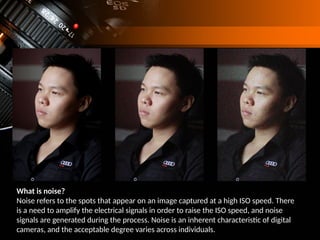
What is noise?
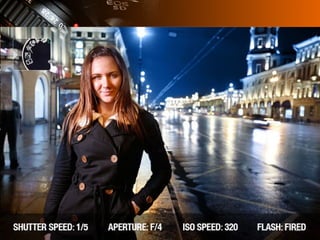
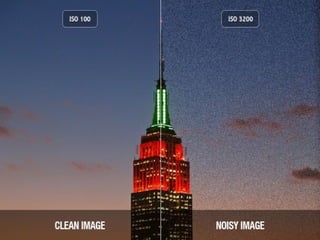
Noiserefers to the spots that appear on an image captured at a high ISO speed. There
is a need to amplify the electrical signals in order to raise the ISO speed, and noise
signals are generated during the process. Noise is an inherent characteristic of digital
cameras, and the acceptable degree varies across individuals.
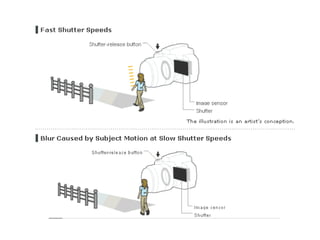
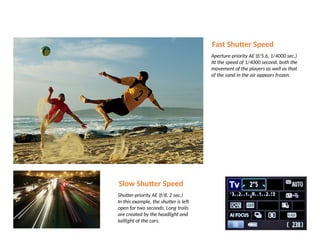
Fast Shutter Speed
Aperture-priorityAE (f/5.6, 1/4000 sec.)
At the speed of 1/4000 second, both the
movement of the players as well as that
of the sand in the air appears frozen.
Slow Shutter Speed
Shutter-priority AE (f/8, 2 sec.)
In this example, the shutter is left
open for two seconds. Long trails
are created by the headlight and
taillight of the cars.
38.
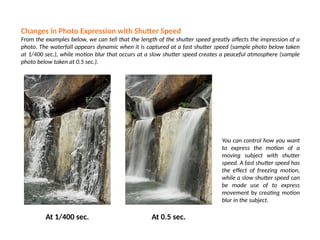
Changes in PhotoExpression with Shutter Speed
From the examples below, we can tell that the length of the shutter speed greatly affects the impression of a
photo. The waterfall appears dynamic when it is captured at a fast shutter speed (sample photo below taken
at 1/400 sec.), while motion blur that occurs at a slow shutter speed creates a peaceful atmosphere (sample
photo below taken at 0.5 sec.).
At 1/400 sec. At 0.5 sec.
You can control how you want
to express the motion of a
moving subject with shutter
speed. A fast shutter speed has
the effect of freezing motion,
while a slow shutter speed can
be made use of to express
movement by creating motion
blur in the subject.
39.
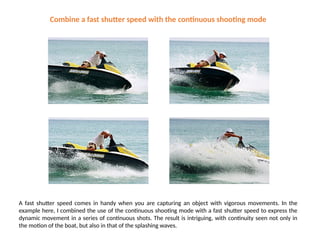
Combine a fastshutter speed with the continuous shooting mode
A fast shutter speed comes in handy when you are capturing an object with vigorous movements. In the
example here, I combined the use of the continuous shooting mode with a fast shutter speed to express the
dynamic movement in a series of continuous shots. The result is intriguing, with continuity seen not only in
the motion of the boat, but also in that of the splashing waves.
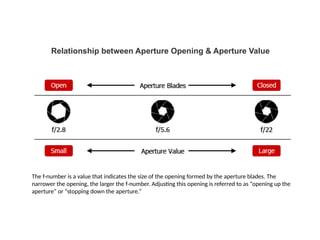
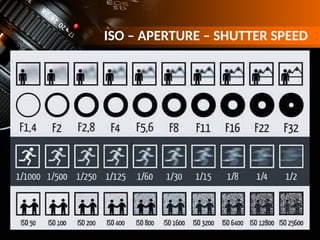
The f-number isa value that indicates the size of the opening formed by the aperture blades. The
narrower the opening, the larger the f-number. Adjusting this opening is referred to as “opening up the
aperture” or “stopping down the aperture.”
Relationship between Aperture Opening & Aperture Value
Lens Basics
Understanding CameraLenses
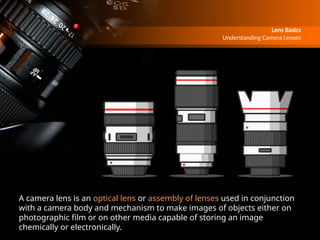
A camera lens is an optical lens or assembly of lenses used in conjunction
with a camera body and mechanism to make images of objects either on
photographic film or on other media capable of storing an image
chemically or electronically.
49.
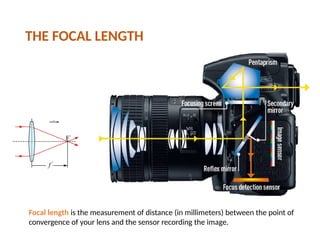
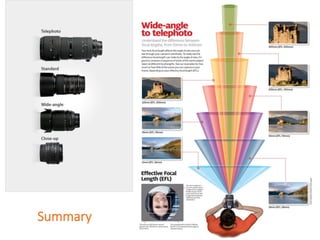
THE FOCAL LENGTH
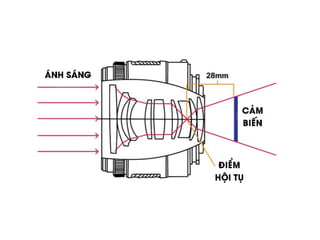
Focallength is the measurement of distance (in millimeters) between the point of
convergence of your lens and the sensor recording the image.
51.
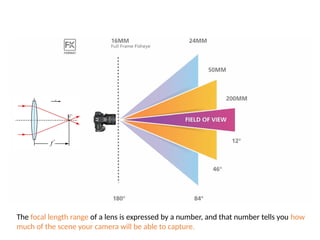
The focal lengthrange of a lens is expressed by a number, and that number tells you how
much of the scene your camera will be able to capture.
52.
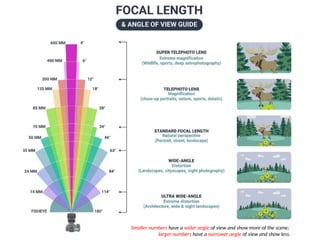
Smaller numbers havea wider angle of view and show more of the scene;
larger numbers have a narrower angle of view and show less.
53.
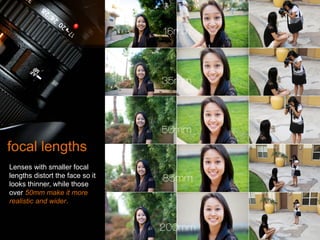
focal lengths
Lenses withsmaller focal
lengths distort the face so it
looks thinner, while those
over 50mm make it more
realistic and wider.
54.
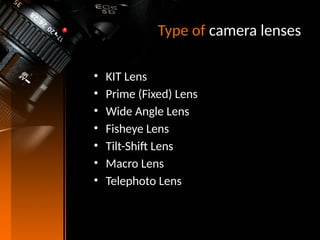
Type of cameralenses
• KIT Lens
• Prime (Fixed) Lens
• Wide Angle Lens
• Fisheye Lens
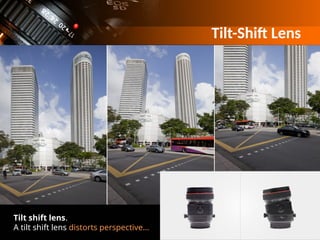
• Tilt-Shift Lens
• Macro Lens
• Telephoto Lens
55.
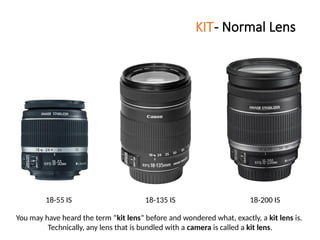
KIT- Normal Lens
18-200IS
You may have heard the term “kit lens” before and wondered what, exactly, a kit lens is.
Technically, any lens that is bundled with a camera is called a kit lens.
18-55 IS 18-135 IS
56.
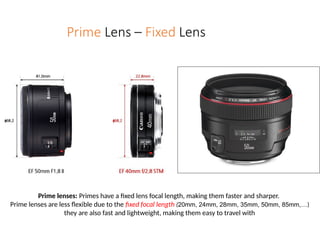
Prime Lens –Fixed Lens
Prime lenses: Primes have a fixed lens focal length, making them faster and sharper.
Prime lenses are less flexible due to the fixed focal length (20mm, 24mm, 28mm, 35mm, 50mm, 85mm,…)
they are also fast and lightweight, making them easy to travel with
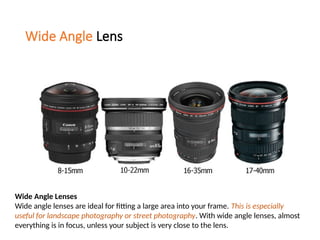
Wide Angle Lens
WideAngle Lenses
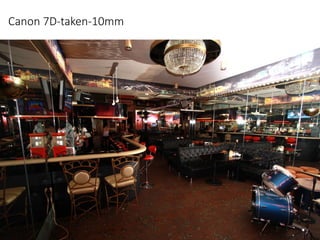
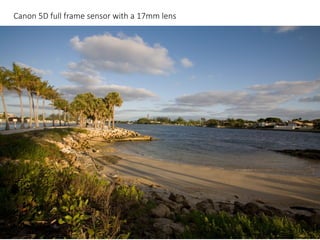
Wide angle lenses are ideal for fitting a large area into your frame. This is especially
useful for landscape photography or street photography. With wide angle lenses, almost
everything is in focus, unless your subject is very close to the lens.
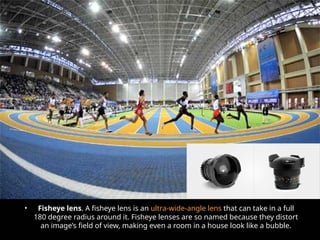
• Fisheye lens.A fisheye lens is an ultra-wide-angle lens that can take in a full
180 degree radius around it. Fisheye lenses are so named because they distort
an image’s field of view, making even a room in a house look like a bubble.
Macro Lens
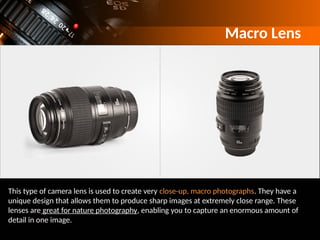
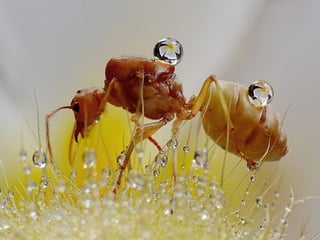
This typeof camera lens is used to create very close-up, macro photographs. They have a
unique design that allows them to produce sharp images at extremely close range. These
lenses are great for nature photography, enabling you to capture an enormous amount of
detail in one image.
65.
Zoom Lens
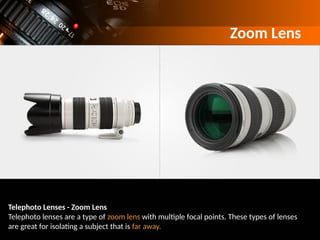
Telephoto Lenses- Zoom Lens
Telephoto lenses are a type of zoom lens with multiple focal points. These types of lenses
are great for isolating a subject that is far away.
66.
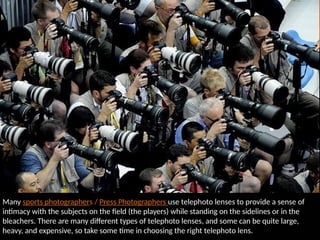
Many sports photographers/ Press Photographers use telephoto lenses to provide a sense of
intimacy with the subjects on the field (the players) while standing on the sidelines or in the
bleachers. There are many different types of telephoto lenses, and some can be quite large,
heavy, and expensive, so take some time in choosing the right telephoto lens.
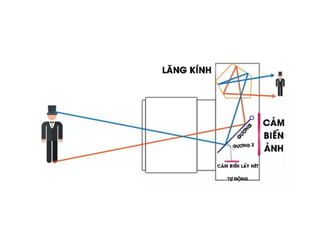
#9 Trong máy ảnh kỹ thuật số DSLR sử dụng kính ngắm quang học, ánh sáng sẽ đi vào ống kính, gặp gương lật và bị phản xạ xuyên qua kính mờ, đến thấu kính hội tụ rồi lên lăng kính ngũ giác, sau đó bị phản xạ một lần nữa rồi mới đi ra kính ngắm quang bên ngoài.
Đồng thời, một số ánh sáng được phản xạ xuống phía dưới, qua gương phụ, vào đi vào cảm biến để lấy nét tự động.
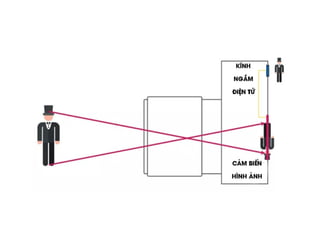
#10 Trong máy ảnh mirrorless (không gương lật), không có sự kết nối quang học giữa ống kính và mắt của bạn, vì ánh sáng sẽ chiếu trực tiếp vào cảm biến. Từ cảm biến, chế độ xem trực tiếp được truyền kỹ thuật số đến kính ngắm điện tử (EVF) hoặc đến màn hình trên máy ảnh.
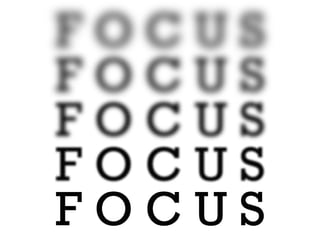
#11 Giống như mắt bạn, ống kính nhìn ra thế giới bên ngoài trên mặt phẳng tiêu cự. Mặt phẳng này chứa nhiều điểm và được truyền đến cảm biến của máy ảnh. Để lấy những điểm trên một mặt phẳng nào đó, thấu kính trên trong ống kính cần phải di chuyển bằng cách xoay vòng để lấy nét hoặc được máy ảnh lấy nét tự động.
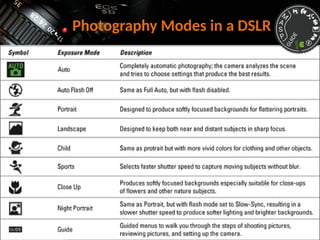
#16 Tất cả những gì bạn cần làm là ngắm và chụp mà thôi. Nó rất hữu ích khi bạn không muốn phải điều chỉnh các thiết lập hay khi bạn cần phải chụp nhanh. Những shot ảnh này hoàn hảo trong những ngày đầy đủ ánh sáng, mặc dù chế độ tiếp xúc tự động có thể tự điều chỉnh trong trường hợp ánh sáng không đồng đều thì nó vẫn có xu hướng kích hoạt đèn flash ngay cả khi không thật sự cần thiết.
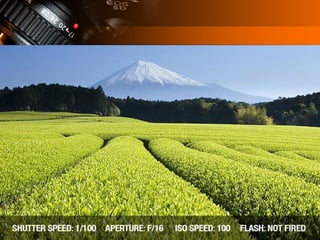
#17 Chế độ phong cảnh có xu hướng phù hợp với một ống kính góc rộng và làm việc tốt nếu cảnh có ánh sáng tốt. Chế độ này sẽ sử dụng đèn flash nếu nó nhận thấy phía nền là quá tối, nhưng bạn có thể tự tắt tính năng này.
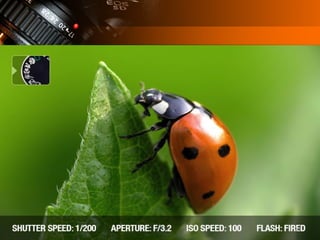
#18 Chế độ macro rất hữu dụng khi chụp những hình ảnh nhỏ hơn bàn tay của bạn. Hãy nhớ rằng, chế độ macro sẽ không cho bạn những hình ảnh gần sát như trong ảnh dưới, để làm được điều này, bạn cần phải có ống kính macro. Chế độ này làm việc tốt nhất trong điều kiện đầy đủ ánh sáng và chọn độ sâu của ảnh để tập trung vào đối tượng. Do đó, nếu ánh sáng yếu thì bạn nên sử dụng chân máy.
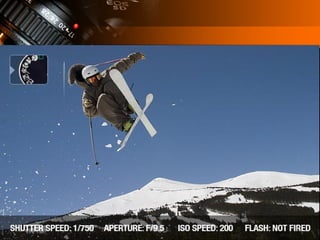
#20 Vì thể thao có tốc độ hoạt động rất nhanh, chế độ này sẽ cho bạn một tốc độ mà trập cao ít nhất là 1/500 - 1/1000. Với tốc độ màn trập cao đóng băng chuyển động.
Chế độ thể thao có thể làm việc tốt cùng với chế độ chụp liên tục, hình ảnh được chụp liên tiếp - kết quả là một số bức ảnh chụp hành động trên không.
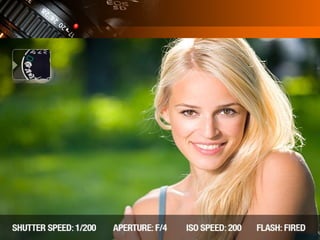
#21 Tại thời điểm đó, đèn flash là cần thiết để chiếu sáng người và tránh mờ. Đôi khi chế độ chân dung ban đêm sẽ tăng gấp đôi flash, tạo ra một cái nhìn khác gấp đôi bình thường.
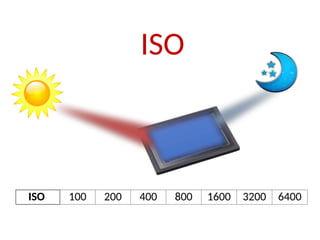
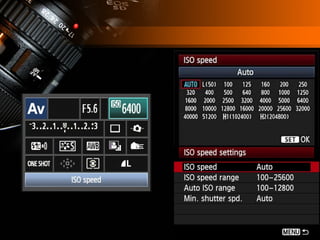
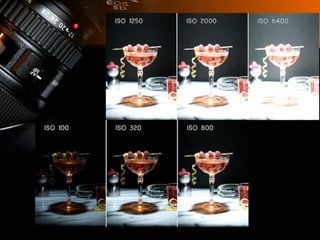
#28 ISO là cụm từ viết tắt của thuật ngữ “International Organisation for Standardisation”. Hiểu một cách đơn giản thì đây là một cài đặt dùng để điều chỉnh mức độ sáng tăng thêm hay giảm xuống cho bức ảnh, hoàn toàn do máy ảnh xử lý. (Nó không có tác dụng thay đổi lượng ánh sáng đi vào cảm biến để làm sáng hoặc tối bức ảnh). Khi bạn tăng ISO lên càng cao thì ảnh càng sáng, việc điều chỉnh này thường gặp khi chụp trong điều kiện ánh sáng yếu, tuy nhiên ISO càng cao sẽ gây hậu quả bức ảnh bị nhiễu hạt, dẫn đến ảnh bị noise và không sắc nét. Chính vì vậy, trừ một số trường hợp, hầu như dân chụp ảnh đều hạn chế việc tăng ISO cao để đảm bảo độ nét cho bức ảnh.
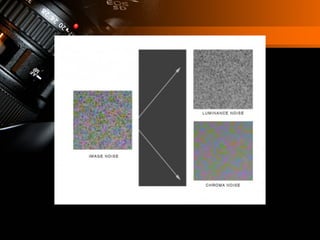
#31 đó những điểm ảnh bị lỗi và xuất hiện trọng quá trình máy ảnh thu nhận tín hiệu hình ảnh. Noise dễ xuất hiện khi ta chụp ảnh trông điều kiện thiếu sáng hoặc thiết lập iso cao và chủ yếu tập chung ở vùng tối của tấm ảnh.
#32 chroma noise (nhiễu màu) và luminance noise (nhiễu đơn sắc). Luminance noise khá giống với nhiễu trên máy ảnh film (grain), là nhiễu do hạt nhiễu đen, trắng và xám (không có màu) giống như những hạt muối tiêu lấm chấm. chroma noise (nhiễu màu) đó là những điểm ảnh bị sai lệch về màu sắc.
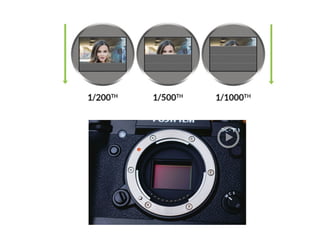
#35 Màn trập cơ học, được tìm thấy trong hầu hết các máy ảnh và thường có hai cửa trập. Khi bạn nhấn nút chụp, cửa trập đầu tiên sẽ trượt lên và để ánh sáng chiếu vào cảm biến máy ảnh. Sau đó, cửa trập sau sẽ kéo xuống che cảm biến để kết thúc quá trình phơi sáng.
Một trong những nhược điểm của màn trập cơ học là bạn có thể sử dụng đèn flash tiêu chuẩn dưới một tốc độ màn trập nhất định. Khoảng thời gian này thường là 1/200 giây, hiển thị một phần khung hình ngay thời gian đó. Các màn cửa có thể di chuyển từ bên này sang bên kia.
Màn trập điện tử thường được tìm thấy trong hầu hết các máy ảnh kỹ thuật số hiện nay. Nó hoạt động bằng cách thu thập dữ liệu từ cảm biến theo các khối (thường là các hàng pixel) theo hướng đi xuống.
Loại màn trập này phù hợp cho việc chụp ở chế độ im lặng (silent shooting) và tốc độ màn trập rất thấp, thậm chí là đạt 1/32000 giây.
Nhược điểm của màn trập điện tử là không dùng được cho các đối tượng chuyển động nhanh, vì mang lại hình ảnh bị méo đo đọc không đồng bộ.
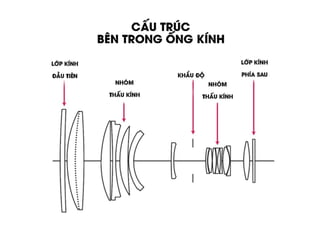
#41 Ống kính là sự kết hợp của nhiều ống kính đơn và được thiết kế, tính toán quang học chính xác cao cũng như trải qua nhiều cuộc thử nghiệm rất tỉ mỉ.
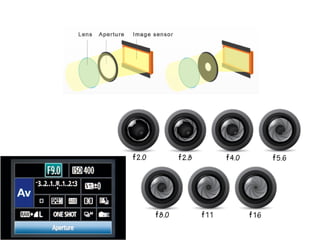
Một số khẩu độ (kiểm soát lượng ánh sáng đi vào ống kính) tiêu chuẩn như 50mm f/1.8, hoặc f/1.4. Hầu như khẩu độ máy ảnh đều giống nhau giữa các nhà sản xuất và không có sự thay đổi gì nhiều từ trước tới nay, trừ một số mẫu ống kính đặc biệt mới nhất hiện nay.
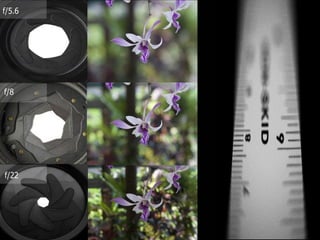
#43 Khẩu độ chính là sự thay đổi đường kính của cửa điều sáng bên trong mỗi ống kính, cho phép ánh sáng đi vào tiếp xúc với bộ dò ánh sáng (phim hoặc cảm biến kỹ thuật số). Nó hoạt động giống như con ngươi trong mắt bạn: độ mở càng hẹp thì càng ít ánh sáng chiếu vào, và ngược lại.
Khẩu độ càng nhỏ thì cho độ sâu trường ảnh sâu hơn và tách nền ít hơn. Giá trị của khẩu độ được tính bằng cách chia độ dài tiêu cự với đường kính của độ mở cửa điều sáng.
#49 Tiêu cự là mức độ phóng đại mà ống kính đạt được. Theo lý thuyết, độ dài tiêu cự là khoảng cách giữa điểm hội tụ của ống kính và cảm biến (hoặc phim).
#50 Độ dài tiêu cự thấp hơn cho góc nhìn rộng hơn, tương tự độ dài tiêu cự cao thì cho góc nhìn hẹp hơn.
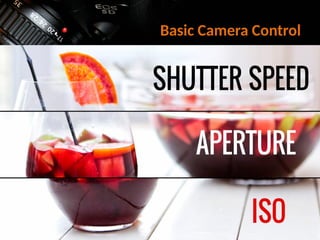
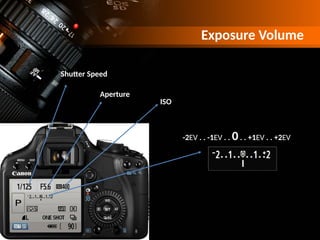
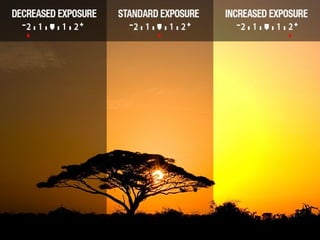
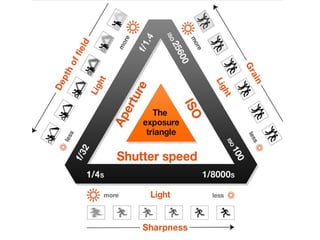
#68 Creating a harmonious exposure using the aperture, shutter speed and ISO is a juggling act. As soon as you make a decision about one element, you'll need to compromise with another.
The trick to balancing The Exposure Triangle is to get all three elements working together so you get the results you want ,and not what the camera tells you you can have.
Because of that, it's really worth putting in the groundwork and getting to grips with the basics of shutter speed (how long the camera's sensor is exposed to the light), what an aperture is (how much light the lens lets in, which also affects depth of field) and ISO (the sensitivity level of the sensor). Once you know how to do this, there's nothing you can't do.
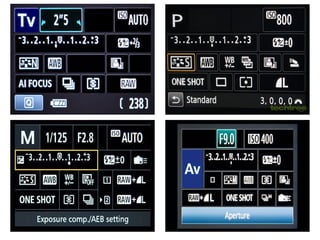
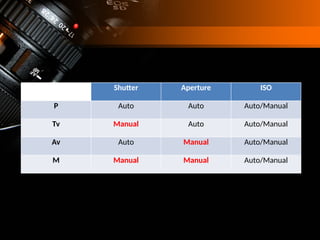
The camera can do this for you in Program, Aperture Priority or Shutter Priority, but it's something you'll need to consider when shooting in Manual mode.
Get the hang of this relationship, and you'll gain much more control over the look and feel of every image you capture.