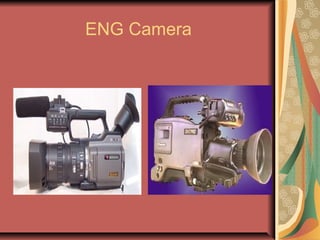
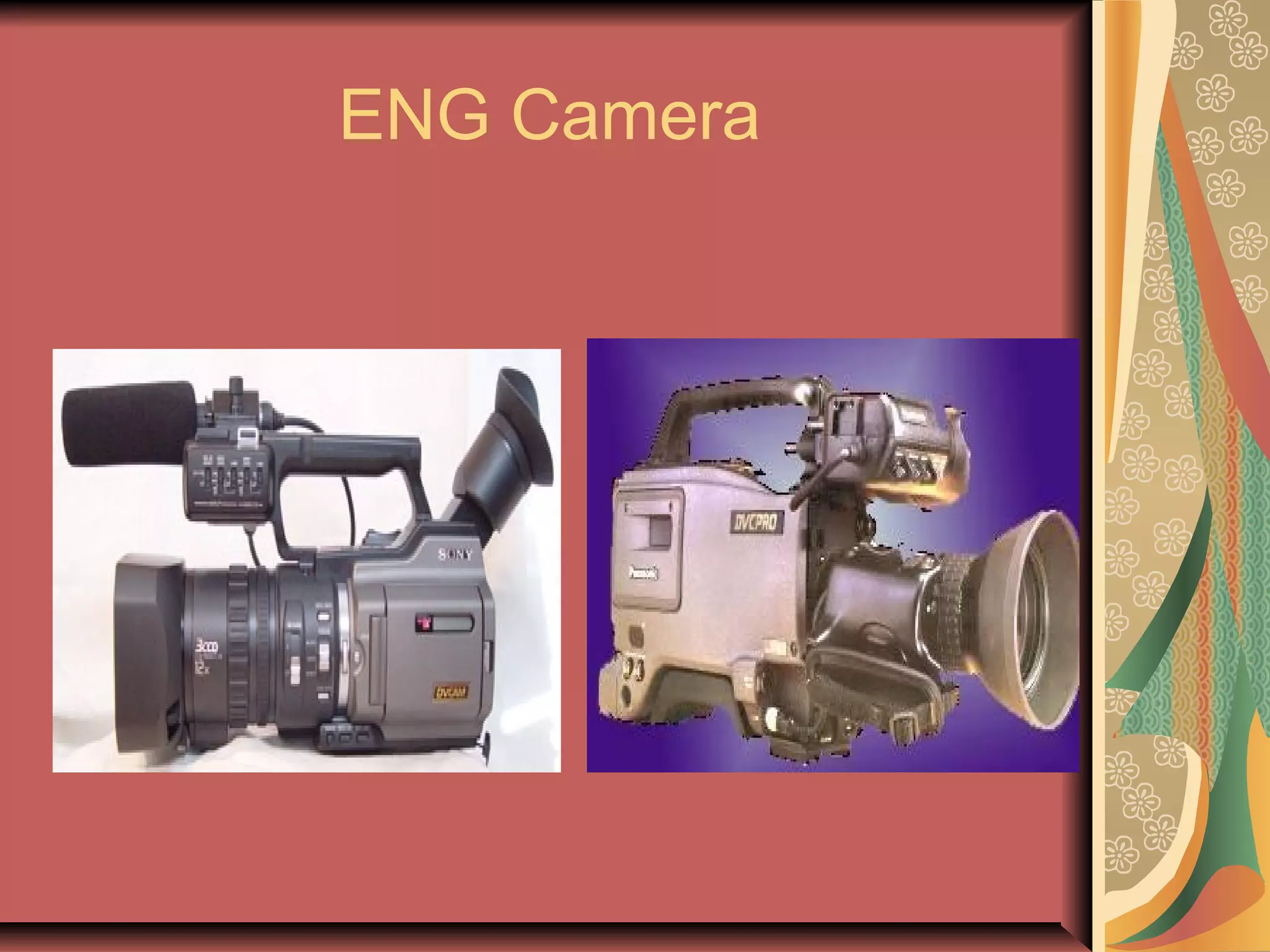
ENG Camera
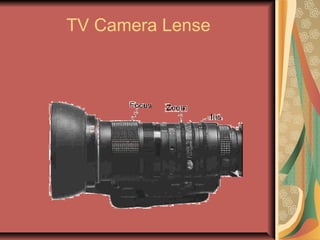
TV Camera Lense
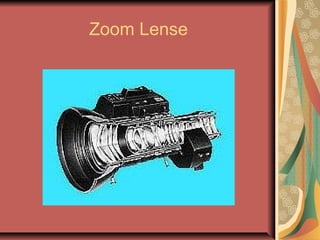
Zoom Lense
The Camera's Imaging Device
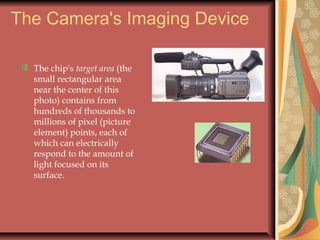
The chip's target area (the
small rectangular area
near the center of this
photo) contains from
hundreds of thousands to
millions of pixel (picture
element) points, each of
which can electrically
respond to the amount of
light focused on its
surface.  
Lens Focal Length
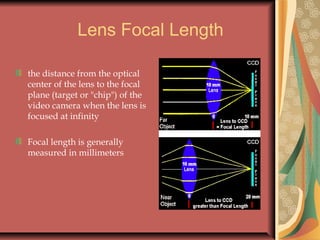
the distance from the optical
center of the lens to the focal
plane (target or "chip") of the
video camera when the lens is
focused at infinity
Focal length is generally
measured in millimeters
Angle of view
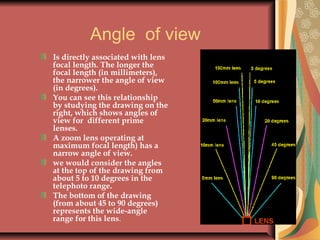
Is directly associated with lens
focal length. The longer the
focal length (in millimeters),
the narrower the angle of view
(in degrees).
You can see this relationship
by studying the drawing on the
right, which shows angles of
view for  different prime
lenses. 
A zoom lens operating at
maximum focal length) has a
narrow angle of view.
we would consider the angles
at the top of the drawing from
about 5 to 10 degrees in the
telephoto range.
The bottom of the drawing
(from about 45 to 90 degrees)
represents the wide-angle
range for this lens.
shot designations
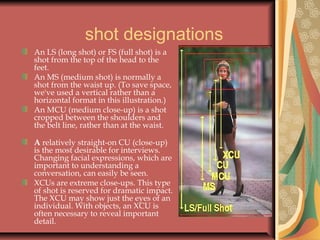
An LS (long shot) or FS (full shot) is a
shot from the top of the head to the
feet.
An MS (medium shot) is normally a
shot from the waist up. (To save space,
we've used a vertical rather than a
horizontal format in this illustration.)
An MCU (medium close-up) is a shot
cropped between the shoulders and
the belt line, rather than at the waist.
A relatively straight-on CU (close-up)
is the most desirable for interviews.
Changing facial expressions, which are
important to understanding a
conversation, can easily be seen.
XCUs are extreme close-ups. This type
of shot is reserved for dramatic impact.
The XCU may show just the eyes of an
individual. With objects, an XCU is
often necessary to reveal important
detail.
F-Stops and Creative
Focus Techniques
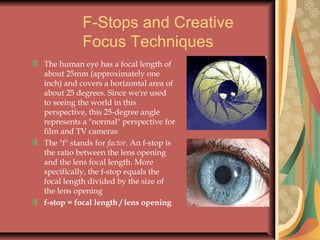
The human eye has a focal length of
about 25mm (approximately one
inch) and covers a horizontal area of
about 25 degrees. Since we're used
to seeing the world in this
perspective, this 25-degree angle
represents a "normal" perspective for
film and TV cameras
The "f" stands for factor. An f-stop is
the ratio between the lens opening
and the lens focal length. More
specifically, the f-stop equals the
focal length divided by the size of
the lens opening
f-stop = focal length / lens opening
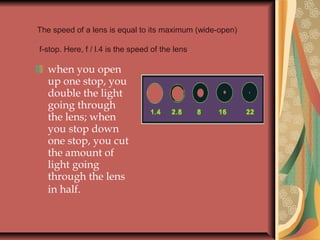
The speed of a lens is equal to its maximum (wide-open)
f-stop. Here, f / l.4 is the speed of the lens

when you open
up one stop, you
double the light
going through
the lens; when
you stop down
one stop, you cut
the amount of
light going
through the lens
in half.
Auto-focus Lenses
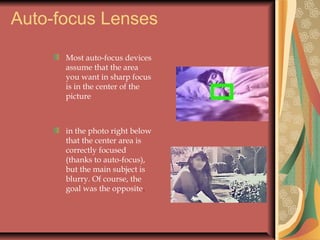
Most auto-focus devices
assume that the area
you want in sharp focus
is in the center of the
picture

in the photo right below
that the center area is
correctly focused
(thanks to auto-focus),
but the main subject is
blurry. Of course, the
goal was the opposite.
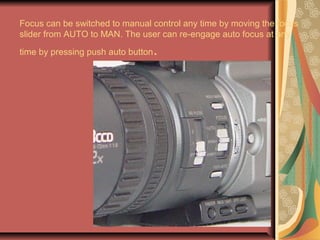
Focus can be switched to manual control any time by moving the focus
slider from AUTO to MAN. The user can re-engage auto focus at any
time by pressing push auto button

.
Minimum Light Levels for Cameras
A foot-candle, is a measure of light intensity from
a candle at a distance of one foot (under very
specific conditions). The origin of the term "lux" is
not known, although it's assumed to refer to
lumens (a measure of light power) times ten.
foot-candle is equal to about 10 lux. (Actually it's
10.76, but 10 is generally close enough,
Most professional video cameras require a light
level of at least 75 foot-candles (750 lux) to
produce the best quality video. However,
some will produce marginally acceptable
video under a few lux of light.  
Depth of Field
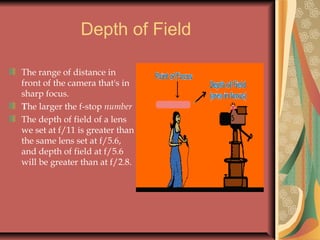
The range of distance in
front of the camera that's in
sharp focus.
The larger the f-stop number
The depth of field of a lens
we set at f/11 is greater than
the same lens set at f/5.6,
and depth of field at f/5.6
will be greater than at f/2.8.
White Balancing On a White Card
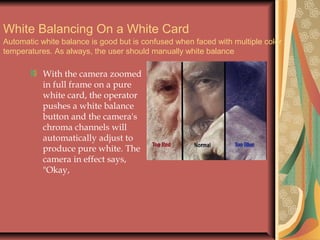
Automatic white balance is good but is confused when faced with multiple color
temperatures. As always, the user should manually white balance

With the camera zoomed
in full frame on a pure
white card, the operator
pushes a white balance
button and the camera's
chroma channels will
automatically adjust to
produce pure white. The
camera in effect says,
"Okay,
Shutter Speeds and Resulting Exposure
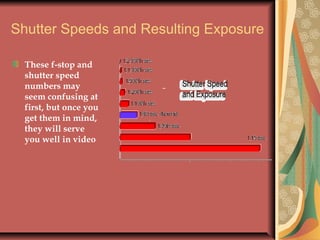
These f-stop and
shutter speed
numbers may
seem confusing at
first, but once you
get them in mind,
they will serve
you well in video
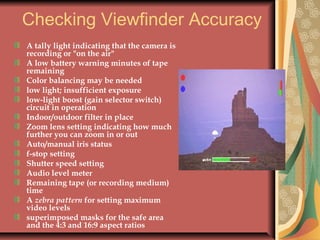
Checking Viewfinder Accuracy
A tally light indicating that the camera is
recording or "on the air"
A low battery warning minutes of tape
remaining
Color balancing may be needed
low light; insufficient exposure
low-light boost (gain selector switch)
circuit in operation
Indoor/outdoor filter in place
Zoom lens setting indicating how much
further you can zoom in or out
Auto/manual iris status
f-stop setting
Shutter speed setting 
Audio level meter
Remaining tape (or recording medium)
time
A zebra pattern for setting maximum
video levels
superimposed masks for the safe area
and the 4:3 and 16:9 aspect ratios
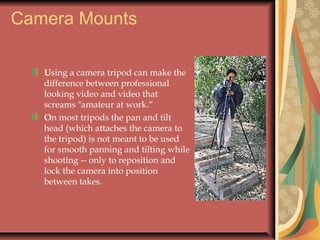
Camera Mounts
Using a camera tripod can make the
difference between professional
looking video and video that
screams "amateur at work.“
On most tripods the pan and tilt
head (which attaches the camera to
the tripod) is not meant to be used
for smooth panning and tilting while
shooting -- only to reposition and
lock the camera into position
between takes.
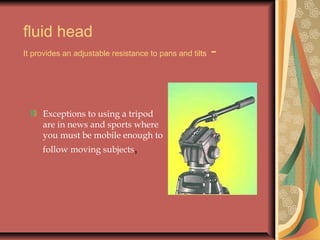
fluid head
It provides an adjustable resistance to pans and tilts

Exceptions to using a tripod
are in news and sports where
you must be mobile enough to
follow moving subjects,

-
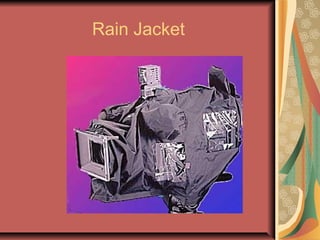
Rain Jacket
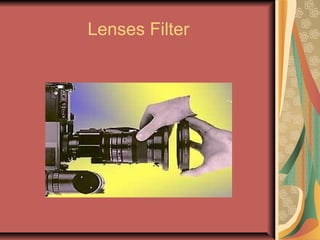
Lenses Filter
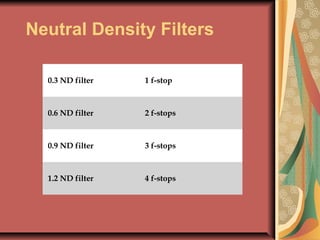
   Neutral Density Filters
 0.3 ND filter

 1 f-stop

 0.6 ND filter

 2 f-stops

 0.9 ND filter

 3 f-stops

 1.2 ND filter

 4 f-stops
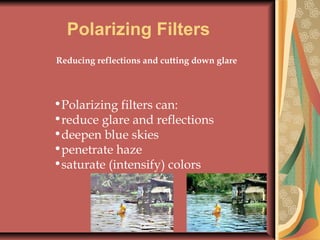
Polarizing Filters
Reducing reflections and cutting down glare

•Polarizing filters can:
•reduce glare and reflections
•deepen blue skies
•penetrate haze
•saturate (intensify) colors
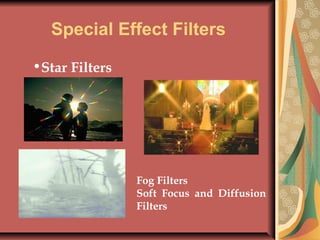
Special Effect Filters
•Star Filters

Fog Filters
Soft Focus and Diffusion
Filters

Tv camera....by sajjad kayani

  • 1.
  • 2.
  • 3.
  • 4.
    The Camera's ImagingDevice The chip's target area (the small rectangular area near the center of this photo) contains from hundreds of thousands to millions of pixel (picture element) points, each of which can electrically respond to the amount of light focused on its surface.  
  • 5.
    Lens Focal Length thedistance from the optical center of the lens to the focal plane (target or "chip") of the video camera when the lens is focused at infinity Focal length is generally measured in millimeters
  • 6.
    Angle of view Isdirectly associated with lens focal length. The longer the focal length (in millimeters), the narrower the angle of view (in degrees). You can see this relationship by studying the drawing on the right, which shows angles of view for  different prime lenses.  A zoom lens operating at maximum focal length) has a narrow angle of view. we would consider the angles at the top of the drawing from about 5 to 10 degrees in the telephoto range. The bottom of the drawing (from about 45 to 90 degrees) represents the wide-angle range for this lens.
  • 7.
    shot designations An LS(long shot) or FS (full shot) is a shot from the top of the head to the feet. An MS (medium shot) is normally a shot from the waist up. (To save space, we've used a vertical rather than a horizontal format in this illustration.) An MCU (medium close-up) is a shot cropped between the shoulders and the belt line, rather than at the waist. A relatively straight-on CU (close-up) is the most desirable for interviews. Changing facial expressions, which are important to understanding a conversation, can easily be seen. XCUs are extreme close-ups. This type of shot is reserved for dramatic impact. The XCU may show just the eyes of an individual. With objects, an XCU is often necessary to reveal important detail.
  • 8.
    F-Stops and Creative FocusTechniques The human eye has a focal length of about 25mm (approximately one inch) and covers a horizontal area of about 25 degrees. Since we're used to seeing the world in this perspective, this 25-degree angle represents a "normal" perspective for film and TV cameras The "f" stands for factor. An f-stop is the ratio between the lens opening and the lens focal length. More specifically, the f-stop equals the focal length divided by the size of the lens opening f-stop = focal length / lens opening
  • 9.
    The speed ofa lens is equal to its maximum (wide-open) f-stop. Here, f / l.4 is the speed of the lens when you open up one stop, you double the light going through the lens; when you stop down one stop, you cut the amount of light going through the lens in half.
  • 10.
    Auto-focus Lenses Most auto-focusdevices assume that the area you want in sharp focus is in the center of the picture in the photo right below that the center area is correctly focused (thanks to auto-focus), but the main subject is blurry. Of course, the goal was the opposite.
  • 11.
    Focus can beswitched to manual control any time by moving the focus slider from AUTO to MAN. The user can re-engage auto focus at any time by pressing push auto button .
  • 12.
    Minimum Light Levelsfor Cameras A foot-candle, is a measure of light intensity from a candle at a distance of one foot (under very specific conditions). The origin of the term "lux" is not known, although it's assumed to refer to lumens (a measure of light power) times ten. foot-candle is equal to about 10 lux. (Actually it's 10.76, but 10 is generally close enough, Most professional video cameras require a light level of at least 75 foot-candles (750 lux) to produce the best quality video. However, some will produce marginally acceptable video under a few lux of light.  
  • 13.
    Depth of Field Therange of distance in front of the camera that's in sharp focus. The larger the f-stop number The depth of field of a lens we set at f/11 is greater than the same lens set at f/5.6, and depth of field at f/5.6 will be greater than at f/2.8.
  • 14.
    White Balancing Ona White Card Automatic white balance is good but is confused when faced with multiple color temperatures. As always, the user should manually white balance With the camera zoomed in full frame on a pure white card, the operator pushes a white balance button and the camera's chroma channels will automatically adjust to produce pure white. The camera in effect says, "Okay,
  • 15.
    Shutter Speeds andResulting Exposure These f-stop and shutter speed numbers may seem confusing at first, but once you get them in mind, they will serve you well in video
  • 16.
    Checking Viewfinder Accuracy Atally light indicating that the camera is recording or "on the air" A low battery warning minutes of tape remaining Color balancing may be needed low light; insufficient exposure low-light boost (gain selector switch) circuit in operation Indoor/outdoor filter in place Zoom lens setting indicating how much further you can zoom in or out Auto/manual iris status f-stop setting Shutter speed setting  Audio level meter Remaining tape (or recording medium) time A zebra pattern for setting maximum video levels superimposed masks for the safe area and the 4:3 and 16:9 aspect ratios
  • 17.
    Camera Mounts Using acamera tripod can make the difference between professional looking video and video that screams "amateur at work.“ On most tripods the pan and tilt head (which attaches the camera to the tripod) is not meant to be used for smooth panning and tilting while shooting -- only to reposition and lock the camera into position between takes.
  • 18.
    fluid head It providesan adjustable resistance to pans and tilts Exceptions to using a tripod are in news and sports where you must be mobile enough to follow moving subjects, -
  • 19.
  • 20.
  • 21.
       Neutral Density Filters  0.3 ND filter  1f-stop  0.6 ND filter  2 f-stops  0.9 ND filter  3 f-stops  1.2 ND filter  4 f-stops
  • 22.
    Polarizing Filters Reducing reflections andcutting down glare •Polarizing filters can: •reduce glare and reflections •deepen blue skies •penetrate haze •saturate (intensify) colors
  • 23.