•Match onAction
•Shot Reverse Shot
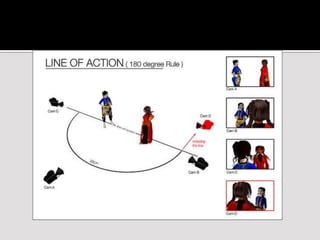
•180 Degree Rule
 Continuity task involving filming and editing
a character opening a door, crossing a room
and sitting down in a chair opposite another
character, with whom she/he then exchanges
a couple of lines of dialogue.This task should
demonstrate match on action, shot/reverse
shot and the 180 degree rule.
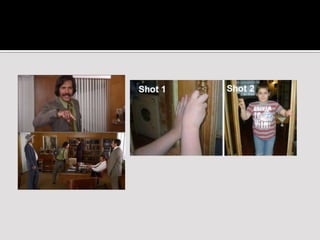
 It is an editing technique for continuity
editing in which one shot cuts to another shot
portraying the action of the subject in the
first shot.
 This creates an impression of continuity –
visual bridge.The view matches the action.
 It portrays a continuous sense of the same
action rather than 2 separate scenarios
(although you may have shot it at different
days).
Remember:
 Wearing the same clothes
 Appears identical to the previous filming time
 Lighting (time of day/weather)
 Clocks in the view must be same time.
 Also if person entering on the left they have
to leave on the right.
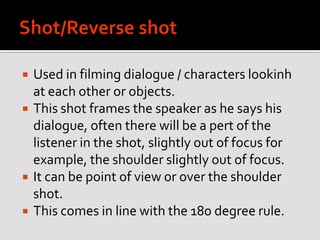
 Used in filming dialogue / characters lookinh
at each other or objects.
 This shot frames the speaker as he says his
dialogue, often there will be a pert of the
listener in the shot, slightly out of focus for
example, the shoulder slightly out of focus.
 It can be point of view or over the shoulder
shot.
 This comes in line with the 180 degree rule.
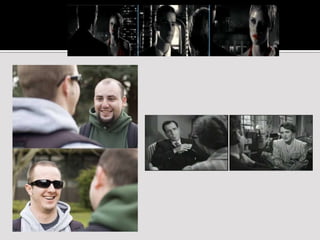
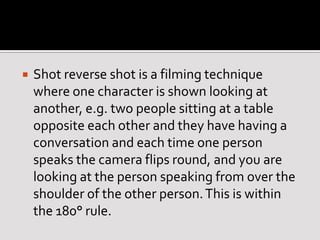
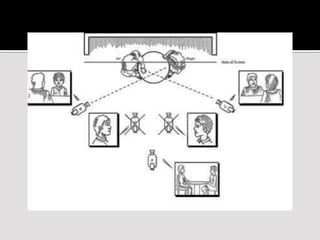
 Shot reverse shot is a filming technique
where one character is shown looking at
another, e.g. two people sitting at a table
opposite each other and they have having a
conversation and each time one person
speaks the camera flips round, and you are
looking at the person speaking from over the
shoulder of the other person.This is within
the 180° rule.
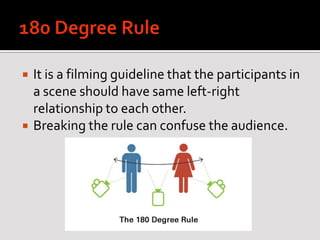
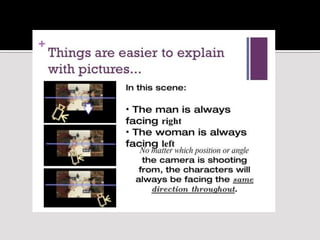
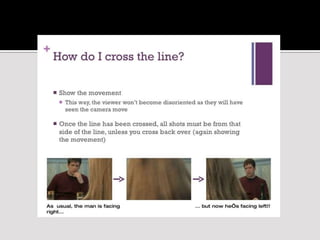
 It is a filming guideline that the participants in
a scene should have same left-right
relationship to each other.
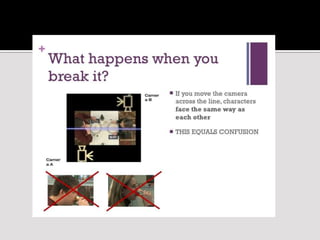
 Breaking the rule can confuse the audience.
Principles of-continuity

Principles of-continuity

  • 1.
    •Match onAction •Shot ReverseShot •180 Degree Rule
  • 2.
     Continuity taskinvolving filming and editing a character opening a door, crossing a room and sitting down in a chair opposite another character, with whom she/he then exchanges a couple of lines of dialogue.This task should demonstrate match on action, shot/reverse shot and the 180 degree rule.
  • 3.
     It isan editing technique for continuity editing in which one shot cuts to another shot portraying the action of the subject in the first shot.  This creates an impression of continuity – visual bridge.The view matches the action.  It portrays a continuous sense of the same action rather than 2 separate scenarios (although you may have shot it at different days).
  • 5.
    Remember:  Wearing thesame clothes  Appears identical to the previous filming time  Lighting (time of day/weather)  Clocks in the view must be same time.  Also if person entering on the left they have to leave on the right.
  • 6.
     Used infilming dialogue / characters lookinh at each other or objects.  This shot frames the speaker as he says his dialogue, often there will be a pert of the listener in the shot, slightly out of focus for example, the shoulder slightly out of focus.  It can be point of view or over the shoulder shot.  This comes in line with the 180 degree rule.
  • 8.
     Shot reverseshot is a filming technique where one character is shown looking at another, e.g. two people sitting at a table opposite each other and they have having a conversation and each time one person speaks the camera flips round, and you are looking at the person speaking from over the shoulder of the other person.This is within the 180° rule.
  • 10.
     It isa filming guideline that the participants in a scene should have same left-right relationship to each other.  Breaking the rule can confuse the audience.