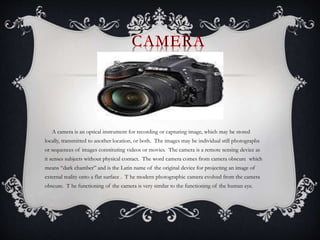
A camera is an optical instrument for recording or capturing image, which may be stored
locally, transmitted to another location, or both. The images may be individual still photographs
or sequences of images constituting videos or movies. The camera is a remote sensing device as
it senses subjects without physical contact. The word camera comes from camera obscure which
means “dark chamber” and is the Latin name of the original device for projecting an image of
external reality onto a flat surface . T he modern photographic camera evolved from the camera
obscure. T he functioning of the camera is very similar to the functioning of the human eye.
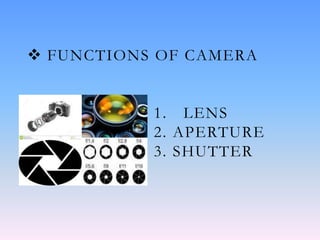
 FUNCTIONS OF CAMERA
1. LENS
2. APERTURE
3. SHUTTER
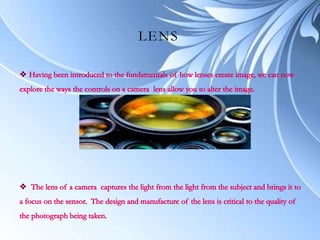
LENS
APERTURE
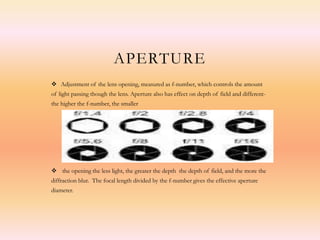
 Adjustment of the lens opening, measured as f-number, which controls the amount
of light passing though the lens. Aperture also has effect on depth of field and different-
the higher the f-number, the smaller
 the opening the less light, the greater the depth the depth of field, and the more the
diffraction blur. The focal length divided by the f-number gives the effective aperture
diameter.
SHUTTER
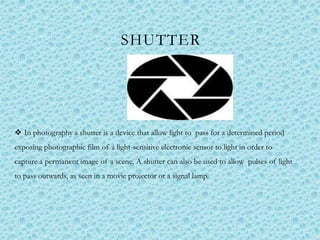
 In photography a shutter is a device that allow light to pass for a determined period
exposing photographic film of a light-sensitive electronic sensor to light in order to
capture a permanent image of a scene. A shutter can also be used to allow pulses of light
to pass outwards, as seen in a movie projector or a signal lamp.
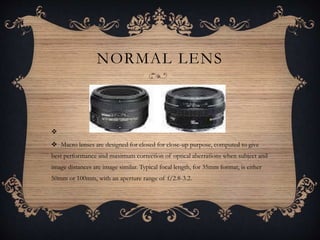
NORMAL LENS

 Macro lenses are designed for closed for close-up purpose, computed to give
best performance and maximum correction of optical aberrations when subject and
image distances are image similar. Typical focal length, for 35mm format, is either
50mm or 100mm, with an aperture range of f/2.8-3.2.
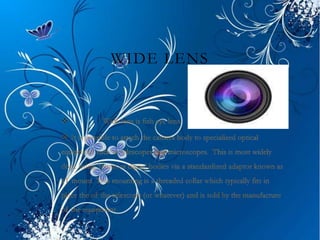
WIDE LENS
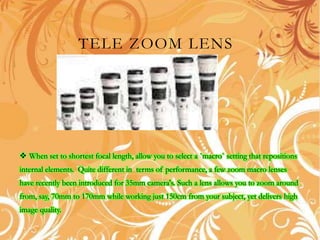
TELE ZOOM LENS
 When set to shortest focal length, allow you to select a `macro` setting that repositions
internal elements. Quite different in terms of performance, a few zoom macro lenses
have recently been introduced for 35mm camera's. Such a lens allows you to zoom around
from, say, 70mm to 170mm while working just 150cm from your subject, yet delivers high
image quality.
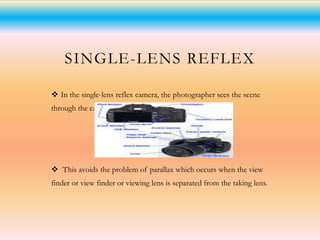
SINGLE-LENS REFLEX
 In the single-lens reflex camera, the photographer sees the scene
through the camera lens.
 This avoids the problem of parallax which occurs when the view
finder or view finder or viewing lens is separated from the taking lens.
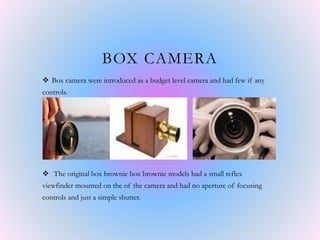
BOX CAMERA
 Box camera were introduced as a budget level camera and had few if any
controls.
 The original box brownie box brownie models had a small reflex
viewfinder mounted on the of the camera and had no aperture of focusing
controls and just a simple shutter.
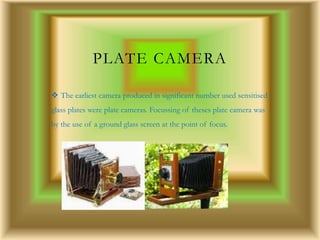
PLATE CAMERA
 The earliest camera produced in significant number used sensitised
glass plates were plate cameras. Focussing of theses plate camera was
by the use of a ground glass screen at the point of focus.
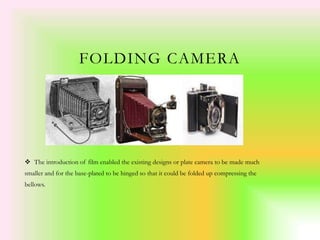
FOLDING CAMERA
 The introduction of film enabled the existing designs or plate camera to be made much
smaller and for the base-plated to be hinged so that it could be folded up compressing the
bellows.
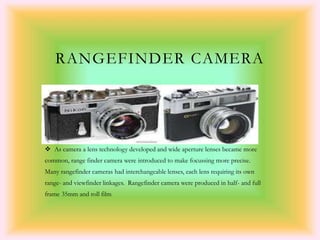
RANGEFINDER CAMERA
 As camera a lens technology developed and wide aperture lenses became more
common, range finder camera were introduced to make focussing more precise.
Many rangefinder cameras had interchangeable lenses, each lens requiring its own
range- and viewfinder linkages. Rangefinder camera were produced in half- and full
frame 35mm and roll film
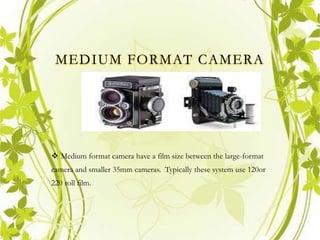
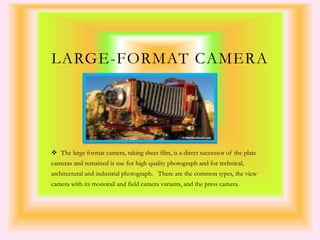
LARGE-FORMAT CAMERA
 The large format camera, taking sheet film, is a direct successor of the plate
cameras and remained is use for high quality photograph and for technical,
architectural and industrial photograph. There are the common types, the view
camera with its monorail and field camera variants, and the press camera.
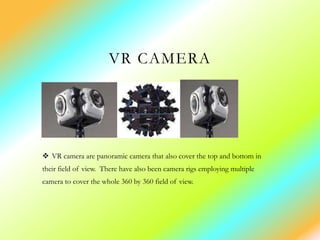
VR CAMERA
 VR camera are panoramic camera that also cover the top and bottom in
their field of view. There have also been camera rigs employing multiple
camera to cover the whole 360 by 360 field of view.
DIGITAL CAMERA
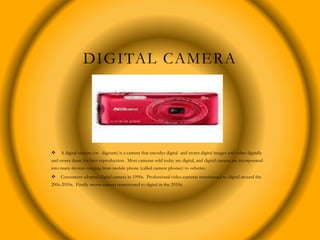
 A digital camera (or digicam) is a camera that encodes digital and stores digital images and video digitally
and stores them for later reproduction. Most cameras sold today are digital, and digital camera are incorporated
into many devices ranging from mobile phone (called camera phones) to vehicles.
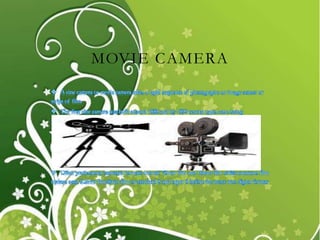
 Consumers adopted digital camera in 1990s. Professional video cameras transitioned to digital around the
200s-2010s. Finally movie camera transitioned to digital in the 2010s.
CAMCORDERS
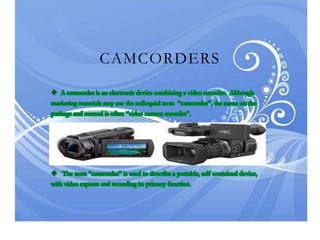
 A camcorder is an electronic device combining a video recorder. Although
marketing materials may use the colloquial term “camcorder”, the name on the
package and manual is often “video camera recorder”.
 The term “camcorder” is used to describe a portable, self-contained device,
with video capture and recording its primary function.
PROFESSIONAL VIDEO
CAMERA
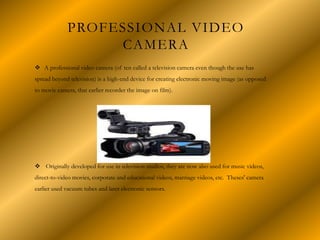
 A professional video camera (of ten called a television camera even though the use has
spread beyond television) is a high-end device for creating electronic moving image (as opposed
to movie camera, that earlier recorder the image on film).
 Originally developed for use in television studios, they are now also used for music videos,
direct-to-video movies, corporate and educational videos, marriage videos, etc. Theses' camera
earlier used vacuum tubes and later electronic sensors.
MOVIE CAMERA
PANORAMIC CAMERA
SUBMINIATURE
 Camera taking film significantly smaller than 35mm were made.
Sub miniature camera were first produced in produced in the
nineteenth century. The expensive 8*11 mm minx, the only type of
camera produced by the company from 1937 to 1976, became very
widely known and was often used for espionage (the Minx company
later also produced larger cameras. Image quality with theses small
film was limited
CAMERA

CAMERA

  • 2.
    A camera isan optical instrument for recording or capturing image, which may be stored locally, transmitted to another location, or both. The images may be individual still photographs or sequences of images constituting videos or movies. The camera is a remote sensing device as it senses subjects without physical contact. The word camera comes from camera obscure which means “dark chamber” and is the Latin name of the original device for projecting an image of external reality onto a flat surface . T he modern photographic camera evolved from the camera obscure. T he functioning of the camera is very similar to the functioning of the human eye.
  • 3.
     FUNCTIONS OFCAMERA 1. LENS 2. APERTURE 3. SHUTTER
  • 5.
  • 6.
    APERTURE  Adjustment ofthe lens opening, measured as f-number, which controls the amount of light passing though the lens. Aperture also has effect on depth of field and different- the higher the f-number, the smaller  the opening the less light, the greater the depth the depth of field, and the more the diffraction blur. The focal length divided by the f-number gives the effective aperture diameter.
  • 7.
    SHUTTER  In photographya shutter is a device that allow light to pass for a determined period exposing photographic film of a light-sensitive electronic sensor to light in order to capture a permanent image of a scene. A shutter can also be used to allow pulses of light to pass outwards, as seen in a movie projector or a signal lamp.
  • 8.
    NORMAL LENS   Macrolenses are designed for closed for close-up purpose, computed to give best performance and maximum correction of optical aberrations when subject and image distances are image similar. Typical focal length, for 35mm format, is either 50mm or 100mm, with an aperture range of f/2.8-3.2.
  • 9.
  • 10.
    TELE ZOOM LENS When set to shortest focal length, allow you to select a `macro` setting that repositions internal elements. Quite different in terms of performance, a few zoom macro lenses have recently been introduced for 35mm camera's. Such a lens allows you to zoom around from, say, 70mm to 170mm while working just 150cm from your subject, yet delivers high image quality.
  • 11.
    SINGLE-LENS REFLEX  Inthe single-lens reflex camera, the photographer sees the scene through the camera lens.  This avoids the problem of parallax which occurs when the view finder or view finder or viewing lens is separated from the taking lens.
  • 12.
    BOX CAMERA  Boxcamera were introduced as a budget level camera and had few if any controls.  The original box brownie box brownie models had a small reflex viewfinder mounted on the of the camera and had no aperture of focusing controls and just a simple shutter.
  • 13.
    PLATE CAMERA  Theearliest camera produced in significant number used sensitised glass plates were plate cameras. Focussing of theses plate camera was by the use of a ground glass screen at the point of focus.
  • 15.
    FOLDING CAMERA  Theintroduction of film enabled the existing designs or plate camera to be made much smaller and for the base-plated to be hinged so that it could be folded up compressing the bellows.
  • 16.
    RANGEFINDER CAMERA  Ascamera a lens technology developed and wide aperture lenses became more common, range finder camera were introduced to make focussing more precise. Many rangefinder cameras had interchangeable lenses, each lens requiring its own range- and viewfinder linkages. Rangefinder camera were produced in half- and full frame 35mm and roll film
  • 18.
    LARGE-FORMAT CAMERA  Thelarge format camera, taking sheet film, is a direct successor of the plate cameras and remained is use for high quality photograph and for technical, architectural and industrial photograph. There are the common types, the view camera with its monorail and field camera variants, and the press camera.
  • 19.
    VR CAMERA  VRcamera are panoramic camera that also cover the top and bottom in their field of view. There have also been camera rigs employing multiple camera to cover the whole 360 by 360 field of view.
  • 20.
    DIGITAL CAMERA  Adigital camera (or digicam) is a camera that encodes digital and stores digital images and video digitally and stores them for later reproduction. Most cameras sold today are digital, and digital camera are incorporated into many devices ranging from mobile phone (called camera phones) to vehicles.  Consumers adopted digital camera in 1990s. Professional video cameras transitioned to digital around the 200s-2010s. Finally movie camera transitioned to digital in the 2010s.
  • 21.
    CAMCORDERS  A camcorderis an electronic device combining a video recorder. Although marketing materials may use the colloquial term “camcorder”, the name on the package and manual is often “video camera recorder”.  The term “camcorder” is used to describe a portable, self-contained device, with video capture and recording its primary function.
  • 22.
    PROFESSIONAL VIDEO CAMERA  Aprofessional video camera (of ten called a television camera even though the use has spread beyond television) is a high-end device for creating electronic moving image (as opposed to movie camera, that earlier recorder the image on film).  Originally developed for use in television studios, they are now also used for music videos, direct-to-video movies, corporate and educational videos, marriage videos, etc. Theses' camera earlier used vacuum tubes and later electronic sensors.
  • 23.
  • 24.
  • 25.
    SUBMINIATURE  Camera takingfilm significantly smaller than 35mm were made. Sub miniature camera were first produced in produced in the nineteenth century. The expensive 8*11 mm minx, the only type of camera produced by the company from 1937 to 1976, became very widely known and was often used for espionage (the Minx company later also produced larger cameras. Image quality with theses small film was limited