Cameras
Cameras
 And stuff.
Types of camera
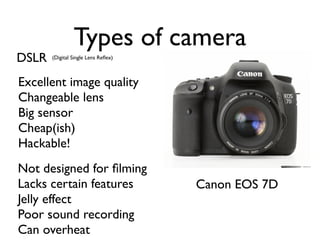
DSLR   (Digital Single Lens Reflex)


Excellent image quality
Changeable lens
Big sensor
Cheap(ish)
Hackable!
Not designed for filming
Lacks certain features               Canon EOS 7D
Jelly effect
Poor sound recording
Can overheat
Types of camera
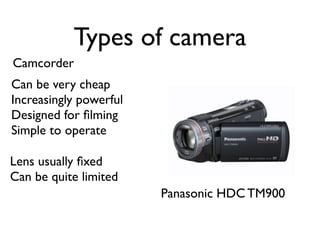
Camcorder
Can be very cheap
Increasingly powerful
Designed for filming
Simple to operate

Lens usually fixed
Can be quite limited
                        Panasonic HDC TM900
Types of camera
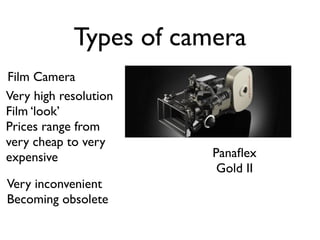
Film Camera
Very high resolution
Film ‘look’
Prices range from
very cheap to very
expensive               Panaflex
                         Gold II
Very inconvenient
Becoming obsolete
Types of camera
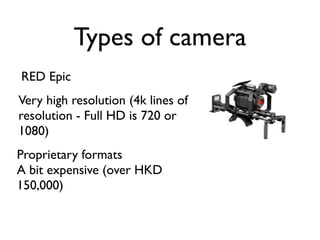
RED Epic
Very high resolution (4k lines of
resolution - Full HD is 720 or
1080)
Proprietary formats
A bit expensive (over HKD
150,000)
Lenses
Prime - doesn’t move           What difference
                                does the lens
Telefoto                           make?
 Zoom - Can change focal length
Wide angle - Very short
focal length
Macro - For extreme close-up work

Fisheye
                                More here
Lenses
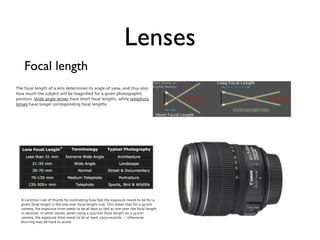
    Focal length
The focal length of a lens determines its angle of view, and thus also
how much the subject will be magnified for a given photographic
position. Wide angle lenses have short focal lengths, while telephoto
lenses have longer corresponding focal lengths.


  A common rule of thumb for estimating how fast the exposure needs to be for a
  given focal length is the one over focal length rule. This states that for a 35 mm
  camera, the exposure time needs to be at least as fast as one over the focal length
  in seconds. In other words, when using a 200 mm focal length on a 35 mm
  camera, the exposure time needs to be at least 1/200 seconds — otherwise
  blurring may be hard to avoid.
Exposure
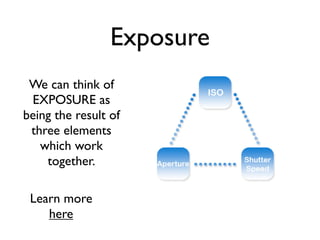
 We can think of
 EXPOSURE as
being the result of
 three elements
   which work
    together.

 Learn more
    here
Shutter speed / frame
              rate
Commonly confused, but not the same thing

Frame rate - Fps.Usually 24, 30 or 48 for video

Shutter speed - how long the frame is open for

 This makes it
 very simple!
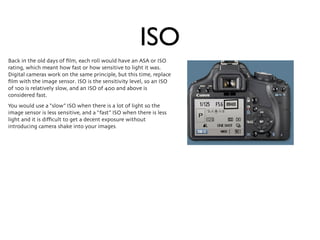
ISO
Back in the old days of film, each roll would have an ASA or ISO
rating, which meant how fast or how sensitive to light it was.
Digital cameras work on the same principle, but this time, replace
film with the image sensor. ISO is the sensitivity level, so an ISO
of 100 is relatively slow, and an ISO of 400 and above is
considered fast.
You would use a “slow” ISO when there is a lot of light so the
image sensor is less sensitive, and a “fast” ISO when there is less
light and it is difficult to get a decent exposure without
introducing camera shake into your images.
Aperture
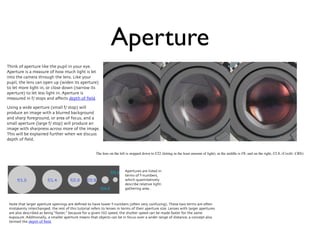
Think of aperture like the pupil in your eye.
Aperture is a measure of how much light is let
into the camera through the lens. Like your
pupil, the lens can open up (widen its aperture)
to let more light in, or close down (narrow its
aperture) to let less light in. Aperture is
measured in f/ stops and affects depth of field.

Using a wide aperture (small f/ stop) will
produce an image with a blurred background
and sharp foreground, or area of focus, and a
small aperture (large f/ stop) will produce an
image with sharpness across more of the image.
This will be explained further when we discuss
depth of field.


                                                       The lens on the left is stopped down to f/22 (letting in the least amount of light), in the middle is f/8, and on the right, f/2.8. (Credit: CBSi)


                                                                           Apertures are listed in
                                                                           terms of f-numbers,
                                                                           which quantitatively
                                                                           describe relative light-
                                                                           gathering area .


 Note that larger aperture openings are defined to have lower f-numbers (o4en very confusing). These two terms are o4en
 mistakenly interchanged; the rest of this tutorial refers to lenses in terms of their aperture size. Lenses with larger apertures
 are also described as being “faster,” because for a given ISO speed, the shutter speed can be made faster for the same
 exposure. Additionally, a smaller aperture means that objects can be in focus over a wider range of distance, a concept also
 termed the depth of field.
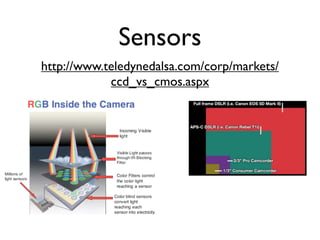
Sensors
http://www.teledynedalsa.com/corp/markets/
            ccd_vs_cmos.aspx
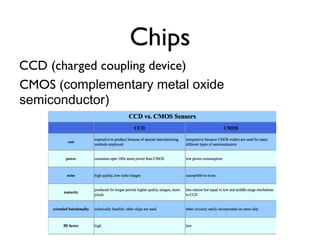
Chips
CCD (charged coupling device)
CMOS (complementary metal oxide
semiconductor)
Depth of Field
Gain

Cameras copy

  • 2.
  • 3.
  • 4.
    Types of camera DSLR (Digital Single Lens Reflex) Excellent image quality Changeable lens Big sensor Cheap(ish) Hackable! Not designed for filming Lacks certain features Canon EOS 7D Jelly effect Poor sound recording Can overheat
  • 5.
    Types of camera Camcorder Canbe very cheap Increasingly powerful Designed for filming Simple to operate Lens usually fixed Can be quite limited Panasonic HDC TM900
  • 6.
    Types of camera FilmCamera Very high resolution Film ‘look’ Prices range from very cheap to very expensive Panaflex Gold II Very inconvenient Becoming obsolete
  • 7.
    Types of camera REDEpic Very high resolution (4k lines of resolution - Full HD is 720 or 1080) Proprietary formats A bit expensive (over HKD 150,000)
  • 8.
    Lenses Prime - doesn’tmove What difference does the lens Telefoto make? Zoom - Can change focal length Wide angle - Very short focal length Macro - For extreme close-up work Fisheye More here
  • 9.
    Lenses Focal length The focal length of a lens determines its angle of view, and thus also how much the subject will be magnified for a given photographic position. Wide angle lenses have short focal lengths, while telephoto lenses have longer corresponding focal lengths. A common rule of thumb for estimating how fast the exposure needs to be for a given focal length is the one over focal length rule. This states that for a 35 mm camera, the exposure time needs to be at least as fast as one over the focal length in seconds. In other words, when using a 200 mm focal length on a 35 mm camera, the exposure time needs to be at least 1/200 seconds — otherwise blurring may be hard to avoid.
  • 10.
    Exposure We canthink of EXPOSURE as being the result of three elements which work together. Learn more here
  • 11.
    Shutter speed /frame rate Commonly confused, but not the same thing Frame rate - Fps.Usually 24, 30 or 48 for video Shutter speed - how long the frame is open for This makes it very simple!
  • 12.
    ISO Back in theold days of film, each roll would have an ASA or ISO rating, which meant how fast or how sensitive to light it was. Digital cameras work on the same principle, but this time, replace film with the image sensor. ISO is the sensitivity level, so an ISO of 100 is relatively slow, and an ISO of 400 and above is considered fast. You would use a “slow” ISO when there is a lot of light so the image sensor is less sensitive, and a “fast” ISO when there is less light and it is difficult to get a decent exposure without introducing camera shake into your images.
  • 13.
    Aperture Think of aperturelike the pupil in your eye. Aperture is a measure of how much light is let into the camera through the lens. Like your pupil, the lens can open up (widen its aperture) to let more light in, or close down (narrow its aperture) to let less light in. Aperture is measured in f/ stops and affects depth of field. Using a wide aperture (small f/ stop) will produce an image with a blurred background and sharp foreground, or area of focus, and a small aperture (large f/ stop) will produce an image with sharpness across more of the image. This will be explained further when we discuss depth of field. The lens on the left is stopped down to f/22 (letting in the least amount of light), in the middle is f/8, and on the right, f/2.8. (Credit: CBSi) Apertures are listed in terms of f-numbers, which quantitatively describe relative light- gathering area . Note that larger aperture openings are defined to have lower f-numbers (o4en very confusing). These two terms are o4en mistakenly interchanged; the rest of this tutorial refers to lenses in terms of their aperture size. Lenses with larger apertures are also described as being “faster,” because for a given ISO speed, the shutter speed can be made faster for the same exposure. Additionally, a smaller aperture means that objects can be in focus over a wider range of distance, a concept also termed the depth of field.
  • 14.
  • 15.
    Chips CCD (charged couplingdevice) CMOS (complementary metal oxide semiconductor)
  • 16.
  • 17.