The Art of Editing
Rhythm, Pace, Emotion
Shannon Walsh / SM2002
School of Creative Media, City University of Hong Kong
The Art of Editing
Good editing makes the director look good.
Great editing makes the film look like it wasn’t
directed at all.
-Victor Fleming
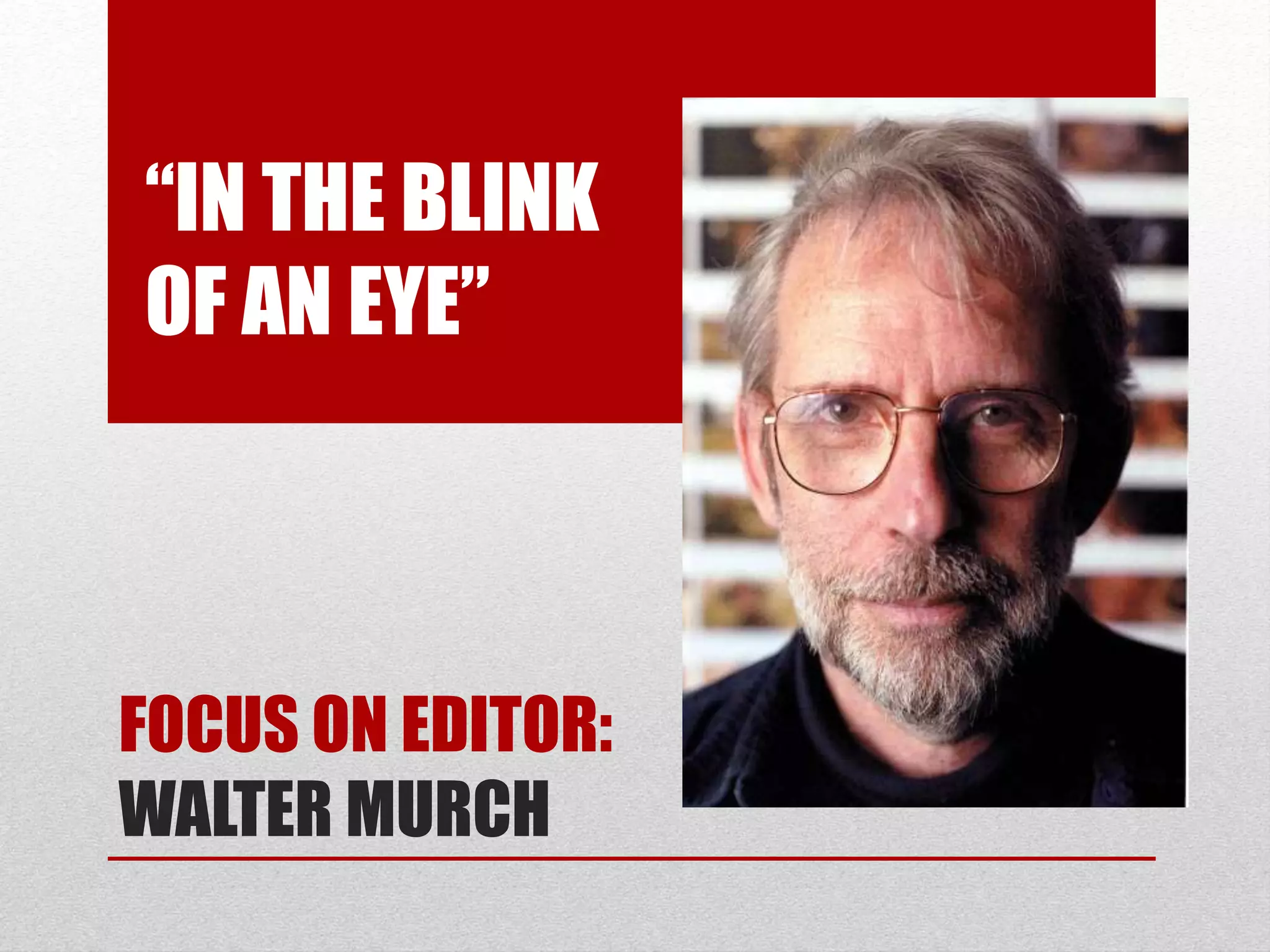
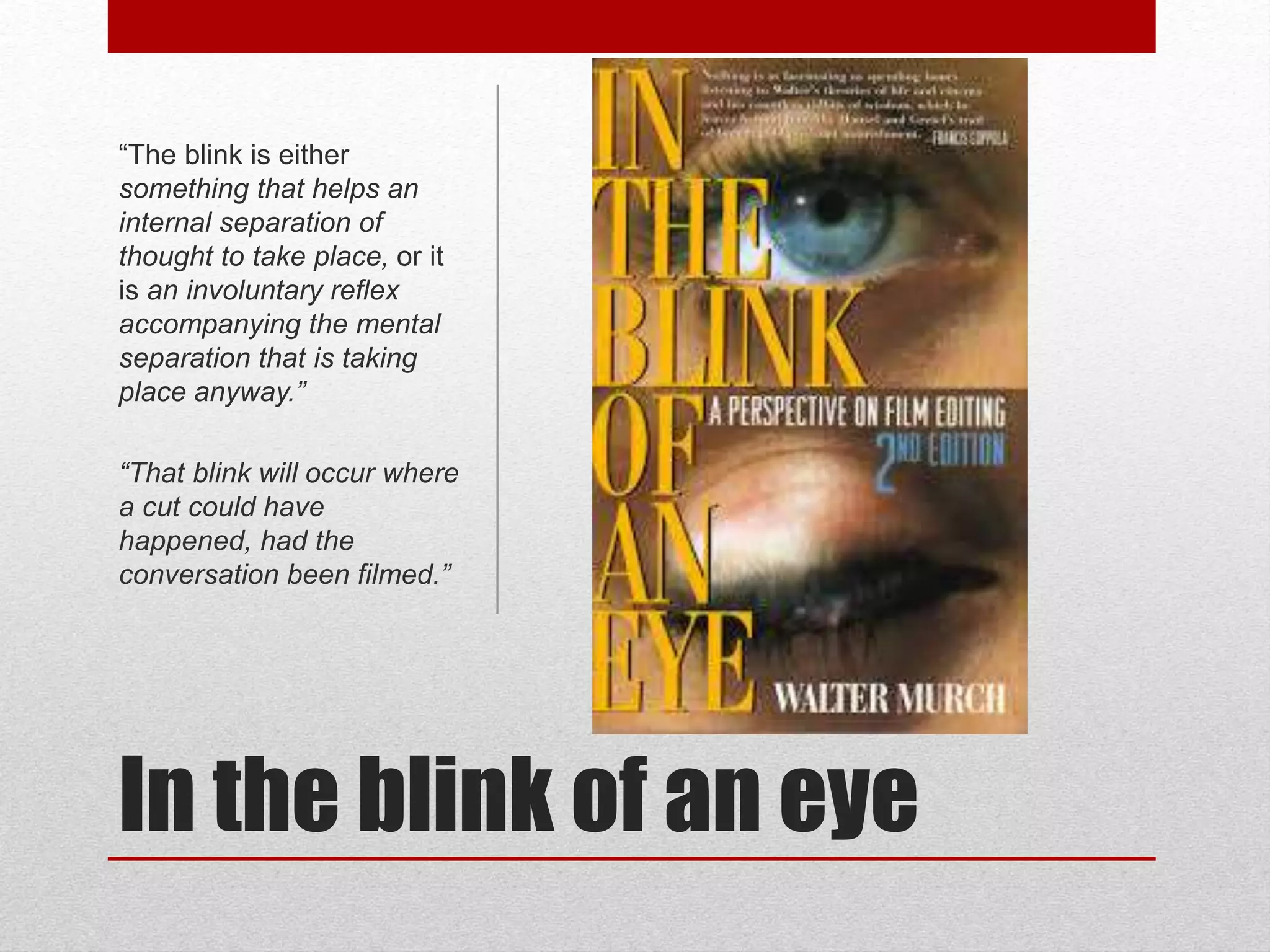
“IN THE BLINK
OF AN EYE”
FOCUS ON EDITOR:
WALTER MURCH
Walter Murch: The rule of 6
1. Emotion: How will this cut affect the audience emotionally at
this particular moment in the film?
2. Story: Does the edit move the story forward in a meaningful
way?
3. Rhythm: Is the cut at a point that makes rhythmic sense?
4. Eye Trace: How does the cut effect the location and
movement of the audience's focus in that particular film?
5. Two-Dimensional Plane of Screen: Is the axis followed
properly?
6. Three-Dimensional Space - Is the cut true to established
physical and spatial relationships?
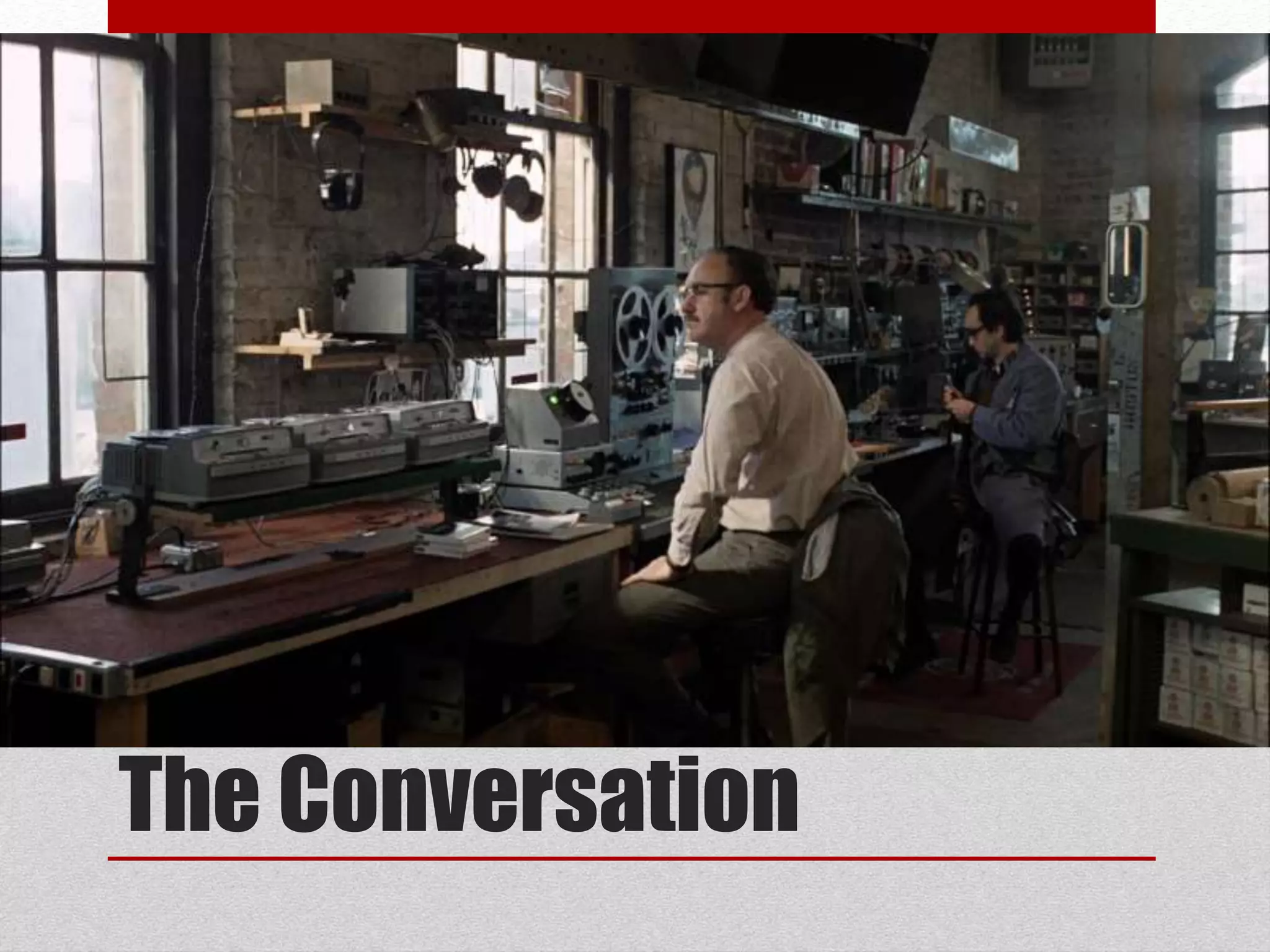
The Conversation
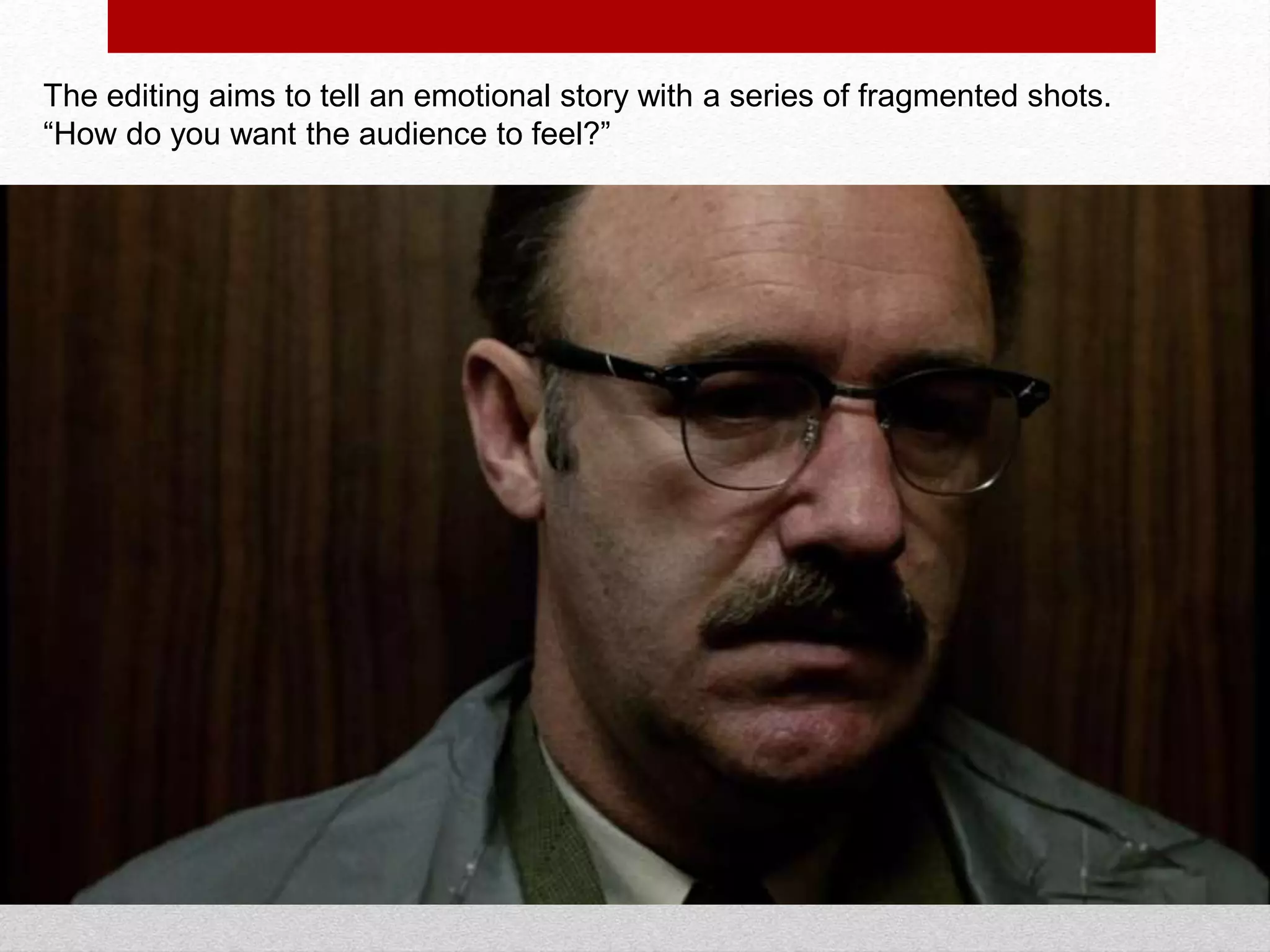
The editing aims to tell an emotional story with a series of fragmented shots.
“How do you want the audience to feel?”
Pace & Rhythm
What is Pace?
• Variation in pace effects emotional response to film
• Pacing is a tool for shaping rhythm in a film.
• Fast pacing and Slow pacing can change the mood and feeling of
the film.
Limits of Pace
In Touch of Evil (1958) Welles used one tracking shot to create a
powerful sequence, without editing, showing how composition, lighting,
performance also are critical.
Similarly, Taiwanese direct TSAI Ming-Liang also uses long shots,
often for entire scenes, such as in Stray Dogs (2013), what has been
called a “cinema of slowness”
Rhythm
• To enhance their rhythmic intuition, editors actively perceive the
rhythmic movement of life and of the world around them.
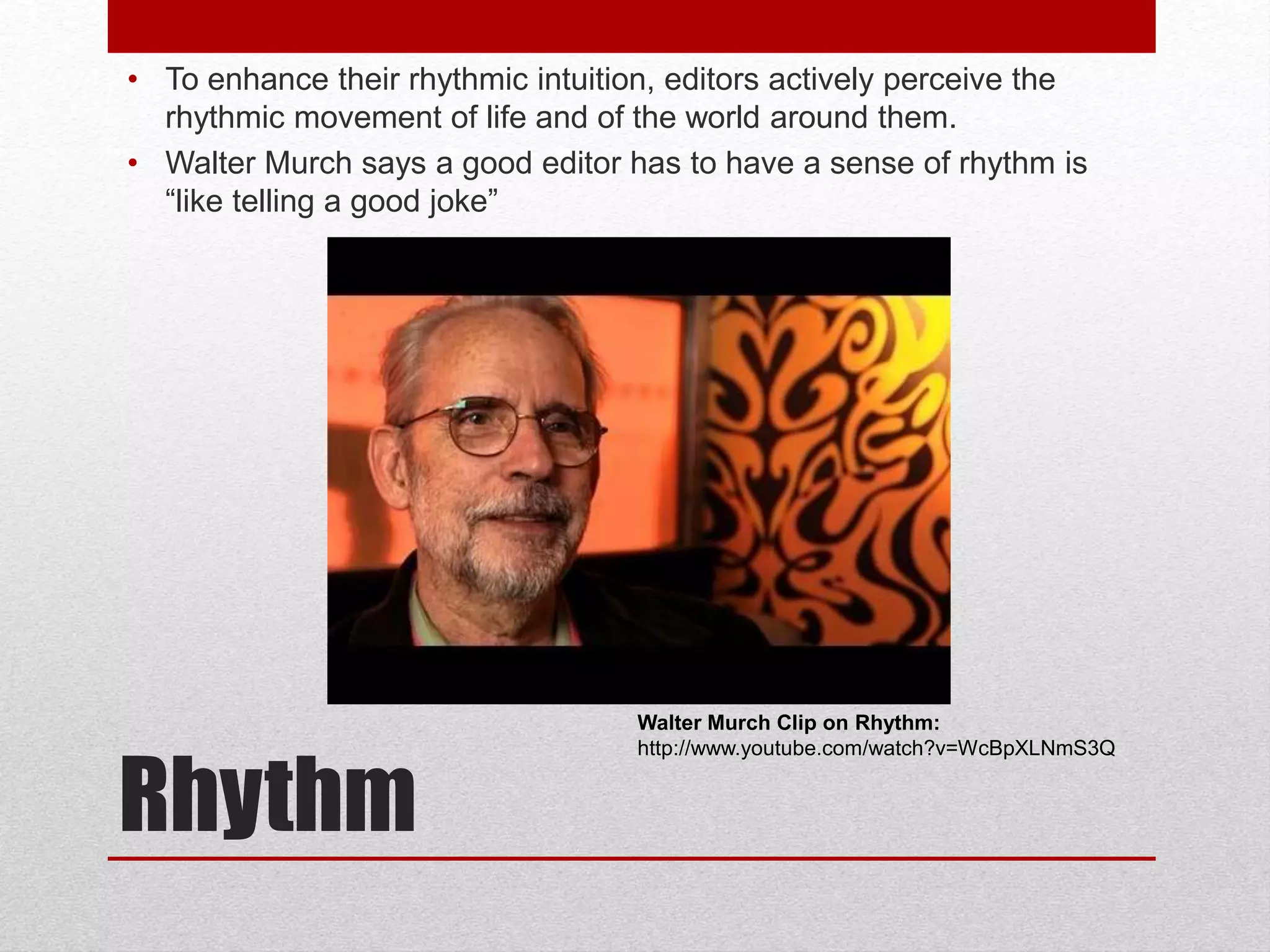
• Walter Murch says a good editor has to have a sense of rhythm is
“like telling a good joke”
Walter Murch Clip on Rhythm:
http://www.youtube.com/watch?v=WcBpXLNmS3Q
Timing
One element of Pace
Timing: the duration or the length of time a shot is held.
• Understanding the purpose of the sequence to decide how to edit for
dramatic effective
• A 10 second shot will feel long if it is juxtaposed with a series of 1-
second shots.
• The feeling of a shot’s duration is created by the relative duration of the
shots near to it and the concentration of information, movement, and
change within it.
• “Where in a sequence should a particular close-up or cutaway be
positioned for maximum impact? When is a subjective shot more
powerful than a an objective one? What is the most effective patter of
crosscutting between shots?”
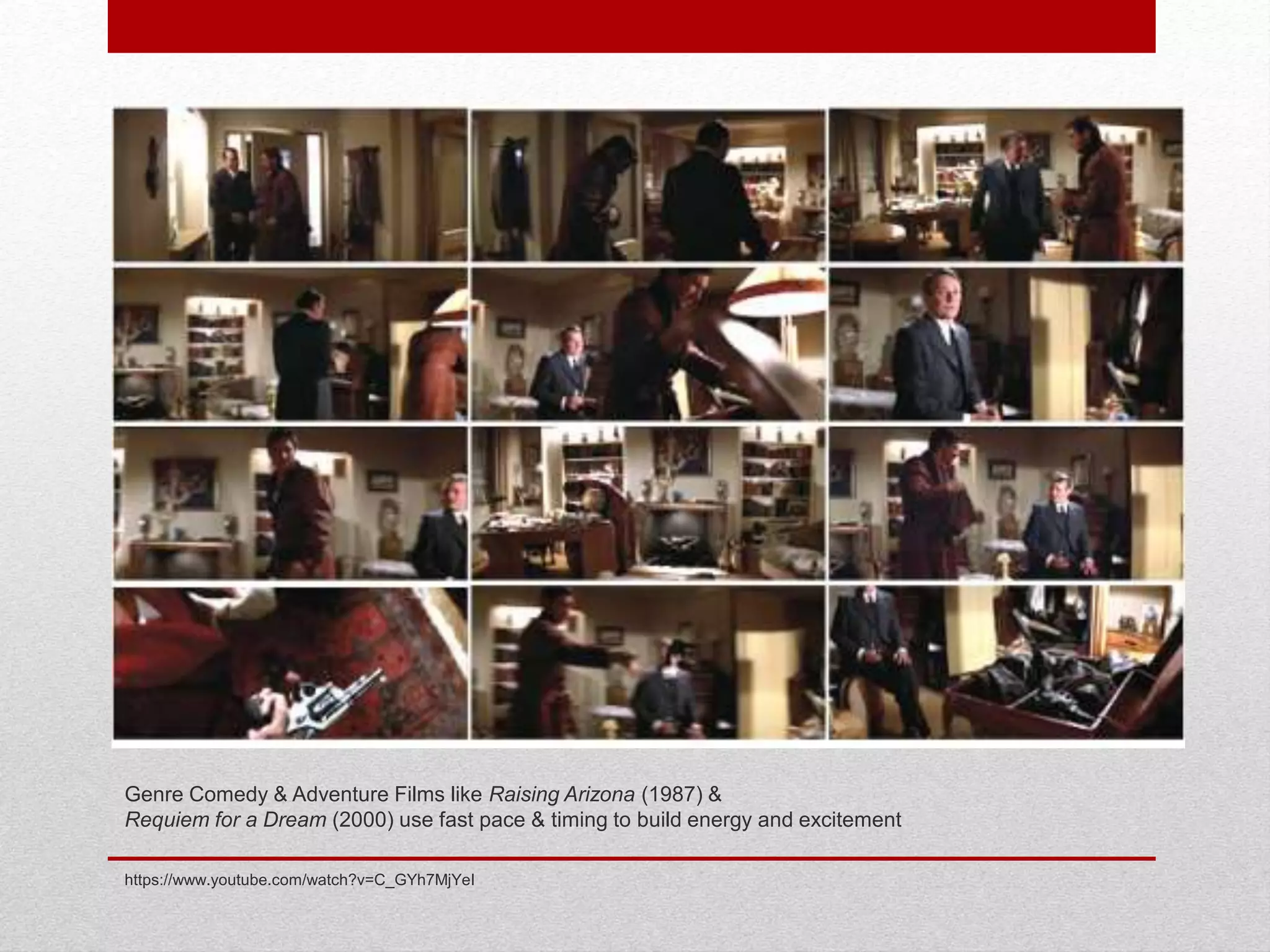
Genre Comedy & Adventure Films like Raising Arizona (1987) &
Requiem for a Dream (2000) use fast pace & timing to build energy and excitement
https://www.youtube.com/watch?v=C_GYh7MjYeI
Rhythm
We know when it does not have rhythm (jerky shots, or we notice the
editing). When the rhythm works, the edit seems smooth. Rhythm is often
individual and intuitive, but there are some rules,
The amount of visual information can determine length of shot:
• A long shot has more information than CU, so will be held longer so
audience can take it in;
• If there is new information (location) the shot might be held longer
• Moving shots are often held longer in order to absorb information
• A CU, static shot or repeated shot is often on screen for less time.
Finding emotional clarity in the scene:
• Respecting emotional structure of performances;
• Distinguish performance from error, or dead space;
• Understanding the narrative goals of the scene.
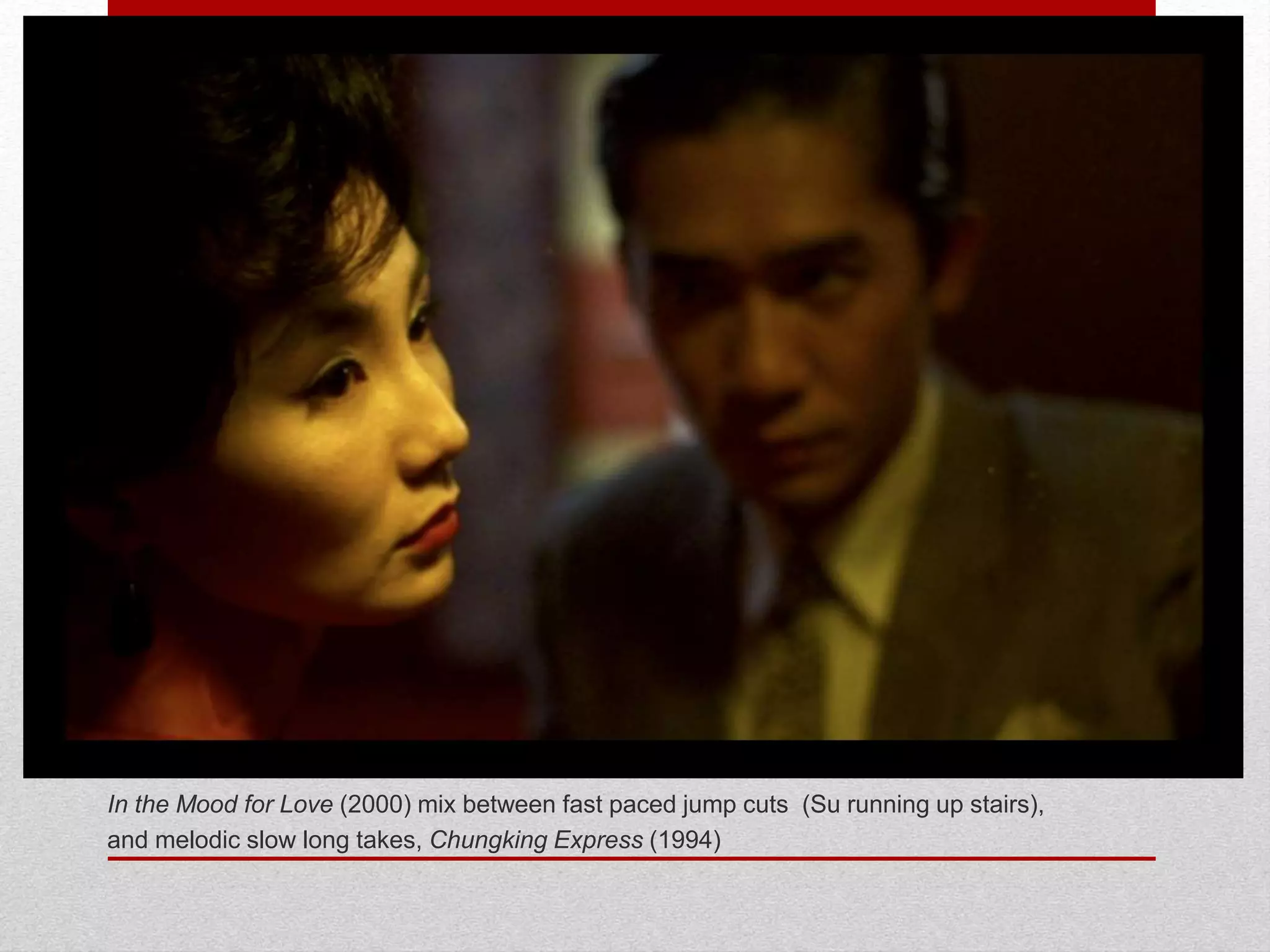
In the Mood for Love (2000) mix between fast paced jump cuts (Su running up stairs),
and melodic slow long takes, Chungking Express (1994)
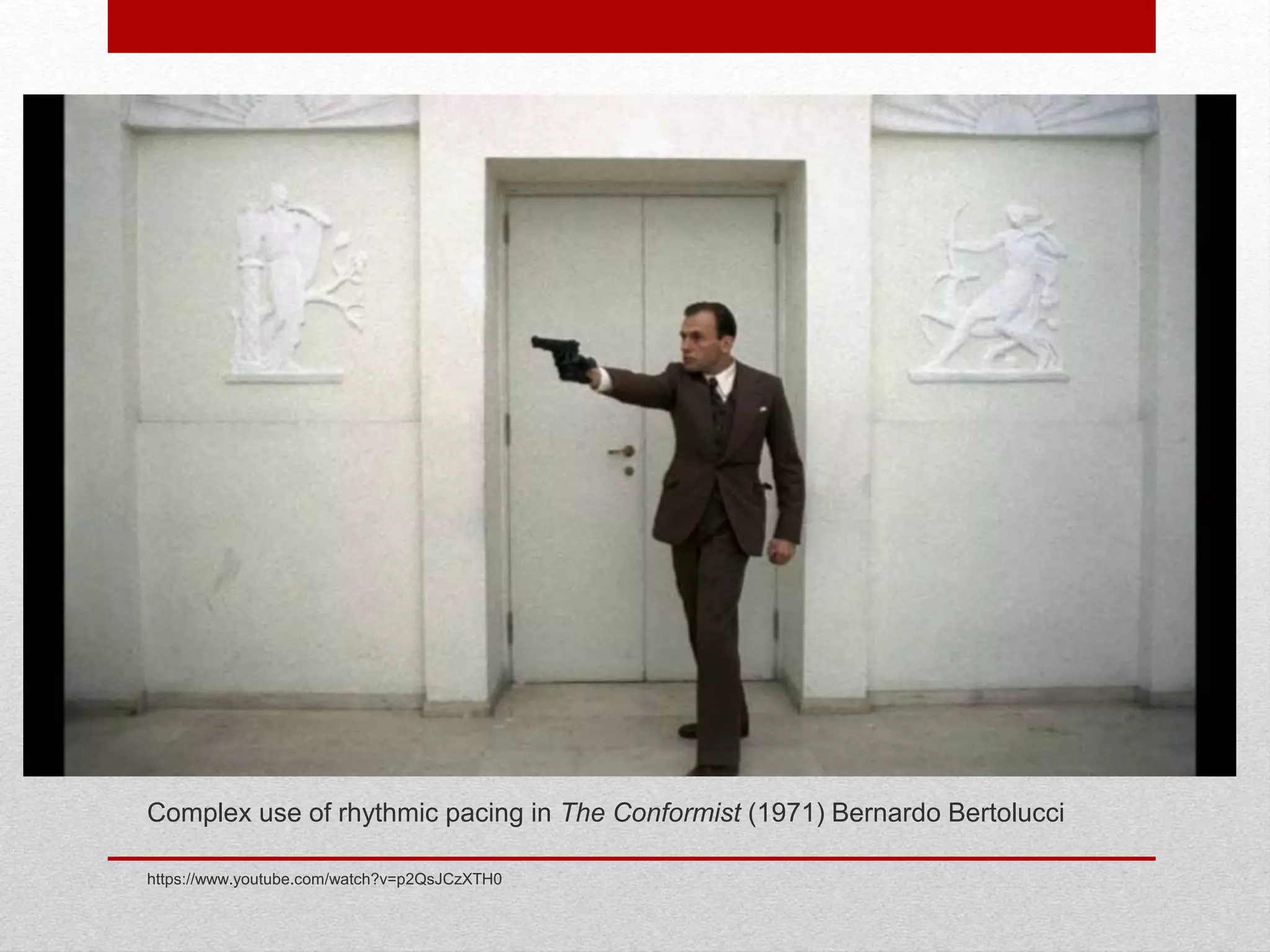
Complex use of rhythmic pacing in The Conformist (1971) Bernardo Bertolucci
https://www.youtube.com/watch?v=p2QsJCzXTH0
Why do cuts Work?
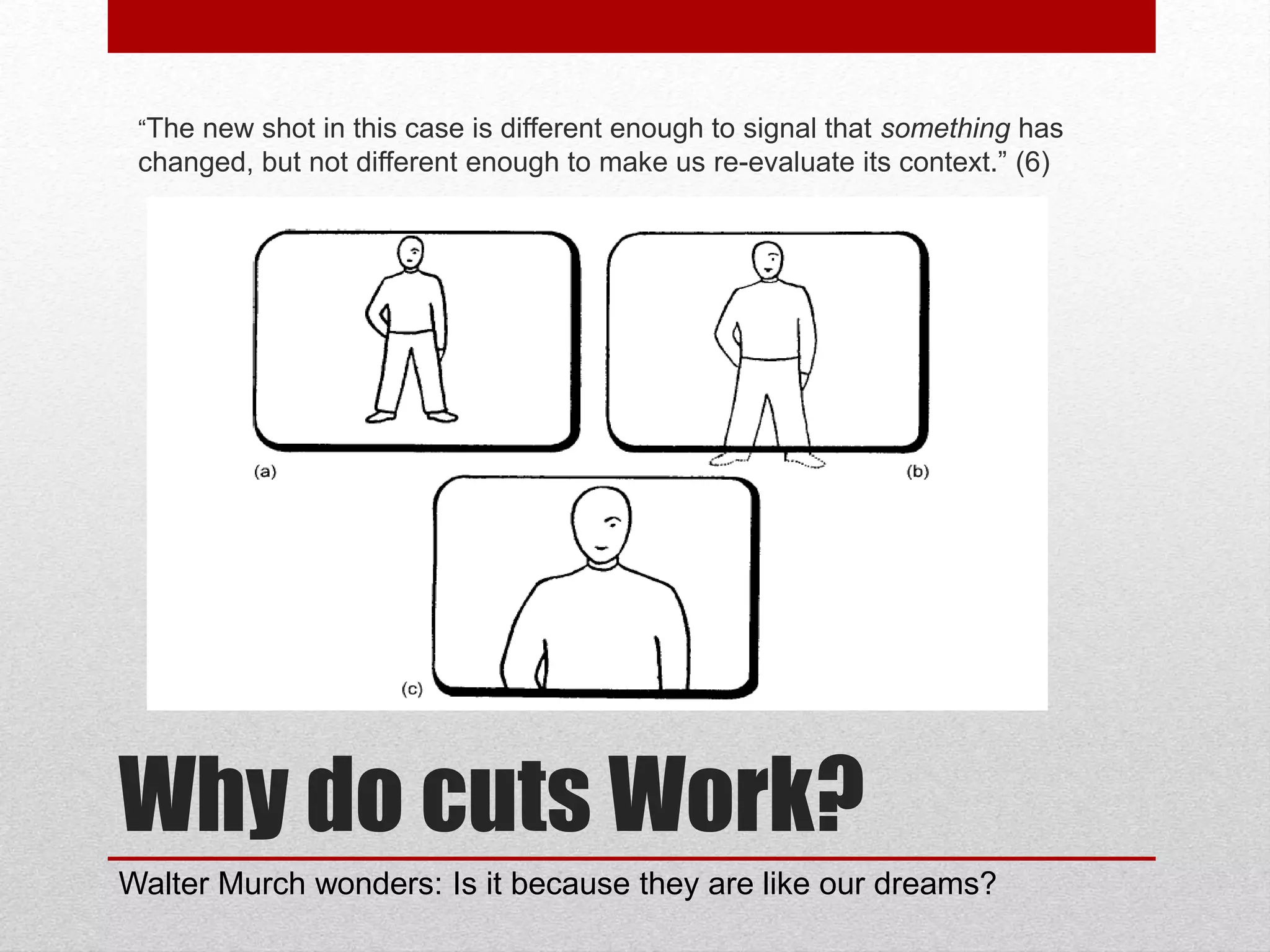
“The new shot in this case is different enough to signal that something has
changed, but not different enough to make us re-evaluate its context.” (6)
Walter Murch wonders: Is it because they are like our dreams?
In the blink of an eye
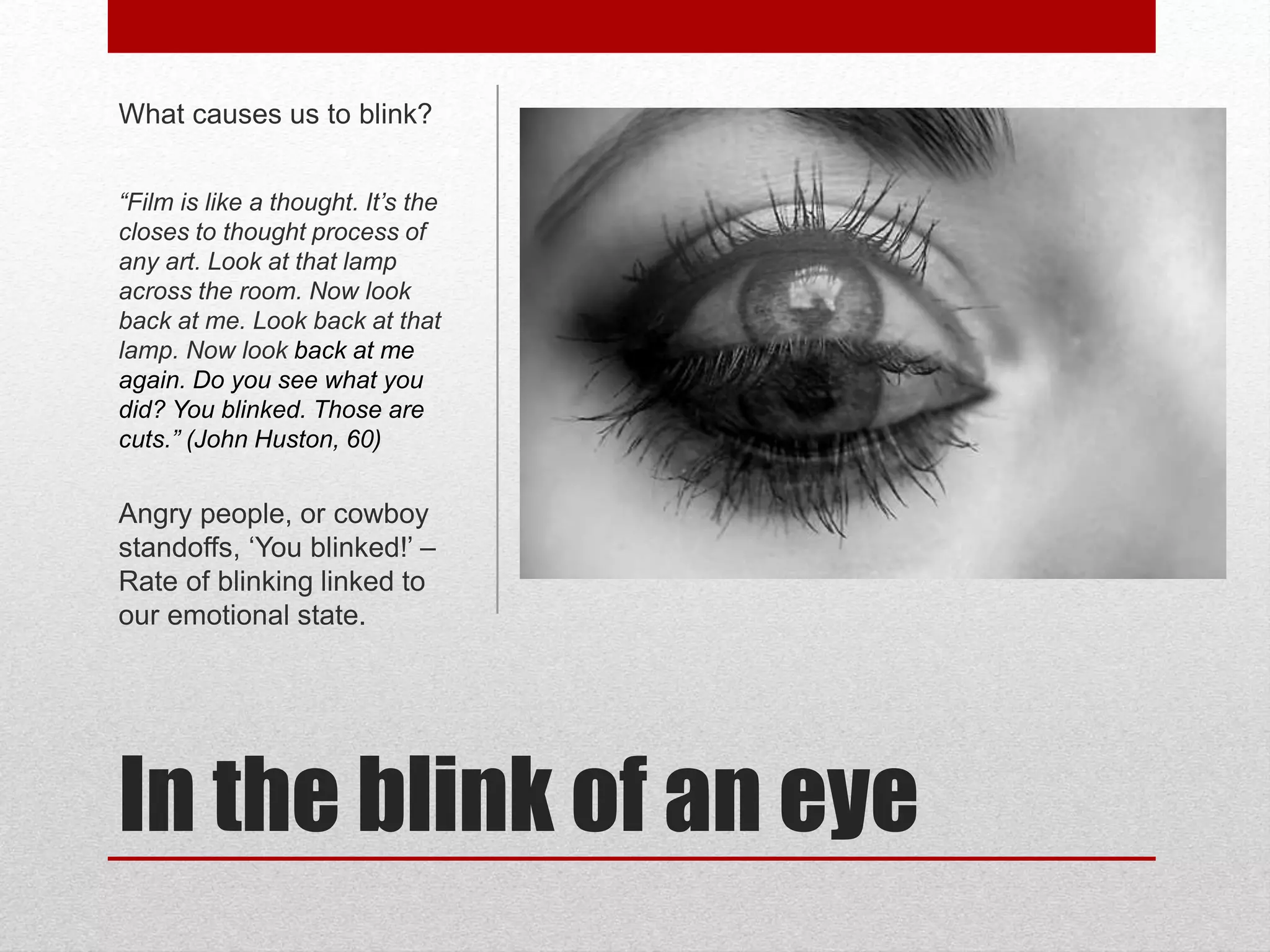
What causes us to blink?
“Film is like a thought. It’s the
closes to thought process of
any art. Look at that lamp
across the room. Now look
back at me. Look back at that
lamp. Now look back at me
again. Do you see what you
did? You blinked. Those are
cuts.” (John Huston, 60)
Angry people, or cowboy
standoffs, ‘You blinked!’ –
Rate of blinking linked to
our emotional state.
In the blink of an eye
“The blink is either
something that helps an
internal separation of
thought to take place, or it
is an involuntary reflex
accompanying the mental
separation that is taking
place anyway.”
“That blink will occur where
a cut could have
happened, had the
conversation been filmed.”
-Walter Murch
1. Identifying a series of potential cut points (and comparisons
with the blink can help you do this)
2. Determining what effect each cut point will have on the
audience, and
3. Choosing which of those effects is the correct one for the
film.
“I believe the sequence of thoughts – that is to say, the rhythm
and rate of cutting– should be appropriate to whatever the
audience is watching at the moment.”
“You are blinking for the audience…Your job is partly to
anticipate, partly to control the thought processes of the
audience… if you are too far behind or ahead of them, you create
problems, but if you are right with them, leading them ever so
slightly, the flow of events feels natural and exciting at the same
time”
The Conversation

The Art of Editing #6

  • 1.
    The Art ofEditing Rhythm, Pace, Emotion Shannon Walsh / SM2002 School of Creative Media, City University of Hong Kong
  • 2.
    The Art ofEditing Good editing makes the director look good. Great editing makes the film look like it wasn’t directed at all. -Victor Fleming
  • 3.
    “IN THE BLINK OFAN EYE” FOCUS ON EDITOR: WALTER MURCH
  • 4.
    Walter Murch: Therule of 6 1. Emotion: How will this cut affect the audience emotionally at this particular moment in the film? 2. Story: Does the edit move the story forward in a meaningful way? 3. Rhythm: Is the cut at a point that makes rhythmic sense? 4. Eye Trace: How does the cut effect the location and movement of the audience's focus in that particular film? 5. Two-Dimensional Plane of Screen: Is the axis followed properly? 6. Three-Dimensional Space - Is the cut true to established physical and spatial relationships?
  • 5.
    The Conversation The editingaims to tell an emotional story with a series of fragmented shots. “How do you want the audience to feel?”
  • 6.
    Pace & Rhythm Whatis Pace? • Variation in pace effects emotional response to film • Pacing is a tool for shaping rhythm in a film. • Fast pacing and Slow pacing can change the mood and feeling of the film. Limits of Pace In Touch of Evil (1958) Welles used one tracking shot to create a powerful sequence, without editing, showing how composition, lighting, performance also are critical. Similarly, Taiwanese direct TSAI Ming-Liang also uses long shots, often for entire scenes, such as in Stray Dogs (2013), what has been called a “cinema of slowness”
  • 7.
    Rhythm • To enhancetheir rhythmic intuition, editors actively perceive the rhythmic movement of life and of the world around them. • Walter Murch says a good editor has to have a sense of rhythm is “like telling a good joke” Walter Murch Clip on Rhythm: http://www.youtube.com/watch?v=WcBpXLNmS3Q
  • 8.
    Timing One element ofPace Timing: the duration or the length of time a shot is held. • Understanding the purpose of the sequence to decide how to edit for dramatic effective • A 10 second shot will feel long if it is juxtaposed with a series of 1- second shots. • The feeling of a shot’s duration is created by the relative duration of the shots near to it and the concentration of information, movement, and change within it. • “Where in a sequence should a particular close-up or cutaway be positioned for maximum impact? When is a subjective shot more powerful than a an objective one? What is the most effective patter of crosscutting between shots?”
  • 9.
    Genre Comedy &Adventure Films like Raising Arizona (1987) & Requiem for a Dream (2000) use fast pace & timing to build energy and excitement https://www.youtube.com/watch?v=C_GYh7MjYeI
  • 10.
    Rhythm We know whenit does not have rhythm (jerky shots, or we notice the editing). When the rhythm works, the edit seems smooth. Rhythm is often individual and intuitive, but there are some rules, The amount of visual information can determine length of shot: • A long shot has more information than CU, so will be held longer so audience can take it in; • If there is new information (location) the shot might be held longer • Moving shots are often held longer in order to absorb information • A CU, static shot or repeated shot is often on screen for less time. Finding emotional clarity in the scene: • Respecting emotional structure of performances; • Distinguish performance from error, or dead space; • Understanding the narrative goals of the scene.
  • 11.
    In the Moodfor Love (2000) mix between fast paced jump cuts (Su running up stairs), and melodic slow long takes, Chungking Express (1994)
  • 12.
    Complex use ofrhythmic pacing in The Conformist (1971) Bernardo Bertolucci https://www.youtube.com/watch?v=p2QsJCzXTH0
  • 13.
    Why do cutsWork? “The new shot in this case is different enough to signal that something has changed, but not different enough to make us re-evaluate its context.” (6) Walter Murch wonders: Is it because they are like our dreams?
  • 14.
    In the blinkof an eye What causes us to blink? “Film is like a thought. It’s the closes to thought process of any art. Look at that lamp across the room. Now look back at me. Look back at that lamp. Now look back at me again. Do you see what you did? You blinked. Those are cuts.” (John Huston, 60) Angry people, or cowboy standoffs, ‘You blinked!’ – Rate of blinking linked to our emotional state.
  • 15.
    In the blinkof an eye “The blink is either something that helps an internal separation of thought to take place, or it is an involuntary reflex accompanying the mental separation that is taking place anyway.” “That blink will occur where a cut could have happened, had the conversation been filmed.”
  • 16.
    -Walter Murch 1. Identifyinga series of potential cut points (and comparisons with the blink can help you do this) 2. Determining what effect each cut point will have on the audience, and 3. Choosing which of those effects is the correct one for the film. “I believe the sequence of thoughts – that is to say, the rhythm and rate of cutting– should be appropriate to whatever the audience is watching at the moment.” “You are blinking for the audience…Your job is partly to anticipate, partly to control the thought processes of the audience… if you are too far behind or ahead of them, you create problems, but if you are right with them, leading them ever so slightly, the flow of events feels natural and exciting at the same time”
  • 17.

Editor's Notes

  • #8 7 min
  • #10 Instead of an uninteresting scene with much exposition to unload, in this single shot we’re given a snappy, dynamically blocked (lots of to-and-away from camera), short dialogue scene packed with info, which behaves exactly as a good oner should.  We get wide shots, CUs, singles, OTSs (over the shoulder), 2 shots, dramatic pans & push-ins, and, of course, one well-placed insert shot https://www.youtube.com/watch?v=mkYNhZvlHv0
  • #13 https://www.youtube.com/watch?v=p2QsJCzXTH0