
1
Department of Pharmacology BVVS COP BGK
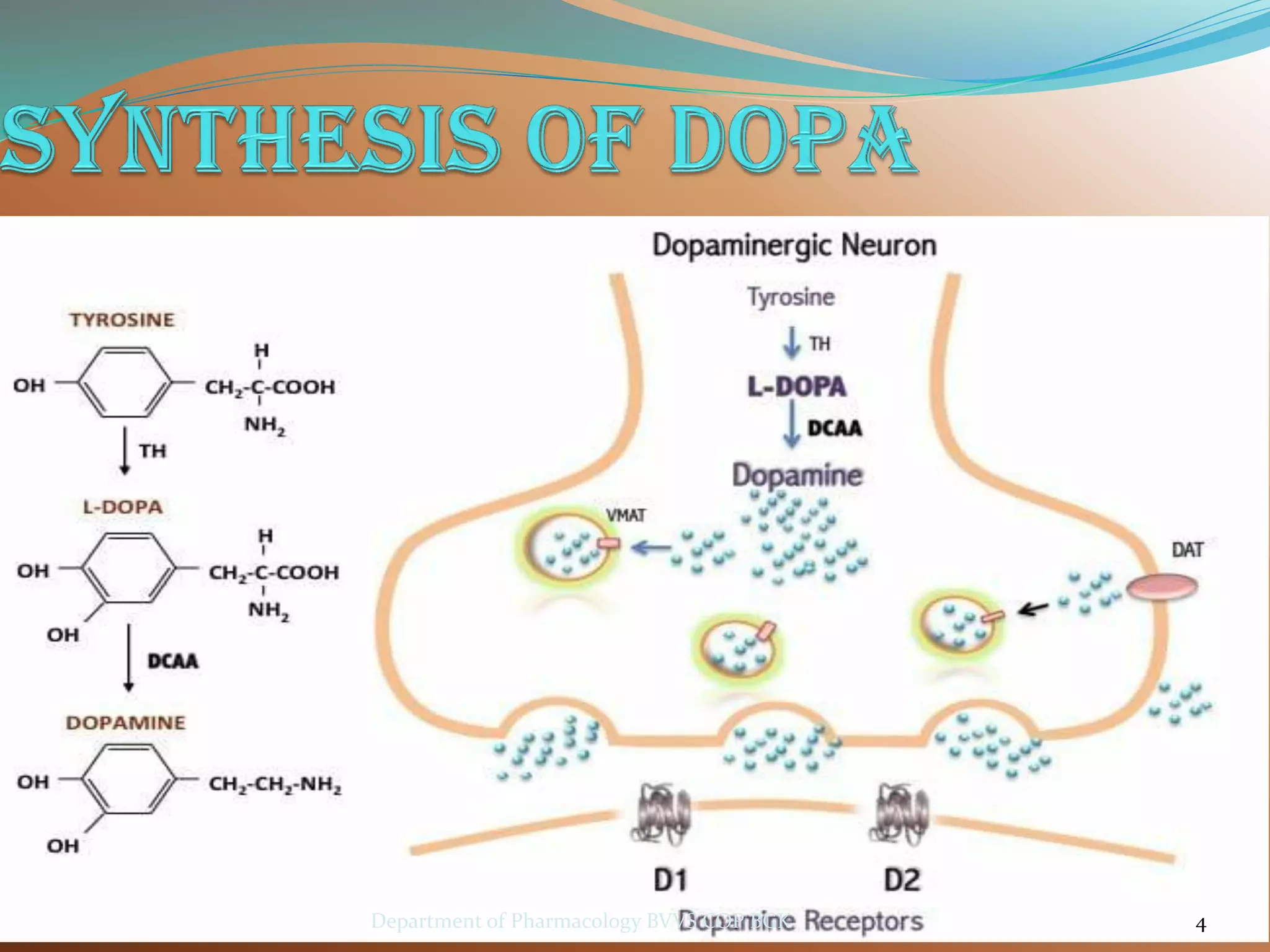
➢Dopamine is an endogenous catecholamine that serve as both
a neurotransmitter and precursor of nor-epinephrine synthesis.
➢When given as an exogenous drug dopamine activates a
variety of receptors in dose dependent manner.
➢ Regulates cardiac, vascular and endocrine function.
2
Department of Pharmacology BVVS COP BGK
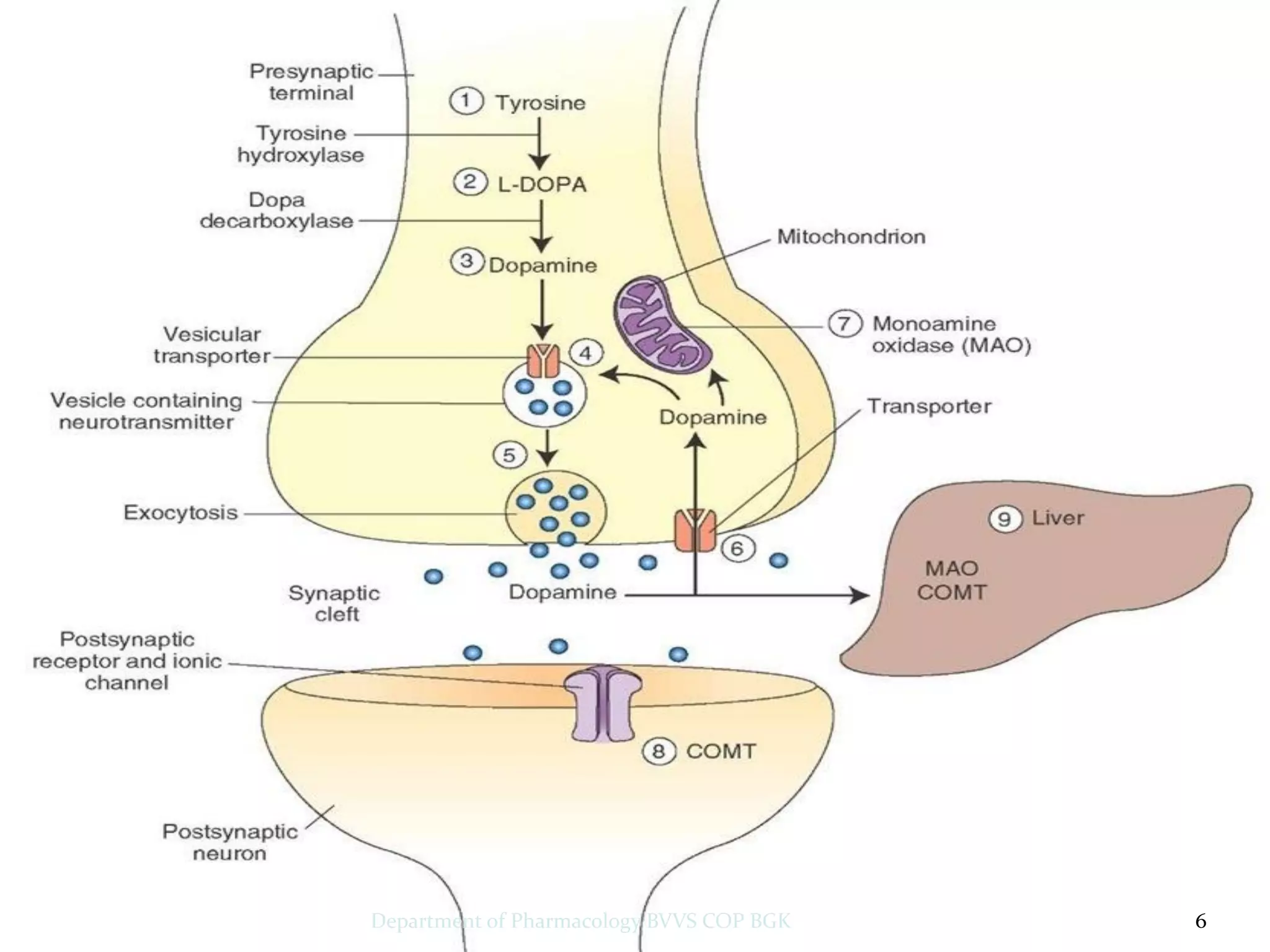
➢Dopamine is produced in dopaminergic neurons in the (VTA)
Ventral tegmental area of substantia nigra, midbrain & the
arcuate nucleus of the hypothalamus.
➢ In the periphery dopamine is found in the kidney where its
function to produce renal vasodilatation, diuressis & natriuresis
(excretion of Na in urine).
3
Department of Pharmacology BVVS COP BGK
4
Department of Pharmacology BVVS COP BGK
5
Department of Pharmacology BVVS COP BGK
6
Department of Pharmacology BVVS COP BGK
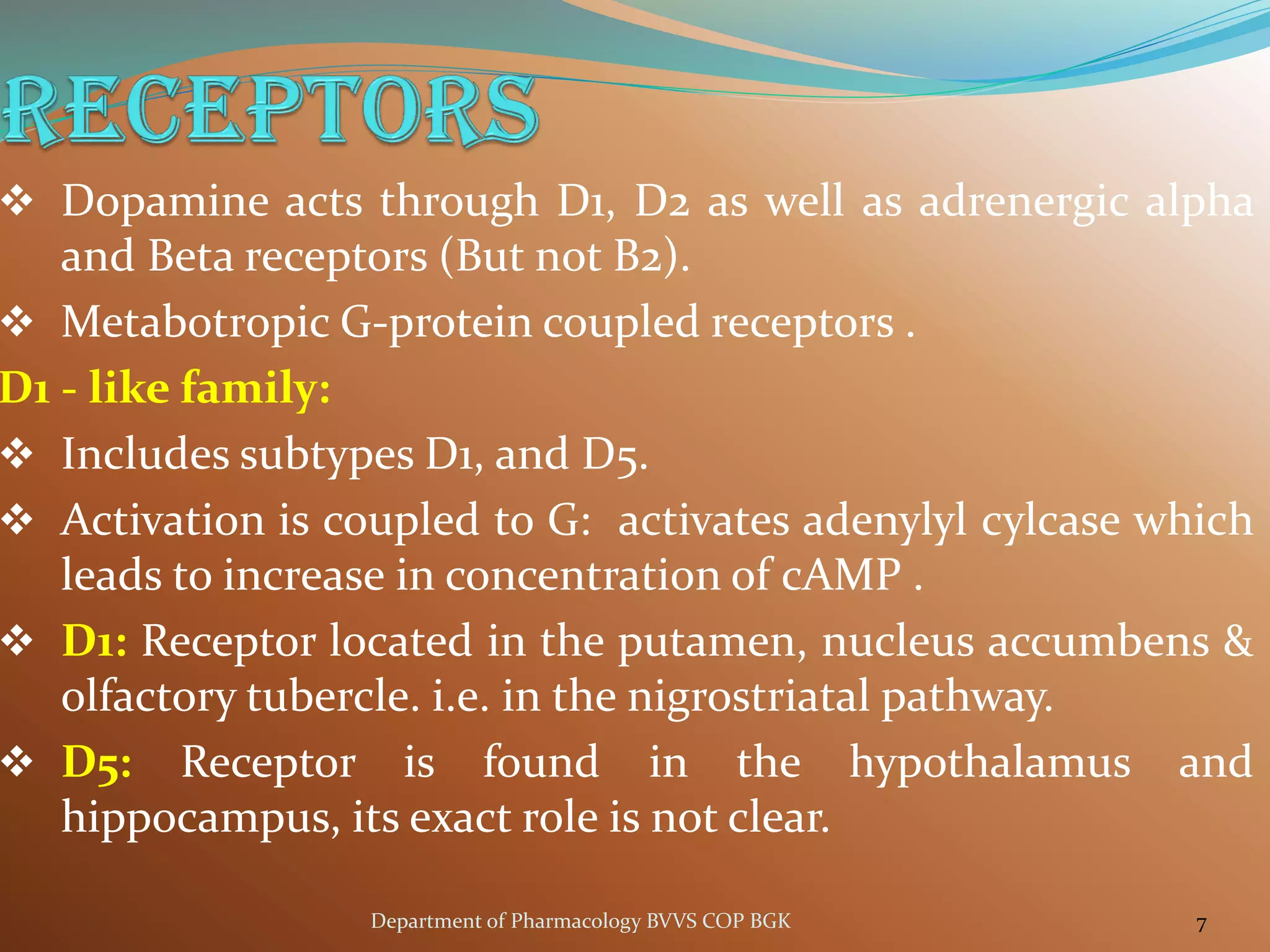
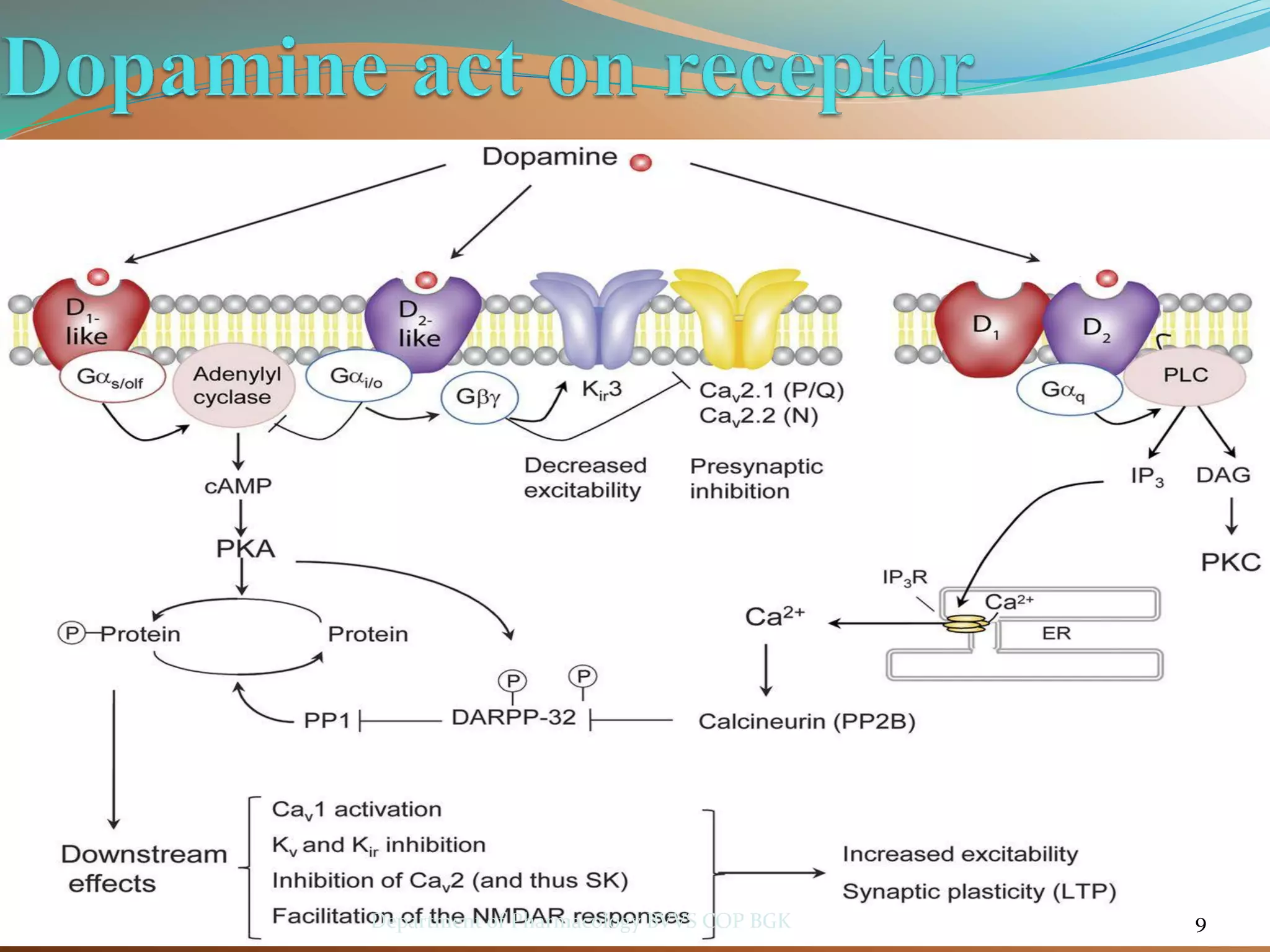
❖ Dopamine acts through D1, D2 as well as adrenergic alpha
and Beta receptors (But not B2).
❖ Metabotropic G-protein coupled receptors .
D1 - like family:
❖ Includes subtypes D1, and D5.
❖ Activation is coupled to G: activates adenylyl cylcase which
leads to increase in concentration of cAMP .
❖ D1: Receptor located in the putamen, nucleus accumbens &
olfactory tubercle. i.e. in the nigrostriatal pathway.
❖ D5: Receptor is found in the hypothalamus and
hippocampus, its exact role is not clear.
7
Department of Pharmacology BVVS COP BGK
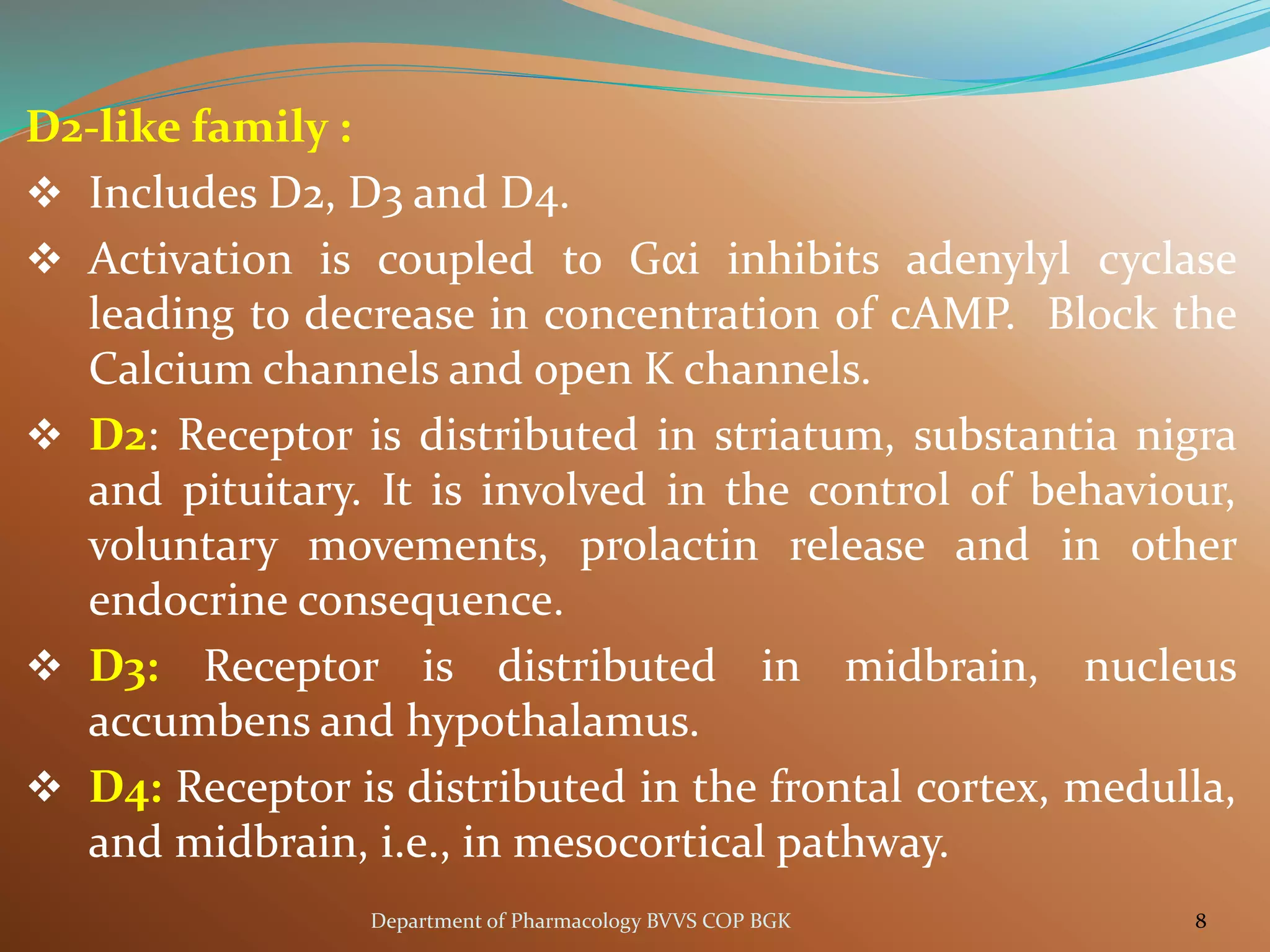
D2-like family :
❖ Includes D2, D3 and D4.
❖ Activation is coupled to Gαi inhibits adenylyl cyclase
leading to decrease in concentration of cAMP. Block the
Calcium channels and open K channels.
❖ D2: Receptor is distributed in striatum, substantia nigra
and pituitary. It is involved in the control of behaviour,
voluntary movements, prolactin release and in other
endocrine consequence.
❖ D3: Receptor is distributed in midbrain, nucleus
accumbens and hypothalamus.
❖ D4: Receptor is distributed in the frontal cortex, medulla,
and midbrain, i.e., in mesocortical pathway.
8
Department of Pharmacology BVVS COP BGK
9
Department of Pharmacology BVVS COP BGK
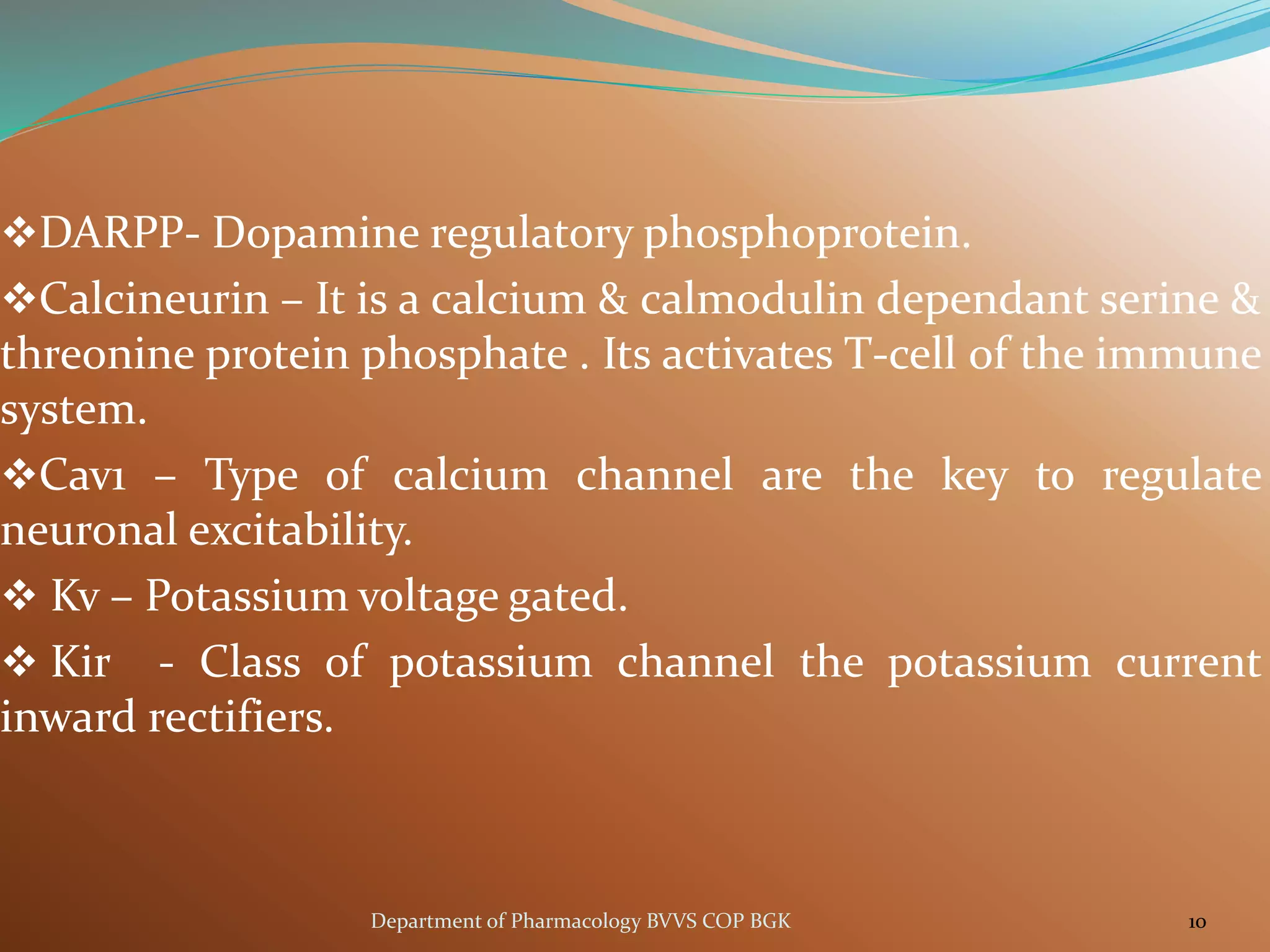
❖DARPP- Dopamine regulatory phosphoprotein.
❖Calcineurin – It is a calcium & calmodulin dependant serine &
threonine protein phosphate . Its activates T-cell of the immune
system.
❖Cav1 – Type of calcium channel are the key to regulate
neuronal excitability.
❖ Kv – Potassium voltage gated.
❖ Kir - Class of potassium channel the potassium current
inward rectifiers.
10
Department of Pharmacology BVVS COP BGK
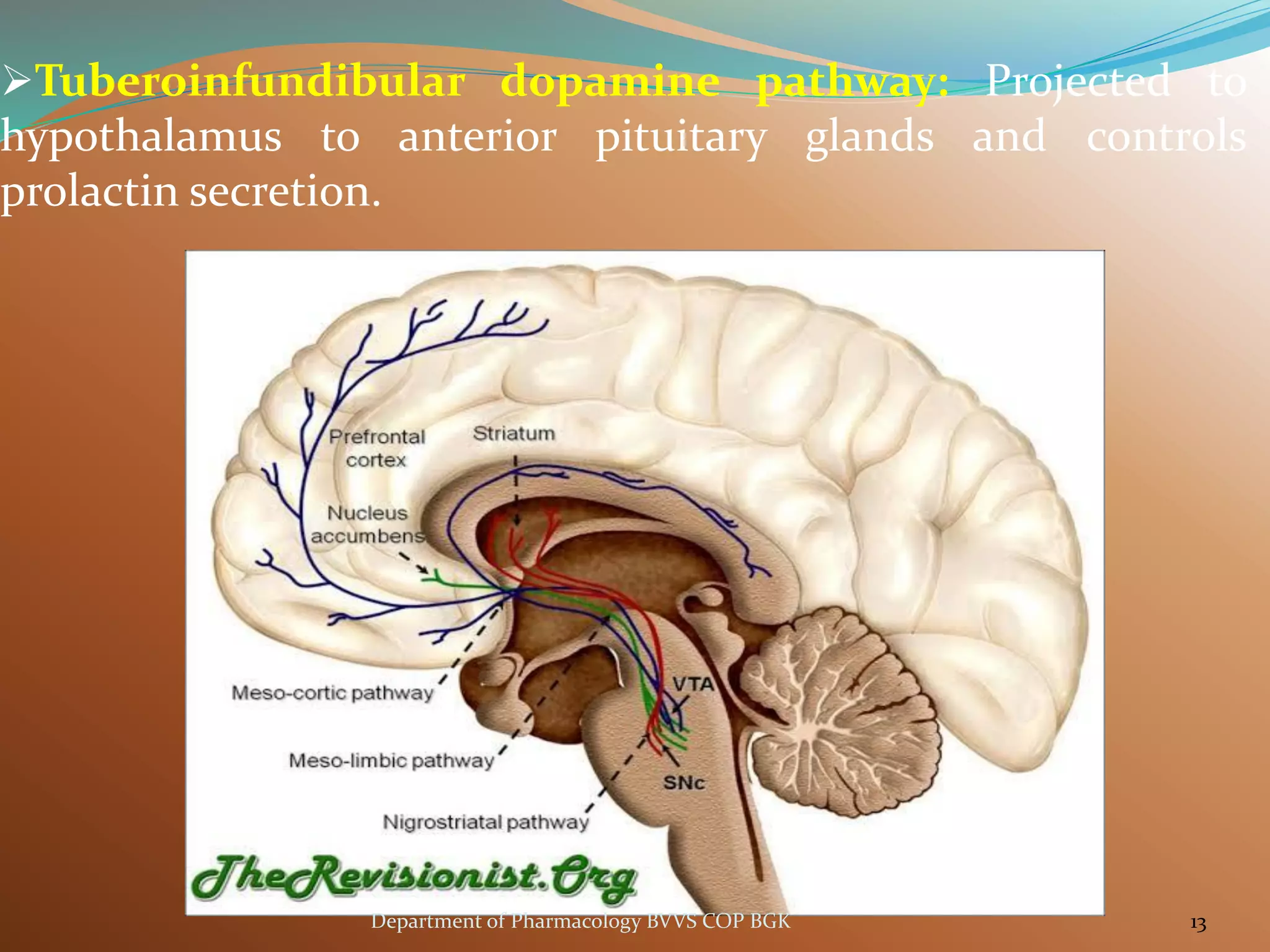
❑ Mesolimbic pathway
❑ Mesocortical pathway
❑ Nigrostrital pathway
❑ Tuberoinfundibular pathway
11
Department of Pharmacology BVVS COP BGK
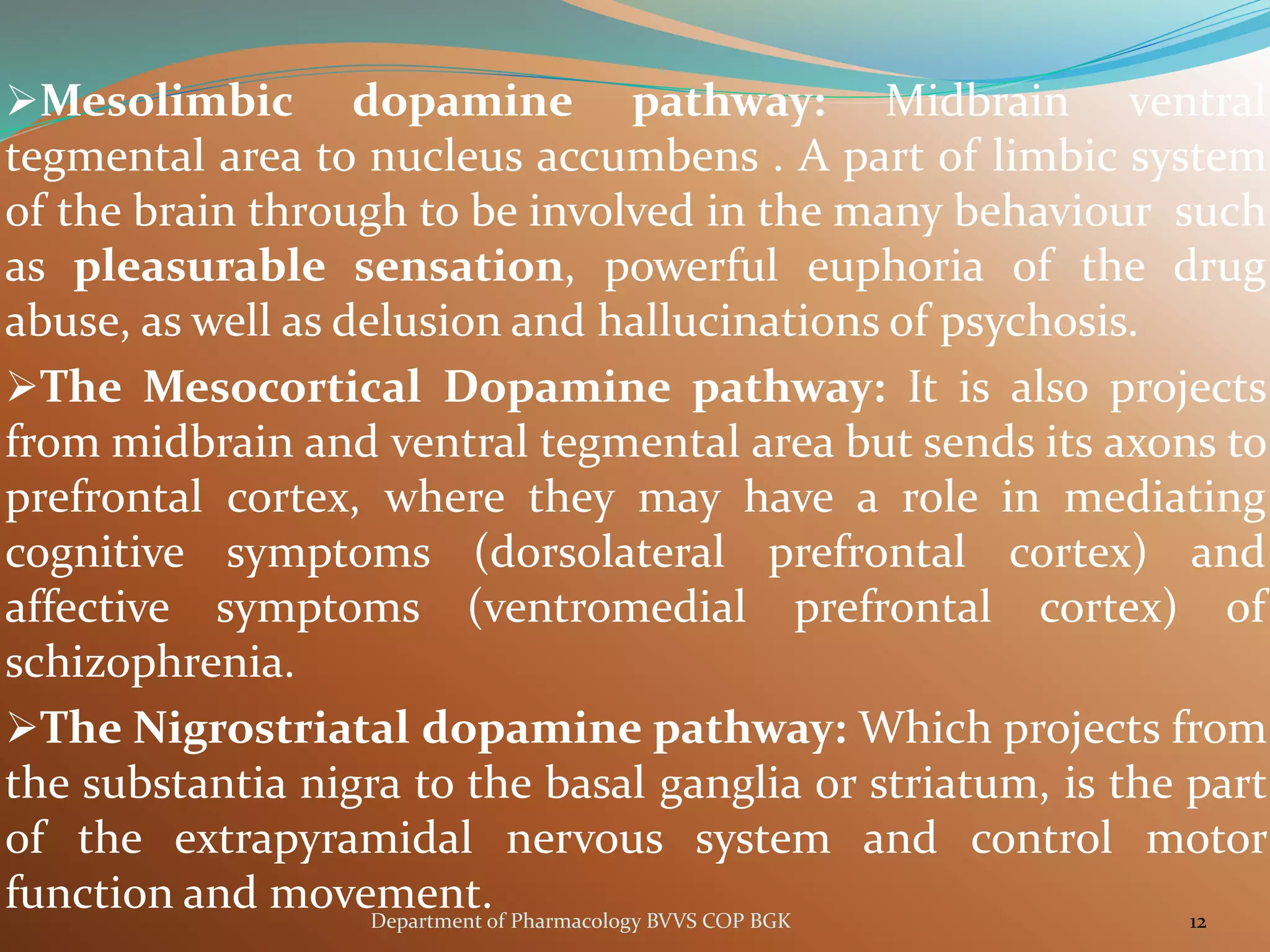
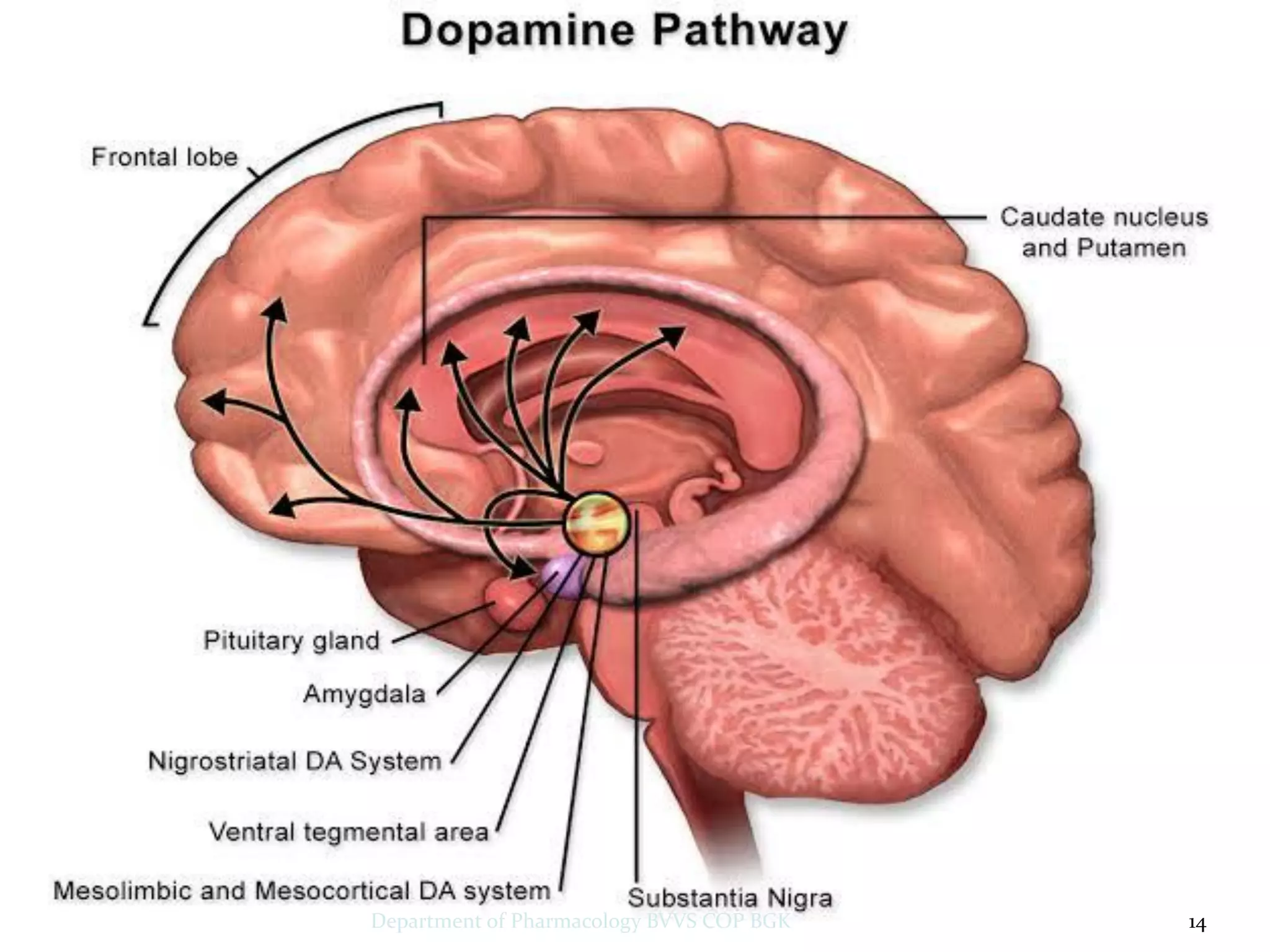
➢Mesolimbic dopamine pathway: Midbrain ventral
tegmental area to nucleus accumbens . A part of limbic system
of the brain through to be involved in the many behaviour such
as pleasurable sensation, powerful euphoria of the drug
abuse, as well as delusion and hallucinations of psychosis.
➢The Mesocortical Dopamine pathway: It is also projects
from midbrain and ventral tegmental area but sends its axons to
prefrontal cortex, where they may have a role in mediating
cognitive symptoms (dorsolateral prefrontal cortex) and
affective symptoms (ventromedial prefrontal cortex) of
schizophrenia.
➢The Nigrostriatal dopamine pathway: Which projects from
the substantia nigra to the basal ganglia or striatum, is the part
of the extrapyramidal nervous system and control motor
function and movement. 12
Department of Pharmacology BVVS COP BGK
➢Tuberoinfundibular dopamine pathway: Projected to
hypothalamus to anterior pituitary glands and controls
prolactin secretion.
13
Department of Pharmacology BVVS COP BGK
14
Department of Pharmacology BVVS COP BGK
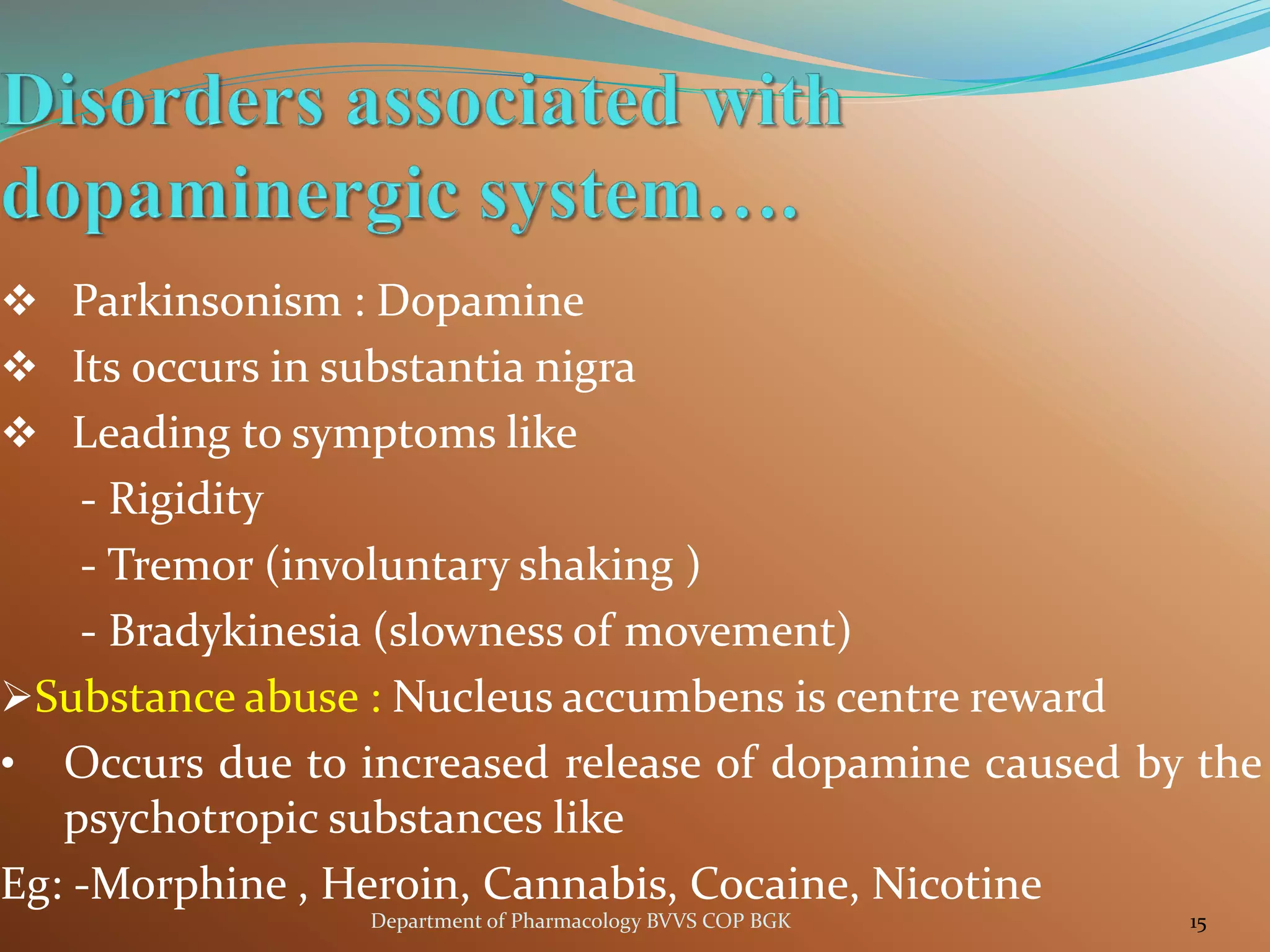
❖ Parkinsonism : Dopamine
❖ Its 0ccurs in substantia nigra
❖ Leading to symptoms like
- Rigidity
- Tremor (involuntary shaking )
- Bradykinesia (slowness of movement)
➢Substance abuse : Nucleus accumbens is centre reward
• Occurs due to increased release of dopamine caused by the
psychotropic substances like
Eg: -Morphine , Heroin, Cannabis, Cocaine, Nicotine
15
Department of Pharmacology BVVS COP BGK
16
Department of Pharmacology BVVS COP BGK
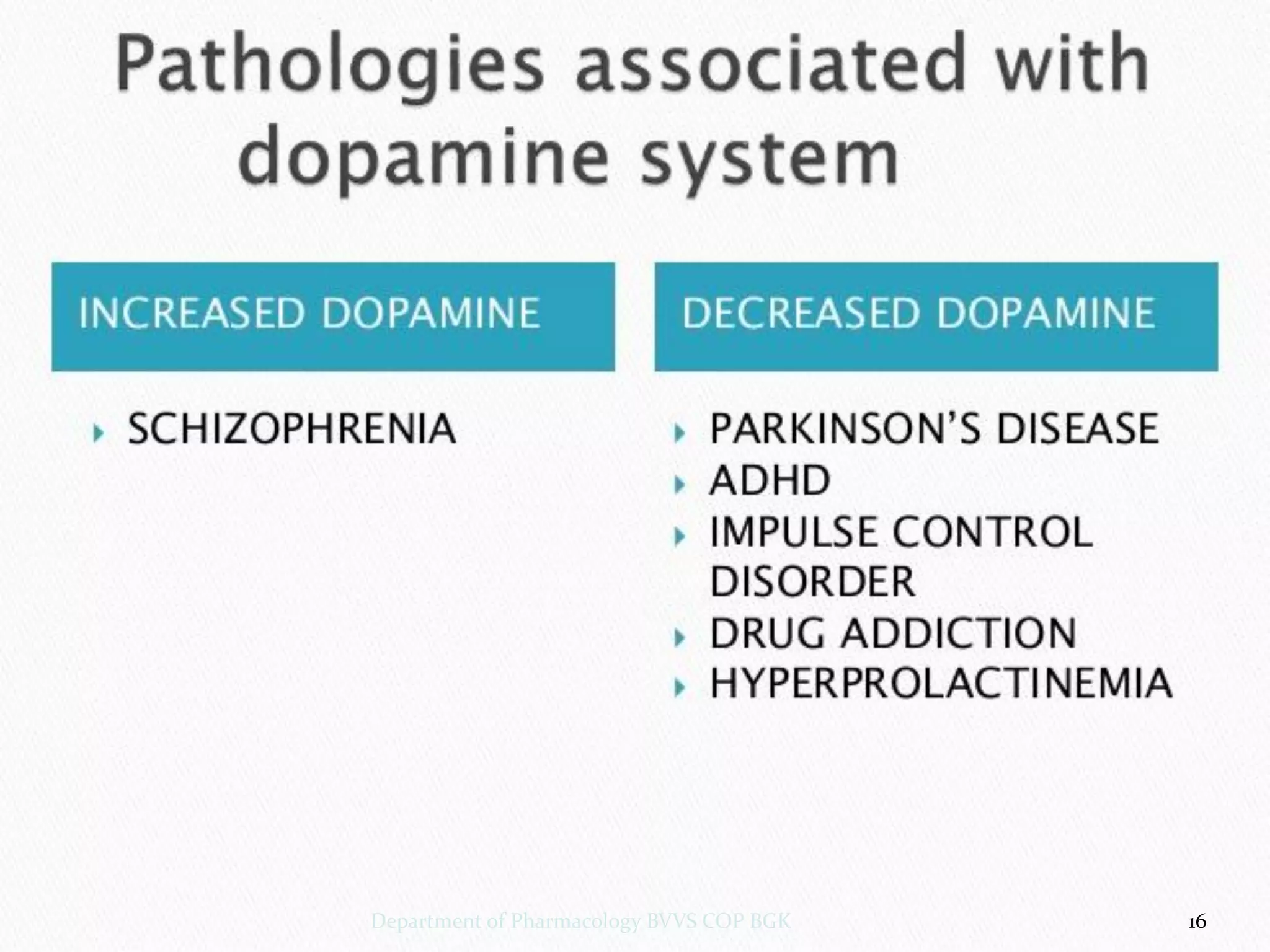
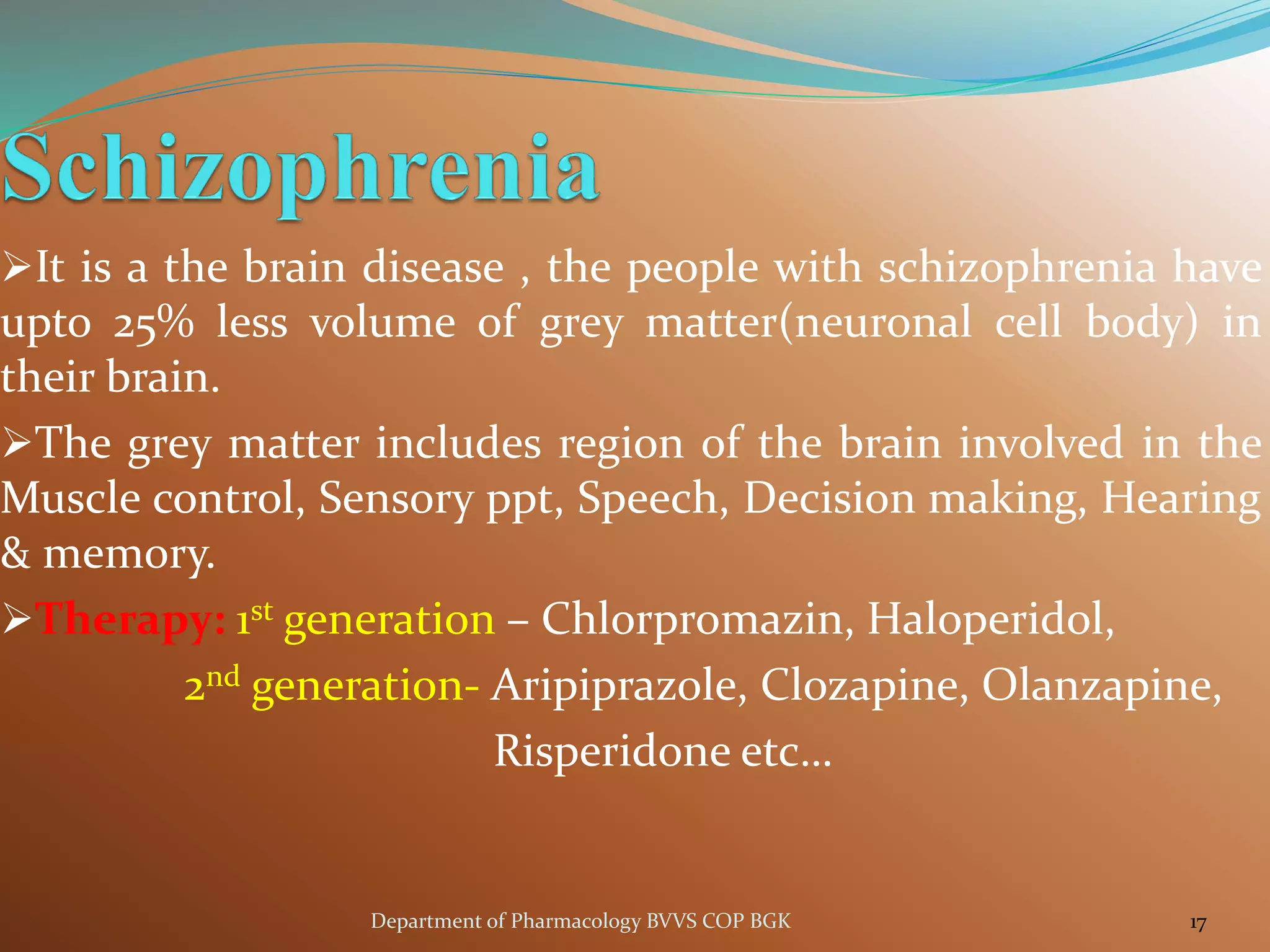
➢It is a the brain disease , the people with schizophrenia have
upto 25% less volume of grey matter(neuronal cell body) in
their brain.
➢The grey matter includes region of the brain involved in the
Muscle control, Sensory ppt, Speech, Decision making, Hearing
& memory.
➢Therapy: 1st generation – Chlorpromazin, Haloperidol,
2nd generation- Aripiprazole, Clozapine, Olanzapine,
Risperidone etc…
17
Department of Pharmacology BVVS COP BGK
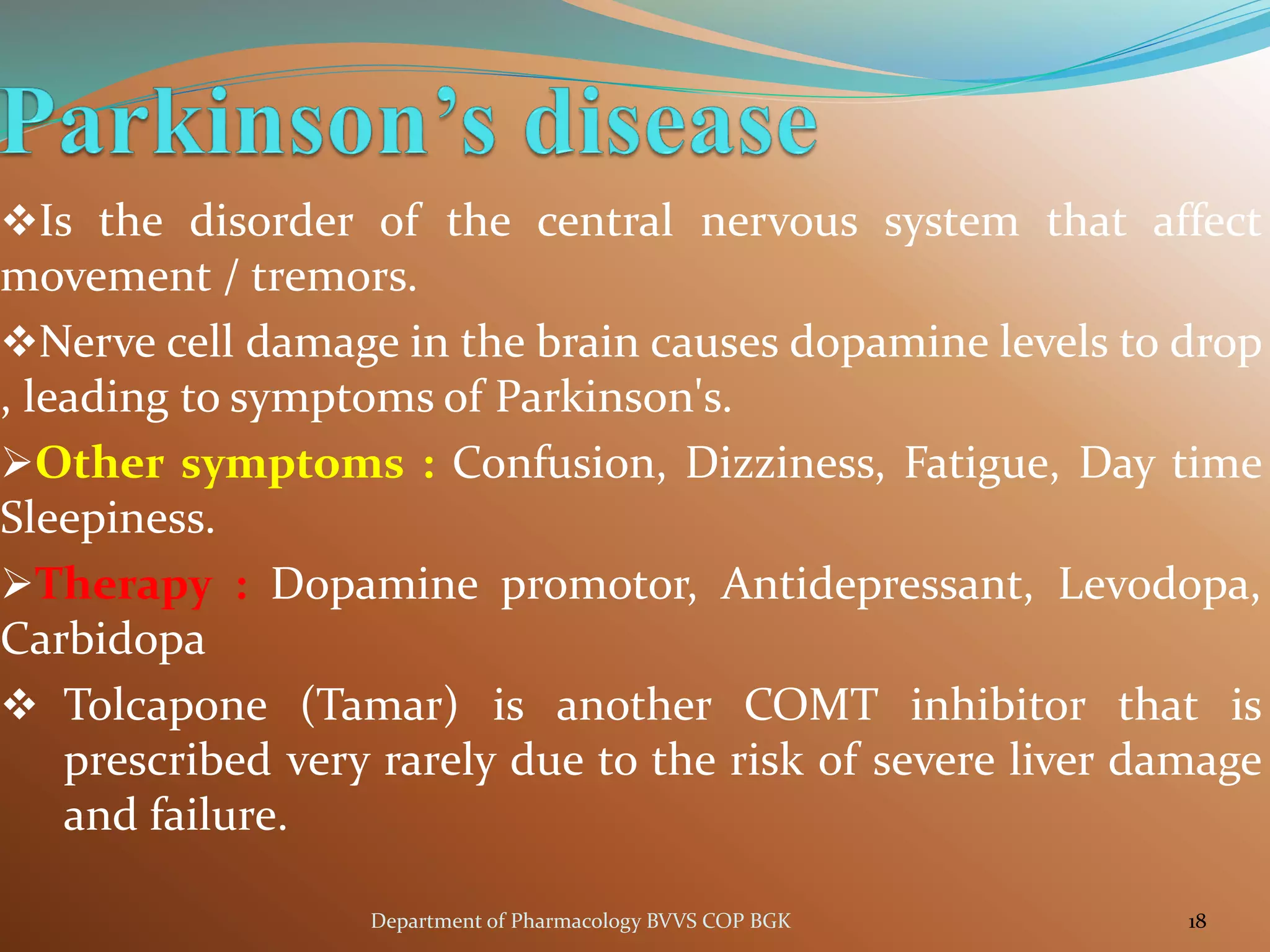
❖Is the disorder of the central nervous system that affect
movement / tremors.
❖Nerve cell damage in the brain causes dopamine levels to drop
, leading to symptoms of Parkinson's.
➢Other symptoms : Confusion, Dizziness, Fatigue, Day time
Sleepiness.
➢Therapy : Dopamine promotor, Antidepressant, Levodopa,
Carbidopa
❖ Tolcapone (Tamar) is another COMT inhibitor that is
prescribed very rarely due to the risk of severe liver damage
and failure.
18
Department of Pharmacology BVVS COP BGK
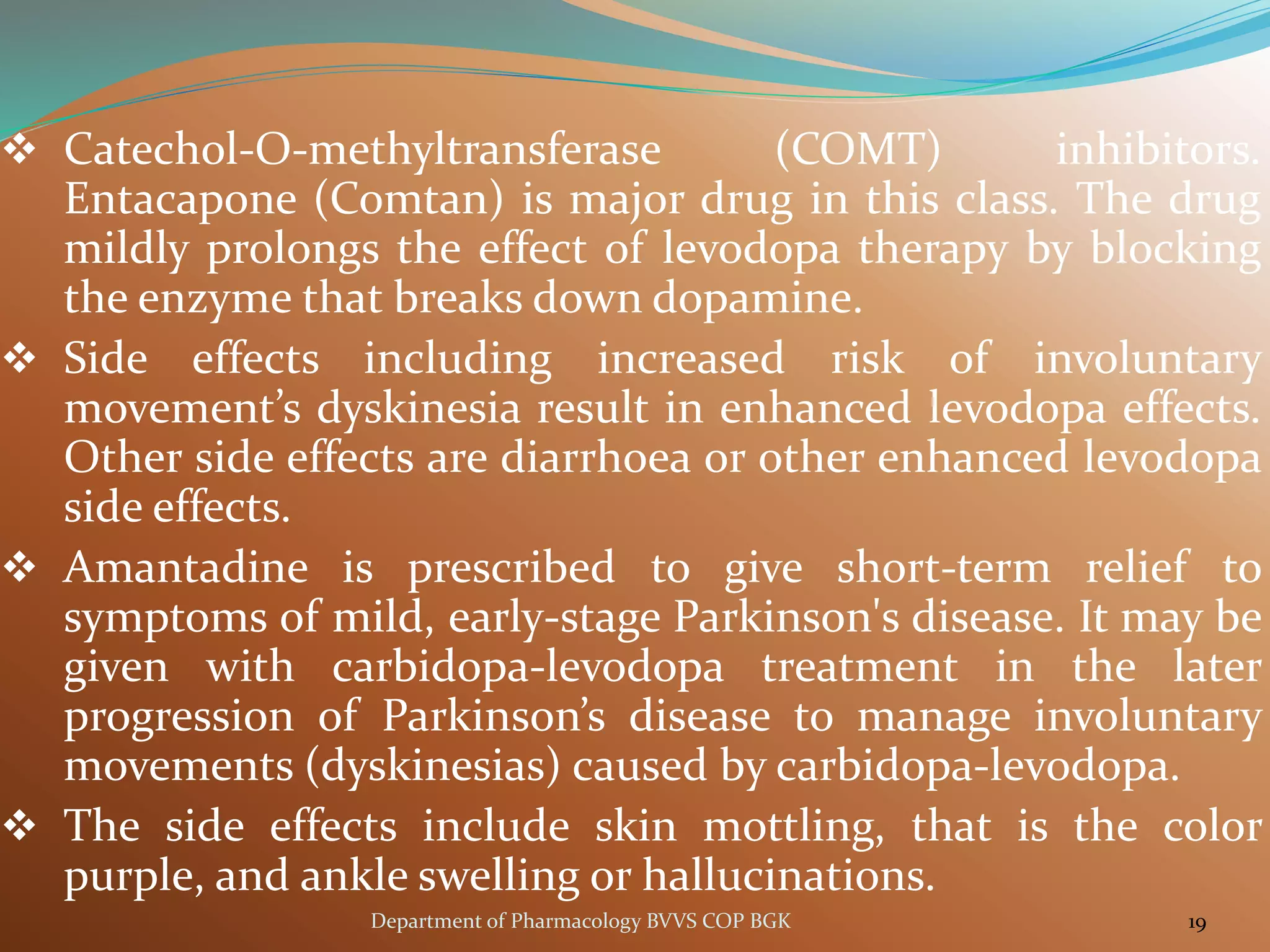
❖ Catechol-O-methyltransferase (COMT) inhibitors.
Entacapone (Comtan) is major drug in this class. The drug
mildly prolongs the effect of levodopa therapy by blocking
the enzyme that breaks down dopamine.
❖ Side effects including increased risk of involuntary
movement’s dyskinesia result in enhanced levodopa effects.
Other side effects are diarrhoea or other enhanced levodopa
side effects.
❖ Amantadine is prescribed to give short-term relief to
symptoms of mild, early-stage Parkinson's disease. It may be
given with carbidopa-levodopa treatment in the later
progression of Parkinson’s disease to manage involuntary
movements (dyskinesias) caused by carbidopa-levodopa.
❖ The side effects include skin mottling, that is the color
purple, and ankle swelling or hallucinations.
19
Department of Pharmacology BVVS COP BGK
GABA
20
Department of Pharmacology BVVS COP BGK
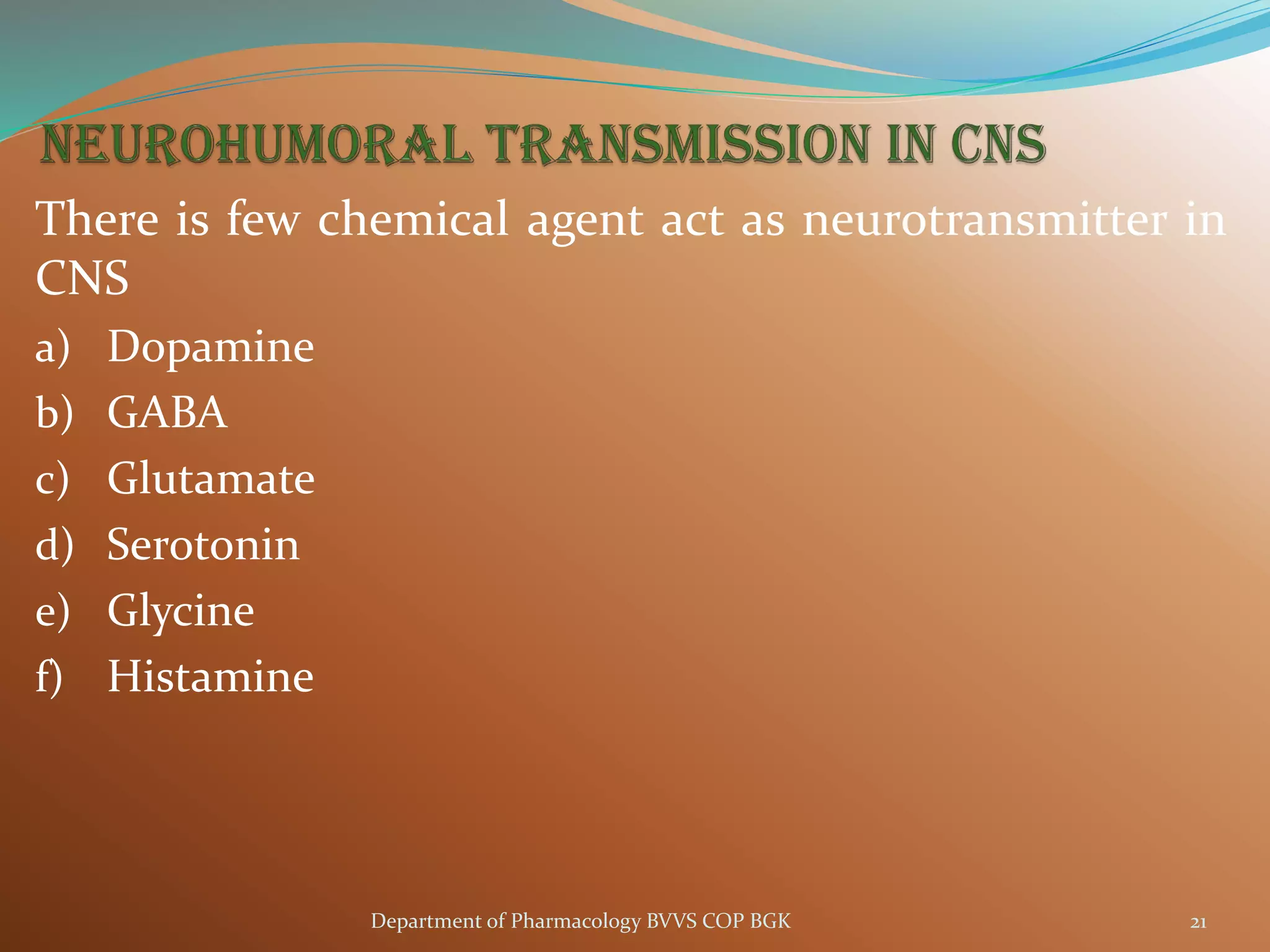
There is few chemical agent act as neurotransmitter in
CNS
a) Dopamine
b) GABA
c) Glutamate
d) Serotonin
e) Glycine
f) Histamine
21
Department of Pharmacology BVVS COP BGK
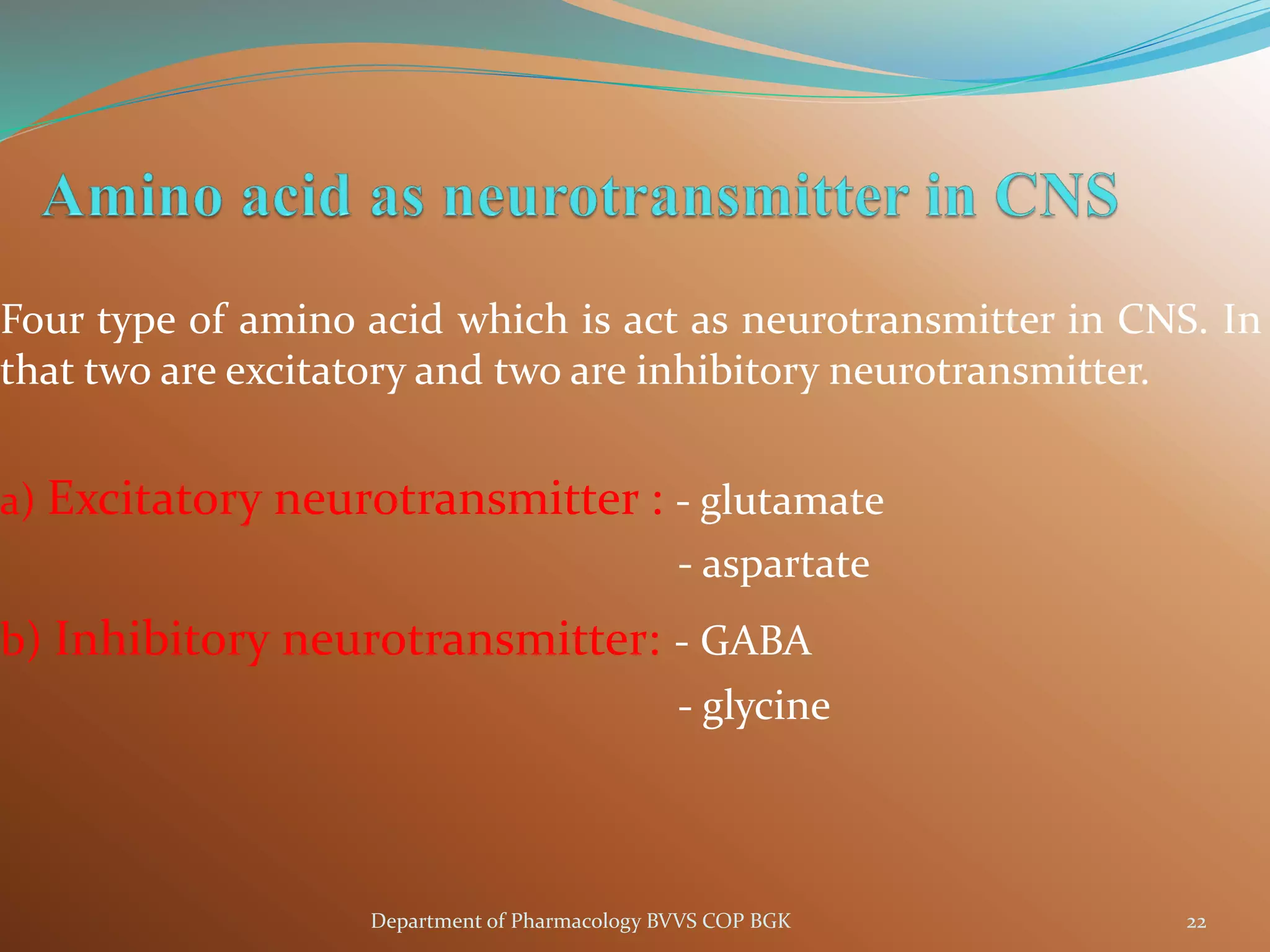
Four type of amino acid which is act as neurotransmitter in CNS. In
that two are excitatory and two are inhibitory neurotransmitter.
a) Excitatory neurotransmitter : - glutamate
- aspartate
b) Inhibitory neurotransmitter: - GABA
- glycine
22
Department of Pharmacology BVVS COP BGK
Synthesis :
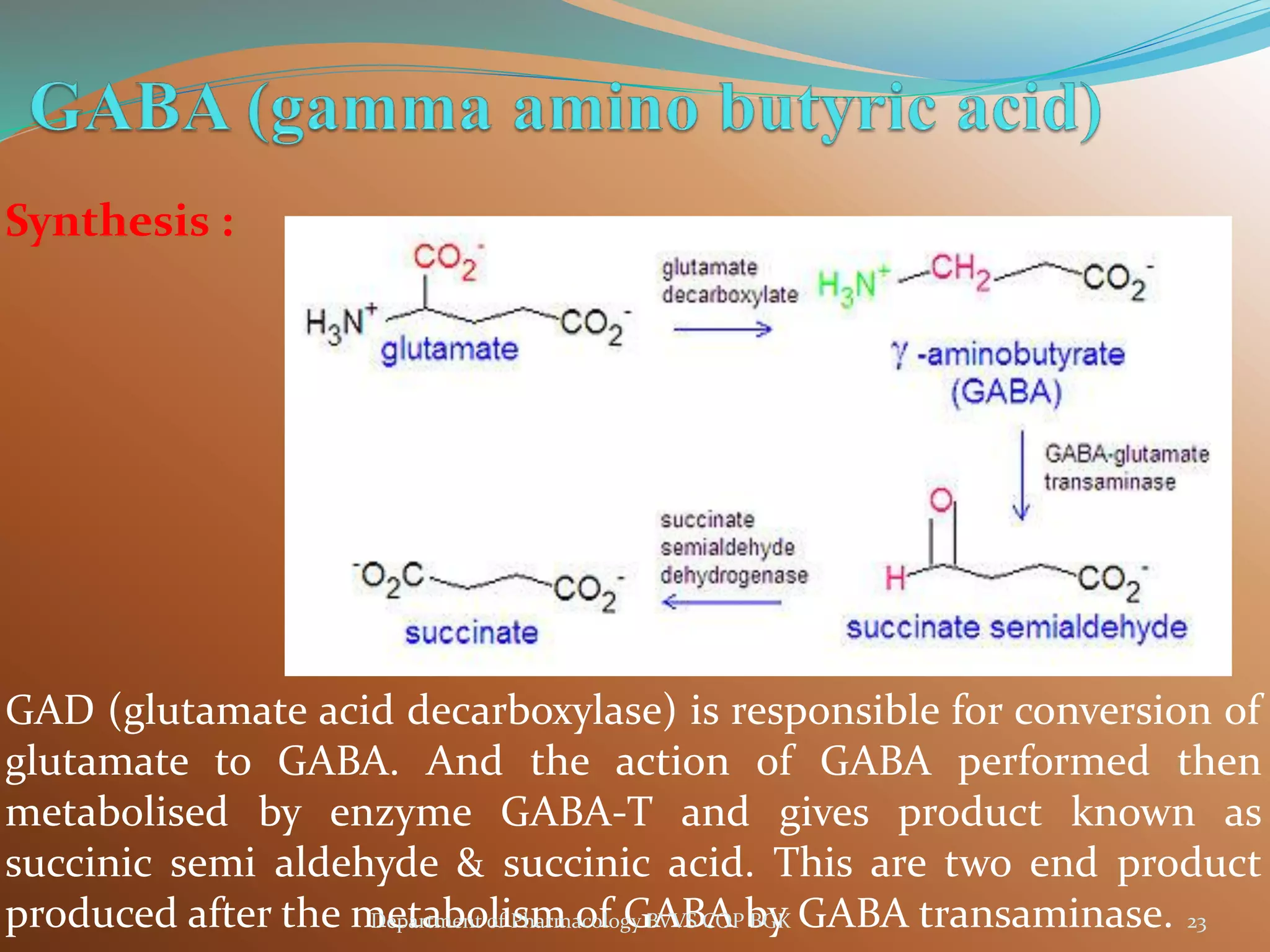
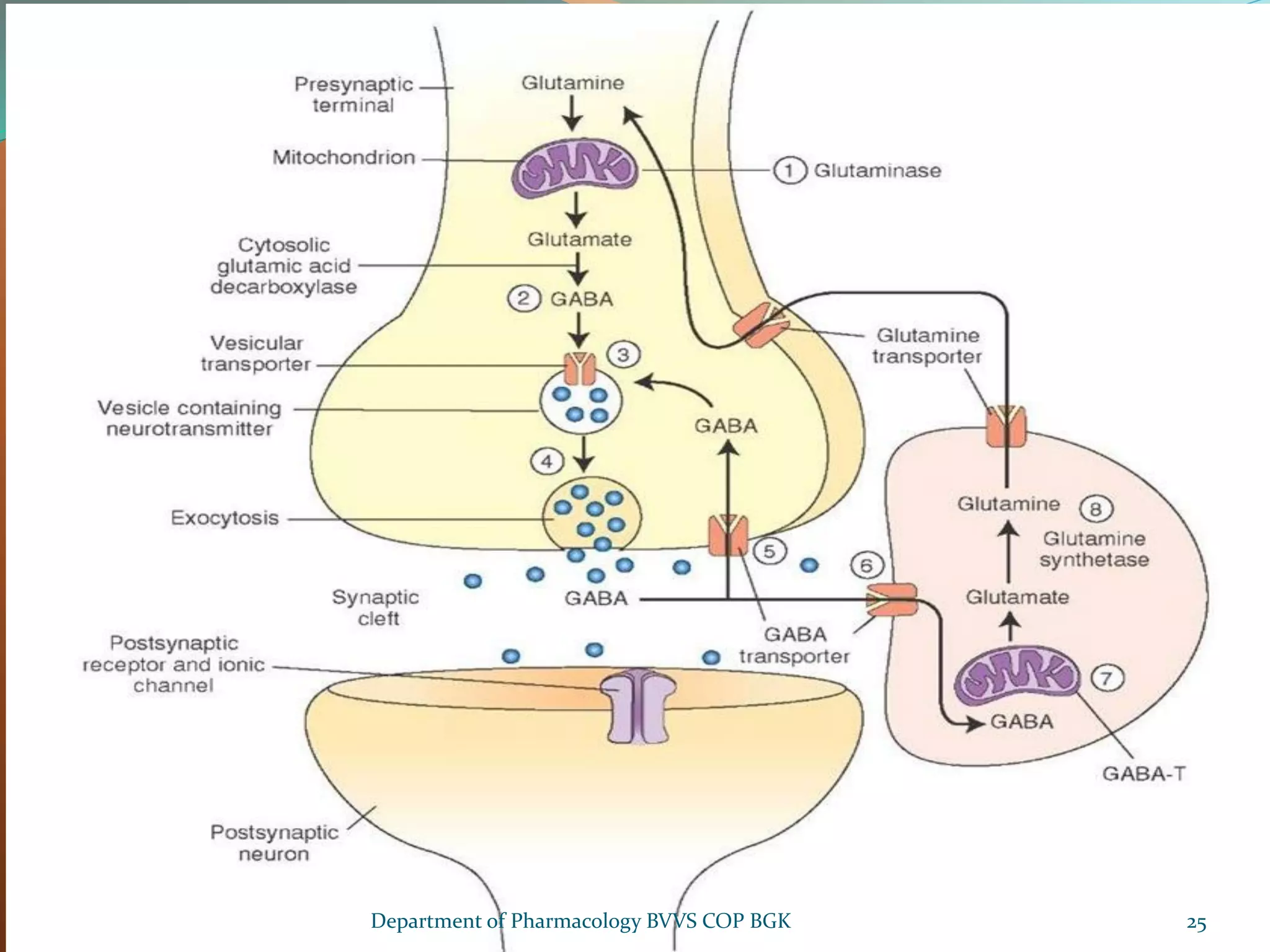
GAD (glutamate acid decarboxylase) is responsible for conversion of
glutamate to GABA. And the action of GABA performed then
metabolised by enzyme GABA-T and gives product known as
succinic semi aldehyde & succinic acid. This are two end product
produced after the metabolism of GABA by GABA transaminase. 23
Department of Pharmacology BVVS COP BGK
Storage:
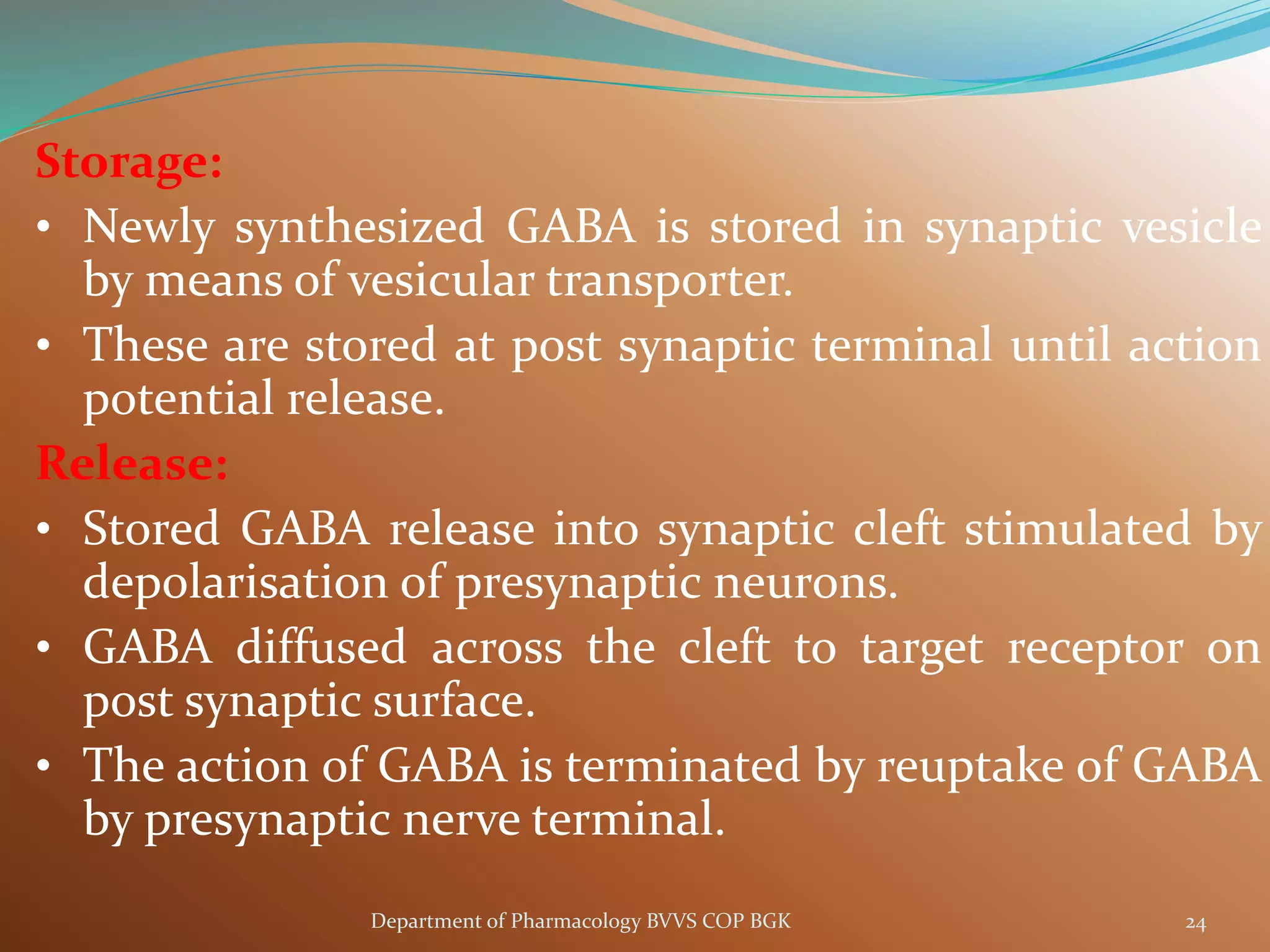
• Newly synthesized GABA is stored in synaptic vesicle
by means of vesicular transporter.
• These are stored at post synaptic terminal until action
potential release.
Release:
• Stored GABA release into synaptic cleft stimulated by
depolarisation of presynaptic neurons.
• GABA diffused across the cleft to target receptor on
post synaptic surface.
• The action of GABA is terminated by reuptake of GABA
by presynaptic nerve terminal.
24
Department of Pharmacology BVVS COP BGK
25
Department of Pharmacology BVVS COP BGK
Receptor :
GABA exert its effect by two types of receptors
- GABA-A
- GABA-B
• They differ in their pharmacological & biochemical
properties
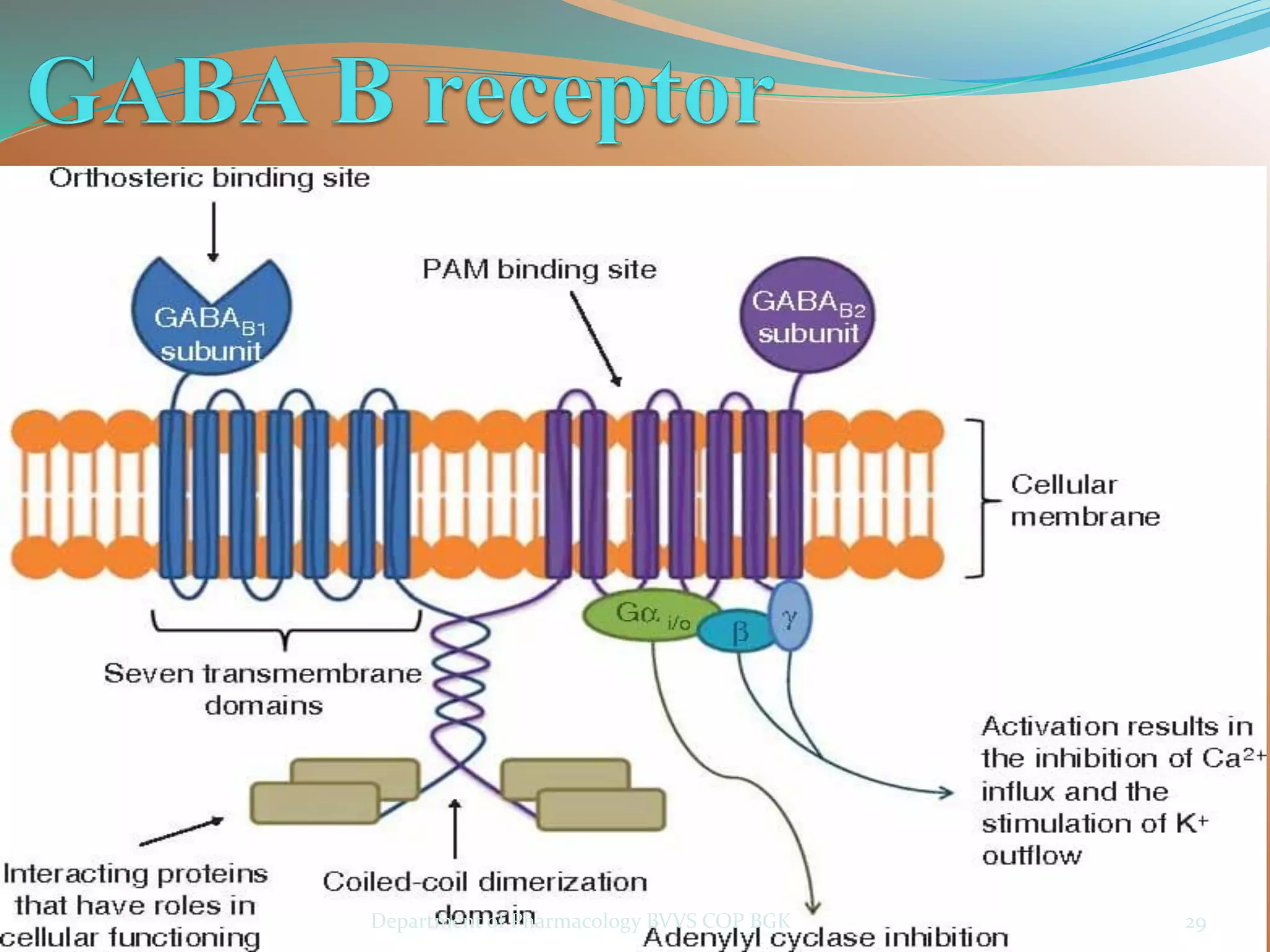
• GABA A is ionotropic & GABA B is metabotropic
• GABA A is also known as voltage gated chlorine
channel & GABA B is known as G-protein couple
receptor.
26
Department of Pharmacology BVVS COP BGK
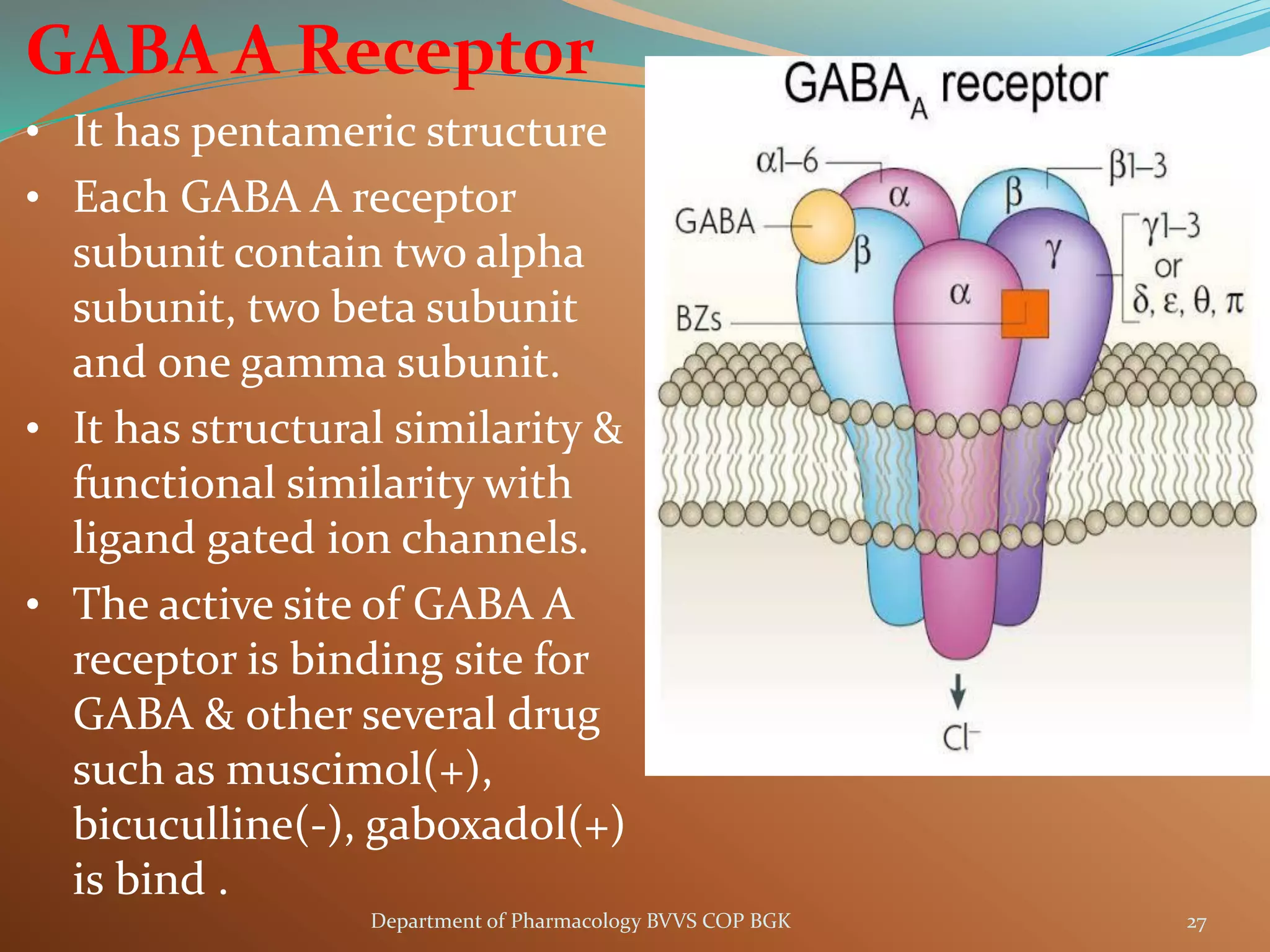
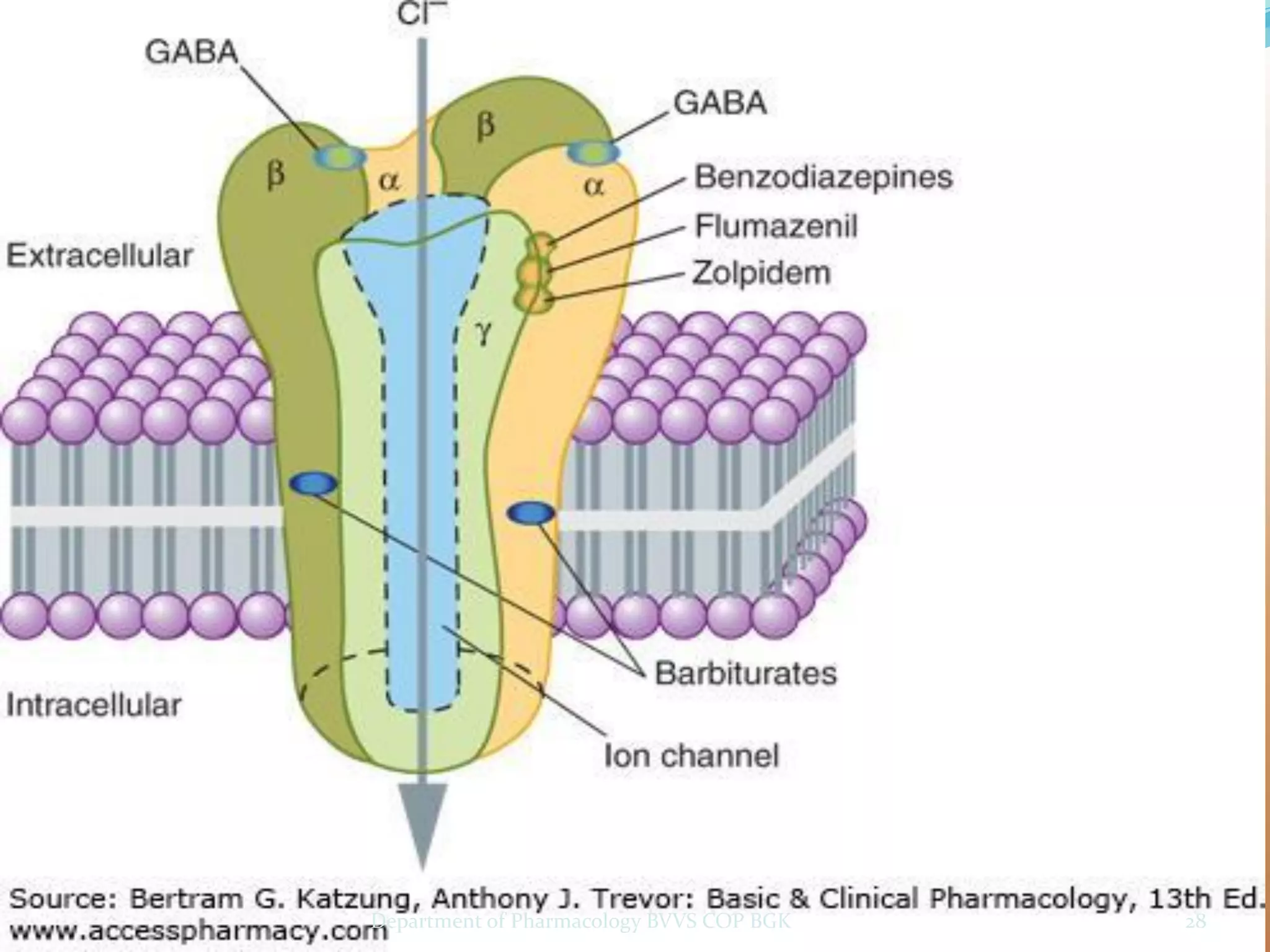
GABA A Receptor
• It has pentameric structure
• Each GABA A receptor
subunit contain two alpha
subunit, two beta subunit
and one gamma subunit.
• It has structural similarity &
functional similarity with
ligand gated ion channels.
• The active site of GABA A
receptor is binding site for
GABA & other several drug
such as muscimol(+),
bicuculline(-), gaboxadol(+)
is bind .
27
Department of Pharmacology BVVS COP BGK
28
Department of Pharmacology BVVS COP BGK
29
Department of Pharmacology BVVS COP BGK
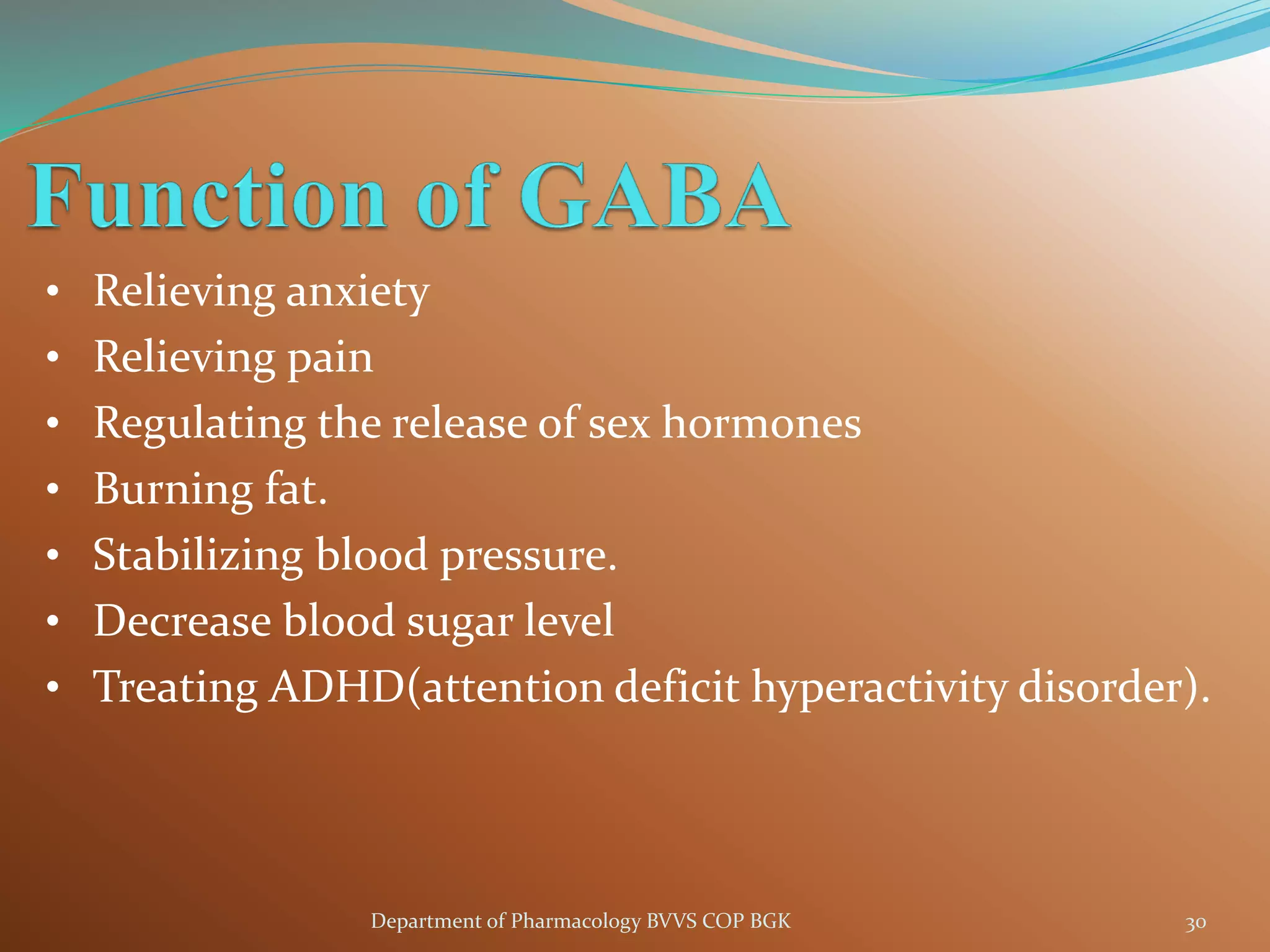
• Relieving anxiety
• Relieving pain
• Regulating the release of sex hormones
• Burning fat.
• Stabilizing blood pressure.
• Decrease blood sugar level
• Treating ADHD(attention deficit hyperactivity disorder).
30
Department of Pharmacology BVVS COP BGK
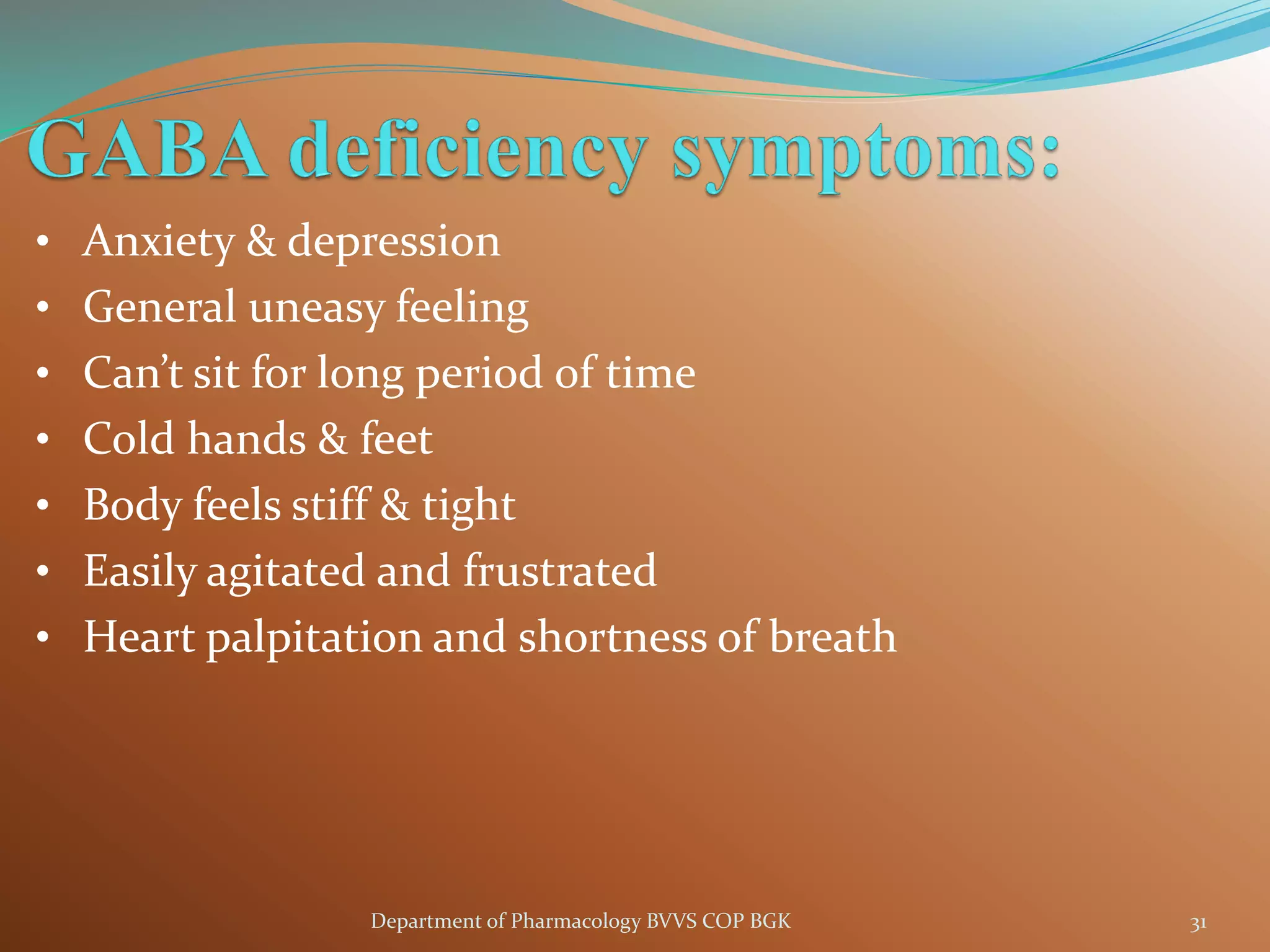
• Anxiety & depression
• General uneasy feeling
• Can’t sit for long period of time
• Cold hands & feet
• Body feels stiff & tight
• Easily agitated and frustrated
• Heart palpitation and shortness of breath
31
Department of Pharmacology BVVS COP BGK
THANK’s
32
Department of Pharmacology BVVS COP BGK

Presentation on neurotransmitter’s on dopamine and gaba converted (1)

  • 1.
  • 2.
    ➢Dopamine is anendogenous catecholamine that serve as both a neurotransmitter and precursor of nor-epinephrine synthesis. ➢When given as an exogenous drug dopamine activates a variety of receptors in dose dependent manner. ➢ Regulates cardiac, vascular and endocrine function. 2 Department of Pharmacology BVVS COP BGK
  • 3.
    ➢Dopamine is producedin dopaminergic neurons in the (VTA) Ventral tegmental area of substantia nigra, midbrain & the arcuate nucleus of the hypothalamus. ➢ In the periphery dopamine is found in the kidney where its function to produce renal vasodilatation, diuressis & natriuresis (excretion of Na in urine). 3 Department of Pharmacology BVVS COP BGK
  • 4.
  • 5.
  • 6.
  • 7.
    ❖ Dopamine actsthrough D1, D2 as well as adrenergic alpha and Beta receptors (But not B2). ❖ Metabotropic G-protein coupled receptors . D1 - like family: ❖ Includes subtypes D1, and D5. ❖ Activation is coupled to G: activates adenylyl cylcase which leads to increase in concentration of cAMP . ❖ D1: Receptor located in the putamen, nucleus accumbens & olfactory tubercle. i.e. in the nigrostriatal pathway. ❖ D5: Receptor is found in the hypothalamus and hippocampus, its exact role is not clear. 7 Department of Pharmacology BVVS COP BGK
  • 8.
    D2-like family : ❖Includes D2, D3 and D4. ❖ Activation is coupled to Gαi inhibits adenylyl cyclase leading to decrease in concentration of cAMP. Block the Calcium channels and open K channels. ❖ D2: Receptor is distributed in striatum, substantia nigra and pituitary. It is involved in the control of behaviour, voluntary movements, prolactin release and in other endocrine consequence. ❖ D3: Receptor is distributed in midbrain, nucleus accumbens and hypothalamus. ❖ D4: Receptor is distributed in the frontal cortex, medulla, and midbrain, i.e., in mesocortical pathway. 8 Department of Pharmacology BVVS COP BGK
  • 9.
  • 10.
    ❖DARPP- Dopamine regulatoryphosphoprotein. ❖Calcineurin – It is a calcium & calmodulin dependant serine & threonine protein phosphate . Its activates T-cell of the immune system. ❖Cav1 – Type of calcium channel are the key to regulate neuronal excitability. ❖ Kv – Potassium voltage gated. ❖ Kir - Class of potassium channel the potassium current inward rectifiers. 10 Department of Pharmacology BVVS COP BGK
  • 11.
    ❑ Mesolimbic pathway ❑Mesocortical pathway ❑ Nigrostrital pathway ❑ Tuberoinfundibular pathway 11 Department of Pharmacology BVVS COP BGK
  • 12.
    ➢Mesolimbic dopamine pathway:Midbrain ventral tegmental area to nucleus accumbens . A part of limbic system of the brain through to be involved in the many behaviour such as pleasurable sensation, powerful euphoria of the drug abuse, as well as delusion and hallucinations of psychosis. ➢The Mesocortical Dopamine pathway: It is also projects from midbrain and ventral tegmental area but sends its axons to prefrontal cortex, where they may have a role in mediating cognitive symptoms (dorsolateral prefrontal cortex) and affective symptoms (ventromedial prefrontal cortex) of schizophrenia. ➢The Nigrostriatal dopamine pathway: Which projects from the substantia nigra to the basal ganglia or striatum, is the part of the extrapyramidal nervous system and control motor function and movement. 12 Department of Pharmacology BVVS COP BGK
  • 13.
    ➢Tuberoinfundibular dopamine pathway:Projected to hypothalamus to anterior pituitary glands and controls prolactin secretion. 13 Department of Pharmacology BVVS COP BGK
  • 14.
  • 15.
    ❖ Parkinsonism :Dopamine ❖ Its 0ccurs in substantia nigra ❖ Leading to symptoms like - Rigidity - Tremor (involuntary shaking ) - Bradykinesia (slowness of movement) ➢Substance abuse : Nucleus accumbens is centre reward • Occurs due to increased release of dopamine caused by the psychotropic substances like Eg: -Morphine , Heroin, Cannabis, Cocaine, Nicotine 15 Department of Pharmacology BVVS COP BGK
  • 16.
  • 17.
    ➢It is athe brain disease , the people with schizophrenia have upto 25% less volume of grey matter(neuronal cell body) in their brain. ➢The grey matter includes region of the brain involved in the Muscle control, Sensory ppt, Speech, Decision making, Hearing & memory. ➢Therapy: 1st generation – Chlorpromazin, Haloperidol, 2nd generation- Aripiprazole, Clozapine, Olanzapine, Risperidone etc… 17 Department of Pharmacology BVVS COP BGK
  • 18.
    ❖Is the disorderof the central nervous system that affect movement / tremors. ❖Nerve cell damage in the brain causes dopamine levels to drop , leading to symptoms of Parkinson's. ➢Other symptoms : Confusion, Dizziness, Fatigue, Day time Sleepiness. ➢Therapy : Dopamine promotor, Antidepressant, Levodopa, Carbidopa ❖ Tolcapone (Tamar) is another COMT inhibitor that is prescribed very rarely due to the risk of severe liver damage and failure. 18 Department of Pharmacology BVVS COP BGK
  • 19.
    ❖ Catechol-O-methyltransferase (COMT)inhibitors. Entacapone (Comtan) is major drug in this class. The drug mildly prolongs the effect of levodopa therapy by blocking the enzyme that breaks down dopamine. ❖ Side effects including increased risk of involuntary movement’s dyskinesia result in enhanced levodopa effects. Other side effects are diarrhoea or other enhanced levodopa side effects. ❖ Amantadine is prescribed to give short-term relief to symptoms of mild, early-stage Parkinson's disease. It may be given with carbidopa-levodopa treatment in the later progression of Parkinson’s disease to manage involuntary movements (dyskinesias) caused by carbidopa-levodopa. ❖ The side effects include skin mottling, that is the color purple, and ankle swelling or hallucinations. 19 Department of Pharmacology BVVS COP BGK
  • 20.
  • 21.
    There is fewchemical agent act as neurotransmitter in CNS a) Dopamine b) GABA c) Glutamate d) Serotonin e) Glycine f) Histamine 21 Department of Pharmacology BVVS COP BGK
  • 22.
    Four type ofamino acid which is act as neurotransmitter in CNS. In that two are excitatory and two are inhibitory neurotransmitter. a) Excitatory neurotransmitter : - glutamate - aspartate b) Inhibitory neurotransmitter: - GABA - glycine 22 Department of Pharmacology BVVS COP BGK
  • 23.
    Synthesis : GAD (glutamateacid decarboxylase) is responsible for conversion of glutamate to GABA. And the action of GABA performed then metabolised by enzyme GABA-T and gives product known as succinic semi aldehyde & succinic acid. This are two end product produced after the metabolism of GABA by GABA transaminase. 23 Department of Pharmacology BVVS COP BGK
  • 24.
    Storage: • Newly synthesizedGABA is stored in synaptic vesicle by means of vesicular transporter. • These are stored at post synaptic terminal until action potential release. Release: • Stored GABA release into synaptic cleft stimulated by depolarisation of presynaptic neurons. • GABA diffused across the cleft to target receptor on post synaptic surface. • The action of GABA is terminated by reuptake of GABA by presynaptic nerve terminal. 24 Department of Pharmacology BVVS COP BGK
  • 25.
  • 26.
    Receptor : GABA exertits effect by two types of receptors - GABA-A - GABA-B • They differ in their pharmacological & biochemical properties • GABA A is ionotropic & GABA B is metabotropic • GABA A is also known as voltage gated chlorine channel & GABA B is known as G-protein couple receptor. 26 Department of Pharmacology BVVS COP BGK
  • 27.
    GABA A Receptor •It has pentameric structure • Each GABA A receptor subunit contain two alpha subunit, two beta subunit and one gamma subunit. • It has structural similarity & functional similarity with ligand gated ion channels. • The active site of GABA A receptor is binding site for GABA & other several drug such as muscimol(+), bicuculline(-), gaboxadol(+) is bind . 27 Department of Pharmacology BVVS COP BGK
  • 28.
  • 29.
  • 30.
    • Relieving anxiety •Relieving pain • Regulating the release of sex hormones • Burning fat. • Stabilizing blood pressure. • Decrease blood sugar level • Treating ADHD(attention deficit hyperactivity disorder). 30 Department of Pharmacology BVVS COP BGK
  • 31.
    • Anxiety &depression • General uneasy feeling • Can’t sit for long period of time • Cold hands & feet • Body feels stiff & tight • Easily agitated and frustrated • Heart palpitation and shortness of breath 31 Department of Pharmacology BVVS COP BGK
  • 32.