Parathyroid
and Calcitonin
Prof. Dr. Rashid Mahmood
(Courtesy: Prof. Dr. M. Yousaf, Dr. Abroo Kainat)
A patient post thyroidectomy admitted in surgical ward presents
in morning round with twisting of fingers while checking her Blood
pressure. Her serum calcium is very low (6mg/dl; Normal 9-
11mg/dl) on that day .
1.What is your diagnosis ?
2.Name the Hormones responsible for Calcium homeostasis, and
describe the role of each.
3.What is the management of above patient?
4.What are the effects of low level and high level of calcium?
Learning Objectives
• Goal/Aim: To give the understanding of the
physiology of Calcium Homeostasis
• Specific Objectives: By the end of this lecture
the students will be able to:
i. Describe the regulation of blood Calcium
ii. Describe the effects of Parathyroid hormone
iii. Describe the effects of Calcitonin
iv. Describe the effects of Vitamin D
2© Prof. Dr. Rashid Mahmood
Triad of Ca++ Homeostasis
• To regulate THREE
Calcium
Phosphorus
Bone
• Regulated by THREE:
Parathyroid Hormone (PTH)
Calcitonin
Vit. D
• Regulated at THREE sites:
Kidney
Intestines
Bone
3© Prof. Dr. Rashid Mahmood
Importance of the topic
• Normal calcium level important
for:
1. Contraction of skeletal muscles
2. Contraction of smooth muscles
3. Cardiac muscle contraction
4. Transmission of nervous
impulses
5. Clotting of blood
6. Secretory activity of the glands
4© Prof. Dr. Rashid Mahmood
Daily calcium exchange
(1000
5© Prof. Dr. Rashid Mahmood
Assessment Q. No. 1
• Name the hormones that control Calcium
metabolism
6© Prof. Dr. Rashid Mahmood
Learning Objectives
• Goal/Aim: To give the understanding of the
physiology of Calcium Homeostasis
• Specific Objectives: By the end of this lecture
the students will be able to:
i. Describe the regulation of blood Calcium
ii. Describe the effects of Parathyroid hormone
iii. Describe the effects of Calcitonin
iv. Describe the effects of Vitamin D
7© Prof. Dr. Rashid Mahmood
PTH
• Physiologic Anatomy
• Chemistry/ Structure
• Functions
• Site of action
• Mechanism of action
• Regulation
8© Prof. Dr. Rashid Mahmood
Physiologic Anatomy
9© Prof. Dr. Rashid Mahmood
Parathyroid Gland
 Chief cells:
hormonal
production
 Oxyphil
cells: no
known
functions 10© Prof. Dr. Rashid Mahmood
Chemistry of PTH
• Protein in nature
• 84 amino acids
• A fragment of 34 amino acids have some
parathyroid hormonal activity
11© Prof. Dr. Rashid Mahmood
Functions of PTH
• Maintenance of blood Calcium level
• Maintenance of blood Phosphate level
• Activation of Vitamin D
• Actions on
 Bone
 Intestine
 Kidney
12© Prof. Dr. Rashid Mahmood
Maintenance of blood Calcium level
by PTH
• Normal blood calcium level = 9-11 mg/dl
• PTH→ ↑blood calcium level
 Resorption from the bones
 Reabsorption from the renal tubules
 Absorption from GIT
13© Prof. Dr. Rashid Mahmood
PTH Hormonal effects on Bone
Action Rapid phase Slow phase
Onset of action within minutes days and weeks
Action on
Osteoclasts
↑activity of
Osteocytes (Mainly
Osteoclasts)
already present (↑
activity of osteocytic
pump)
Formation of new
Osteoclasts
Reabsorptive action of amorphous
calcium salts and
PO4 (Osteolysis)
Resorption of bone
itself osteoporosis
14
Rapid phase & Slow phase
Effects of PTH
15© Prof. Dr. Rashid Mahmood
CaSR= Calcium
Sensing receptor
Functions of PTH
16© Prof. Dr. Rashid Mahmood
PTH effects on Kidney
17
↑ reabsorption
of Mg, H+
↓reabsorption
of Na+
, K+
and
amino acids
© Prof. Dr. Rashid Mahmood
PTH: Main functions
18© Prof. Dr. Rashid Mahmood
Effects of PTH on blood Ca++
and PO4
19© Prof. Dr. Rashid Mahmood
Effects on intestine
• PTH→ formation of
1,25,dihydroxycholecalciferol→formation of
 Calcium binding protein
» Calbindin
 Calcium stimulated ATPase
 Alkaline phosphatase
↑ calcium
absorption
20© Prof. Dr. Rashid Mahmood
Mechanism of action of PTH
• Cyclic AMP mechanism
21© Prof. Dr. Rashid Mahmood
Regulation of secretion of PTH
• Hypocalcemia is the most important
stimulus for PTH production & secretion
• Hypocalcemia→ hypertrophy of
parathyroid gland e.g.
 In pregnancy
 During lactation
 In rickets
• Hypercalcemia →↓activity and size of
parathyroid gland
22© Prof. Dr. Rashid Mahmood
Effect of Ca level on PTH secretion
23© Prof. Dr. Rashid Mahmood
Assessment Q. No. 2
• Which ions are likely to be secreted more
than normal in urine if PTH is deficient?
24© Prof. Dr. Rashid Mahmood
Learning Objectives
• Goal/Aim: To give the understanding of the
physiology of Calcium Homeostasis
• Specific Objectives: By the end of this lecture
the students will be able to:
i. Describe the regulation of blood Calcium
ii. Describe the effects of Parathyroid hormone
iii. Describe the effects of Calcitonin
iv. Describe the effects of Vitamin D
25© Prof. Dr. Rashid Mahmood
Calcitonin
• Secreted by Thyroid gland
 Parafollicular cells or C- cells
• Effects are opposite to parathyroid
hormone
• Lesser role as compared to PTH
• Decreases the calcium level in the blood
• Stimulated by ↑ serum Ca++
level
26© Prof. Dr. Rashid Mahmood
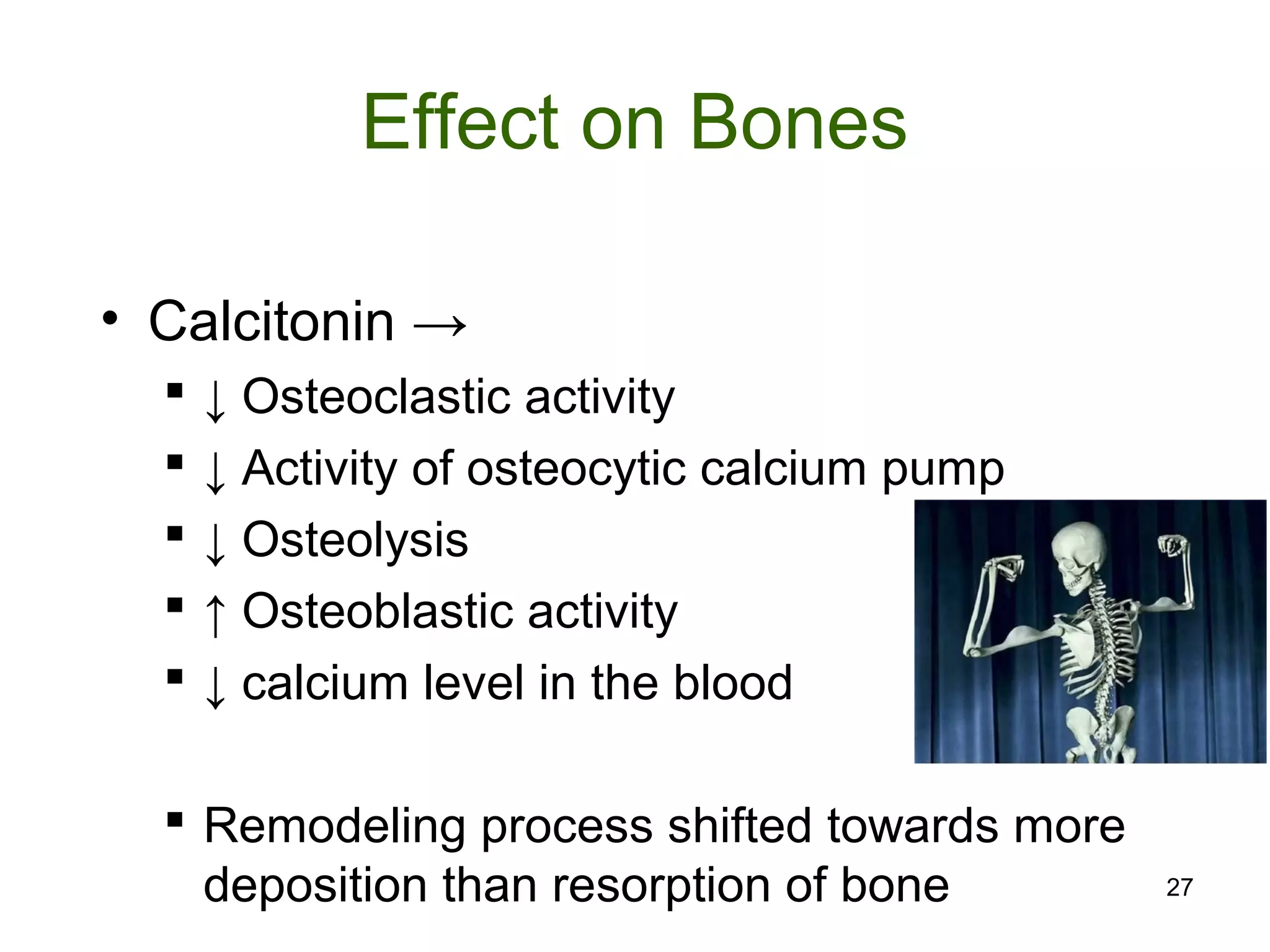
Effect on Bones
• Calcitonin →
 ↓ Osteoclastic activity
 ↓ Activity of osteocytic calcium pump
 ↓ Osteolysis
 ↑ Osteoblastic activity
 ↓ calcium level in the blood
 Remodeling process shifted towards more
deposition than resorption of bone 27
Effect on bones (contd.)
Prolonged effects
Calcitonin →
 ↓ Formation of new osteoblasts leads to
secondary decrease in Osteoblastic activity
 Finally ↓activity of both osteoclasts and
osteoblasts
 Hypocalcemic effect is transient
28© Prof. Dr. Rashid Mahmood
Assessment Q. No. 3
• Activity of which cells is increased in
bones under the effect of calcitonin?
29© Prof. Dr. Rashid Mahmood
Still have one more hormone to
go!!!
30© Prof. Dr. Rashid Mahmood
Learning Objectives
• Goal/Aim: To give the understanding of the
physiology of Calcium Homeostasis
• Specific Objectives: By the end of this lecture
the students will be able to:
i. Describe the regulation of blood Calcium
ii. Describe the effects of Parathyroid hormone
iii. Describe the effects of Calcitonin
iv. Describe the effects of Vitamin D
31© Prof. Dr. Rashid Mahmood
Vitamin D
• Potent effect to ↑ Ca++
absorption from the
intestinal tract
• Cholecalciferol (vitamin D3 ) is formed in the
skin and activated by liver and kidneys
• In the absence of PTH , almost none of the 1,
25 dihydrocholecalciferol is formed
• Several effects on intestines, bones, and
kidneys
• ↑ blood Ca++
and PO4 through ↑ absorption
from intestines & ↓ excretion by kidneys
32© Prof. Dr. Rashid Mahmood
Activation of Vitamin D & its actions on intestine
33
© Prof. Dr. Rashid Mahmood
Review of Calcium Homeostasis
© Prof. Dr. Rashid Mahmood 34
Review of Calcium Homeostasis
35
(Contd…)
© Prof. Dr. Rashid Mahmood
Calcium ,
PTH, Vit D
© Prof. Dr. Rashid Mahmood 36
Calcium
Homeostasis
Review
(Contd…)
37
© Prof. Dr. Rashid Mahmood
Take Home points (1/3)
• Calcium Homeostasis is essential for
normal living
• Calcium levels are regulated by mainly
three hormones: Calcitonin, PTH, and
activated Vitamin D
• Calcium levels also maintained by utilizing
exchangeable calcium with amorphous
salts in the bone and Calcium in the ECF
38© Prof. Dr. Rashid Mahmood
Take Home points (2/3)
• PTH increases blood Calcium levels by
resorption from Bone , Renal reabsorption
and Intestinal reabsorption of Calcium
through increased synthesis of active
vitamin D
• PTH is necessary for activation of vit. D
• PTH decreases blood PO4 levelby
decreasing its reabsorption in kidneys.
This action is more marked than increase
absorption from intestines and bones
39
Take Home points (3/3)
• Calcitonin decreases blood calcium levels,
and increases bone deposition
• Activated Vitamin D has several effects on
intestines, bones, and kidneys. It
increases absorption of Ca++
and PO4 into
ECF
40© Prof. Dr. Rashid Mahmood
Assessment Q. No. 4
• PTH secretion is inhibited by
A. ↑ activity of dihydrocholecalciferol
B. ↑ serum Ca++
level in blood
C. ↑ serum Mg++
level in blood
D. ↓ Calcitonin
E. Thyroid surgery
41© Prof. Dr. Rashid Mahmood
References
• Guyton and Hall Textbook of Physiology , 13th
Edition
• Ganong’s review of Medical Physiology,25th
edition
• Human Physiology, from cells to system, Lauralee
Sherwood, 9th
edition
© Prof. Dr. Rashid Mahmood 42
Next Topic
• Next Topic: Mineralocorticoids,
• Thu, 02/11/2017, 10.30 to 11.30
• Prior knowledge required for next
topic:
 Anatomy & Histology of Adrenal Gland
 Physiology of Glucocorticoids
 Biochemistry of Glucocorticoids and
Mineralocorticoids
© Prof. Dr. Rashid Mahmood 43
The End
Thank You
Questions ?
Comments ?
drrashid62@gmail.com
rashid.mahmood@rmi.edu.pk
ppt also available at
https://www.slideshare.net
© Prof. Dr. Rashid Mahmood 44

Parathyroid and Calcitonin Physiology

  • 1.
    Parathyroid and Calcitonin Prof. Dr.Rashid Mahmood (Courtesy: Prof. Dr. M. Yousaf, Dr. Abroo Kainat) A patient post thyroidectomy admitted in surgical ward presents in morning round with twisting of fingers while checking her Blood pressure. Her serum calcium is very low (6mg/dl; Normal 9- 11mg/dl) on that day . 1.What is your diagnosis ? 2.Name the Hormones responsible for Calcium homeostasis, and describe the role of each. 3.What is the management of above patient? 4.What are the effects of low level and high level of calcium?
  • 2.
    Learning Objectives • Goal/Aim:To give the understanding of the physiology of Calcium Homeostasis • Specific Objectives: By the end of this lecture the students will be able to: i. Describe the regulation of blood Calcium ii. Describe the effects of Parathyroid hormone iii. Describe the effects of Calcitonin iv. Describe the effects of Vitamin D 2© Prof. Dr. Rashid Mahmood
  • 3.
    Triad of Ca++Homeostasis • To regulate THREE Calcium Phosphorus Bone • Regulated by THREE: Parathyroid Hormone (PTH) Calcitonin Vit. D • Regulated at THREE sites: Kidney Intestines Bone 3© Prof. Dr. Rashid Mahmood
  • 4.
    Importance of thetopic • Normal calcium level important for: 1. Contraction of skeletal muscles 2. Contraction of smooth muscles 3. Cardiac muscle contraction 4. Transmission of nervous impulses 5. Clotting of blood 6. Secretory activity of the glands 4© Prof. Dr. Rashid Mahmood
  • 5.
    Daily calcium exchange (1000 5©Prof. Dr. Rashid Mahmood
  • 6.
    Assessment Q. No.1 • Name the hormones that control Calcium metabolism 6© Prof. Dr. Rashid Mahmood
  • 7.
    Learning Objectives • Goal/Aim:To give the understanding of the physiology of Calcium Homeostasis • Specific Objectives: By the end of this lecture the students will be able to: i. Describe the regulation of blood Calcium ii. Describe the effects of Parathyroid hormone iii. Describe the effects of Calcitonin iv. Describe the effects of Vitamin D 7© Prof. Dr. Rashid Mahmood
  • 8.
    PTH • Physiologic Anatomy •Chemistry/ Structure • Functions • Site of action • Mechanism of action • Regulation 8© Prof. Dr. Rashid Mahmood
  • 9.
  • 10.
    Parathyroid Gland  Chiefcells: hormonal production  Oxyphil cells: no known functions 10© Prof. Dr. Rashid Mahmood
  • 11.
    Chemistry of PTH •Protein in nature • 84 amino acids • A fragment of 34 amino acids have some parathyroid hormonal activity 11© Prof. Dr. Rashid Mahmood
  • 12.
    Functions of PTH •Maintenance of blood Calcium level • Maintenance of blood Phosphate level • Activation of Vitamin D • Actions on  Bone  Intestine  Kidney 12© Prof. Dr. Rashid Mahmood
  • 13.
    Maintenance of bloodCalcium level by PTH • Normal blood calcium level = 9-11 mg/dl • PTH→ ↑blood calcium level  Resorption from the bones  Reabsorption from the renal tubules  Absorption from GIT 13© Prof. Dr. Rashid Mahmood
  • 14.
    PTH Hormonal effectson Bone Action Rapid phase Slow phase Onset of action within minutes days and weeks Action on Osteoclasts ↑activity of Osteocytes (Mainly Osteoclasts) already present (↑ activity of osteocytic pump) Formation of new Osteoclasts Reabsorptive action of amorphous calcium salts and PO4 (Osteolysis) Resorption of bone itself osteoporosis 14 Rapid phase & Slow phase
  • 15.
    Effects of PTH 15©Prof. Dr. Rashid Mahmood CaSR= Calcium Sensing receptor
  • 16.
    Functions of PTH 16©Prof. Dr. Rashid Mahmood
  • 17.
    PTH effects onKidney 17 ↑ reabsorption of Mg, H+ ↓reabsorption of Na+ , K+ and amino acids © Prof. Dr. Rashid Mahmood
  • 18.
    PTH: Main functions 18©Prof. Dr. Rashid Mahmood
  • 19.
    Effects of PTHon blood Ca++ and PO4 19© Prof. Dr. Rashid Mahmood
  • 20.
    Effects on intestine •PTH→ formation of 1,25,dihydroxycholecalciferol→formation of  Calcium binding protein » Calbindin  Calcium stimulated ATPase  Alkaline phosphatase ↑ calcium absorption 20© Prof. Dr. Rashid Mahmood
  • 21.
    Mechanism of actionof PTH • Cyclic AMP mechanism 21© Prof. Dr. Rashid Mahmood
  • 22.
    Regulation of secretionof PTH • Hypocalcemia is the most important stimulus for PTH production & secretion • Hypocalcemia→ hypertrophy of parathyroid gland e.g.  In pregnancy  During lactation  In rickets • Hypercalcemia →↓activity and size of parathyroid gland 22© Prof. Dr. Rashid Mahmood
  • 23.
    Effect of Calevel on PTH secretion 23© Prof. Dr. Rashid Mahmood
  • 24.
    Assessment Q. No.2 • Which ions are likely to be secreted more than normal in urine if PTH is deficient? 24© Prof. Dr. Rashid Mahmood
  • 25.
    Learning Objectives • Goal/Aim:To give the understanding of the physiology of Calcium Homeostasis • Specific Objectives: By the end of this lecture the students will be able to: i. Describe the regulation of blood Calcium ii. Describe the effects of Parathyroid hormone iii. Describe the effects of Calcitonin iv. Describe the effects of Vitamin D 25© Prof. Dr. Rashid Mahmood
  • 26.
    Calcitonin • Secreted byThyroid gland  Parafollicular cells or C- cells • Effects are opposite to parathyroid hormone • Lesser role as compared to PTH • Decreases the calcium level in the blood • Stimulated by ↑ serum Ca++ level 26© Prof. Dr. Rashid Mahmood
  • 27.
    Effect on Bones •Calcitonin →  ↓ Osteoclastic activity  ↓ Activity of osteocytic calcium pump  ↓ Osteolysis  ↑ Osteoblastic activity  ↓ calcium level in the blood  Remodeling process shifted towards more deposition than resorption of bone 27
  • 28.
    Effect on bones(contd.) Prolonged effects Calcitonin →  ↓ Formation of new osteoblasts leads to secondary decrease in Osteoblastic activity  Finally ↓activity of both osteoclasts and osteoblasts  Hypocalcemic effect is transient 28© Prof. Dr. Rashid Mahmood
  • 29.
    Assessment Q. No.3 • Activity of which cells is increased in bones under the effect of calcitonin? 29© Prof. Dr. Rashid Mahmood
  • 30.
    Still have onemore hormone to go!!! 30© Prof. Dr. Rashid Mahmood
  • 31.
    Learning Objectives • Goal/Aim:To give the understanding of the physiology of Calcium Homeostasis • Specific Objectives: By the end of this lecture the students will be able to: i. Describe the regulation of blood Calcium ii. Describe the effects of Parathyroid hormone iii. Describe the effects of Calcitonin iv. Describe the effects of Vitamin D 31© Prof. Dr. Rashid Mahmood
  • 32.
    Vitamin D • Potenteffect to ↑ Ca++ absorption from the intestinal tract • Cholecalciferol (vitamin D3 ) is formed in the skin and activated by liver and kidneys • In the absence of PTH , almost none of the 1, 25 dihydrocholecalciferol is formed • Several effects on intestines, bones, and kidneys • ↑ blood Ca++ and PO4 through ↑ absorption from intestines & ↓ excretion by kidneys 32© Prof. Dr. Rashid Mahmood
  • 33.
    Activation of VitaminD & its actions on intestine 33 © Prof. Dr. Rashid Mahmood
  • 34.
    Review of CalciumHomeostasis © Prof. Dr. Rashid Mahmood 34
  • 35.
    Review of CalciumHomeostasis 35 (Contd…) © Prof. Dr. Rashid Mahmood
  • 36.
    Calcium , PTH, VitD © Prof. Dr. Rashid Mahmood 36
  • 37.
  • 38.
    Take Home points(1/3) • Calcium Homeostasis is essential for normal living • Calcium levels are regulated by mainly three hormones: Calcitonin, PTH, and activated Vitamin D • Calcium levels also maintained by utilizing exchangeable calcium with amorphous salts in the bone and Calcium in the ECF 38© Prof. Dr. Rashid Mahmood
  • 39.
    Take Home points(2/3) • PTH increases blood Calcium levels by resorption from Bone , Renal reabsorption and Intestinal reabsorption of Calcium through increased synthesis of active vitamin D • PTH is necessary for activation of vit. D • PTH decreases blood PO4 levelby decreasing its reabsorption in kidneys. This action is more marked than increase absorption from intestines and bones 39
  • 40.
    Take Home points(3/3) • Calcitonin decreases blood calcium levels, and increases bone deposition • Activated Vitamin D has several effects on intestines, bones, and kidneys. It increases absorption of Ca++ and PO4 into ECF 40© Prof. Dr. Rashid Mahmood
  • 41.
    Assessment Q. No.4 • PTH secretion is inhibited by A. ↑ activity of dihydrocholecalciferol B. ↑ serum Ca++ level in blood C. ↑ serum Mg++ level in blood D. ↓ Calcitonin E. Thyroid surgery 41© Prof. Dr. Rashid Mahmood
  • 42.
    References • Guyton andHall Textbook of Physiology , 13th Edition • Ganong’s review of Medical Physiology,25th edition • Human Physiology, from cells to system, Lauralee Sherwood, 9th edition © Prof. Dr. Rashid Mahmood 42
  • 43.
    Next Topic • NextTopic: Mineralocorticoids, • Thu, 02/11/2017, 10.30 to 11.30 • Prior knowledge required for next topic:  Anatomy & Histology of Adrenal Gland  Physiology of Glucocorticoids  Biochemistry of Glucocorticoids and Mineralocorticoids © Prof. Dr. Rashid Mahmood 43
  • 44.
    The End Thank You Questions? Comments ? drrashid62@gmail.com rashid.mahmood@rmi.edu.pk ppt also available at https://www.slideshare.net © Prof. Dr. Rashid Mahmood 44

Editor's Notes