ANTI - EPILEPTIC SCREENING
MODELS
BY KHUSHBOO THAKUR
M.PHARM SEM I
Department of Pharmacology
SSR COLLEGE OF PHARMACY, SAYLI , SILVASSA 1
Epilepsy
These are a group of disorders of the CNS characterized by
paroxysmal cerebral dysrhythmia, manifesting as brief episodes
(seizures) of loss or disturbance of consciousness, with or without
characteristic body movements (convulsions), sensory or
psychiatric phenomena.
These episodes are unpredictable and their frequency is highly
variable. Epilepsy has a focal origin in the brain, manifestations
depend on the site of the focus, regions into which the discharges
spread and postictal depression of these regions.
Recognized from the dawn of history as ‘disease of lightening’, it
was correctly described by JH Jackson little over a century ago
2
Epilepsies have been classified variously; major types are described below.
I. Generalised seizures
1. Generalised tonic- clonic seizures: (GTCS, major epilepsy, grand mal):
epilepsy, grand mal): commonest, lasts 1–2 min.
The usual sequence is aura—cry—unconsciousness—tonic spasm of all
body muscles— clonic jerking followed by prolonged sleep and depression
of all CNS functions.
2. Absence seizures : (minor epilepsy, petit mal): prevalent in children,
in children, lasts about 1/2 min.
Momentary loss of consciousness, patient apparently freezes and stares in
one direction, no muscular component or little bilateral jerking. EEG shows
characteristic 3 cycles per second spike and wave pattern.
3
3. Atonic seizures : (Akinetic epilepsy):
Unconsciousness with relaxation of all muscles due to
inhibitory discharges. Patient may fall.
4. Myoclonic seizures : Shock-like momentary
contraction of muscles of a limb or the whole body.
5. Infantile spasms (Hypsarrhythmia): Seen in infants.
Probably not a form of epilepsy. Intermittent muscle
progressive mental deterioration. Diffuse changes in the
interseizure EEG are noted.
4
II. Partial seizures
1. Simple partial seizures : (SPS, cortical focal epilepsy): lasts 1/2–1
lasts 1/2–1 min. Often secondary. Convulsions are confined to a
group of muscles or localized sensory disturbance depending on
the area of cortex involved in the seizure, without loss of
consciousness.
2. Complex partial seizures : (CPS, temporal lobe epilepsy,
psychomotor): attacks of bizarre and confused behaviour and
purposeless movements, emotional changes lasting 1–2 min along
with impairment of consciousness. An aura often precedes. The
seizure focus is located in the temporal lobe. 5
3. Simple partial or complex partial seizures
secondarily generalized :The partial seizure occurs
first and evolves into generalized tonic-clonic seizures
consciousness.
Most of the cases of epilepsy are primary
some may be secondary to trauma/ surgery on the
intracranial tumour, tuberculoma, cysticercosis,
ischaemia, etc. Treatment is symptomatic and the
whether epilepsy is primary or secondary.
6
What causes epilepsy?
For 6 out of 10 people with epilepsy, the cause can’t be
. A variety of things can lead to seizures.
Possible causes includes:
 Traumatic brain injury
 Scarring on the brain after a brain injury (post -
epilepsy)
 Serious illness or very high fever
 Stroke, which is a leading cause of epilepsy in people
 Other vascular diseases 7
 Lack of oxygen to the brain
 Brain tumor or cyst
 Dementia or Alzheimer’s disease
 Maternal drug use, prenatal injury, brain malformation, or lack of
oxygen at birth
 Infectious diseases such as AIDS and meningitis
 Genetic or developmental disorders or neurological diseases
8
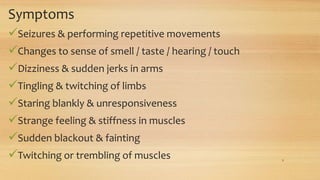
Symptoms
Seizures & performing repetitive movements
Changes to sense of smell / taste / hearing / touch
Dizziness & sudden jerks in arms
Tingling & twitching of limbs
Staring blankly & unresponsiveness
Strange feeling & stiffness in muscles
Sudden blackout & fainting
Twitching or trembling of muscles 9
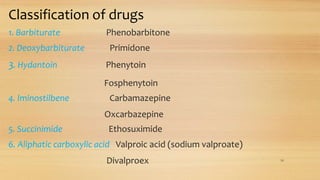
Classification of drugs
1. Barbiturate Phenobarbitone
2. Deoxybarbiturate Primidone
3. Hydantoin Phenytoin
Fosphenytoin
4. Iminostilbene Carbamazepine
Oxcarbazepine
5. Succinimide Ethosuximide
6. Aliphatic carboxylic acid Valproic acid (sodium valproate)
Divalproex 10
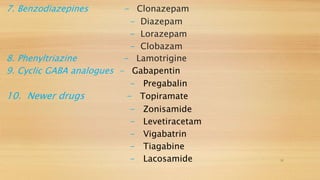
7. Benzodiazepines - Clonazepam
- Diazepam
- Lorazepam
- Clobazam
8. Phenyltriazine - Lamotrigine
9. Cyclic GABA analogues - Gabapentin
- Pregabalin
10. Newer drugs - Topiramate
- Zonisamide
- Levetiracetam
- Vigabatrin
- Tiagabine
- Lacosamide 11
ANTI-EPILEPTIC
SCREENING MODELS
12
In Vitro Methods
1. 3H-GABA Receptor Binding
2. GABA-A Receptor Binding
3. GABA-B Receptor Binding
4. 3H-GABA Uptake in Rat Cerebral Cortex Synaptosomes
5. GABA Uptake and Release in Rat Hippocampal Slices
6. Glutamate Receptors: [3H]CPP Binding
7. NMDA Receptor Complex: [3H]TCP Binding
8. Metabotropic Glutamate Receptors
9. Excitatory Amino Acid Transporters . . . . . . . . 13
In Vivo Methods
1. Electroshock in Mice
2. Chemical Induced seizures
a. Pentylenetetrazol Test in Mice and Rats
b. Strychnine-Induced Convulsions in Mice
c. Picrotoxin-Induced Convulsions in Mice
d. Isoniazid-Induced Convulsions in Mice
e. Bicuculline Test in Rats
f. 4-Aminopyridine-Induced Seizures in Mice
g. 3-Nitropropionic Acid-Induced Seizures in Mice 14
3. Epilepsy Induced by Focal Lesions
4. Kindled Rat Seizure Model
5. Posthypoxic Myoclonus in Rats
6. Rat Kainate Model of Epilepsy
7. Pilocarpine Model of Epilepsy
8. Self-Sustained Status Epilepticus
9. Rat Model of Cortical Dysplasia
10. Genetic Animal Models of Epilepsy
11. Transgenic Animals as Models of Epilepsy
15
In Vitro Methods
1. 3H-GABA Receptor Binding
Same as given in anxiolytic screening model test (refer anxiolytic screening
model In-vitro test)
2. GABA-A Receptor Binding
Same as given in anxiolytic screening model test (refer anxiolytic screening
model In-vitro test)
3. GABA-B Receptor Binding
Same as given in anxiolytic screening model test (refer anxiolytic screening
model In-vitro test) 16
4. GABA Uptake and Release in Rat
Hippocampal Slices
PURPOSE AND RATIONALE
The GABA transporter, the subsynaptic GABA-A receptor, and the GABA-B
auto receptor are therapeutically the most relevant targets for drug
actions influencing GABAergic synaptic transmission. Uptake inhibitors are
potential anticonvulsants.
PROCEDURE
For measurement of GABA uptake, rat hippocampal slices are cut with a
cut with a McIlwain tissue slicer (100µmthick prisms) and dispersed in ice-
cold Krebs-Ringer solution with HEPES buffer (pH7.4). 17
 Following two washes, slices (15mg) are incubated at 37°C for 15min in the
presence or absence of test compound.
[3H]-GABA is added and samples are incubated for an additional 5min
before filtration through Whatman GF/F filters.
Samples are then washed twice with 5ml ice-chilled 0.9% saline.
Distilled water is added and samples are allowed to sit at least 60min before
measured for radioactivity by liquid scintillation spectroscopy.
Blanks are treated in an identical manner but are left on ice throughoutthe
incubation.
18
For measurement of GABA release, rat hippocampal slices are
prepared and dispersed in ice-cold HEPES buffered (pH7.2)
solution and incubated with 0.05µM [3H]-GABA for 15min at
Following two washes, the slices are incubated for an additional
finally resuspended in medium.
Tissue (10mg) is incubated at 37°C for a 15 min release period
presence or absence of test compound.
At the end of the release period, the medium is separated from
centrifugation at 500g for approximately 1 min and poured into
perchloric acid (0.4N).
The tissue is homogenized in 0.13 N perchloric acid.
Radioactivity in the samples is measured by using liquid
spectroscopy. 19
EVALUATION
For GABA-uptake, IC50-values (µM) are determined.
In GABA-release experiments, results are expressed as the amount of radioactivity
released as a percent of the total radioactivity.
MODIFICATIONS OF THE METHOD
Roskoski (1978) studied the net uptake of GABA by high affinity
synaptosomal transport systems.
Nilsson et al. (1990, 1992) tested GABA uptake in astroglial primary
cultures.
The isolated nerve-bouton preparation was used to study GABA release.
The technique was developed by Drewe et al. (1988), Vorobjev (1991),
Haage et al. (1998), Rhee et al. (1999),and Koyama et al. (1999).
20
The method is based on the local application of mechanical vibration
directly to the chosen site of a brain slice and does not require the
enzymatic pretreatment of the tissue.
The mechanical vibration is applied via a glass rod (0.5mm in diameter)
mounted on a piezoelectric bimorph crystal at the site of the chosen brain
tissue.
The dissociated cells are allowed to settle at the bottom of a Petri dish for
20min. The cell bodies are usually 10–15µm at their longest axis, rounded or
elongated in shape. Some cells had remaining neurites up to 100µm long.
The majority of cells had neurites less than 15µm long.
In other studies, a custom-built vibrating stylus was placed in the
appropriate region for mechanical dissociation. The glass capillary (1.5mm
o.d.) was pulled to a fine tip and fire-polished . 21
The tip was placed within the appropriate region by a manipulator . The
vibrating stylus was driven by an electronic relay and the tip was horizontally
moved (excursions of 2–3mm at 0.5–2Hz) for 2min.
Neurons with adherent functional synaptic terminals were investigated by
tight-seal whole-cell recordings from the postsynaptic cells.
22
In Vivo Methods
1. Electroshock in Mice
PURPOSE AND RATIONALE
The electroshock assay in mice is used primarily as an indication for
compounds which are effective in grand mal epilepsy. Tonic hind limb
extensions are evoked by electric stimuli which are suppressed by anti-
epileptics but also by other centrally active drugs.
23
PROCEDURE
Groups of 6–10 male NMRI mice (18–30g) are used.
The test is started 30min after i.p. injection or 60 min after oral treatment
with the test compound or the vehicle.
An apparatus with corneal or ear electrodes (Woodbury and Davenport
1952) is used to deliver the stimuli.
The intensity of stimulus is dependent on the apparatus,
e.g., 12mA , 50 Hz for 0.2 s have been used.
Under these conditions all vehicle treated mice show the characteristic
extensor tonus.
24
EVALUATION
The animals are observed closely for 2 min.
Disappearance of the hind leg extens or tonic convulsion is used as
positive criterion.
Percent of inhibition of seizures relative to controls is calculated.
Using various doses, ED50-values and 95% confidence interval are
calculated by probit analysis.
ED50-values after oral administration are:
• Diazepam 3.0mg/kg
• Diphenylhydantoin20.0mg/kg 25
CRITICAL ASSESSMENTOF THE METHOD
The electroshock test in mice has been proven to be a useful tool to
detect compounds with anticonvulsant activity.
MODIFICATIONS OF THE METHOD
Cashin and Jackson (1962) described a simple apparatus for
assessing anticonvulsant drugs by the electroshock seizure test in
mice.
Kitano et al. (1996) developed the increasing-current electroshock
seizure test, a new method for assessment of anti-and pro-
convulsant activities of drugs in mice.
26
A single train of pulses (square wave, 5ms, 20Hz) of linearly
increasing intensity from 5 to 30 mA was applied via ear electrodes.
The current at which tonic hind limb extension occurred was
recorded as the seizure threshold. The method allows the
determination of seizure threshold current for individual animals.
27
2. Bicuculline Test in Rats
PURPOSE AND RATIONALE
Seizures can be induced by the GAGAA-antagonist bicuculline and
are antagonized by known anti-epileptics.
PROCEDURE
Female Sprague- Dawley rats are injected i.v. with 1 mg/kg
bicuculline.
At this dose, a tonic convulsion appears in all treated rats within
30 s after injection.
28
Test compounds are administered orally 1 or 2 h before bicuculline
injection.
Dose-response curves can be obtained.
EVALUATION
Percentage of protected animals is evaluated.
ED50 values and 95% confidence limits are calculated by probit
analysis.
29
CRITICAL ASSESSMENTOF THE METHOD
Like the electroshock test, the bicuculline test is considered to be
relatively specific for anti-epileptic activity.
MODIFICATIONS OF THE METHOD
Czuczwar et al. (1985) studied the antagonism of N- methyl-D,L-
aspartic acid-induced convulsions by anti-epileptic drugs and other
agents.
30
3. Strychnine-Induced Convulsions
PURPOSE AND RATIONALE
The convulsing action of strychnine is due to interference with
postsynaptic inhibition mediated by glycine. Glycine is an important
inhibitory transmitter to motoneurons and interneurons in the
spinal cord, and strychnine acts as a selective, competitive
antagonist to block the inhibitory effects of glycine at all glycine
receptors. Strychnine-sensitive postsynaptic inhibition in higher
centers of the CNS is also mediated by glycine. Compounds which
reverse the action of strychnine have been shown to have anxiolytic
properties. 31
PROCEDURE
Groups of 10 mice of either sex with a weight between 18 and 22
g are used.
They are treated orally with the test compound or the standard
(e.g. diazepam 5mg/kg).
One hour later the mice are injected with 2 mg/kg strychnine
nitrate i.p.
The time until occurrence of tonic extensor convulsions and
death is noted during a 1 h period.
With this dose of strychnine convulsions are observed in 80% of
the controls.
32
EVALUATION
ED50- values are calculated using various doses taking the
percentage of the controls as 100%.
For time response curves the interval between treatment
and strychnine injection varies from 30 to 120 min.
CRITICAL ASSESSMENTOF THE METHOD
The method has been proven to be useful in a battery of
tests to characterize CNS-active drugs. 33
MODIFICATIONS OF THE METHOD
McAllister (1992) induced spinal seizures in mice by rotating
them along the body axis clockwise and anticlockwise
alternatively three times following pretreatment with a
subconvulsive dose of strychnine.
Lambert et al. (1994) tested the antagonism of a glycine
derivative against seizures induced by
3mercaptopropionicacid (3-MPA).
34
35

Anti epileptic screening model

  • 1.
    ANTI - EPILEPTICSCREENING MODELS BY KHUSHBOO THAKUR M.PHARM SEM I Department of Pharmacology SSR COLLEGE OF PHARMACY, SAYLI , SILVASSA 1
  • 2.
    Epilepsy These are agroup of disorders of the CNS characterized by paroxysmal cerebral dysrhythmia, manifesting as brief episodes (seizures) of loss or disturbance of consciousness, with or without characteristic body movements (convulsions), sensory or psychiatric phenomena. These episodes are unpredictable and their frequency is highly variable. Epilepsy has a focal origin in the brain, manifestations depend on the site of the focus, regions into which the discharges spread and postictal depression of these regions. Recognized from the dawn of history as ‘disease of lightening’, it was correctly described by JH Jackson little over a century ago 2
  • 3.
    Epilepsies have beenclassified variously; major types are described below. I. Generalised seizures 1. Generalised tonic- clonic seizures: (GTCS, major epilepsy, grand mal): epilepsy, grand mal): commonest, lasts 1–2 min. The usual sequence is aura—cry—unconsciousness—tonic spasm of all body muscles— clonic jerking followed by prolonged sleep and depression of all CNS functions. 2. Absence seizures : (minor epilepsy, petit mal): prevalent in children, in children, lasts about 1/2 min. Momentary loss of consciousness, patient apparently freezes and stares in one direction, no muscular component or little bilateral jerking. EEG shows characteristic 3 cycles per second spike and wave pattern. 3
  • 4.
    3. Atonic seizures: (Akinetic epilepsy): Unconsciousness with relaxation of all muscles due to inhibitory discharges. Patient may fall. 4. Myoclonic seizures : Shock-like momentary contraction of muscles of a limb or the whole body. 5. Infantile spasms (Hypsarrhythmia): Seen in infants. Probably not a form of epilepsy. Intermittent muscle progressive mental deterioration. Diffuse changes in the interseizure EEG are noted. 4
  • 5.
    II. Partial seizures 1.Simple partial seizures : (SPS, cortical focal epilepsy): lasts 1/2–1 lasts 1/2–1 min. Often secondary. Convulsions are confined to a group of muscles or localized sensory disturbance depending on the area of cortex involved in the seizure, without loss of consciousness. 2. Complex partial seizures : (CPS, temporal lobe epilepsy, psychomotor): attacks of bizarre and confused behaviour and purposeless movements, emotional changes lasting 1–2 min along with impairment of consciousness. An aura often precedes. The seizure focus is located in the temporal lobe. 5
  • 6.
    3. Simple partialor complex partial seizures secondarily generalized :The partial seizure occurs first and evolves into generalized tonic-clonic seizures consciousness. Most of the cases of epilepsy are primary some may be secondary to trauma/ surgery on the intracranial tumour, tuberculoma, cysticercosis, ischaemia, etc. Treatment is symptomatic and the whether epilepsy is primary or secondary. 6
  • 7.
    What causes epilepsy? For6 out of 10 people with epilepsy, the cause can’t be . A variety of things can lead to seizures. Possible causes includes:  Traumatic brain injury  Scarring on the brain after a brain injury (post - epilepsy)  Serious illness or very high fever  Stroke, which is a leading cause of epilepsy in people  Other vascular diseases 7
  • 8.
     Lack ofoxygen to the brain  Brain tumor or cyst  Dementia or Alzheimer’s disease  Maternal drug use, prenatal injury, brain malformation, or lack of oxygen at birth  Infectious diseases such as AIDS and meningitis  Genetic or developmental disorders or neurological diseases 8
  • 9.
    Symptoms Seizures & performingrepetitive movements Changes to sense of smell / taste / hearing / touch Dizziness & sudden jerks in arms Tingling & twitching of limbs Staring blankly & unresponsiveness Strange feeling & stiffness in muscles Sudden blackout & fainting Twitching or trembling of muscles 9
  • 10.
    Classification of drugs 1.Barbiturate Phenobarbitone 2. Deoxybarbiturate Primidone 3. Hydantoin Phenytoin Fosphenytoin 4. Iminostilbene Carbamazepine Oxcarbazepine 5. Succinimide Ethosuximide 6. Aliphatic carboxylic acid Valproic acid (sodium valproate) Divalproex 10
  • 11.
    7. Benzodiazepines -Clonazepam - Diazepam - Lorazepam - Clobazam 8. Phenyltriazine - Lamotrigine 9. Cyclic GABA analogues - Gabapentin - Pregabalin 10. Newer drugs - Topiramate - Zonisamide - Levetiracetam - Vigabatrin - Tiagabine - Lacosamide 11
  • 12.
  • 13.
    In Vitro Methods 1.3H-GABA Receptor Binding 2. GABA-A Receptor Binding 3. GABA-B Receptor Binding 4. 3H-GABA Uptake in Rat Cerebral Cortex Synaptosomes 5. GABA Uptake and Release in Rat Hippocampal Slices 6. Glutamate Receptors: [3H]CPP Binding 7. NMDA Receptor Complex: [3H]TCP Binding 8. Metabotropic Glutamate Receptors 9. Excitatory Amino Acid Transporters . . . . . . . . 13
  • 14.
    In Vivo Methods 1.Electroshock in Mice 2. Chemical Induced seizures a. Pentylenetetrazol Test in Mice and Rats b. Strychnine-Induced Convulsions in Mice c. Picrotoxin-Induced Convulsions in Mice d. Isoniazid-Induced Convulsions in Mice e. Bicuculline Test in Rats f. 4-Aminopyridine-Induced Seizures in Mice g. 3-Nitropropionic Acid-Induced Seizures in Mice 14
  • 15.
    3. Epilepsy Inducedby Focal Lesions 4. Kindled Rat Seizure Model 5. Posthypoxic Myoclonus in Rats 6. Rat Kainate Model of Epilepsy 7. Pilocarpine Model of Epilepsy 8. Self-Sustained Status Epilepticus 9. Rat Model of Cortical Dysplasia 10. Genetic Animal Models of Epilepsy 11. Transgenic Animals as Models of Epilepsy 15
  • 16.
    In Vitro Methods 1.3H-GABA Receptor Binding Same as given in anxiolytic screening model test (refer anxiolytic screening model In-vitro test) 2. GABA-A Receptor Binding Same as given in anxiolytic screening model test (refer anxiolytic screening model In-vitro test) 3. GABA-B Receptor Binding Same as given in anxiolytic screening model test (refer anxiolytic screening model In-vitro test) 16
  • 17.
    4. GABA Uptakeand Release in Rat Hippocampal Slices PURPOSE AND RATIONALE The GABA transporter, the subsynaptic GABA-A receptor, and the GABA-B auto receptor are therapeutically the most relevant targets for drug actions influencing GABAergic synaptic transmission. Uptake inhibitors are potential anticonvulsants. PROCEDURE For measurement of GABA uptake, rat hippocampal slices are cut with a cut with a McIlwain tissue slicer (100µmthick prisms) and dispersed in ice- cold Krebs-Ringer solution with HEPES buffer (pH7.4). 17
  • 18.
     Following twowashes, slices (15mg) are incubated at 37°C for 15min in the presence or absence of test compound. [3H]-GABA is added and samples are incubated for an additional 5min before filtration through Whatman GF/F filters. Samples are then washed twice with 5ml ice-chilled 0.9% saline. Distilled water is added and samples are allowed to sit at least 60min before measured for radioactivity by liquid scintillation spectroscopy. Blanks are treated in an identical manner but are left on ice throughoutthe incubation. 18
  • 19.
    For measurement ofGABA release, rat hippocampal slices are prepared and dispersed in ice-cold HEPES buffered (pH7.2) solution and incubated with 0.05µM [3H]-GABA for 15min at Following two washes, the slices are incubated for an additional finally resuspended in medium. Tissue (10mg) is incubated at 37°C for a 15 min release period presence or absence of test compound. At the end of the release period, the medium is separated from centrifugation at 500g for approximately 1 min and poured into perchloric acid (0.4N). The tissue is homogenized in 0.13 N perchloric acid. Radioactivity in the samples is measured by using liquid spectroscopy. 19
  • 20.
    EVALUATION For GABA-uptake, IC50-values(µM) are determined. In GABA-release experiments, results are expressed as the amount of radioactivity released as a percent of the total radioactivity. MODIFICATIONS OF THE METHOD Roskoski (1978) studied the net uptake of GABA by high affinity synaptosomal transport systems. Nilsson et al. (1990, 1992) tested GABA uptake in astroglial primary cultures. The isolated nerve-bouton preparation was used to study GABA release. The technique was developed by Drewe et al. (1988), Vorobjev (1991), Haage et al. (1998), Rhee et al. (1999),and Koyama et al. (1999). 20
  • 21.
    The method isbased on the local application of mechanical vibration directly to the chosen site of a brain slice and does not require the enzymatic pretreatment of the tissue. The mechanical vibration is applied via a glass rod (0.5mm in diameter) mounted on a piezoelectric bimorph crystal at the site of the chosen brain tissue. The dissociated cells are allowed to settle at the bottom of a Petri dish for 20min. The cell bodies are usually 10–15µm at their longest axis, rounded or elongated in shape. Some cells had remaining neurites up to 100µm long. The majority of cells had neurites less than 15µm long. In other studies, a custom-built vibrating stylus was placed in the appropriate region for mechanical dissociation. The glass capillary (1.5mm o.d.) was pulled to a fine tip and fire-polished . 21
  • 22.
    The tip wasplaced within the appropriate region by a manipulator . The vibrating stylus was driven by an electronic relay and the tip was horizontally moved (excursions of 2–3mm at 0.5–2Hz) for 2min. Neurons with adherent functional synaptic terminals were investigated by tight-seal whole-cell recordings from the postsynaptic cells. 22
  • 23.
    In Vivo Methods 1.Electroshock in Mice PURPOSE AND RATIONALE The electroshock assay in mice is used primarily as an indication for compounds which are effective in grand mal epilepsy. Tonic hind limb extensions are evoked by electric stimuli which are suppressed by anti- epileptics but also by other centrally active drugs. 23
  • 24.
    PROCEDURE Groups of 6–10male NMRI mice (18–30g) are used. The test is started 30min after i.p. injection or 60 min after oral treatment with the test compound or the vehicle. An apparatus with corneal or ear electrodes (Woodbury and Davenport 1952) is used to deliver the stimuli. The intensity of stimulus is dependent on the apparatus, e.g., 12mA , 50 Hz for 0.2 s have been used. Under these conditions all vehicle treated mice show the characteristic extensor tonus. 24
  • 25.
    EVALUATION The animals areobserved closely for 2 min. Disappearance of the hind leg extens or tonic convulsion is used as positive criterion. Percent of inhibition of seizures relative to controls is calculated. Using various doses, ED50-values and 95% confidence interval are calculated by probit analysis. ED50-values after oral administration are: • Diazepam 3.0mg/kg • Diphenylhydantoin20.0mg/kg 25
  • 26.
    CRITICAL ASSESSMENTOF THEMETHOD The electroshock test in mice has been proven to be a useful tool to detect compounds with anticonvulsant activity. MODIFICATIONS OF THE METHOD Cashin and Jackson (1962) described a simple apparatus for assessing anticonvulsant drugs by the electroshock seizure test in mice. Kitano et al. (1996) developed the increasing-current electroshock seizure test, a new method for assessment of anti-and pro- convulsant activities of drugs in mice. 26
  • 27.
    A single trainof pulses (square wave, 5ms, 20Hz) of linearly increasing intensity from 5 to 30 mA was applied via ear electrodes. The current at which tonic hind limb extension occurred was recorded as the seizure threshold. The method allows the determination of seizure threshold current for individual animals. 27
  • 28.
    2. Bicuculline Testin Rats PURPOSE AND RATIONALE Seizures can be induced by the GAGAA-antagonist bicuculline and are antagonized by known anti-epileptics. PROCEDURE Female Sprague- Dawley rats are injected i.v. with 1 mg/kg bicuculline. At this dose, a tonic convulsion appears in all treated rats within 30 s after injection. 28
  • 29.
    Test compounds areadministered orally 1 or 2 h before bicuculline injection. Dose-response curves can be obtained. EVALUATION Percentage of protected animals is evaluated. ED50 values and 95% confidence limits are calculated by probit analysis. 29
  • 30.
    CRITICAL ASSESSMENTOF THEMETHOD Like the electroshock test, the bicuculline test is considered to be relatively specific for anti-epileptic activity. MODIFICATIONS OF THE METHOD Czuczwar et al. (1985) studied the antagonism of N- methyl-D,L- aspartic acid-induced convulsions by anti-epileptic drugs and other agents. 30
  • 31.
    3. Strychnine-Induced Convulsions PURPOSEAND RATIONALE The convulsing action of strychnine is due to interference with postsynaptic inhibition mediated by glycine. Glycine is an important inhibitory transmitter to motoneurons and interneurons in the spinal cord, and strychnine acts as a selective, competitive antagonist to block the inhibitory effects of glycine at all glycine receptors. Strychnine-sensitive postsynaptic inhibition in higher centers of the CNS is also mediated by glycine. Compounds which reverse the action of strychnine have been shown to have anxiolytic properties. 31
  • 32.
    PROCEDURE Groups of 10mice of either sex with a weight between 18 and 22 g are used. They are treated orally with the test compound or the standard (e.g. diazepam 5mg/kg). One hour later the mice are injected with 2 mg/kg strychnine nitrate i.p. The time until occurrence of tonic extensor convulsions and death is noted during a 1 h period. With this dose of strychnine convulsions are observed in 80% of the controls. 32
  • 33.
    EVALUATION ED50- values arecalculated using various doses taking the percentage of the controls as 100%. For time response curves the interval between treatment and strychnine injection varies from 30 to 120 min. CRITICAL ASSESSMENTOF THE METHOD The method has been proven to be useful in a battery of tests to characterize CNS-active drugs. 33
  • 34.
    MODIFICATIONS OF THEMETHOD McAllister (1992) induced spinal seizures in mice by rotating them along the body axis clockwise and anticlockwise alternatively three times following pretreatment with a subconvulsive dose of strychnine. Lambert et al. (1994) tested the antagonism of a glycine derivative against seizures induced by 3mercaptopropionicacid (3-MPA). 34
  • 35.