Machine Learning
Dr. P. Kuppusamy
Prof / CSE
2
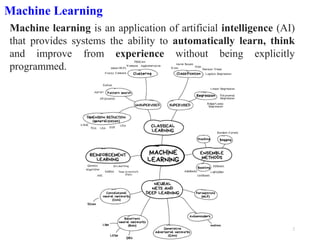
Machine Learning
Machine learning is an application of artificial intelligence (AI)
that provides systems the ability to automatically learn, think
and improve from experience without being explicitly
programmed.
3
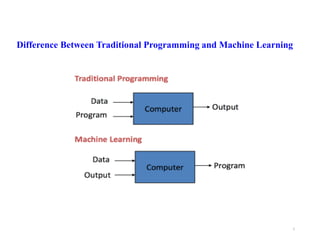
Difference Between Traditional Programming and Machine Learning
Build a ML Model
4
ML Software Development
5
automatically learn and improve from experience
Features (Variables/Attributes) in ML
• Feature is an individual measurable attribute or characteristic of a
phenomenon being observed.
• Choosing informative, discriminating and independent features is
a crucial for effective algorithms in pattern
recognition, classification and regression.
• Features are usually numeric, but structural features such
as strings and graphs are used in syntactic pattern recognition.
• Eg. Table – Length, Breadth, Height, Weight, Color, Location,
no_of_draws, no_of _doors, Price
Features (Variables/Attributes) in ML
• Vector - collection / array of numbers in similar data type
• Feature Vector is an n-dimensional vector of
numerical features that represent some object.
• Eg. Length of 3 tables in feet
𝐿[1]
𝐿[2]
𝐿[3]
=
5
7
3
Feature extraction - definition
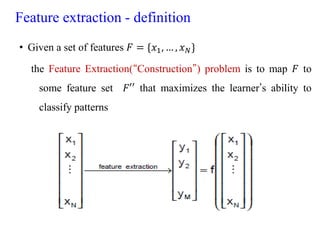
• Given a set of features 𝐹 = {𝑥1, … , 𝑥𝑁}
the Feature Extraction(“Construction”) problem is to map 𝐹 to
some feature set 𝐹′′ that maximizes the learner’s ability to
classify patterns
Feature Extraction
• Find a projection matrix w from n-dimensional to m-dimensional
vectors that keeps error low
𝒛 = 𝑤𝑇𝑿
w – Parameters
X – Set of features
Types of Learning
• Supervised (inductive) learning
• Training data includes desired outputs
• Unsupervised learning
• Training data does not include desired outputs
• Semi-supervised learning
• Training data includes a few desired outputs
• Reinforcement learning
• Rewards from sequence of actions
Supervised (Inductive) Learning
• Training data includes desired outputs
• Given examples of a function (X, F(X))
• Predict function F(X) for new examples X
• Discrete data - F(X): Classification
• Continuous data - F(X): Regression
• F(X) = Probability(X): Probability estimation
12
Supervised learning:
Learning a model from labeled data.
13
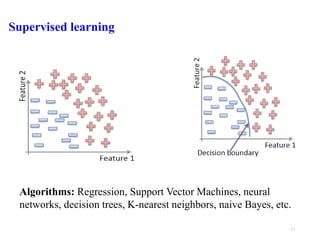
Supervised learning
Algorithms: Regression, Support Vector Machines, neural
networks, decision trees, K-nearest neighbors, naive Bayes, etc.
14
Unsupervised learning
Algorithms: K-means, gaussian mixtures, hierarchical clustering,
spectral clustering, etc.
Learning a model from unlabeled data.
15
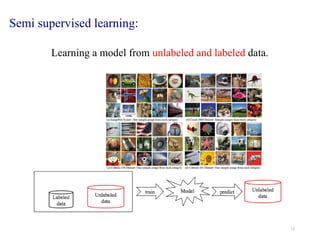
Semi supervised learning:
Learning a model from unlabeled and labeled data.
Linear Regression
• Linear Regression analysis is a statistical tool
• Predictive modeling method to investigate the mathematical
relationship between a dependent variable (outcome – y) and an
independent variable (predictor – x).
• Predictor shows the changes in Dependent variable (y axis) to the
changes in explanatory variables in X axis.
Linear Regression
• It is quantitative analysis tool
• It uses current information about a phenomenon to predict its future behavior.
• Involves the graphical lines over a set of data points that most closely towards
all shape of the data.
• when the data form a set of pairs of numbers, it is interpreted as the observed
values of an independent (or predictor ) variable X and a dependent ( or
response) variable Y.
y x
  
  
0 1
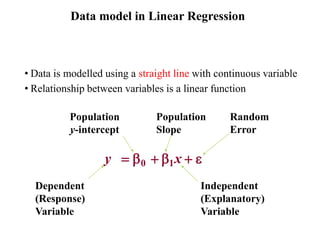
Data model in Linear Regression
• Data is modelled using a straight line with continuous variable
• Relationship between variables is a linear function
Dependent
(Response)
Variable
Independent
(Explanatory)
Variable
Population
Slope
Population
y-intercept
Random
Error
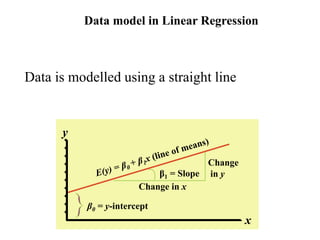
y
β0 = y-intercept
x
Change
in y
Change in x
β1 = Slope
Data model in Linear Regression
Data is modelled using a straight line
Types of Relationships
Y
X
Y
X
Y
Y
X
X
Strong relationships Weak relationships
Types of Relationships
Y
X
Y
X
No relationship
(continued)
Plot for x and actual y values
 Plot the graph using x and y values
Random Error Identification
 Random Error  = Estimated Value (yi) – Actual Value (yi)
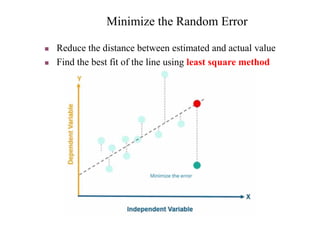
Minimize the Random Error
 Reduce the distance between estimated and actual value
 Find the best fit of the line using least square method
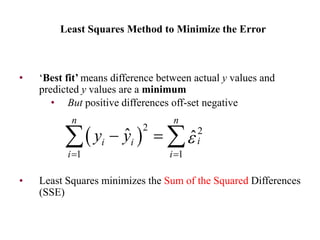
Least Squares Method to Minimize the Error
• ‘Best fit’ means difference between actual y values and
predicted y values are a minimum
• But positive differences off-set negative
 
2 2
1 1
ˆ ˆ
n n
i
i i
i i
y y 
 
 
 
• Least Squares minimizes the Sum of the Squared Differences
(SSE)
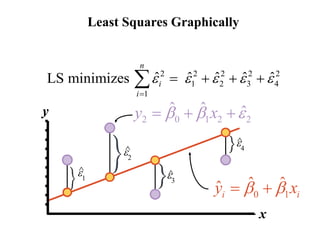
Least Squares Graphically
2
y
x
1 3
4
^
^
^
^
2 0 1 2 2
ˆ ˆ ˆ
y x
  
  
0 1
ˆ ˆ
ˆi i
y x
 
 
2 2 2 2 2
1 2 3 4
1
ˆ ˆ ˆ ˆ ˆ
LS minimizes
n
i
i
    

   

Case Study
 Let consider x and y values and mark in scatter plot
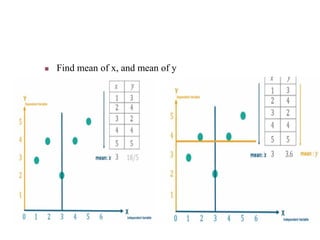
 Find mean of x, and mean of y
 Find the coefficients m and c in the straight line y = mx+c
 Find x-x1, and y-y1
 Find m
Plot the x, y values in the graph
x = {1, 2, 3, 4, 5} y = {3, 4, 2, 4, 5}
Plot the regression line using estimated y values
x = {1, 2, 3, 4, 5} y = {2.8, 3.2, 3.6, 4, 4.4}
Estimated y values
Estimated y values
Find the Error 
Mean Square Error minimizes the
error in the linear regression.
Regression Line with least error is
the ‘best fit’ line
 
2 2
1 1
ˆ ˆ
n n
i
i i
i i
y y 
 
 
 
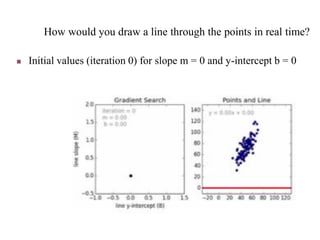
How would you draw a line through the points in real time?
 Initial values (iteration 0) for slope m = 0 and y-intercept b = 0
How would you draw a line through the points?
iteration 1, slope m = 0.04 and y-
intercept b = 0
iteration 20, slope m = 0.59 and y-
intercept b = 0.01
Determine which line ‘fits best’ in 100 iterations
iteration 47, slope m = 1.03 and y-
intercept b = 0.02
iteration 99, slope m = 1.36 and y-
intercept b = 0.03
3 major Uses of Regression
•Determining the strength of predictors
•Forecasting an effect
•Trend forecasting
Where Linear Regression used?
• Evaluating trends and sales estimates
• Analyze the impact of price changes
• Insurance domain
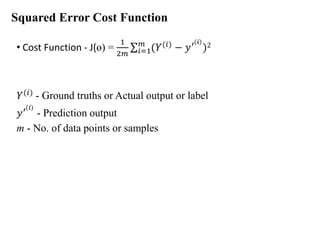
Squared Error Cost Function
• Cost Function - J(ɵ) =
1
2𝑚
σ𝑖=1
𝑚
(𝑌(𝑖)
− 𝑦′ 𝑖
)2
𝑌(𝑖) - Ground truths or Actual output or label
𝑦′ 𝑖
- Prediction output
m - No. of data points or samples
Gradient Descent
• The objective of training a machine learning model is to minimize the loss or error
between ground truths and predictions by changing the trainable parameters.
• Gradient is the extension of derivative in multi-dimensional space, tells the direction
along which the loss or error is optimally minimized.
• Gradient is defined as the maximum rate of change.
𝜃𝑗 = 𝜃𝑗 − 𝛼
𝜕
𝜕𝜃𝑗
𝐽(𝜃)
• 𝜃𝑗-Training parameter 𝛼 – Learning rate 𝐽(𝜃) – Error / Cost function
Gradient Descent
• Gradient Descent:
𝜃𝑗 = 𝜃𝑗 − 𝛼
1
𝑚
σ𝑖=1
𝑚
(𝑦′(𝑖)
−𝑌 𝑖 )𝑥𝑗
𝑖
for All j
j=0; 𝜃0 = 𝜃0 − 𝛼
1
𝑚
σ𝑖=1
𝑚
(𝑦′(𝑖)
−𝑌 𝑖 )𝑥0
𝑖
for All j
j=1; 𝜃1 = 𝜃1 − 𝛼
1
𝑚
σ𝑖=1
𝑚
(𝑦′(𝑖)
−𝑌 𝑖 )𝑥1
𝑖
for All j
………..
j=n; 𝜃𝑛 = 𝜃𝑛 − 𝛼
1
𝑚
σ𝑖=1
𝑚
(𝑦′(𝑖)
−𝑌 𝑖 )𝑥𝑛
𝑖 for All j
References
• Tom Markiewicz& Josh Zheng,Getting started with Artificial
Intelligence, Published by O’Reilly Media,2017
• Stuart J. Russell and Peter Norvig,Artificial Intelligence A Modern
Approach
• Richard Szeliski, Computer Vision: Algorithms and Applications,
Springer 2010
• Artificial Intelligence and Machine Learning, Chandra S.S. & H.S.
Anand, PHI Publications
• Machine Learning, Rajiv Chopra, Khanna Publishing House
•

Machine learning Introduction

  • 1.
    Machine Learning Dr. P.Kuppusamy Prof / CSE
  • 2.
    2 Machine Learning Machine learningis an application of artificial intelligence (AI) that provides systems the ability to automatically learn, think and improve from experience without being explicitly programmed.
  • 3.
    3 Difference Between TraditionalProgramming and Machine Learning
  • 4.
    Build a MLModel 4
  • 5.
    ML Software Development 5 automaticallylearn and improve from experience
  • 6.
    Features (Variables/Attributes) inML • Feature is an individual measurable attribute or characteristic of a phenomenon being observed. • Choosing informative, discriminating and independent features is a crucial for effective algorithms in pattern recognition, classification and regression. • Features are usually numeric, but structural features such as strings and graphs are used in syntactic pattern recognition. • Eg. Table – Length, Breadth, Height, Weight, Color, Location, no_of_draws, no_of _doors, Price
  • 7.
    Features (Variables/Attributes) inML • Vector - collection / array of numbers in similar data type • Feature Vector is an n-dimensional vector of numerical features that represent some object. • Eg. Length of 3 tables in feet 𝐿[1] 𝐿[2] 𝐿[3] = 5 7 3
  • 8.
    Feature extraction -definition • Given a set of features 𝐹 = {𝑥1, … , 𝑥𝑁} the Feature Extraction(“Construction”) problem is to map 𝐹 to some feature set 𝐹′′ that maximizes the learner’s ability to classify patterns
  • 9.
    Feature Extraction • Finda projection matrix w from n-dimensional to m-dimensional vectors that keeps error low 𝒛 = 𝑤𝑇𝑿 w – Parameters X – Set of features
  • 10.
    Types of Learning •Supervised (inductive) learning • Training data includes desired outputs • Unsupervised learning • Training data does not include desired outputs • Semi-supervised learning • Training data includes a few desired outputs • Reinforcement learning • Rewards from sequence of actions
  • 11.
    Supervised (Inductive) Learning •Training data includes desired outputs • Given examples of a function (X, F(X)) • Predict function F(X) for new examples X • Discrete data - F(X): Classification • Continuous data - F(X): Regression • F(X) = Probability(X): Probability estimation
  • 12.
    12 Supervised learning: Learning amodel from labeled data.
  • 13.
    13 Supervised learning Algorithms: Regression,Support Vector Machines, neural networks, decision trees, K-nearest neighbors, naive Bayes, etc.
  • 14.
    14 Unsupervised learning Algorithms: K-means,gaussian mixtures, hierarchical clustering, spectral clustering, etc. Learning a model from unlabeled data.
  • 15.
    15 Semi supervised learning: Learninga model from unlabeled and labeled data.
  • 16.
    Linear Regression • LinearRegression analysis is a statistical tool • Predictive modeling method to investigate the mathematical relationship between a dependent variable (outcome – y) and an independent variable (predictor – x). • Predictor shows the changes in Dependent variable (y axis) to the changes in explanatory variables in X axis.
  • 17.
    Linear Regression • Itis quantitative analysis tool • It uses current information about a phenomenon to predict its future behavior. • Involves the graphical lines over a set of data points that most closely towards all shape of the data. • when the data form a set of pairs of numbers, it is interpreted as the observed values of an independent (or predictor ) variable X and a dependent ( or response) variable Y.
  • 18.
    y x      0 1 Data model in Linear Regression • Data is modelled using a straight line with continuous variable • Relationship between variables is a linear function Dependent (Response) Variable Independent (Explanatory) Variable Population Slope Population y-intercept Random Error
  • 19.
    y β0 = y-intercept x Change iny Change in x β1 = Slope Data model in Linear Regression Data is modelled using a straight line
  • 20.
    Types of Relationships Y X Y X Y Y X X Strongrelationships Weak relationships
  • 21.
    Types of Relationships Y X Y X Norelationship (continued)
  • 22.
    Plot for xand actual y values  Plot the graph using x and y values
  • 23.
    Random Error Identification Random Error  = Estimated Value (yi) – Actual Value (yi)
  • 24.
    Minimize the RandomError  Reduce the distance between estimated and actual value  Find the best fit of the line using least square method
  • 25.
    Least Squares Methodto Minimize the Error • ‘Best fit’ means difference between actual y values and predicted y values are a minimum • But positive differences off-set negative   2 2 1 1 ˆ ˆ n n i i i i i y y        • Least Squares minimizes the Sum of the Squared Differences (SSE)
  • 26.
    Least Squares Graphically 2 y x 13 4 ^ ^ ^ ^ 2 0 1 2 2 ˆ ˆ ˆ y x       0 1 ˆ ˆ ˆi i y x     2 2 2 2 2 1 2 3 4 1 ˆ ˆ ˆ ˆ ˆ LS minimizes n i i           
  • 27.
    Case Study  Letconsider x and y values and mark in scatter plot
  • 28.
     Find meanof x, and mean of y
  • 29.
     Find thecoefficients m and c in the straight line y = mx+c
  • 30.
  • 31.
  • 32.
    Plot the x,y values in the graph x = {1, 2, 3, 4, 5} y = {3, 4, 2, 4, 5}
  • 33.
    Plot the regressionline using estimated y values x = {1, 2, 3, 4, 5} y = {2.8, 3.2, 3.6, 4, 4.4} Estimated y values Estimated y values
  • 34.
    Find the Error Mean Square Error minimizes the error in the linear regression. Regression Line with least error is the ‘best fit’ line   2 2 1 1 ˆ ˆ n n i i i i i y y       
  • 35.
    How would youdraw a line through the points in real time?  Initial values (iteration 0) for slope m = 0 and y-intercept b = 0
  • 36.
    How would youdraw a line through the points? iteration 1, slope m = 0.04 and y- intercept b = 0 iteration 20, slope m = 0.59 and y- intercept b = 0.01
  • 37.
    Determine which line‘fits best’ in 100 iterations iteration 47, slope m = 1.03 and y- intercept b = 0.02 iteration 99, slope m = 1.36 and y- intercept b = 0.03
  • 38.
    3 major Usesof Regression •Determining the strength of predictors •Forecasting an effect •Trend forecasting
  • 39.
    Where Linear Regressionused? • Evaluating trends and sales estimates • Analyze the impact of price changes • Insurance domain
  • 40.
    Squared Error CostFunction • Cost Function - J(ɵ) = 1 2𝑚 σ𝑖=1 𝑚 (𝑌(𝑖) − 𝑦′ 𝑖 )2 𝑌(𝑖) - Ground truths or Actual output or label 𝑦′ 𝑖 - Prediction output m - No. of data points or samples
  • 41.
    Gradient Descent • Theobjective of training a machine learning model is to minimize the loss or error between ground truths and predictions by changing the trainable parameters. • Gradient is the extension of derivative in multi-dimensional space, tells the direction along which the loss or error is optimally minimized. • Gradient is defined as the maximum rate of change. 𝜃𝑗 = 𝜃𝑗 − 𝛼 𝜕 𝜕𝜃𝑗 𝐽(𝜃) • 𝜃𝑗-Training parameter 𝛼 – Learning rate 𝐽(𝜃) – Error / Cost function
  • 42.
    Gradient Descent • GradientDescent: 𝜃𝑗 = 𝜃𝑗 − 𝛼 1 𝑚 σ𝑖=1 𝑚 (𝑦′(𝑖) −𝑌 𝑖 )𝑥𝑗 𝑖 for All j j=0; 𝜃0 = 𝜃0 − 𝛼 1 𝑚 σ𝑖=1 𝑚 (𝑦′(𝑖) −𝑌 𝑖 )𝑥0 𝑖 for All j j=1; 𝜃1 = 𝜃1 − 𝛼 1 𝑚 σ𝑖=1 𝑚 (𝑦′(𝑖) −𝑌 𝑖 )𝑥1 𝑖 for All j ……….. j=n; 𝜃𝑛 = 𝜃𝑛 − 𝛼 1 𝑚 σ𝑖=1 𝑚 (𝑦′(𝑖) −𝑌 𝑖 )𝑥𝑛 𝑖 for All j
  • 43.
    References • Tom Markiewicz&Josh Zheng,Getting started with Artificial Intelligence, Published by O’Reilly Media,2017 • Stuart J. Russell and Peter Norvig,Artificial Intelligence A Modern Approach • Richard Szeliski, Computer Vision: Algorithms and Applications, Springer 2010 • Artificial Intelligence and Machine Learning, Chandra S.S. & H.S. Anand, PHI Publications • Machine Learning, Rajiv Chopra, Khanna Publishing House •