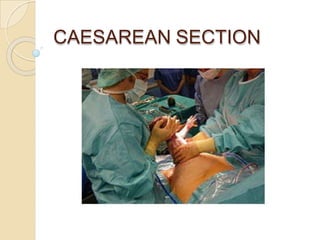
CAESAREAN SECTION
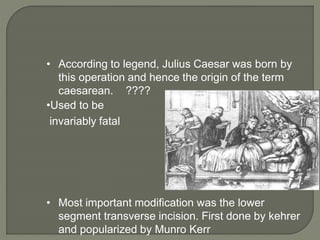
• According to legend, Julius Caesar was born by
this operation and hence the origin of the term
caesarean. ????
•Used to be
invariably fatal
• Most important modification was the lower
segment transverse incision. First done by kehrer
and popularized by Munro Kerr
INTRODUCTION
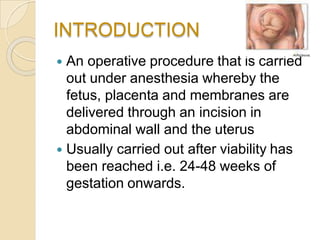
 An operative procedure that is carried
out under anesthesia whereby the
fetus, placenta and membranes are
delivered through an incision in
abdominal wall and the uterus
 Usually carried out after viability has
been reached i.e. 24-48 weeks of
gestation onwards.
 The first operation performed on a
women is referred to as a primary
caesarean section.
 When operation is performed in
subsequent pregnancies,it is called
repeat caesarean section.(C/S)
INCIDENCE:
 The incidence of caesarean is steadly
raising.
 During the last decade there has been
two-three folds rise in the inciddence
from the initial rate of about 10%.
 Factors responsible are increased safety
of operation due to improved anesthesia,
availability of blood transfusion and
antibiotics.
 Increased awareness of fetal well being
and idenification of risk factors have
caused reduction of difficult operation or
manipulative vaginal deliveries.
Indication for Caesarean section
. Absolute:
 VaginalAtresia
 Advanced carcinoma of cervix
 Cervical or broad of contracted pelvis.
 Severe degree of contracted pelvis.
. Relatives:
 Cephalopelvic disproporton
 Previous uterine scar
 Fetal distress.
 Malpresentations
 Antepartum hemorrhage
 Elderly primigravidae
 Chronic hypertension
 Diabetes
 Pelvis atresia
.Fetal indicaton
 Fetal distress
 Umbilical cord prolapse
 Macrosomia
 Placental insufficiency
 Multiple pregnancy
Contraindication
 Dead fetus
 Baby is too much premature
 Presence of blood coagulation
disorder
Time of operation:
A. Elective caesarean section:
 The term elective indicates that the
decision to deliver the baby by
caesarean has been made during the
pregnancy and before the onset of
labour.
 It means pre-planning for doing
caesarean section.
 Indication:
CPD
Placenta previa
Bad obstetric history
B. Emergency caesarean
delivery
 When the operation is performed due
to unforseen complication arising
either during pregnancy or labour
without wasting time following the
decision.
 Indication:
Cord prolapse
Uterine rupture
Eclampsia
Prolonged first stage of labour
Abnormal uterine contraction
Types of operation:
1. Lower segment caesarean section:
 Is lesser muscular than the upper
segment of the uterus.
 Transverse incision is made in the lower
segment this heals faster and sucessfully
than an incision in the upper segment of the
uterus.
 There is less muscle and more fibrous
tissue in lower segment which reduces the
risk of rupture in a subsequent pregnancy.
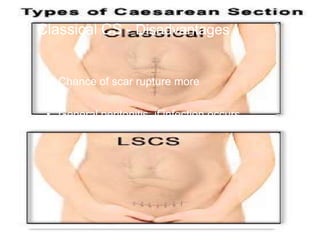
 Also known as “pfannensteel or bikini line
2. Classical caesarean section:
 In this baby is extracted through an
incision made in upper segment of
uterus.
 Is rarely performed.
 Operation is done only under forced
circumstances, such as:
carcinoma of cervix
Big fibroid on lower segment
constriction ring
lower segment is difficult or risky
example:placenta previa, adhesion due to
previous abdominal operation.
Classical CS - Disadvantages
• Chance of scar rupture more
• General peritonitis ,if infection occurs
LSCS SCAR CLASSICAL SCAR
Apposition Better Difficult
Healing in Better as the Lower Imperfect due to
puerperium segment is quiscent contraction and
retraction of upper
segment
Placental
implantation
May be over the scar much more likely
Rupture .5-2% 4-8%
Timing of rupture In labour In pregnancy and
labour
Infection Less chance More chance
Supplies/ Equipment
1. Extra drape sheet
2. Towels
3. Receiving pack for baby
4. C-section tray
5. Delivery forceps
6. Cord clamp
7. Basin set
8. Blades
9. Neonatal receiving unit
10. Self-contained oxygen
11. I.D bands
12. Suction
13. Bulb syringe
14. Solutions
15. Suture
LOWER SEGMENT CAESAREAN
SECTION
 Preoperative actions






Valid informed consent
Inj Ranitidine 50 mg IV half to one hour
before the procedure
Inj Metoclopramide 10 mg IV half to one
hour before the procedure
Stomach should be empty
Bladder should be catheterized
Fetal presentation, position and FHS should
be checked
LOWER SEGMENT CAESAREAN SECTION
 ANAESTHESIA



Spinal
Epidural
GA
 POSITION


Dorsal position
15 degree lateral tilt to prevent supine hypotension /
venocaval compression may be given
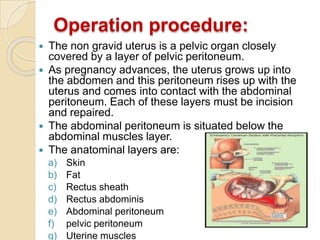
Operation procedure:
 The non gravid uterus is a pelvic organ closely
covered by a layer of pelvic peritoneum.
 As pregnancy advances, the uterus grows up into
the abdomen and this peritoneum rises up with the
uterus and comes into contact with the abdominal
peritoneum. Each of these layers must be incision
and repaired.
 The abdominal peritoneum is situated below the
abdominal muscles layer.
 The anatominal layers are:
a) Skin
b) Fat
c) Rectus sheath
d) Rectus abdominis
e) Abdominal peritoneum
f) pelvic peritoneum
g) Uterine muscles
 The operation most commonly carried out
is the lower segment caesarean section.
 The lower segment incision is in the less
muscular and active part of the uterus and
heals better.
 The main reason for preferring the lower
uterine segment technique is the reduced
incidence of dehiscent pregnancy.
 The abdomen is opened and the loose
folds of the peritoneum over the anterior
aspect of the lower uterine segment and
above the bladder is incised. The operator
continues so incise this further to visualize
the fundus of bladder which is then pushed
down and away from the surgeon.
 The surgeon direct the fetal head out while
the assistant applies fundal pressure to hip
the delivery of the baby.
 Oxytocins may be given by the anesthetist
after delivery of the baby and clamping the
cord.
 When the baby and placental have been
delivered the uterus is sutured.
 This is usualy done in two layers. The
peritoneum then be clased over uterine
wound to exclude it from the peritoneal
cavity.
 The rectus sheath is closed then the layers
of fat and finally the skin is sutured with the
surgeons choice of materials; commonly
Nursing Management
A. Pre-operative management:
Patient should be physically prepared
i.e.abdomen,back ,private parts and upper
part os thigh are shaved and cleaned.
Prepare mother psychologically by
providing assurance a nd explanning the
indication,procedure and need of
caesarean section.
Administration of IV infusion of 50%
dextrose to avoid hypotension following
spinal anaesthesia,the infusion line is
maintained patent by an intra venous
cannula.
Blood grouped and cross matched for
emergency requirement.
Bladder should be empty by inserting
foleys catheter.This may be done
before and after induction of
anaesthesia.
Mother should be in NPO for about 8
hours.
Patient should be in clean
gown,valuable ornament should be
taken off and all make up should be
removed.
If elective caesarean section then
Ranitidine 150mg should be given
orally in the night before and repeated
one hour before surgery to prevent
B. Post operative care :
1. Immediate care (4-6 hours):
• In the immediate recovery period,the blood
pressure is recorded in every 2 hourly.
• The wound must be inspected half hourly
to detect any blood loss.
• The lochia are inspected and drainage
should be small initially Following general
anaesthesia, the women is nursed in left
lateral or recovery position until she is fully
conscious.
• Analgesic is given as prescribed.
2. First 24 hours:
 IV fluids are continued,blood transfusion is helpful
in anemia mothers.
 Parental antibiotic is usually given for 1st 48
hours,analgesics is the form of pethidine 75-100mg
are given as needed.
 Ambulation is encouraged following day of surgery
and baby is given to mother.
3. After 24 hours:
 TPR are usually checked every 4 hourly
 Orally feeding is started with clear liquid and then
advanced to normal diet and IV fluid are continued
for about 48 hours.
 Catheter may be removed on following day when
the women is able to get up to the toilet. She should
be helped to get out of bed.
 The mother must be encouraged to take rest and
provide care to the baby and should breast feed the
Complication
 Mother:
 post partum hemorrhage related to uterine
atony and rarely blood coagulation
disorders.
Shocks related to blood loss.
Anesthesia hazards
Sepsis, secondary PPH.
Thrombosis
Lung infection post.
 Late compilcation:
Menstrual irregularity
Chronic pelvic pain
Backache
 Fetus:
Iatrogenic prematurity.
Respiratory distress syndrome.
Injury to baby due to surgical knife.
Birth asphyxia due to anaesthesia.

LOWER SEGMENT CAESAREAN SECTION.pptx

  • 1.
  • 2.
    • According tolegend, Julius Caesar was born by this operation and hence the origin of the term caesarean. ???? •Used to be invariably fatal • Most important modification was the lower segment transverse incision. First done by kehrer and popularized by Munro Kerr
  • 3.
    INTRODUCTION  An operativeprocedure that is carried out under anesthesia whereby the fetus, placenta and membranes are delivered through an incision in abdominal wall and the uterus  Usually carried out after viability has been reached i.e. 24-48 weeks of gestation onwards.
  • 4.
     The firstoperation performed on a women is referred to as a primary caesarean section.  When operation is performed in subsequent pregnancies,it is called repeat caesarean section.(C/S)
  • 5.
    INCIDENCE:  The incidenceof caesarean is steadly raising.  During the last decade there has been two-three folds rise in the inciddence from the initial rate of about 10%.  Factors responsible are increased safety of operation due to improved anesthesia, availability of blood transfusion and antibiotics.  Increased awareness of fetal well being and idenification of risk factors have caused reduction of difficult operation or manipulative vaginal deliveries.
  • 6.
    Indication for Caesareansection . Absolute:  VaginalAtresia  Advanced carcinoma of cervix  Cervical or broad of contracted pelvis.  Severe degree of contracted pelvis. . Relatives:  Cephalopelvic disproporton  Previous uterine scar  Fetal distress.  Malpresentations  Antepartum hemorrhage  Elderly primigravidae  Chronic hypertension  Diabetes  Pelvis atresia
  • 7.
    .Fetal indicaton  Fetaldistress  Umbilical cord prolapse  Macrosomia  Placental insufficiency  Multiple pregnancy
  • 8.
    Contraindication  Dead fetus Baby is too much premature  Presence of blood coagulation disorder
  • 9.
    Time of operation: A.Elective caesarean section:  The term elective indicates that the decision to deliver the baby by caesarean has been made during the pregnancy and before the onset of labour.  It means pre-planning for doing caesarean section.  Indication: CPD Placenta previa Bad obstetric history
  • 10.
    B. Emergency caesarean delivery When the operation is performed due to unforseen complication arising either during pregnancy or labour without wasting time following the decision.  Indication: Cord prolapse Uterine rupture Eclampsia Prolonged first stage of labour Abnormal uterine contraction
  • 11.
    Types of operation: 1.Lower segment caesarean section:  Is lesser muscular than the upper segment of the uterus.  Transverse incision is made in the lower segment this heals faster and sucessfully than an incision in the upper segment of the uterus.  There is less muscle and more fibrous tissue in lower segment which reduces the risk of rupture in a subsequent pregnancy.  Also known as “pfannensteel or bikini line
  • 12.
    2. Classical caesareansection:  In this baby is extracted through an incision made in upper segment of uterus.  Is rarely performed.  Operation is done only under forced circumstances, such as: carcinoma of cervix Big fibroid on lower segment constriction ring lower segment is difficult or risky example:placenta previa, adhesion due to previous abdominal operation.
  • 13.
    Classical CS -Disadvantages • Chance of scar rupture more • General peritonitis ,if infection occurs
  • 14.
    LSCS SCAR CLASSICALSCAR Apposition Better Difficult Healing in Better as the Lower Imperfect due to puerperium segment is quiscent contraction and retraction of upper segment Placental implantation May be over the scar much more likely Rupture .5-2% 4-8% Timing of rupture In labour In pregnancy and labour Infection Less chance More chance
  • 15.
    Supplies/ Equipment 1. Extradrape sheet 2. Towels 3. Receiving pack for baby 4. C-section tray 5. Delivery forceps 6. Cord clamp 7. Basin set 8. Blades 9. Neonatal receiving unit 10. Self-contained oxygen 11. I.D bands 12. Suction 13. Bulb syringe 14. Solutions 15. Suture
  • 16.
    LOWER SEGMENT CAESAREAN SECTION Preoperative actions       Valid informed consent Inj Ranitidine 50 mg IV half to one hour before the procedure Inj Metoclopramide 10 mg IV half to one hour before the procedure Stomach should be empty Bladder should be catheterized Fetal presentation, position and FHS should be checked
  • 17.
    LOWER SEGMENT CAESAREANSECTION  ANAESTHESIA    Spinal Epidural GA  POSITION   Dorsal position 15 degree lateral tilt to prevent supine hypotension / venocaval compression may be given
  • 18.
    Operation procedure:  Thenon gravid uterus is a pelvic organ closely covered by a layer of pelvic peritoneum.  As pregnancy advances, the uterus grows up into the abdomen and this peritoneum rises up with the uterus and comes into contact with the abdominal peritoneum. Each of these layers must be incision and repaired.  The abdominal peritoneum is situated below the abdominal muscles layer.  The anatominal layers are: a) Skin b) Fat c) Rectus sheath d) Rectus abdominis e) Abdominal peritoneum f) pelvic peritoneum g) Uterine muscles
  • 19.
     The operationmost commonly carried out is the lower segment caesarean section.  The lower segment incision is in the less muscular and active part of the uterus and heals better.  The main reason for preferring the lower uterine segment technique is the reduced incidence of dehiscent pregnancy.  The abdomen is opened and the loose folds of the peritoneum over the anterior aspect of the lower uterine segment and above the bladder is incised. The operator continues so incise this further to visualize the fundus of bladder which is then pushed down and away from the surgeon.
  • 20.
     The surgeondirect the fetal head out while the assistant applies fundal pressure to hip the delivery of the baby.  Oxytocins may be given by the anesthetist after delivery of the baby and clamping the cord.  When the baby and placental have been delivered the uterus is sutured.  This is usualy done in two layers. The peritoneum then be clased over uterine wound to exclude it from the peritoneal cavity.  The rectus sheath is closed then the layers of fat and finally the skin is sutured with the surgeons choice of materials; commonly
  • 21.
    Nursing Management A. Pre-operativemanagement: Patient should be physically prepared i.e.abdomen,back ,private parts and upper part os thigh are shaved and cleaned. Prepare mother psychologically by providing assurance a nd explanning the indication,procedure and need of caesarean section. Administration of IV infusion of 50% dextrose to avoid hypotension following spinal anaesthesia,the infusion line is maintained patent by an intra venous cannula. Blood grouped and cross matched for emergency requirement.
  • 22.
    Bladder should beempty by inserting foleys catheter.This may be done before and after induction of anaesthesia. Mother should be in NPO for about 8 hours. Patient should be in clean gown,valuable ornament should be taken off and all make up should be removed. If elective caesarean section then Ranitidine 150mg should be given orally in the night before and repeated one hour before surgery to prevent
  • 23.
    B. Post operativecare : 1. Immediate care (4-6 hours): • In the immediate recovery period,the blood pressure is recorded in every 2 hourly. • The wound must be inspected half hourly to detect any blood loss. • The lochia are inspected and drainage should be small initially Following general anaesthesia, the women is nursed in left lateral or recovery position until she is fully conscious. • Analgesic is given as prescribed.
  • 24.
    2. First 24hours:  IV fluids are continued,blood transfusion is helpful in anemia mothers.  Parental antibiotic is usually given for 1st 48 hours,analgesics is the form of pethidine 75-100mg are given as needed.  Ambulation is encouraged following day of surgery and baby is given to mother. 3. After 24 hours:  TPR are usually checked every 4 hourly  Orally feeding is started with clear liquid and then advanced to normal diet and IV fluid are continued for about 48 hours.  Catheter may be removed on following day when the women is able to get up to the toilet. She should be helped to get out of bed.  The mother must be encouraged to take rest and provide care to the baby and should breast feed the
  • 25.
    Complication  Mother:  postpartum hemorrhage related to uterine atony and rarely blood coagulation disorders. Shocks related to blood loss. Anesthesia hazards Sepsis, secondary PPH. Thrombosis Lung infection post.
  • 26.
     Late compilcation: Menstrualirregularity Chronic pelvic pain Backache  Fetus: Iatrogenic prematurity. Respiratory distress syndrome. Injury to baby due to surgical knife. Birth asphyxia due to anaesthesia.