Heat Transfer
One dimensional transient heat conduction
Introduction
During any period in which temperatures changes
in time at any place within an object, the mode of
thermal energy flow is termed transient
conduction. Another term is "non steady-
state" conduction, referring to time-dependence of
temperature fields in an object in one dimension
only .
2
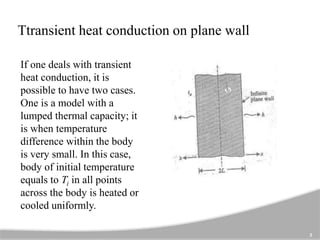
Ttransient heat conduction on plane wall
If one deals with transient
heat conduction, it is
possible to have two cases.
One is a model with a
lumped thermal capacity; it
is when temperature
difference within the body
is very small. In this case,
body of initial temperature
equals to Ti in all points
across the body is heated or
cooled uniformly.
3
Transient heat conduction in semi-infinite
solids
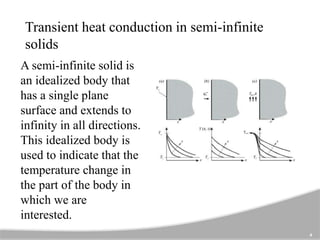
A semi-infinite solid is
an idealized body that
has a single plane
surface and extends to
infinity in all directions.
This idealized body is
used to indicate that the
temperature change in
the part of the body in
which we are
interested.
4
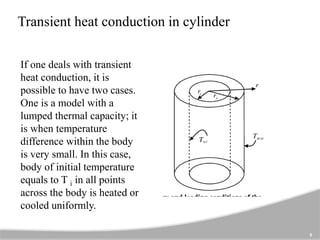
Transient heat conduction in cylinder
If one deals with transient
heat conduction, it is
possible to have two cases.
One is a model with a
lumped thermal capacity; it
is when temperature
difference within the body
is very small. In this case,
body of initial temperature
equals to T i in all points
across the body is heated or
cooled uniformly.
5
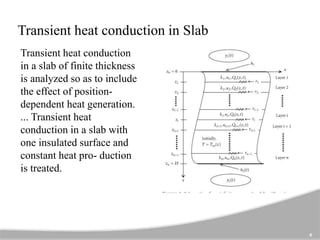
Transient heat conduction in Slab
Transient heat conduction
in a slab of finite thickness
is analyzed so as to include
the effect of position-
dependent heat generation.
... Transient heat
conduction in a slab with
one insulated surface and
constant heat pro- duction
is treated.
6
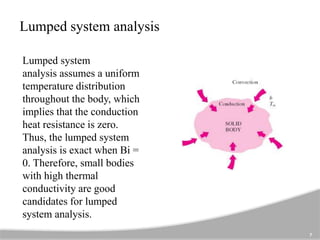
Lumped system analysis
Lumped system
analysis assumes a uniform
temperature distribution
throughout the body, which
implies that the conduction
heat resistance is zero.
Thus, the lumped system
analysis is exact when Bi =
0. Therefore, small bodies
with high thermal
conductivity are good
candidates for lumped
system analysis.
7
Applications of transient heat conduction
• Used in determining the integration point.
• Used for calculating the colocation point.
• Solves heat conduction problems.
• Internal heat conduction points are determined.
• Used in heat exchangers.
• Boiler tubes work under this principle.
8
9

One Dimensional Transient Heat Conduction

  • 1.
    Heat Transfer One dimensionaltransient heat conduction
  • 2.
    Introduction During any periodin which temperatures changes in time at any place within an object, the mode of thermal energy flow is termed transient conduction. Another term is "non steady- state" conduction, referring to time-dependence of temperature fields in an object in one dimension only . 2
  • 3.
    Ttransient heat conductionon plane wall If one deals with transient heat conduction, it is possible to have two cases. One is a model with a lumped thermal capacity; it is when temperature difference within the body is very small. In this case, body of initial temperature equals to Ti in all points across the body is heated or cooled uniformly. 3
  • 4.
    Transient heat conductionin semi-infinite solids A semi-infinite solid is an idealized body that has a single plane surface and extends to infinity in all directions. This idealized body is used to indicate that the temperature change in the part of the body in which we are interested. 4
  • 5.
    Transient heat conductionin cylinder If one deals with transient heat conduction, it is possible to have two cases. One is a model with a lumped thermal capacity; it is when temperature difference within the body is very small. In this case, body of initial temperature equals to T i in all points across the body is heated or cooled uniformly. 5
  • 6.
    Transient heat conductionin Slab Transient heat conduction in a slab of finite thickness is analyzed so as to include the effect of position- dependent heat generation. ... Transient heat conduction in a slab with one insulated surface and constant heat pro- duction is treated. 6
  • 7.
    Lumped system analysis Lumpedsystem analysis assumes a uniform temperature distribution throughout the body, which implies that the conduction heat resistance is zero. Thus, the lumped system analysis is exact when Bi = 0. Therefore, small bodies with high thermal conductivity are good candidates for lumped system analysis. 7
  • 8.
    Applications of transientheat conduction • Used in determining the integration point. • Used for calculating the colocation point. • Solves heat conduction problems. • Internal heat conduction points are determined. • Used in heat exchangers. • Boiler tubes work under this principle. 8
  • 9.