Finite Element Modelling
Expression for shape function of linear
element
Introduction
The shape function is the function which interpolates the
solution between the discrete values obtained at the mesh
nodes. Therefore, appropriate functions have to be used
and, as already mentioned, low order polynomials are
typically chosen as shape functions. In this work linear
shape functions are used
2
Contents
 Concept of shape function and natural co-ordinates.
 Strain-Displacement Matrix.
 Properties of stiffness matrix.
3
Shape functions and coordinates.
Natural Coordinate and Shape Functions
Natural Coordinate
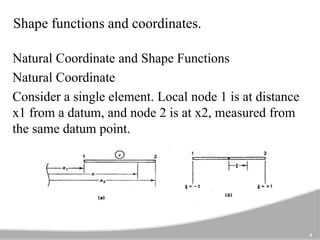
Consider a single element. Local node 1 is at distance
x1 from a datum, and node 2 is at x2, measured from
the same datum point.
4
Shape functions
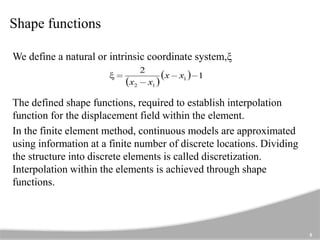
We define a natural or intrinsic coordinate system,ξ
The defined shape functions, required to establish interpolation
function for the displacement field within the element.
In the finite element method, continuous models are approximated
using information at a finite number of discrete locations. Dividing
the structure into discrete elements is called discretization.
Interpolation within the elements is achieved through shape
functions.
5
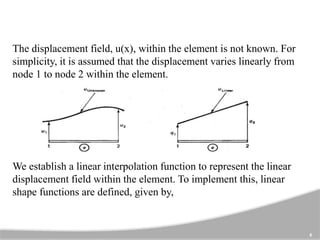
The displacement field, u(x), within the element is not known. For
simplicity, it is assumed that the displacement varies linearly from
node 1 to node 2 within the element.
We establish a linear interpolation function to represent the linear
displacement field within the element. To implement this, linear
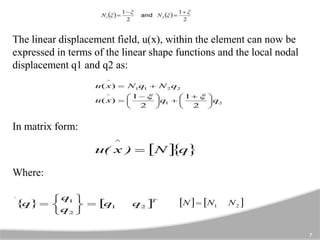
shape functions are defined, given by,
6
The linear displacement field, u(x), within the element can now be
expressed in terms of the linear shape functions and the local nodal
displacement q1 and q2 as:
In matrix form:
Where:
7
Isoperimetric Formulation
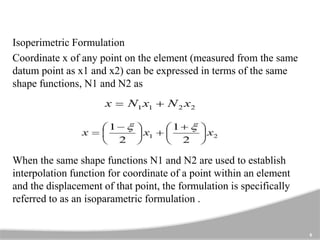
Coordinate x of any point on the element (measured from the same
datum point as x1 and x2) can be expressed in terms of the same
shape functions, N1 and N2 as
When the same shape functions N1 and N2 are used to establish
interpolation function for coordinate of a point within an element
and the displacement of that point, the formulation is specifically
referred to as an isoparametric formulation .
8
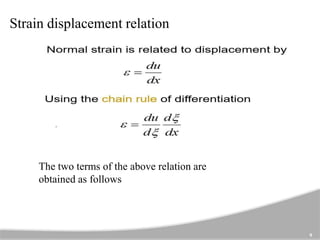
Strain displacement relation
9
The two terms of the above relation are
obtained as follows
Thus the normal strain relation can be written as
which can be written in matrix form as
where [B] is a row matrix called the strain-displacement matrix, given
by since x2 – x1 = element length = le
10
Properties od stiffness matrix
 The dimension of the global stiffness matrix is (nxn),
where n is total number d.o.f. of the body(or structure).
 It is symmetric matrix.
 It is singular matrix, and hence [K]-1 does not exist.
 For global stiffness matrix, sum of any row or column
is equal to zero.
 It is positive definite i.e. all diagonal elements are
nonzero and positive.
 I tis banded matrix. That is, all elements outside the
band are zero.
11
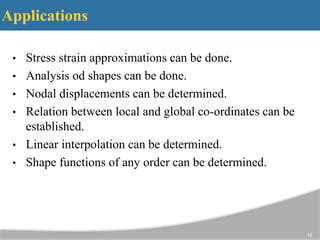
Applications
• Stress strain approximations can be done.
• Analysis od shapes can be done.
• Nodal displacements can be determined.
• Relation between local and global co-ordinates can be
established.
• Linear interpolation can be determined.
• Shape functions of any order can be determined.
12
13

Expressions for shape functions of linear element

  • 1.
    Finite Element Modelling Expressionfor shape function of linear element
  • 2.
    Introduction The shape functionis the function which interpolates the solution between the discrete values obtained at the mesh nodes. Therefore, appropriate functions have to be used and, as already mentioned, low order polynomials are typically chosen as shape functions. In this work linear shape functions are used 2
  • 3.
    Contents  Concept ofshape function and natural co-ordinates.  Strain-Displacement Matrix.  Properties of stiffness matrix. 3
  • 4.
    Shape functions andcoordinates. Natural Coordinate and Shape Functions Natural Coordinate Consider a single element. Local node 1 is at distance x1 from a datum, and node 2 is at x2, measured from the same datum point. 4
  • 5.
    Shape functions We definea natural or intrinsic coordinate system,ξ The defined shape functions, required to establish interpolation function for the displacement field within the element. In the finite element method, continuous models are approximated using information at a finite number of discrete locations. Dividing the structure into discrete elements is called discretization. Interpolation within the elements is achieved through shape functions. 5
  • 6.
    The displacement field,u(x), within the element is not known. For simplicity, it is assumed that the displacement varies linearly from node 1 to node 2 within the element. We establish a linear interpolation function to represent the linear displacement field within the element. To implement this, linear shape functions are defined, given by, 6
  • 7.
    The linear displacementfield, u(x), within the element can now be expressed in terms of the linear shape functions and the local nodal displacement q1 and q2 as: In matrix form: Where: 7
  • 8.
    Isoperimetric Formulation Coordinate xof any point on the element (measured from the same datum point as x1 and x2) can be expressed in terms of the same shape functions, N1 and N2 as When the same shape functions N1 and N2 are used to establish interpolation function for coordinate of a point within an element and the displacement of that point, the formulation is specifically referred to as an isoparametric formulation . 8
  • 9.
    Strain displacement relation 9 Thetwo terms of the above relation are obtained as follows
  • 10.
    Thus the normalstrain relation can be written as which can be written in matrix form as where [B] is a row matrix called the strain-displacement matrix, given by since x2 – x1 = element length = le 10
  • 11.
    Properties od stiffnessmatrix  The dimension of the global stiffness matrix is (nxn), where n is total number d.o.f. of the body(or structure).  It is symmetric matrix.  It is singular matrix, and hence [K]-1 does not exist.  For global stiffness matrix, sum of any row or column is equal to zero.  It is positive definite i.e. all diagonal elements are nonzero and positive.  I tis banded matrix. That is, all elements outside the band are zero. 11
  • 12.
    Applications • Stress strainapproximations can be done. • Analysis od shapes can be done. • Nodal displacements can be determined. • Relation between local and global co-ordinates can be established. • Linear interpolation can be determined. • Shape functions of any order can be determined. 12
  • 13.