Curves and Surfaces
1
Objectives
• Introduce types of curves and surfaces
• Explicit
• Implicit
• Parametric
• Strengths and weaknesses
• Discuss Modeling and Approximations
• Conditions
• Stability
2
Escaping Flatland
• Until now we have worked with flat entities such as lines and flat
polygons
• Fit well with graphics hardware
• Mathematically simple
• But the world is not composed of flat entities
• Need curves and curved surfaces
• May only have need at the application level
• Implementation can render them approximately with flat primitives
3
Modeling with Curves
4
data points
approximating curve
interpolating data point
What Makes a Good Representation?
• There are many ways to represent curves and surfaces
• Want a representation that is
• Stable
• Smooth
• Easy to evaluate
• Must we interpolate or can we just come close to data?
• Do we need derivatives?
5
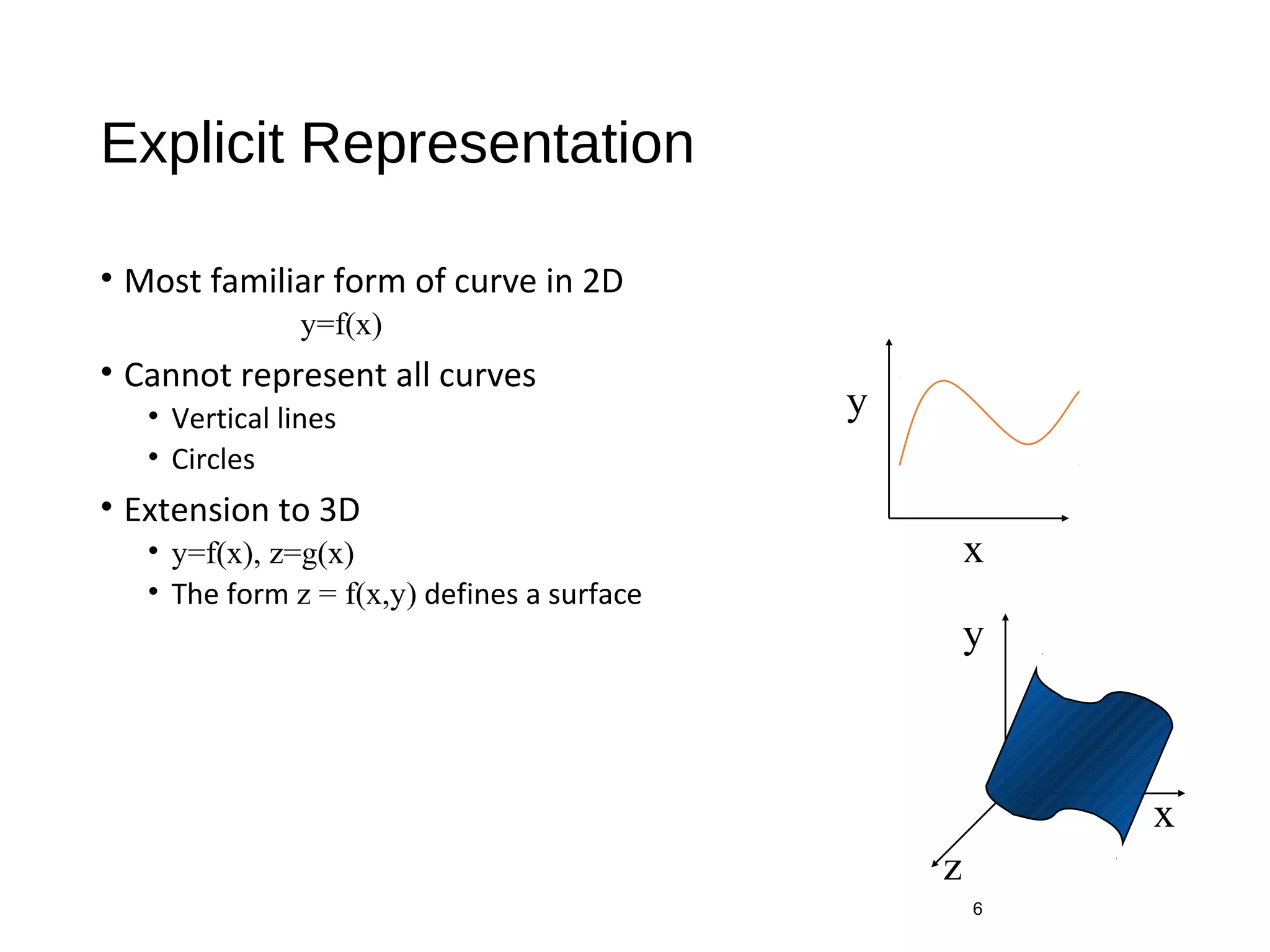
Explicit Representation
• Most familiar form of curve in 2D
y=f(x)
• Cannot represent all curves
• Vertical lines
• Circles
• Extension to 3D
• y=f(x), z=g(x)
• The form z = f(x,y) defines a surface
6
x
y
x
y
z
Implicit Representation
•Two dimensional curve(s)
g(x,y)=0
•Much more robust
• All lines ax+by+c=0
• Circles x2
+y2
-r2
=0
•Three dimensions g(x,y,z)=0 defines a surface
• Intersect two surface to get a curve
•In general, we cannot solve for points that satisfy
7
Algebraic Surface
8
0=∑∑∑ zyx
kj
i j k
i
•Quadric surface 2 ≥ i+j+k
•At most 10 terms
•Can solve intersection with a ray by
reducing problem to solving quadratic equation
Parametric Curves
•Separate equation for each spatial variable
x=x(u)
y=y(u)
z=z(u)
• For umax ≥ u ≥ umin we trace out a curve in two or three
dimensions
9
p(u)=[x(u), y(u), z(u)]T
p(u)
p(umin)
p(umax)
Selecting Functions
• Usually we can select “good” functions
• not unique for a given spatial curve
• Approximate or interpolate known data
• Want functions which are easy to evaluate
• Want functions which are easy to differentiate
• Computation of normals
• Connecting pieces (segments)
•Want functions which are smooth
10
Parametric Lines
11
Line connecting two points p0 and p1
p(u)=(1-u)p0+up1
We can normalize u to be over the interval (0,1)
p(0) = p0
p(1)= p1
Ray from p0 in the direction d
p(u)=p0+ud
p(0) = p0
p(1)= p0 +d
d
Parametric Surfaces
• Surfaces require 2 parameters
x=x(u,v)
y=y(u,v)
z=z(u,v)
p(u,v) = [x(u,v), y(u,v), z(u,v)]T
• Want same properties as curves:
• Smoothness
• Differentiability
• Ease of evaluation
12
x
y
z p(u,0)
p(1,v)
p(0,v)
p(u,1)
Normals
We can differentiate with respect to u and v to obtain
the normal at any point p
13










∂∂
∂∂
∂∂
=
∂
∂
uvu
uvu
uvu
u
vu
/),(z
/),(y
/),(x
),(p










∂∂
∂∂
∂∂
=
∂
∂
vvu
vvu
vvu
v
vu
/),(z
/),(y
/),(x
),(p
v
vu
u
vu
∂
∂
×
∂
∂
=
),(),( pp
n
Parametric Planes
14
point-vector form
p(u,v)=p0+uq+vr
n = q x r
q
r
p0
n
three-point form
p0
n
p1
p2
q = p1 – p0
r = p2 – p0
Parametric Sphere
15
x(u,v) = r cos θ sin φ
y(u,v) = r sin θ sin φ
z(u,v) = r cos φ
360 ≥ θ ≥ 0
180 ≥ φ ≥ 0
θ constant: circles of constant longitude
φ constant: circles of constant latitude
differentiate to show n = p
Curve Segments
•After normalizing u, each curve is written
p(u)=[x(u), y(u), z(u)]T
, 1 ≥ u ≥ 0
•In classical numerical methods, we design a single
global curve
•In computer graphics and CAD, it is better to design
small connected curve segments
16
p(u)
q(u)
p(0)
q(1)
join point p(1) = q(0)
Parametric Polynomial Curves
17
ucux i
N
i
xi∑=
=
0
)( ucuy j
M
j
yj∑=
=
0
)( ucuz k
L
k
zk∑=
=
0
)(
•If N=M=K, we need to determine 3(N+1) coefficients
•Equivalently we need 3(N+1) independent conditions
•Noting that the curves for x, y and z are independent,
we can define each independently in an identical manner
•We will use the form
where p can be any of x, y, z
ucu k
L
k
k∑=
=
0
)(p
Why Polynomials
• Easy to evaluate
• Continuous and differentiable everywhere
• Must worry about continuity at join points including continuity of derivatives
18
p(u)
q(u)
join point p(1) = q(0)
but p’(1) ≠ q’(0)
Cubic Parametric Polynomials
•N=M=L=3, gives balance between ease of evaluation
and flexibility in design
•Four coefficients to determine for each of x, y and z
•Seek four independent conditions for various values of
u resulting in 4 equations in 4 unknowns for each of x,
y and z
• Conditions are a mixture of continuity requirements at the join points and
conditions for fitting the data
19
ucu k
k
k∑=
=
3
0
)(p
Cubic Polynomial Surfaces
20
vucvu ji
i j
ij∑∑= =
=
3
0
3
0
),(p
p(u,v)=[x(u,v), y(u,v), z(u,v)]T
where
p is any of x, y or z
Need 48 coefficients ( 3 independent sets of 16) to
determine a surface patch

Curves and Surfaces

  • 1.
  • 2.
    Objectives • Introduce typesof curves and surfaces • Explicit • Implicit • Parametric • Strengths and weaknesses • Discuss Modeling and Approximations • Conditions • Stability 2
  • 3.
    Escaping Flatland • Untilnow we have worked with flat entities such as lines and flat polygons • Fit well with graphics hardware • Mathematically simple • But the world is not composed of flat entities • Need curves and curved surfaces • May only have need at the application level • Implementation can render them approximately with flat primitives 3
  • 4.
    Modeling with Curves 4 datapoints approximating curve interpolating data point
  • 5.
    What Makes aGood Representation? • There are many ways to represent curves and surfaces • Want a representation that is • Stable • Smooth • Easy to evaluate • Must we interpolate or can we just come close to data? • Do we need derivatives? 5
  • 6.
    Explicit Representation • Mostfamiliar form of curve in 2D y=f(x) • Cannot represent all curves • Vertical lines • Circles • Extension to 3D • y=f(x), z=g(x) • The form z = f(x,y) defines a surface 6 x y x y z
  • 7.
    Implicit Representation •Two dimensionalcurve(s) g(x,y)=0 •Much more robust • All lines ax+by+c=0 • Circles x2 +y2 -r2 =0 •Three dimensions g(x,y,z)=0 defines a surface • Intersect two surface to get a curve •In general, we cannot solve for points that satisfy 7
  • 8.
    Algebraic Surface 8 0=∑∑∑ zyx kj ij k i •Quadric surface 2 ≥ i+j+k •At most 10 terms •Can solve intersection with a ray by reducing problem to solving quadratic equation
  • 9.
    Parametric Curves •Separate equationfor each spatial variable x=x(u) y=y(u) z=z(u) • For umax ≥ u ≥ umin we trace out a curve in two or three dimensions 9 p(u)=[x(u), y(u), z(u)]T p(u) p(umin) p(umax)
  • 10.
    Selecting Functions • Usuallywe can select “good” functions • not unique for a given spatial curve • Approximate or interpolate known data • Want functions which are easy to evaluate • Want functions which are easy to differentiate • Computation of normals • Connecting pieces (segments) •Want functions which are smooth 10
  • 11.
    Parametric Lines 11 Line connectingtwo points p0 and p1 p(u)=(1-u)p0+up1 We can normalize u to be over the interval (0,1) p(0) = p0 p(1)= p1 Ray from p0 in the direction d p(u)=p0+ud p(0) = p0 p(1)= p0 +d d
  • 12.
    Parametric Surfaces • Surfacesrequire 2 parameters x=x(u,v) y=y(u,v) z=z(u,v) p(u,v) = [x(u,v), y(u,v), z(u,v)]T • Want same properties as curves: • Smoothness • Differentiability • Ease of evaluation 12 x y z p(u,0) p(1,v) p(0,v) p(u,1)
  • 13.
    Normals We can differentiatewith respect to u and v to obtain the normal at any point p 13           ∂∂ ∂∂ ∂∂ = ∂ ∂ uvu uvu uvu u vu /),(z /),(y /),(x ),(p           ∂∂ ∂∂ ∂∂ = ∂ ∂ vvu vvu vvu v vu /),(z /),(y /),(x ),(p v vu u vu ∂ ∂ × ∂ ∂ = ),(),( pp n
  • 14.
    Parametric Planes 14 point-vector form p(u,v)=p0+uq+vr n= q x r q r p0 n three-point form p0 n p1 p2 q = p1 – p0 r = p2 – p0
  • 15.
    Parametric Sphere 15 x(u,v) =r cos θ sin φ y(u,v) = r sin θ sin φ z(u,v) = r cos φ 360 ≥ θ ≥ 0 180 ≥ φ ≥ 0 θ constant: circles of constant longitude φ constant: circles of constant latitude differentiate to show n = p
  • 16.
    Curve Segments •After normalizingu, each curve is written p(u)=[x(u), y(u), z(u)]T , 1 ≥ u ≥ 0 •In classical numerical methods, we design a single global curve •In computer graphics and CAD, it is better to design small connected curve segments 16 p(u) q(u) p(0) q(1) join point p(1) = q(0)
  • 17.
    Parametric Polynomial Curves 17 ucuxi N i xi∑= = 0 )( ucuy j M j yj∑= = 0 )( ucuz k L k zk∑= = 0 )( •If N=M=K, we need to determine 3(N+1) coefficients •Equivalently we need 3(N+1) independent conditions •Noting that the curves for x, y and z are independent, we can define each independently in an identical manner •We will use the form where p can be any of x, y, z ucu k L k k∑= = 0 )(p
  • 18.
    Why Polynomials • Easyto evaluate • Continuous and differentiable everywhere • Must worry about continuity at join points including continuity of derivatives 18 p(u) q(u) join point p(1) = q(0) but p’(1) ≠ q’(0)
  • 19.
    Cubic Parametric Polynomials •N=M=L=3,gives balance between ease of evaluation and flexibility in design •Four coefficients to determine for each of x, y and z •Seek four independent conditions for various values of u resulting in 4 equations in 4 unknowns for each of x, y and z • Conditions are a mixture of continuity requirements at the join points and conditions for fitting the data 19 ucu k k k∑= = 3 0 )(p
  • 20.
    Cubic Polynomial Surfaces 20 vucvuji i j ij∑∑= = = 3 0 3 0 ),(p p(u,v)=[x(u,v), y(u,v), z(u,v)]T where p is any of x, y or z Need 48 coefficients ( 3 independent sets of 16) to determine a surface patch