Cache Memory
By
Ms.V.VENNILA,MCA.,M.Phil.,
Assistant Professor, Bon Secours College for Women
Thanjavur.
Cache Memory
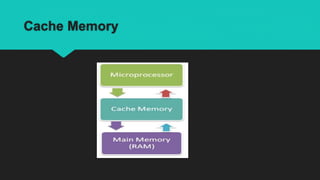
 It is small in size but faster than the main memory. The CPU can access it more
quickly than the primary memory.
 It holds the data and programs frequently used by the CPU. So if the CPU finds the
required data or instructions in cache memory it doesn't need to access the primary
memory (RAM). Thus, it speeds up the system performance.
What is cache Memory
 A cache is a smaller,
 faster memory,
 located closer to a processor core,
 which stores copies of the data from frequently used main memory locations.
Cache Memory
Types of cache Memory
Level 1 cache.
 Level 2 cache.
Level 3 cache.
Level of cache Memory
Level 1 cache Memory primary Cache
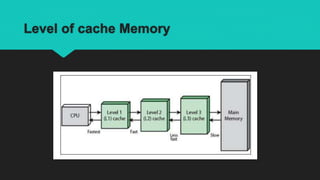
 The L1 cache memory is built on processor chip and it is very fast because it runs on the speed of
the processor.
 It is also called primary or internal cache.
 It has less memory compared to other levels of cache and can store up to the 64kb cache
memory.
 This cache is made of SRAM (Static RAM).
Level 2 cache Memory
 The L2 cache memory is larger but slower than L1 cache.
 It is used to see recent accesses that are not picked by the L1 cache and it usually stores 64kb to
the 2MB cache memory.
 An L2 cache is also found on the CPU.
 L2 caches are composed of SRAM but they are larger.
 L2 is usually a separate static RAM (SRAM) chip and it is located between the CPU and DRAM
(Main memory).
Level 3 cache Memory
 The L3 Cache memory is an enhanced form of memory present on the motherboard of the
computer.
 It is an extra cache built into the motherboard between the processor and main memory to speed
up the processing operations.
 It reduces the time gap between request and retrieving of the data and instructions much more
quickly than the main memory.
CACHE MEMORY

CACHE MEMORY

  • 1.
  • 2.
    Cache Memory  Itis small in size but faster than the main memory. The CPU can access it more quickly than the primary memory.  It holds the data and programs frequently used by the CPU. So if the CPU finds the required data or instructions in cache memory it doesn't need to access the primary memory (RAM). Thus, it speeds up the system performance.
  • 3.
    What is cacheMemory  A cache is a smaller,  faster memory,  located closer to a processor core,  which stores copies of the data from frequently used main memory locations.
  • 4.
  • 5.
    Types of cacheMemory Level 1 cache.  Level 2 cache. Level 3 cache.
  • 6.
  • 7.
    Level 1 cacheMemory primary Cache  The L1 cache memory is built on processor chip and it is very fast because it runs on the speed of the processor.  It is also called primary or internal cache.  It has less memory compared to other levels of cache and can store up to the 64kb cache memory.  This cache is made of SRAM (Static RAM).
  • 8.
    Level 2 cacheMemory  The L2 cache memory is larger but slower than L1 cache.  It is used to see recent accesses that are not picked by the L1 cache and it usually stores 64kb to the 2MB cache memory.  An L2 cache is also found on the CPU.  L2 caches are composed of SRAM but they are larger.  L2 is usually a separate static RAM (SRAM) chip and it is located between the CPU and DRAM (Main memory).
  • 9.
    Level 3 cacheMemory  The L3 Cache memory is an enhanced form of memory present on the motherboard of the computer.  It is an extra cache built into the motherboard between the processor and main memory to speed up the processing operations.  It reduces the time gap between request and retrieving of the data and instructions much more quickly than the main memory.