Unit VI Multiprocessors
by:
Er. Dipesh Vaya
Head & Asst. Prof.
Department of CSE
SSCE, Udaipur, Rajasthan
Contents
 Characteristics of Multiprocessors
 Interconnection Structure
 Interprocessor Arbitration
 Interprocessor Communication and Synchronization
 Cache Coherence
 Shared Memory Multiprocessors
SS College of Engineering, Udaipur, Rajasthan 2
Shared Memory
Multiprocessors
by:
Er. Dipesh Vaya
Head & Asst. Prof.
Department of CSE
SSCE, Udaipur, Rajasthan
SS College of Engineering, Udaipur, Rajasthan
3
Shared Memory Multiprocessors
 Shared memory parallel computers vary widely, but generally have in
common the ability for all processors to access all memory as global
address space.
 Multiple processors can operate independently but share the same
memory resources.
 Changes in a memory location effected by one processor are visible to
all other processors.
 Shared memory machines can be divided into two main classes based
upon memory access times: UMA and NUMA.
SS College of Engineering, Udaipur, Rajasthan
4
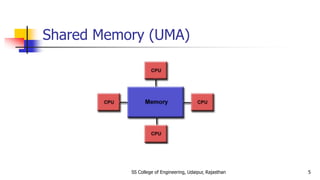
Shared Memory (UMA)
SS College of Engineering, Udaipur, Rajasthan 5
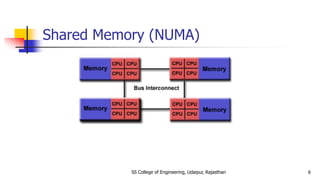
Shared Memory (NUMA)
SS College of Engineering, Udaipur, Rajasthan 6
Uniform Memory Access (UMA):
 Most commonly represented today by Symmetric
Multiprocessor (SMP) machines
 Identical processors
 Equal access and access times to memory
 Sometimes called CC-UMA - Cache Coherent UMA.
Cache coherent means if one processor updates a location
in shared memory, all the other processors know about the
update. Cache coherency is accomplished at the hardware
level.
SS College of Engineering, Udaipur, Rajasthan 7
Non-Uniform Memory Access (NUMA)
 Often made by physically linking two or more SMPs (Symmetric
Multiprocessor)
 One SMP can directly access memory of another SMP
 Not all processors have equal access time to all memories
 Memory access across link is slower
 If cache coherency is maintained, then may also be called CC-
NUMA - Cache Coherent NUMA
SS College of Engineering, Udaipur, Rajasthan 8
Advantages:
 Global address space provides a user-friendly
programming perspective to memory
 Data sharing between tasks is both fast and uniform
due to the proximity of memory to CPUs
SS College of Engineering, Udaipur, Rajasthan 9
Disadvantages:
 Primary disadvantage is the lack of scalability between memory and CPUs.
Adding more CPUs can geometrically increases traffic on the shared memory-
CPU path.
 Programmer responsibility for synchronization constructs that ensure "correct"
access of global memory.
 Expense: it becomes increasingly difficult and expensive to design and produce
shared memory machines with ever increasing numbers of processors.
SS College of Engineering, Udaipur, Rajasthan
10

Unit 6 shared memory multiprocessors

  • 1.
    Unit VI Multiprocessors by: Er.Dipesh Vaya Head & Asst. Prof. Department of CSE SSCE, Udaipur, Rajasthan
  • 2.
    Contents  Characteristics ofMultiprocessors  Interconnection Structure  Interprocessor Arbitration  Interprocessor Communication and Synchronization  Cache Coherence  Shared Memory Multiprocessors SS College of Engineering, Udaipur, Rajasthan 2
  • 3.
    Shared Memory Multiprocessors by: Er. DipeshVaya Head & Asst. Prof. Department of CSE SSCE, Udaipur, Rajasthan SS College of Engineering, Udaipur, Rajasthan 3
  • 4.
    Shared Memory Multiprocessors Shared memory parallel computers vary widely, but generally have in common the ability for all processors to access all memory as global address space.  Multiple processors can operate independently but share the same memory resources.  Changes in a memory location effected by one processor are visible to all other processors.  Shared memory machines can be divided into two main classes based upon memory access times: UMA and NUMA. SS College of Engineering, Udaipur, Rajasthan 4
  • 5.
    Shared Memory (UMA) SSCollege of Engineering, Udaipur, Rajasthan 5
  • 6.
    Shared Memory (NUMA) SSCollege of Engineering, Udaipur, Rajasthan 6
  • 7.
    Uniform Memory Access(UMA):  Most commonly represented today by Symmetric Multiprocessor (SMP) machines  Identical processors  Equal access and access times to memory  Sometimes called CC-UMA - Cache Coherent UMA. Cache coherent means if one processor updates a location in shared memory, all the other processors know about the update. Cache coherency is accomplished at the hardware level. SS College of Engineering, Udaipur, Rajasthan 7
  • 8.
    Non-Uniform Memory Access(NUMA)  Often made by physically linking two or more SMPs (Symmetric Multiprocessor)  One SMP can directly access memory of another SMP  Not all processors have equal access time to all memories  Memory access across link is slower  If cache coherency is maintained, then may also be called CC- NUMA - Cache Coherent NUMA SS College of Engineering, Udaipur, Rajasthan 8
  • 9.
    Advantages:  Global addressspace provides a user-friendly programming perspective to memory  Data sharing between tasks is both fast and uniform due to the proximity of memory to CPUs SS College of Engineering, Udaipur, Rajasthan 9
  • 10.
    Disadvantages:  Primary disadvantageis the lack of scalability between memory and CPUs. Adding more CPUs can geometrically increases traffic on the shared memory- CPU path.  Programmer responsibility for synchronization constructs that ensure "correct" access of global memory.  Expense: it becomes increasingly difficult and expensive to design and produce shared memory machines with ever increasing numbers of processors. SS College of Engineering, Udaipur, Rajasthan 10