The document discusses data definition language (DDL), including its introduction, types, uses in data manipulation and relational databases. DDL is defined as a special language used to define the database schema by setting out definitions that describe the storage structure and access methods used by the database system. It also covers the four types of authorization in DDL and provides examples of DDL statements for creating tables and constraints.
Data definition language.
Ms.V.VENNILA MCA., M.Phil..,
Assistant Professor
Bon Secours College for Women, Thanjavur.
2.
AGENDA:
• INTRODUCTION
• DATADEFINATION LAMGUAGE
• TYPES OF DDL AUTHORIZATION
• DDL IN DATA MANIPULATION
• DDL IN RELATIONAL DATABASE
• CONCLUSION
3.
INTRODUCTION
• A collectionof interrelated data and set of program to access the
data.
• To provide a way to store and retrieve database information
• To keep information about all customers a saving accounts.
• To allow users to manipulate the information.
• File processing system.
4.
DATA DEFINITION LANGUAGE
•The database schema by set of definition expressed by a special
language is called data definition language.
• The storage structured and access methods used by the database
system in DDL , is called data storage and definition language.
• The output of the DDL list, placed in the data dictionary which
contains meta data(data about data).
5.
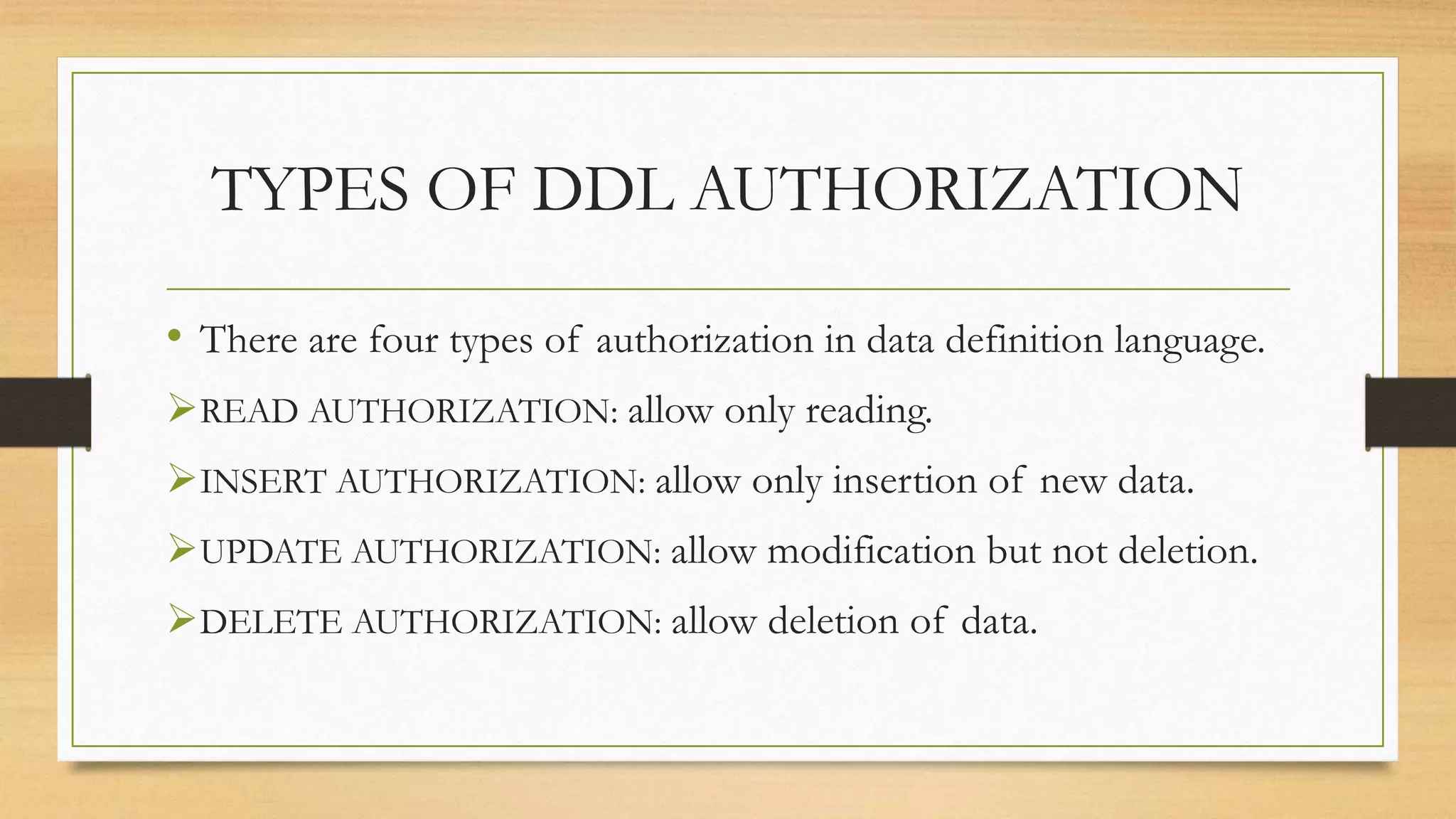
TYPES OF DDLAUTHORIZATION
• There are four types of authorization in data definition language.
READ AUTHORIZATION: allow only reading.
INSERT AUTHORIZATION: allow only insertion of new data.
UPDATE AUTHORIZATION: allow modification but not deletion.
DELETE AUTHORIZATION: allow deletion of data.
6.
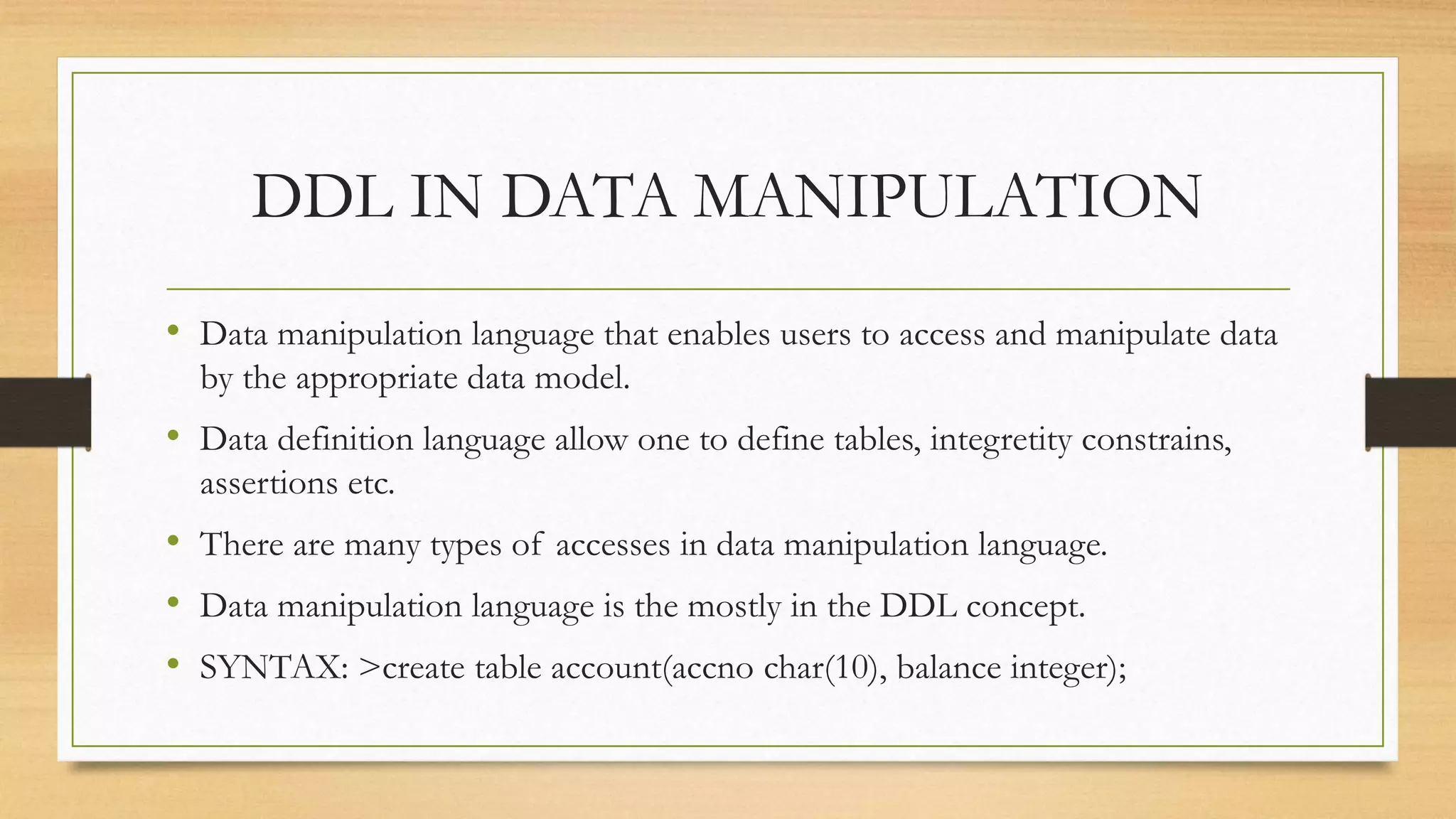
DDL IN DATAMANIPULATION
• Data manipulation language that enables users to access and manipulate data
by the appropriate data model.
• Data definition language allow one to define tables, integretity constrains,
assertions etc.
• There are many types of accesses in data manipulation language.
• Data manipulation language is the mostly in the DDL concept.
• SYNTAX: >create table account(accno char(10), balance integer);
7.
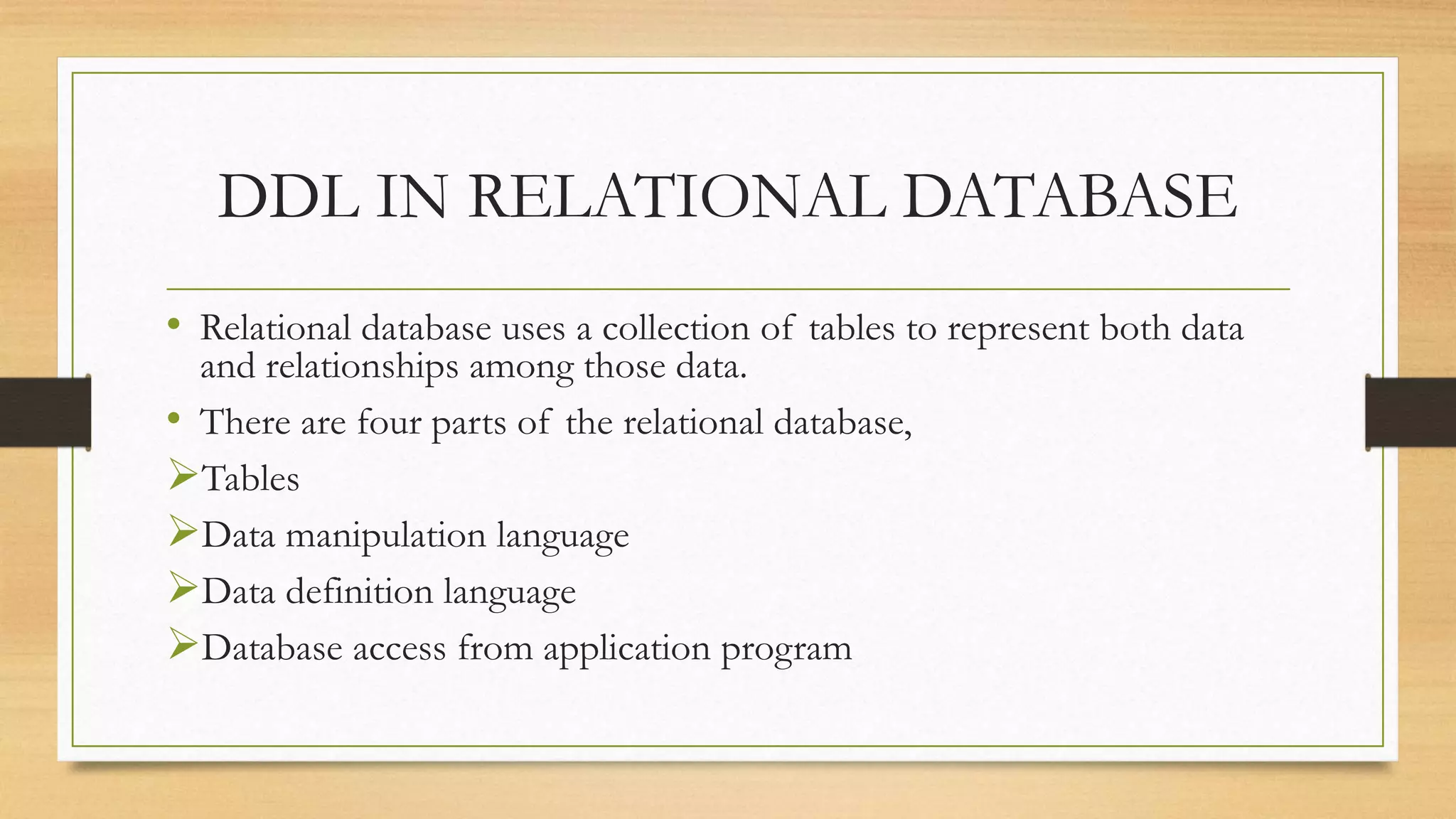
DDL IN RELATIONALDATABASE
• Relational database uses a collection of tables to represent both data
and relationships among those data.
• There are four parts of the relational database,
Tables
Data manipulation language
Data definition language
Database access from application program
8.
CONCLUSION
• Data definitionlanguage is a standard for commands that define
the different structures in a database
• Data definition language statements create, modify, and remove
database objects such as tables, indexes, and users.
• Common data definition language statements are
CREATE,ALTER, and DROP.