Covalent bonding

Learning objectives:
1. How can I draw covalent bonds?
2. What are covalent bonds?
Starter - match these up!
• Carbon dioxide   • Cl2

• Water            • O2

• Chlorine
                   • CO2
• Oxygen
                   • CH4
• Methane
                   • H2
• Hydrogen
                   • H2O
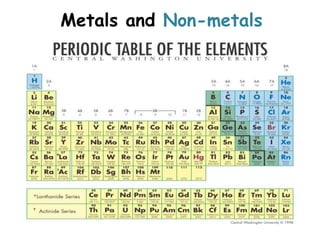
Metals and Non-metals
Complete exam questions on the next slide.
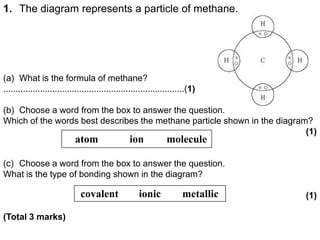
1. The diagram represents a particle of methane.


(a) What is the formula of methane?
..........................................................................(1)

(b) Choose a word from the box to answer the question.
Which of the words best describes the methane particle shown in the diagram?
                                                                           (1)
                            atom                  ion            molecule

(c) Choose a word from the box to answer the question.
What is the type of bonding shown in the diagram?

                               covalent               ionic            metallic   (1)

(Total 3 marks)
Study and take notes
Find out what covalent bond is and how to
  draw covalent bonds.
What is a covalent bond?

                             incomplete
         Cl                 outer shells      Cl


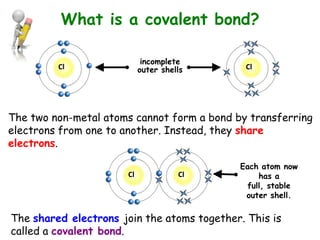
The two non-metal atoms cannot form a bond by transferring
electrons from one to another. Instead, they share
electrons.

                                            Each atom now
                       Cl             Cl         has a
                                              full, stable
                                             outer shell.

The shared electrons join the atoms together. This is
called a covalent bond.
Drawing covalent bonds
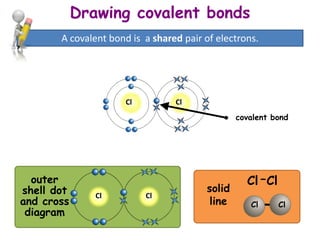
       A covalent bond is a shared pair of electrons.


                     Cl          Cl
                                                covalent bond


  outer                                           Cl – Cl
shell dot                               solid
                                                        –
               Cl         Cl
and cross                                line      Cl       Cl
 diagram
Rules of Covalent bonding

o Needs 2 or more NON-METAL ATOMS

o Electrons are SHARED to complete the shells

o The electron shells overlap.
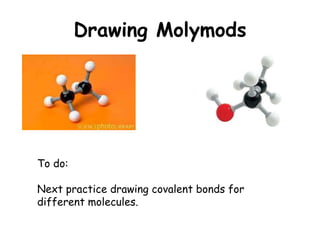
Drawing Molymods


To do:

Next practice drawing covalent bonds for
different molecules.
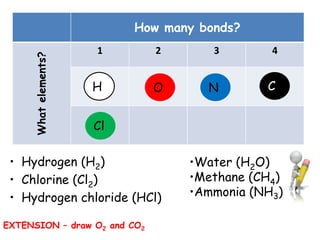
How many bonds?
                      1       2       3       4
     What elements?


                      H       O      N       C


                      Cl

 • Hydrogen (H2)                  •Water (H2O)
 • Chlorine (Cl2)                 •Methane (CH4)
 • Hydrogen chloride (HCl)        •Ammonia (NH3)

EXTENSION – draw O2 and CO2
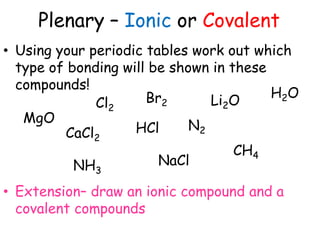
Plenary – Ionic or Covalent
• Using your periodic tables work out which
  type of bonding will be shown in these
  compounds!
                      Br2                H2O
              Cl2               Li2O
   MgO
                    HCl      N2
         CaCl2
                                    CH4
           NH3          NaCl

• Extension– draw an ionic compound and a
  covalent compounds
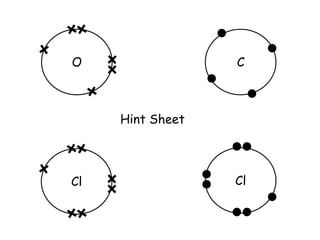
O                 C


     Hint Sheet


Cl                Cl
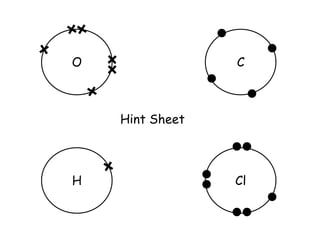
O                C


    Hint Sheet


H                Cl

C5 simple covalent-bonding

  • 1.
    Covalent bonding Learning objectives: 1.How can I draw covalent bonds? 2. What are covalent bonds?
  • 2.
    Starter - matchthese up! • Carbon dioxide • Cl2 • Water • O2 • Chlorine • CO2 • Oxygen • CH4 • Methane • H2 • Hydrogen • H2O
  • 3.
  • 4.
    Complete exam questionson the next slide.
  • 5.
    1. The diagramrepresents a particle of methane. (a) What is the formula of methane? ..........................................................................(1) (b) Choose a word from the box to answer the question. Which of the words best describes the methane particle shown in the diagram? (1) atom ion molecule (c) Choose a word from the box to answer the question. What is the type of bonding shown in the diagram? covalent ionic metallic (1) (Total 3 marks)
  • 6.
    Study and takenotes Find out what covalent bond is and how to draw covalent bonds.
  • 7.
    What is acovalent bond? incomplete Cl outer shells Cl The two non-metal atoms cannot form a bond by transferring electrons from one to another. Instead, they share electrons. Each atom now Cl Cl has a full, stable outer shell. The shared electrons join the atoms together. This is called a covalent bond.
  • 8.
    Drawing covalent bonds A covalent bond is a shared pair of electrons. Cl Cl covalent bond outer Cl – Cl shell dot solid – Cl Cl and cross line Cl Cl diagram
  • 9.
    Rules of Covalentbonding o Needs 2 or more NON-METAL ATOMS o Electrons are SHARED to complete the shells o The electron shells overlap.
  • 10.
    Drawing Molymods To do: Nextpractice drawing covalent bonds for different molecules.
  • 11.
    How many bonds? 1 2 3 4 What elements? H O N C Cl • Hydrogen (H2) •Water (H2O) • Chlorine (Cl2) •Methane (CH4) • Hydrogen chloride (HCl) •Ammonia (NH3) EXTENSION – draw O2 and CO2
  • 12.
    Plenary – Ionicor Covalent • Using your periodic tables work out which type of bonding will be shown in these compounds! Br2 H2O Cl2 Li2O MgO HCl N2 CaCl2 CH4 NH3 NaCl • Extension– draw an ionic compound and a covalent compounds
  • 13.
    O C Hint Sheet Cl Cl
  • 14.
    O C Hint Sheet H Cl