GCSE
GCSE
  S
science
HIGHER
Project Directors                                Editors
Angela Hall       Emma Palmer           Emma Palmer           Carol Usher
Robin Millar     Mary Whitehouse           Anne Scott      Mary Whitehouse


                                 Authors
   Ann Fullick    Andrew Hunt      Jacqueline Punter    Elizabeth Swinbank
  Helen Harden     Neil Ingram        David Sang            Vicky Wong
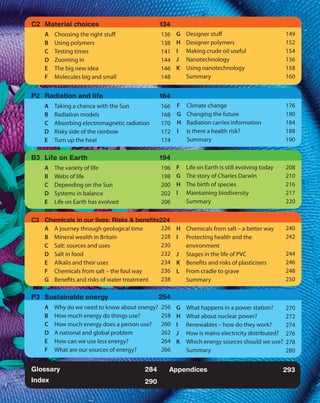
Contents
Contents
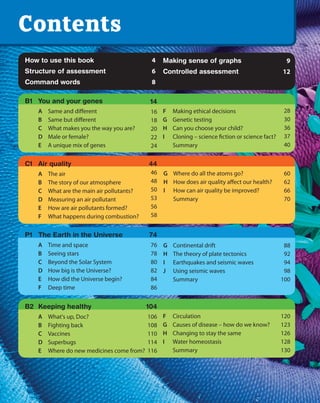
How to use this book                          4    Making sense of graphs                         9
Structure of assessment                       6    Controlled assessment                         12
Command words                                 8

B1 	 You and your genes                       14
	   A	   Same and different                  	16 F	 Making ethical decisions                      28
	   B	   Same but different                  	18 G	 Genetic testing                               30
	   C	   What makes you the way you are?     	20 H	 Can you choose your child?                    36
	   D	   Male or female?                     	22 I	 Cloning – science fiction or science fact?    37
	   E	   A unique mix of genes               		Summary
                                              24                                                  40


C1 	 Air quality                             44
	    A	 The air                               	46 G	 Where do all the atoms go?                   60
	   B	   The story of our atmosphere          	48 H	 How does air quality affect our health?      62
	   C	   What are the main air pollutants?    	50 I	 How can air quality be improved?             66
	   D	   Measuring an air pollutant            53
                                              		Summary                                           70
	   E	   How are air pollutants formed?        56
                                              		
	   F	   What happens during combustion?       58


P1 	 The Earth in the Universe               74
	    A	 Time and space                        	76 G	 Continental drift                            88
	   B	   Seeing stars                         	78 H	 The theory of plate tectonics                92
	   C	   Beyond the Solar System               80
                                              	I	 Earthquakes and seismic waves                   94
	   D	   How big is the Universe?              82
                                              	J	 Using seismic waves                             98
	   E	   How did the Universe begin?           84
                                              		Summary                                          100
	   F	   Deep time                             86


B2 	Keeping healthy                          104
	   A	 What's up, Doc?                       106 F	Circulation
                                              	                                                  120
	   B	 Fighting back                         108 G	 Causes of disease – how do we know?
                                              	                                                  123
	   C	Vaccines                               110 H	 Changing to stay the same
                                              	                                                  126
	   D	Superbugs                              114 I	 Water homeostasis
                                              	                                                  128
	   E	 Where do new medicines come from?      		Summary
                                             116                                                 130
C2 	Material choices                            134
	   A	 Choosing the right stuff                 136 G	 Designer stuff
                                                 	                                             149
	   B	   Using polymers                         138 H	 Designer polymers
                                                 	                                             152
	   C	   Testing times                          141 I	 Making crude oil useful
                                                 	                                             154
	   D	   Zooming in                             144 J	Nanotechnology
                                                 	                                             156
	   E	   The big new idea                       146 K	 Using nanotechnology
                                                 	                                             158
	   F	   Molecules big and small                 		Summary
                                                148                                            160


P2 	Radiation and life                          164
	   A	 Taking a chance with the Sun             166 F	 Climate change
                                                 	                                             176
	   B	   Radiation models                       168 G	 Changing the future
                                                 	                                             180
	   C	   Absorbing electromagnetic radiation    170 H	 Radiation carries information
                                                 	                                             184
	   D	   Risky side of the rainbow               	I	 Is there a health risk?
                                                172                                            188
	   E	   Turn up the heat                        		Summary
                                                174                                            190

B3 	Life on Earth                               194
	   A	   The variety of life                    196 F	 Life on Earth is still evolving today
                                                 	                                             208
	   B	   Webs of life                           198 G	 The story of Charles Darwin
                                                 	                                             210
	   C	   Depending on the Sun                   200 H	 The birth of species
                                                 	                                             216
	   D	   Systems in balance                     202 I	 Maintaining biodiversity
                                                 	                                             217
	   E	   Life on Earth has evolved               		Summary
                                                206                                            220


C3 	 Chemicals in our lives: Risks & benefits224
	    A	 A journey through geological time      	
                                              226 H	 Chemicals from salt – a better way        240
	    B	 Mineral wealth in Britain             228 I	 Protecting health and the 	
                                               	                                               242
	    C	 Salt: sources and uses                230
                                               		environment
	    D	 Salt in food                          232 J	 Stages in the life of PVC
                                               	                                               244
	    E	 Alkalis and their uses                234 K	 Benefits and risks of plasticisers
                                               	                                               246
	    F	 Chemicals from salt – the foul way    236 L	 From cradle to grave
                                               	                                               248
	    G	 Benefits and risks of water treatment 238
                                               		Summary                                       250

P3 	Sustainable energy                     254
	                                            Glossary
    A	 Why do we need to know about energy? 256 G	 What happens in a power station?
                                             	                                               270
	   B	 How much energy do things use?       258 H	 What about nuclear power?
                                             Index
                                             	                                               272
	   C	   How much energy does a person use?     260 I	 Renewables – how do they work?
                                                 	                                           274
                                                 Appendices	
	   D	   A national and global problem          262 J	 How is mains electricity distributed? 276
                                                 	
	   E	   How can we use less energy?            264 K	 Which energy sources should we use? 278
                                                 	
	   F	   What are our sources of energy?        266
                                                 		Summary                                   280


Glossary                                  284      Appendices                                  293
Index                                     290
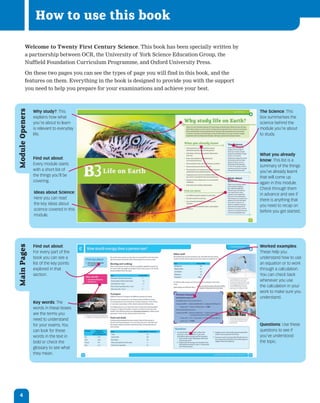
How to use this book

          Welcome to Twenty First Century Science. This book has been specially written by
          a partnership between OCR, the University of York Science Education Group, the
          Nuffield Foundation Curriculum Programme, and Oxford University Press.

          On these two pages you can see the types of page you will find in this book, and the
          features on them. Everything in the book is designed to provide you with the support
          you need to help you prepare for your examinations and achieve your best.
Module Openers


                 Why study?: This                                                                The Science: This
                 explains how what                                                               box summarises the
                 you’re about to learn                                                           science behind the
                 is relevant to everyday                                                         module you’re about
                 life.                                                                           to study.


                                                                                                 What you already
                 Find out about:                                                                 know: This list is a
                 Every module starts                                                             summary of the things
                 with a short list of                                                            you’ve already learnt
                 the things you’ll be                                                            that will come up
                 covering.                                                                       again in this module.
                                                                                                 Check through them
                 Ideas about Science:                                                            in advance and see if
                 Here you can read                                                               there is anything that
                 the key ideas about                                                             you need to recap on
                 science covered in this                                                         before you get started.
                 module.


                 Find out about:                                                                 Worked examples:
Main Pages


                 For every part of the                                                           These help you
                 book you can see a                                                              understand how to use
                 list of the key points                                                          an equation or to work
                 explored in that                                                                through a calculation.
                 section.                                                                        You can check back
                                                                                                 whenever you use
                                                                                                 the calculation in your
                                                                                                 work to make sure you
                                                                                                 understand.
                 Key words: The
                 words in these boxes
                 are the terms you
                 need to understand
                 for your exams. You                                                             Questions: Use these
                 can look for these                                                              questions to see if
                 words in the text in                                                            you’ve understood
                 bold or check the                                                               the topic.
                 glossary to see what
                 they mean.


   4
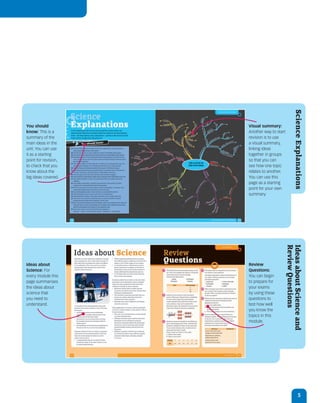
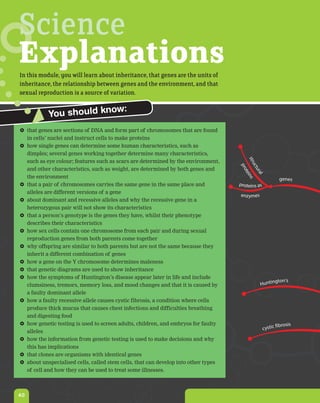
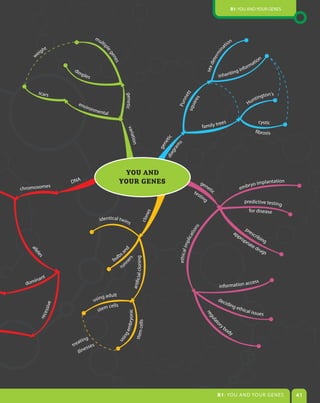
Science Explanations
You should            Visual summary:
know: This is a       Another way to start
summary of the        revision is to use
main ideas in the     a visual summary,
unit. You can use     linking ideas
it as a starting      together in groups
point for revision,   so that you can
to check that you     see how one topic
know about the        relates to another.
big ideas covered.    You can use this
                      page as a starting
                      point for your own
                      summary.


                                             Review Questions
                                             Ideas about Science and
Ideas about           Review
Science: For          Questions:
every module this     You can begin
page summarises       to prepare for
the ideas about       your exams
science that          by using these
you need to           questions to
understand.           test how well
                      you know the
                      topics in this
                      module.


                                                               5
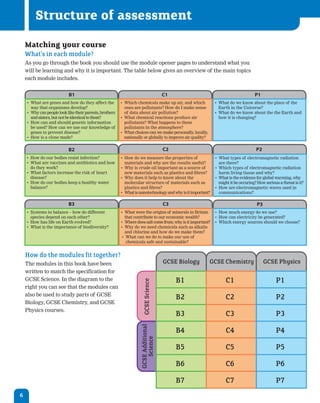
Structure of assessment
    Matching your course
    What’s in each module?
    As you go through the book you should use the module opener pages to understand what you
    will be learning and why it is important. The table below gives an overview of the main topics
    each module includes.


                            B1                                                          C1                                              P1
    •   hat are genes and how do they affect the
       W                                                   •   hich chemicals make up air, and which
                                                              W                                                  •   hat do we know about the place of the
                                                                                                                    W
       way that organisms develop?                            ones are pollutants? How do I make sense              Earth in the Universe?
    •   hy can people look like their parents, brothers
       W                                                      of data about air pollution?                       •  
                                                                                                                    What do we know about the the Earth and
       and sisters, but not be identical to them?          •   hat chemical reactions produce air
                                                              W                                                     how it is changing?
    •   ow can and should genetic information
       H                                                      pollutants? What happens to these
       be used? How can we use our knowledge of               pollutants in the atmosphere?
       genes to prevent disease?                           •   hat choices can we make personally, locally,
                                                              W
    •   ow is a clone made?
       H                                                      nationally or globally to improve air quality?


                            B2                                                          C2                                               P2
    •   ow do our bodies resist infection?
       H                                                   •   ow do we measure the properties of
                                                              H                                                  •   hat types of electromagnetic radiation
                                                                                                                    W
    •   hat are vaccines and antibiotics and how
       W                                                      materials and why are the results useful?             are there?
       do they work?                                       •   hy is crude oil important as a source of
                                                              W                                                  •   hich types of electromagnetic radiation
                                                                                                                    W
    •   hat factors increase the risk of heart
       W                                                      new materials such as plastics and fibres?            harm living tissue and why?
       disease?                                            •   hy does it help to know about the
                                                              W                                                  •   hat is the evidence for global warming, why
                                                                                                                    W
    •   ow do our bodies keep a healthy water
       H                                                      molecular structure of materials such as              might it be occuring? How serious a threat is it?
       balance?                                               plastics and fibres?                               •   ow are electromagnetic waves used in
                                                                                                                    H
                                                           •   hat is nanotechnology and why is it important?
                                                              W                                                     communications?

                            B3                                                          C3                                               P3
    •   ystems in balance – how do different
       S                                                   •   hat were the origins of minerals in Britain
                                                              W                                                  •   ow much energy do we use?
                                                                                                                    H
       species depend on each other?                          that contribute to our economic wealth?            •   ow can electricity be generated?
                                                                                                                    H
    •   ow has life on Earth evolved?
       H                                                   •   here does salt come from; why is it important?
                                                              W                                                  •   hich energy sources should we choose?
                                                                                                                    W
    •   hat is the importance of biodiversity?
       W                                                   •   hy do we need chemicals such as alkalis
                                                              W
                                                              and chlorine and how do we make them?
                                                            •   hat can we do to make our use of
                                                               W
                                                               chemicals safe and sustainable?


    How do the modules fit together?
    The modules in this book have been                                                  GCSE Biology           GCSE Chemistry                 GCSE Physics
    written to match the specification for
    GCSE Science. In the diagram to the                                                      B1                        C1                           P1
                                                                        GCSE Science


    right you can see that the modules can
    also be used to study parts of GCSE
                                                                                             B2                        C2                           P2
    Biology, GCSE Chemistry, and GCSE
    Physics courses.
                                                                                             B3                        C3                           P3
                                                                      GCSE Additional


                                                                                             B4                        C4                           P4
                                                                         Science


                                                                                             B5                        C5                           P5

                                                                                             B6                        C6                           P6

                                                                                             B7                        C7                           P7
6
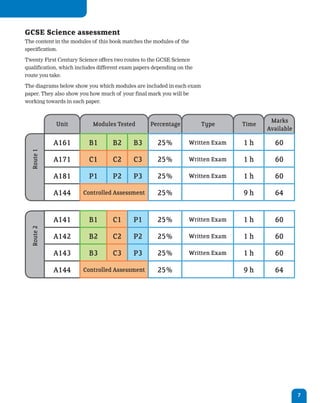
GCSE Science assessment
The content in the modules of this book matches the modules of the
specification.

Twenty First Century Science offers two routes to the GCSE Science
qualification, which includes different exam papers depending on the
route you take.

The diagrams below show you which modules are included in each exam
paper. They also show you how much of your final mark you will be
working towards in each paper.


                                                                                         Marks
            Unit           Modules Tested         Percentage           Type      Time
                                                                                        Available

            A161         B1        B2       B3       25%          Written Exam   1h       60
  Route 1


            A171          C1       C2       C3       25%          Written Exam   1h       60
            A181         P1        P2       P3       25%          Written Exam   1h       60
            A144       Controlled Assessment         25%                         9h       64


            A141         B1        C1       P1       25%          Written Exam   1h       60
  Route 2


            A142         B2        C2       P2       25%          Written Exam   1h       60

            A143         B3        C3       P3       25%          Written Exam   1h       60

            A144       Controlled Assessment         25%                         9h       64


                                                                                                    7
Controlled words
        Command assessment
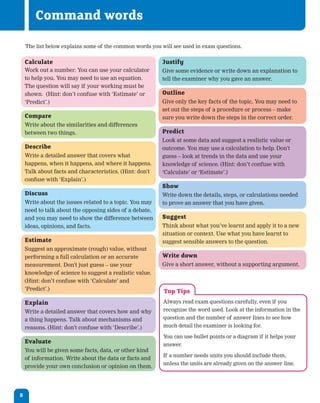
    The list below explains some of the common words you will see used in exam questions.


    Calculate                                            Justify	
    Work out a number. You can use your calculator       Give some evidence or write down an explanation to
    to help you. You may need to use an equation.        tell the examiner why you gave an answer.
    The question will say if your working must be
    shown.  (Hint: don’t confuse with ‘Estimate’ or      Outline 	
    ‘Predict’.)                                          Give only the key facts of the topic. You may need to
                                                         set out the steps of a procedure or process – make
    Compare                                              sure you write down the steps in the correct order.
    Write about the similarities and differences
    between two things.                                  Predict	
                                                         Look at some data and suggest a realistic value or
    Describe                                             outcome. You may use a calculation to help. Don't
    Write a detailed answer that covers what             guess – look at trends in the data and use your
    happens, when it happens, and where it happens.      knowledge of science. (Hint: don’t confuse with
    Talk about facts and characteristics. (Hint: don't   ‘Calculate’ or ‘Estimate’.)
    confuse with ‘Explain’.)
                                                         Show	
    Discuss                                              Write down the details, steps, or calculations needed
    Write about the issues related to a topic. You may   to prove an answer that you have given.
    need to talk about the opposing sides of a debate,
    and you may need to show the difference between      Suggest	
    ideas, opinions, and facts.                          Think about what you’ve learnt and apply it to a new
                                                         situation or context. Use what you have learnt to
    Estimate                                             suggest sensible answers to the question.
    Suggest an approximate (rough) value, without
    performing a full calculation or an accurate         Write down	
    measurement. Don't just guess – use your             Give a short answer, without a supporting argument.
    knowledge of science to suggest a realistic value.
    (Hint: don’t confuse with ‘Calculate’ and
    ‘Predict’.)                                           Top Tips
    Explain 	                                             Always read exam questions carefully, even if you
    Write a detailed answer that covers how and why       recognise the word used. Look at the information in the
    a thing happens. Talk about mechanisms and            question and the number of answer lines to see how
    reasons. (Hint: don't confuse with ‘Describe’.)       much detail the examiner is looking for.

                                                          You can use bullet points or a diagram if it helps your
    Evaluate	                                             answer.
    You will be given some facts, data, or other kind
                                                          If a number needs units you should include them,
    of information. Write about the data or facts and
                                                          unless the units are already given on the answer line.
    provide your own conclusion or opinion on them.


8
Controlled assessment
     Making sense of graphs

Scientists use graphs and charts to present data clearly and to look for
patterns in the data. You will need to plot graphs or draw charts to
present data and then describe and explain what the data is showing.
Examination questions may also give you a graph and ask you to
describe and explain what a graph is telling you.


Reading the axes
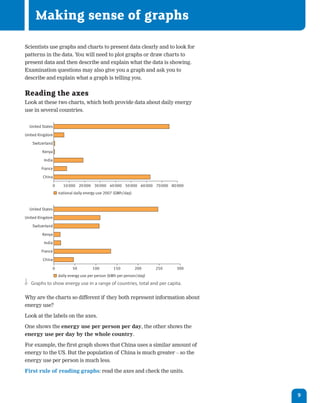
Look at these two charts, which both provide data about daily energy
use in several countries.


  United States

United Kingdom

   Switzerland

         Kenya

          India

        France

         China

              0     10 000 20 000 30 000 40 000 50 000 60 000 70 000 80 000
                  national daily energy use 2007 (GWh/day)


  United States

United Kingdom

   Switzerland

         Kenya

          India

        France

         China

              0          50         100         150          200     250   300
                  daily energy use per person (kWh per person/day)
   Graphs to show energy use in a range of countries, total and per capita.

Why are the charts so different if they both represent information about
energy use?

Look at the labels on the axes.

One shows the energy use per person per day, the other shows the
energy use per day by the whole country.

For example, the first graph shows that China uses a similar amount of
energy to the US. But the population of China is much greater – so the
energy use per person is much less.

First rule of reading graphs: read the axes and check the units.


                                                                                 9
Describing the relationship between variables
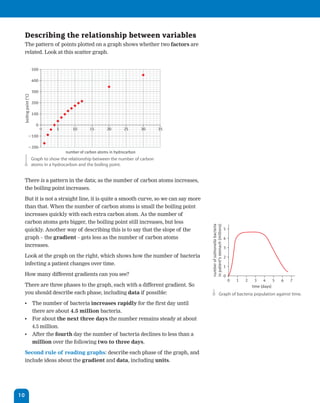
     The pattern of points plotted on a graph shows whether two factors are
     related. Look at this scatter graph.


                          500

                          400

                          300
     boiling point (ЊC)


                          200

                          100

                            0
                                0     5       10      15       20       25        30    35
                 Ϫ100

                 Ϫ200
                                          number of carbon atoms in hydrocarbon
                          Graph to show the relationship between the number of carbon
                          atoms in a hydrocarbon and the boiling point.


     There is a pattern in the data; as the number of carbon atoms increases,
     the boiling point increases.

     But it is not a straight line, it is quite a smooth curve, so we can say more
     than that. When the number of carbon atoms is small the boiling point
     increases quickly with each extra carbon atom. As the number of
     carbon atoms gets bigger, the boiling point still increases, but less
                                                                                             number of salmonella bacteria
                                                                                             in patient’s stomach (millions)

     quickly. Another way of describing this is to say that the slope of the                                                   5

     graph – the gradient – gets less as the number of carbon atoms                                                            4
     increases.                                                                                                                3

     Look at the graph on the right, which shows how the number of bacteria                                                    2
     infecting a patient changes over time.
                                                                                                                               1
     How many different gradients can you see?                                                                                 0
                                                                                                                                   0   1   2     3    4    5   6   7
     There are three phases to the graph, each with a different gradient. So                                                                   time (days)
     you should describe each phase, including data if possible:                                                  Graph of bacteria population against time.

     •	 The number of bacteria increases rapidly for the first day until
        there are about 4.5 million bacteria.
     •	 For about the next three days the number remains steady at about
        4.5 million.
     •	 After the fourth day the number of bacteria declines to less than a
        million over the following two to three days.

     Second rule of reading graphs: describe each phase of the graph, and
     include ideas about the gradient and data, including units.


10
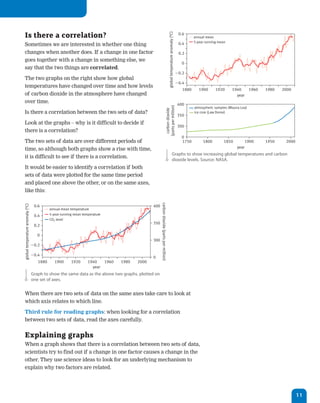
Is there a correlation?                                                                                                                                                        0.6


                                                                                                                                              global temperature anomaly (°C)
                                                                                                                                                                                          annual mean
                                                                                                                                                                                 0.4      5-year running mean
  Sometimes we are interested in whether one thing
  changes when another does. If a change in one factor                                                                                                                           0.2
  goes together with a change in something else, we
                                                                                                                                                                                  0
  say that the two things are correlated.
                                                                                                                                                                                Ϫ0.2
  The two graphs on the right show how global
                                                                                                                                                                                Ϫ0.4
  temperatures have changed over time and how levels
                                                                                                                                                                                   1880      1900      1920     1940        1960   1980   2000
  of carbon dioxide in the atmosphere have changed                                                                                                                                                                year
  over time.                                                                                                                                                                    400


                                                                                                                                 (parts per million)
                                                                                                                                                                                          atmospheric samples (Mauna Loa)


                                                                                                                                   carbon dioxide
  Is there a correlation between the two sets of data?                                                                                                                                    ice core (Law Dome)
                                                                                                                                                                                350
  Look at the graphs – why is it difficult to decide if
                                                                                                                                                                                300
  there is a correlation?
                                                                                                                                                                                  0
  The two sets of data are over different periods of                                                                                                                              1750         1800         1850          1900     1950    2000
  time, so although both graphs show a rise with time,                                                                                                                                                             year
                                                                                                                                                                  Graphs to show increasing global temperatures and carbon
  it is difficult to see if there is a correlation.
                                                                                                                                                                  dioxide levels. Source: NASA.
  It would be easier to identify a correlation if both
  sets of data were plotted for the same time period
  and placed one above the other, or on the same axes,
  like this:
                                                                                                         carbon dioxide (parts per million)


                                   0.6
global temperature anomaly (°C)


                                                                                                   400
                                            annual mean temperature
                                   0.4      5-year running mean temperature
                                            CO2 level
                                                                                                   350
                                   0.2

                                     0
                                                                                                   300
                                  Ϫ0.2

                                  Ϫ0.4
                                                                                                   0
                                     1880      1900      1920      1940       1960   1980   2000
                                                                     year
                                  Graph to show the same data as the above two graphs, plotted on
                                  one set of axes.


  When there are two sets of data on the same axes take care to look at
  which axis relates to which line.

  Third rule for reading graphs: when looking for a correlation
  between two sets of data, read the axes carefully.


  Explaining graphs
  When a graph shows that there is a correlation between two sets of data,
  scientists try to find out if a change in one factor causes a change in the
  other. They use science ideas to look for an underlying mechanism to
  explain why two factors are related.


                                                                                                                                                                                                                                                  11
Controlled assessment

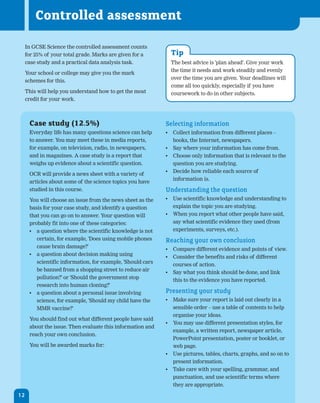
     In GCSE Science the controlled assessment counts
     for 25% of your total grade. Marks are given for a        Tip
     case study and a practical data analysis task.            The best advice is 'plan ahead'. Give your work
                                                               the time it needs and work steadily and evenly
     Your school or college may give you the mark
                                                               over the time you are given. Your deadlines will
     schemes for this.
                                                               come all too quickly, especially if you have
     This will help you understand how to get the most         coursework to do in other subjects.
     credit for your work.


      Case study (12.5%)                                     Selecting information
      Everyday life has many questions science can help      •	 Collect information from different places –
      to answer. You may meet these in media reports,           books, the Internet, newspapers.
      for example, on television, radio, in newspapers,      •	 Say where your information has come from.
      and in magazines. A case study is a report that        •	 Choose only information that is relevant to the
      weighs up evidence about a scientific question.           question you are studying.
                                                             •	 Decide how reliable each source of
      OCR will provide a news sheet with a variety of
                                                                information is.
      articles about some of the science topics you have
      studied in this course.                                Understanding the question
      You will choose an issue from the news sheet as the    •	 Use scientific knowledge and understanding to
      basis for your case study, and identify a question        explain the topic you are studying.
      that you can go on to answer. Your question will       •	 When you report what other people have said,
      probably fit into one of these categories:                say what scientific evidence they used (from
      •	 a question where the scientific knowledge is not       experiments, surveys, etc.).
         certain, for example, 'Does using mobile phones     Reaching your own conclusion
         cause brain damage?'
                                                             •	 Compare different evidence and points of view.
      •	 a question about decision making using
                                                             •	 Consider the benefits and risks of different
         scientific information, for example, 'Should cars
                                                                courses of action.
         be banned from a shopping street to reduce air
                                                             •	 Say what you think should be done, and link
         pollution?' or 'Should the government stop
                                                                this to the evidence you have reported.
         research into human cloning?'
      •	 a question about a personal issue involving         Presenting your study
         science, for example, 'Should my child have the     •	 Make sure your report is laid out clearly in a
         MMR vaccine?'                                          sensible order – use a table of contents to help
                                                                organise your ideas.
      You should find out what different people have said
                                                             •	 You may use different presentation styles, for
      about the issue. Then evaluate this information and
                                                                example, a written report, newspaper article,
      reach your own conclusion.
                                                                PowerPoint presentation, poster or booklet, or
      You will be awarded marks for:                            web page.
                                                             •	 Use pictures, tables, charts, graphs, and so on to
                                                                present information.
                                                             •	 Take care with your spelling, grammar, and
                                                                punctuation, and use scientific terms where
                                                                they are appropriate.

12
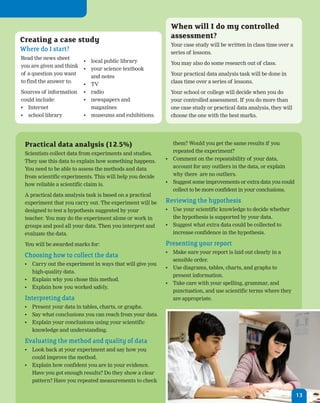
When will I do my controlled
Creating a case study                                       assessment?
                                                            Your case study will be written in class time over a
Where do I start?                                           series of lessons.
Read the news sheet
                          •	 local public library           You may also do some research out of class.
you are given and think
                          •	 your science textbook
of a question you want                                      Your practical data analysis task will be done in
                             and notes
to find the answer to.                                      class time over a series of lessons.
                          •	 TV
Sources of information    •	 radio                          Your school or college will decide when you do
could include:            •	 newspapers and                 your controlled assessment. If you do more than
•	 Internet                  magazines                      one case study or practical data analysis, they will
•	 school library         •	 museums and exhibitions.       choose the one with the best marks.


 Practical data analysis (12.5%)                             them? Would you get the same results if  you 
 Scientists collect data from experiments and studies.       repeated the experiment?
 They use this data to explain how something happens.     •	 Comment on the repeatability of your data,
 You need to be able to assess the methods and data          account for any outliers in the data, or explain
 from scientific experiments. This will help you decide      why there are no outliers.
 how reliable a scientific claim is.                      •	 Suggest some improvements or extra data you could
                                                             collect to be more confident in your conclusions.
 A practical data analysis task is based on a practical
 experiment that you carry out. The experiment will be    Reviewing the hypothesis
 designed to test a hypothesis suggested by your          •	 Use your scientific knowledge to decide whether
 teacher. You may do the experiment alone or work in         the hypothesis is supported by your data.
 groups and pool all your data. Then you interpret and    •	 Suggest what extra data could be collected to
 evaluate the data.                                          increase confidence in the hypothesis.

 You will be awarded marks for:                           Presenting your report
                                                          •	 Make sure your report is laid out clearly in a
 Choosing how to collect the data
                                                             sensible order.
 •	 Carry out the experiment in ways that will give you
                                                          •	 Use diagrams, tables, charts, and graphs to
    high-quality data.
                                                             present information.
 •	 Explain why you chose this method.
                                                          •	 Take care with your spelling, grammar, and
 •	 Explain how you worked safely.
                                                             punctuation, and use scientific terms where they
 Interpreting data                                           are appropriate.
 •	 Present your data in tables, charts, or graphs.
 •	 Say what conclusions you can reach from your data.
 •	 Explain your conclusions using your scientific
    knowledge and understanding.

 Evaluating the method and quality of data
 •	 Look back at your experiment and say how you
    could improve the method.
 •	 Explain how confident you are in your evidence.
    Have you got enough results? Do they show a clear 
    pattern? Have you repeated measurements to check 

                                                                                                                   13
B1   You and your
      genes


14
B1: You and your genes


Why study genes?
   What makes me the way that I am? Your ancestors probably asked the same question. How
   are features passed on from parents to children? You may look like your relatives, but you
   are unique. Only in the last few generations has science been able to answer questions
   like these.


What you already know                                          The Science
•	 In sexual reproduction fertilisation happens when a         Your environment has a huge
   male and female sex cell join together. Information         effect on you, for example,
                                                               on your appearance, your
   from two parents is mixed to make a new plan for the
                                                               body, and your health.
   offspring. The offspring will be similar but not
                                                               But these features are also
   identical to their parents.
                                                               affected by your genes. In
•	 There are variations between members of the same            this Module you’ll find out
   species that are due to environmental as well as            how. You’ll discover the story
   inherited causes.                                           of inheritance.

•	 Clones are individuals with indentical genetic
   information.

•	 The science of cloning raises ethical issues.               Ideas about
                                                               Science
Find out about                                                 In the future, science could
                                                               help you to change your
•	 how genes and your environment make you                     baby’s genes before it is
   unique                                                      born. Cloned embryos could
                                                               provide cells to cure diseases.
•	 how and why people find out about their genes               But, as new technologies are
•	 how we can use our knowledge of genes                       developed, we must decide
                                                               how they should be used.
•	 whether we should allow this.                               These can be questions of
                                                               ethics – decisions about what
                                                               is right and wrong.


                                                                                                 15
A          Same and different
                                            Plants and animals look a lot like their parents. They have inherited
         Find out about                     information from them. This information is in genes and controls how
                                            the organisms develop and function.
          what makes us
           all different                    A lot of information goes into making a human being. So inheritance
          what genes are and               does a big job pretty well. All people have most features in common.
           what genes do                    Children look a lot like their parents. If you look at the people around
                                            you, the differences between us are very, very small. But we’re
                                            interested in them because they make us unique.


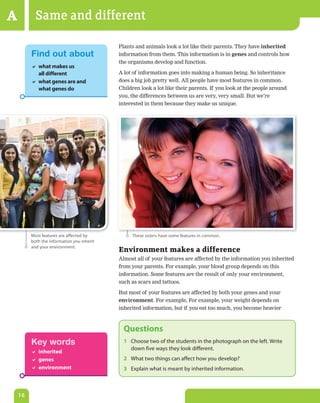
         Most features are affected by           These sisters have some features in common.
         both the information you inherit
         and your environment.
                                            Environment makes a difference
                                            Almost all of your features are affected by the information you inherited
                                            from your parents. For example, your blood group depends on this
                                            information. Some features are the result of only your environment,
                                            such as scars and tattoos.

                                            But most of your features are affected by both your genes and your
                                            environment. For example, For example, your weight depends on
                                            inherited information, but if you eat too much, you become heavier


                                              Questions
         Key words                            1 Choose two of the students in the photograph on the left. Write
                                                down five ways they look different.
          inherited
          genes                              2 What two things can affect how you develop?
          environment                        3 explain what is meant by inherited information.


    16
B1: You and Your genes


Inheritance – the story of life
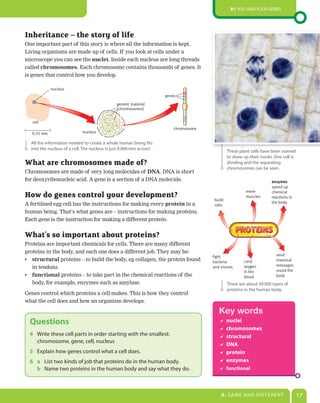
One important part of this story is where all the information is kept.
Living organisms are made up of cells. If you look at cells under a
microscope you can see the nuclei. Inside each nucleus are long threads
called chromosomes. Each chromosome contains thousands of genes. It
is genes that control how you develop.

             nucleus
                                                                     genes

                                               genetic material
                                               (chromosomes)


   cell
                                                                         chromosome
   0.25 mm                   nucleus

  all the information needed to create a whole human being fits
  into the nucleus of a cell. The nucleus is just 0.006 mm across!
                                                                                              These plant cells have been stained
                                                                                              to show up their nuclei. one cell is
What are chromosomes made of?                                                                 dividing and the separating
                                                                                              chromosomes can be seen.
Chromosomes are made of very long molecules of DNA. DNA is short
for deoxyribonucleic acid. A gene is a section of a DNA molecule.                                                    enzymes
                                                                                                                     speed up
                                                                                                       move          chemical
How do genes control your development?                                                build
                                                                                                       muscles       reactions in
A fertilised egg cell has the instructions for making every protein in a                                             the body
                                                                                      cells
human being. That’s what genes are – instructions for making proteins.
Each gene is the instruction for making a different protein.


What’s so important about proteins?
Proteins are important chemicals for cells. There are many different
proteins in the body, and each one does a different job. They may be:
                                                                                      fight                            send
•	 structural proteins – to build the body, eg collagen, the protein found            bacteria        carry            chemical
                                                                                                                       messages
   in tendons                                                                         and viruses     oxygen
                                                                                                      in the           round the
•	 functional	proteins – to take part in the chemical reactions of the                                blood            body
   body, for example, enzymes such as amylase.                                                There are about 50 000 types of
                                                                                              proteins in the human body.
Genes control which proteins a cell makes. This is how they control
what the cell does and how an organism develops.

                                                                                         Key words
  Questions                                                                               nuclei
                                                                                          chromosomes
  4 Write these cell parts in order starting with the smallest:                           structural
    chromosome, gene, cell, nucleus
                                                                                          DNA
  5 explain how genes control what a cell does.                                           protein
  6 a List two kinds of job that proteins do in the human body.                           enzymes
    b name two proteins in the human body and say what they do.                           functional


                                                                                          A: saMe and dIFFerenT                      17
B          Same but different
                                       When a baby is born, who can say how it will grow and develop? Your
         Find out about                genes decide a lot about you. A few characteristics, like having dangly
                                       earlobes or dimples, are decided by just one pair of genes. Most of your
          why identical twins
                                       characteristics, such as your height, your weight, and your eye colour,
           look like each other
                                       are decided by several different genes working together. But your genes
          why identical twins do
                                       don’t tell the whole story.
           not stay identical
          what a clone is
                                       Twins and the environment


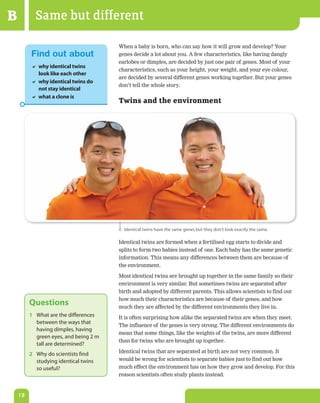
                                         Identical twins have the same genes but they don‘t look exactly the same.

                                       Identical twins are formed when a fertilised egg starts to divide and
                                       splits to form two babies instead of one. Each baby has the same genetic
                                       information. This means any differences between them are because of
                                       the environment.

                                       Most identical twins are brought up together in the same family so their
                                       environment is very similar. But sometimes twins are separated after
                                       birth and adopted by different parents. This allows scientists to find out
                                       how much their characteristics are because of their genes, and how
         Questions                     much they are affected by the different environments they live in.
         1 What are the differences    It is often surprising how alike the separated twins are when they meet.
           between the ways that
                                       The influence of the genes is very strong. The different environments do
           having dimples, having
                                       mean that some things, like the weights of the twins, are more different
           green eyes, and being 2 m
                                       than for twins who are brought up together.
           tall are determined?
                                       Identical twins that are separated at birth are not very common. It
         2 Why do scientists find
           studying identical twins    would be wrong for scientists to separate babies just to find out how
           so useful?                  much effect the environment has on how they grow and develop. For this
                                       reason scientists often study plants instead.


    18
B1: You and Your genes


Cloning
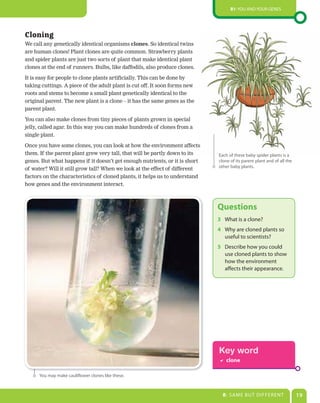
We call any genetically identical organisms clones. So identical twins
are human clones! Plant clones are quite common. Strawberry plants
and spider plants are just two sorts of plant that make identical plant
clones at the end of runners. Bulbs, like daffodils, also produce clones.

It is easy for people to clone plants artificially. This can be done by
taking cuttings. A piece of the adult plant is cut off. It soon forms new
roots and stems to become a small plant genetically identical to the
original parent. The new plant is a clone – it has the same genes as the
parent plant.

You can also make clones from tiny pieces of plants grown in special
jelly, called agar. In this way you can make hundreds of clones from a
single plant.

Once you have some clones, you can look at how the environment affects
them. If the parent plant grew very tall, that will be partly down to its    each of these baby spider plants is a
genes. But what happens if it doesn’t get enough nutrients, or it is short   clone of its parent plant and of all the
                                                                             other baby plants.
of water? Will it still grow tall? When we look at the effect of different
factors on the characteristics of cloned plants, it helps us to understand
how genes and the environment interact.


                                                                             Questions
                                                                             3 What is a clone?
                                                                             4 Why are cloned plants so
                                                                               useful to scientists?
                                                                             5 describe how you could
                                                                               use cloned plants to show
                                                                               how the environment
                                                                               affects their appearance.


                                                                             Key word
                                                                              clone

      You may make cauliflower clones like these.


                                                                               B: saMe BuT dIFFerenT                    19
C          What makes you the way you are?

                                              It can be funny to see that people in a family look like each other. Perhaps
         Find out about                       you don’t like a feature you’ve inherited – your dad’s big ears or your
                                              mum’s freckles. For some people, family likenesses are very serious.
          how you inherit genes
          Huntington’s disease
           (an inherited illness)
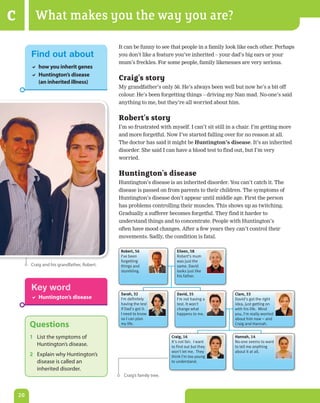
                                              Craig’s story
                                              My grandfather’s only 56. He’s always been well but now he’s a bit off
                                              colour. He’s been forgetting things – driving my Nan mad. No-one’s said
                                              anything to me, but they’re all worried about him.


                                              Robert’s story
                                              I’m so frustrated with myself. I can’t sit still in a chair. I’m getting more
                                              and more forgetful. Now I’ve started falling over for no reason at all.
                                              The doctor has said it might be Huntington’s	disease. It’s an inherited
                                              disorder. She said I can have a blood test to find out, but I’m very
                                              worried.


                                              Huntington’s disease
                                              Huntington’s disease is an inherited disorder. You can’t catch it. The
                                              disease is passed on from parents to their children. The symptoms of
                                              Huntington’s disease don’t appear until middle age. First the person
                                              has problems controlling their muscles. This shows up as twitching.
                                              Gradually a sufferer becomes forgetful. They find it harder to
                                              understand things and to concentrate. People with Huntington’s
                                              often have mood changes. After a few years they can’t control their
                                              movements. Sadly, the condition is fatal.

                                               Robert, 56                 Eileen, 58
                                               I've been                  Robert’s mum
                                               forgetting                 was just the
         Craig and his grandfather, robert.    things and                 same. David
                                               stumbling.                 looks just like
                                                                          his father.


         Key word
                                               Sarah, 32                  David, 35              Clare, 33
          Huntington’s disease                I'm definitely             I'm not having a       David's got the right
                                               having the test            test. It won't         idea, just getting on
                                               if Dad's got it.           change what            with his life. Mind
                                               I need to know             happens to me.         you, I'm really worried
                                               so I can plan                                     about him now – and
         Questions                             my life.                                          Craig and Hannah.


         1 List the symptoms of                                        Craig, 16                 Hannah, 14
                                                                       It's not fair. I want     No-one seems to want
           Huntington’s disease.                                       to find out but they      to tell me anything
                                                                       won't let me. They        about it at all.
         2 explain why Huntington’s                                    think I'm too young
           disease is called an                                        to understand.
           inherited disorder.
                                                Craig’s family tree.


    20
B1: You and Your genes


How do you inherit your genes?                                                                                    same gene

Sometimes people in the same family
look a lot alike. In other families brothers
and sisters look very different. They may
also look different from their parents.
The key to this mystery lies in our genes.

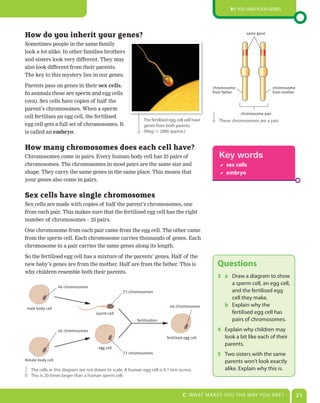
Parents pass on genes in their sex	cells.                                                         chromosome                      chromosome
In animals these are sperm and egg cells                                                          from father                     from mother

(ova). Sex cells have copies of half the
parent’s chromosomes. When a sperm
                                                                                                                chromosome pair
cell fertilises an egg cell, the fertilised
                                                              The fertilised egg cell will have      These chromosomes are a pair.
egg cell gets a full set of chromosomes. It                   genes from both parents.
is called an embryo.                                          (Mag: ϫ 2000 approx.)


How many chromosomes does each cell have?
Chromosomes come in pairs. Every human body cell has 23 pairs of                                     Key words
chromosomes. The chromosomes in most pairs are the same size and                                      sex cells
shape. They carry the same genes in the same place. This means that                                   embryo
your genes also come in pairs.


Sex cells have single chromosomes
Sex cells are made with copies of half the parent’s chromosomes, one
from each pair. This makes sure that the fertilised egg cell has the right
number of chromosomes – 23 pairs.

One chromosome from each pair came from the egg cell. The other came
from the sperm cell. Each chromosome carries thousands of genes. Each
chromosome in a pair carries the same genes along its length.

So the fertilised egg cell has a mixture of the parents’ genes. Half of the
new baby’s genes are from the mother. Half are from the father. This is                             Questions
why children resemble both their parents.
                                                                                                    3 a draw a diagram to show
                                                                                                        a sperm cell, an egg cell,
                   46 chromosomes
                                                  23 chromosomes                                        and the fertilised egg
                                                                                                        cell they make.
                                                                             46 chromosomes           b explain why the
 male body cell
                                    sperm cell                                                          fertilised egg cell has
                                                          fertilisation                                 pairs of chromosomes.
                   46 chromosomes                                                                   4 explain why children may
                                                                           fertilised egg cell        look a bit like each of their
                                                                                                      parents.
                                      egg cell
                                                  23 chromosomes                                    5 Two sisters with the same
female body cell                                                                                      parents won’t look exactly
   The cells in this diagram are not drawn to scale. a human egg cell is 0.1 mm across.               alike. explain why this is.
   This is 20 times larger than a human sperm cell.


                                                                                     C: WHaT MaKes You THe WaY You are?                         21
D          Male or female?

                                         Ever wondered what it would be like to be the opposite sex? Well, if
         Find out about                  you are male there was a time when you were female – just for a short
                                         while. Male and female embryos are very alike until they are about
          what decides if you are
                                         six weeks old.
           male or female
          how a Y chromosome
           makes a baby male
                                         What decides an embryo’s sex?
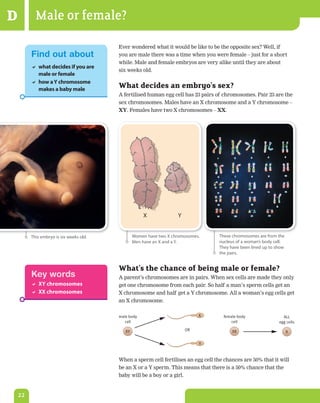
                                         A fertilised human egg cell has 23 pairs of chromosomes. Pair 23 are the
                                         sex chromosomes. Males have an X chromosome and a Y chromosome –
                                         XY. Females have two X chromosomes – XX.


                                                     X              Y


         This embryo is six weeks old.           Women have two X chromosomes.      These chromosomes are from the
                                                 Men have an X and a Y.             nucleus of a woman’s body cell.
                                                                                    They have been lined up to show
                                                                                    the pairs.


                                         What’s the chance of being male or female?
         Key words                       A parent’s chromosomes are in pairs. When sex cells are made they only
          XY chromosomes                get one chromosome from each pair. So half a man’s sperm cells get an
          XX chromosomes                X chromosome and half get a Y chromosome. All a woman’s egg cells get
                                         an X chromosome.


                                         male body                           X        female body                 ALL
                                            cell                                          cell                  egg cells

                                            XY                          OR                XX                          X

                                                                             Y


                                         When a sperm cell fertilises an egg cell the chances are 50% that it will
                                         be an X or a Y sperm. This means that there is a 50% chance that the
                                         baby will be a boy or a girl.


    22
B1: You and Your genes


How does the Y chromosome make a baby male?                                                       SRY gene

A male embryo’s testes develop when it is about six weeks old. This is
caused by a gene on the Y chromosome – the SRY gene. SRY stands for
‘sex-determining region of the Y chromosome’.

Testes produce male sex hormones called androgens. Androgens make
the embryo develop into a male. If there is no male sex hormone present,
                                                                             The Y chromosome
the sex organs develop into the ovaries, clitoris, and vagina of a female.


What are hormones?
Hormones are chemicals that control many processes in the cells. Tiny
amounts of hormones are made by different parts of the body. You can
read more about hormones in Module B2: Keeping Healthy.


Jan’s story
At eighteen Jan was studying at college. She was very happy, and was
going out with a college football player. She thought her periods hadn’t
started because she did a lot of sport.

Then in a science class Jan looked at the chromosomes in her cheek
cells. She discovered that she had male sex chromosomes – XY.

Sometimes a person has X and Y chromosomes but looks female. This is
because their body makes androgens but the cells take no notice of it.
About 1 in 20 000 people have this condition. They have small internal
testes and a short vagina. They can’t have children.

Jan had no idea she had this condition. She found it very difficult to
come to terms with. But she has now told her boyfriend and they have
stayed together.

                                                                             Questions
                                                                             1 Which sex chromosome(s)
                                                                               would be in the nucleus of:
                                                                               a a man’s body cell?
                                                                               b an egg cell?
                                                                               c a woman’s body cell?
                                                                               d a sperm cell?
                                                                             2 explain why an embryo
                                                                               needs the Y chromosome to
                                                                               become a boy.
                                                                             3 Imagine you are Jan or
                                                                               her boyfriend. How
                                                                               would you have felt about
                                                                               her condition?

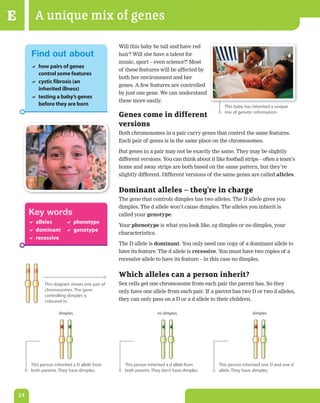
     Jan on holiday, aged eighteen.


                                                                                  D: MaLe or FeMaLe?         23
E          A unique mix of genes
                                                 Will this baby be tall and have red
         Find out about                          hair? Will she have a talent for
                                                 music, sport – even science?! Most
          how pairs of genes
                                                 of these features will be affected by
           control some features
                                                 both her environment and her
          cystic fibrosis (an
                                                 genes. A few features are controlled
           inherited illness)
                                                 by just one gene. We can understand
          testing a baby’s genes
                                                 these more easily.
           before they are born                                                                  This baby has inherited a unique
                                                                                                 mix of genetic information.
                                                 Genes come in different
                                                 versions
                                                 Both chromosomes in a pair carry genes that control the same features.
                                                 Each pair of genes is in the same place on the chromosomes.

                                                 But genes in a pair may not be exactly the same. They may be slightly
                                                 different versions. You can think about it like football strips – often a team’s
                                                 home and away strips are both based on the same pattern, but they’re
                                                 slightly different. Different versions of the same genes are called alleles.


                                                 Dominant alleles – they’re in charge
                                                 The gene that controls dimples has two alleles. The D allele gives you
                                                 dimples. The d allele won’t cause dimples. The alleles you inherit is
         Key words                               called your genotype.
          alleles    phenotype
                                                 Your phenotype is what you look like, eg dimples or no dimples, your
          dominant  genotype
                                                 characteristics.
          recessive
                                                 The D allele is dominant. You only need one copy of a dominant allele to
                                                 have its feature. The d allele is recessive. You must have two copies of a
                                                 recessive allele to have its feature – in this case no dimples.


                                                 Which alleles can a person inherit?
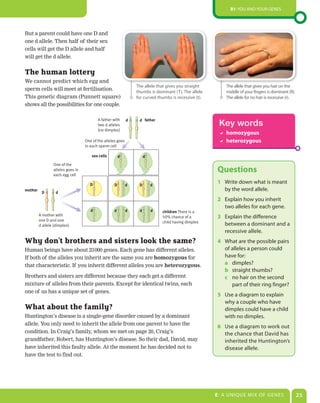
                This diagram shows one pair of   Sex cells get one chromosome from each pair the parent has. So they
                chromosomes. The gene            only have one allele from each pair. If a parent has two D or two d alleles,
                controlling dimples is
                coloured in.                     they can only pass on a D or a d allele to their children.

                       dimples                                     no dimples                                  dimples


                        D   D                                         d   d                                     D   d


         This person inherited a d allele from     This person inherited a d allele from      This person inherited one d and one d
         both parents. They have dimples.          both parents. They don’t have dimples.     allele. They have dimples.


    24
B1: You and Your genes


But a parent could have one D and
one d allele. Then half of their sex
cells will get the D allele and half
will get the d allele.


The human lottery
We cannot predict which egg and
                                                                 The allele that gives you straight       The allele that gives you hair on the
sperm cells will meet at fertilisation.                          thumbs is dominant (T). The allele       middle of your fingers is dominant (r).
This genetic diagram (Punnett square)                            for curved thumbs is recessive (t).      The allele for no hair is recessive (r).
shows all the possibilities for one couple.

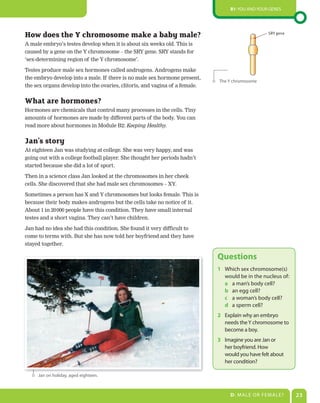
                                          A father with           d father
                                          two d alleles
                                                             d
                                                                                                        Key words
                                          (no dimples)
                                                                                                         homozygous
                                   One of the alleles goes                                               heterozygous
                                   in each sperm cell

                                      sex cells         d             d
                 One of the
                 alleles goes in
                 each egg cell
                                                                                                       Questions
                                     D              D        d    D       d
                                                                                                       1 Write down what is meant
mother                                                                                                   by the word allele.
          D        d
                                                                                                       2 explain how you inherit
                                                                                                         two alleles for each gene.
                                      d             d        d    d       d   children There is a
         A mother with                                                        50% chance of a          3 explain the difference
         one D and one                                                        child having dimples
         d allele (dimples)                                                                              between a dominant and a
                                                                                                         recessive allele.
Why don’t brothers and sisters look the same?                                                          4 What are the possible pairs
Human beings have about 23 000 genes. Each gene has different alleles.                                   of alleles a person could
If both of the alleles you inherit are the same you are homozygous for                                   have for:
that characteristic. If you inherit different alleles you are heterozygous.                              a dimples?
                                                                                                         b straight thumbs?
Brothers and sisters are different because they each get a different                                     c no hair on the second
mixture of alleles from their parents. Except for identical twins, each                                     part of their ring finger?
one of us has a unique set of genes.
                                                                                                       5 use a diagram to explain
                                                                                                         why a couple who have
What about the family?                                                                                   dimples could have a child
Huntington’s disease is a single-gene disorder caused by a dominant                                      with no dimples.
allele. You only need to inherit the allele from one parent to have the
                                                                                                       6 use a diagram to work out
condition. In Craig’s family, whom we met on page 20, Craig’s                                            the chance that david has
grandfather, Robert, has Huntington’s disease. So their dad, David, may                                  inherited the Huntington’s
have inherited this faulty allele. At the moment he has decided not to                                   disease allele.
have the test to find out.


                                                                                                       E: a unIQue MIX oF genes                      25
Dear Clare,
                                 nd Huw                  Dear Doctor
     Please help us. My husba
     and I have jus t been told that our                 We’ve had a huge postbag in response to last month’s letter from
                                rosis. No
     first child has cystic fib                          Emma. So this month we’re looking in depth at cystic fibrosis,
     one in our fam   ily has ever had                   a disease that one in twenty-five of us carries in the UK …
                               I do
      this disease before. Did
      something wro   ng during my
      pregnancy? I’m so worried
                                   .                     What is cystic fibrosis?
      Yours sincerely
      Emma
                                                         Y    ou can’t catch cystic fibrosis. It is a genetic disorder. This means it
                                                              is passed on from parents to their children. The disease causes big problems
                                                         for breathing and digestion. Cells that make mucus in the body don’t work properly.
                  Dear Emma,                             The mucus is much thicker than it should be, so it blocks up the lungs. It also
                  What a difficult time for              blocks tubes that take enzymes from the pancreas to the gut. People with cystic
                                              you all.
                  First of all, nothing you              fibrosis get breathless. They also get lots of chest infections. The shortage of
                                             did
                  during your pregnancy                  enzymes in their gut means that their food isn’t digested properly. So the person
                                            could
                 have affected this, so don              can be short of nutrients.
                                            ’t feel
                 guilty. Cystic fibrosis is
                                            an
                 inherited disorder …                    How do you get cystic fibrosis?

     Emma’s parents                  Huw’s parents
                                                         M     ost people with cystic fibrosis (CF) can’t have children. The thick mucus
                                                               affects their reproductive systems. So babies with CF are usually born
                                                         to healthy parents. At first glance this seems very strange – how can a parent pass
                                                         a disease on to their children when they don’t have it themselves?
                                                         The answer lies with one of the thousands of genes responsible for producing a
                                                         human being. One of these instructs cells to make mucus. But sometimes there are
                   Emma        Huw
                                                         errors in the DNA, so that it does not do its job.
                                                         A person who has one dominant, normal-functioning allele (F) and one recessive,
                                                         faulty allele (f) will not have CF. They can still make normal mucus. But they are a
                Emma and Huw’s child
                 with cystic fibrosis                    carrier of the faulty allele. When parents who are carriers make sex cells, half will
                                                         contain the normal allele – and half will contain the faulty allele. When two sex cells
             Female with dominant allele F               carrying the faulty allele meet at fertilisation, the baby will have CF. One in every 25
             Female with recessive allele f              people in the UK carries the CF allele.
             Male with dominant allele F
             Male with recessive allele f

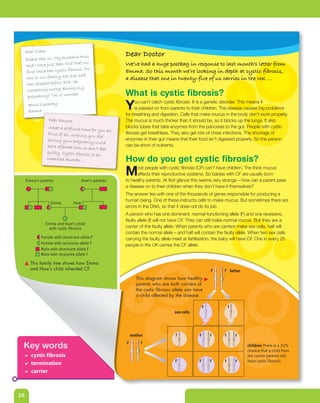
       This family tree shows how Emma
       and Huw's child inherited CF.                                                                     F     f father
                                                               This diagram shows how healthy
                                                               parents who are both carriers of
                                                               the cystic fibrosis allele can have
                                                               a child affected by the disease.

                                                                                                     F             f
                                                                                   sex cells


                                                             mother                 f            F       f     f       f

 Key words                                               F        f
                                                                                                                            children There is a 25%
                                                                                                                            chance that a child from
  cystic fibrosis                                                                                                          the carrier parents will
                                                                                    F            F       F     f       F    have cystic fibrosis.
  termination
  carrier


26
B1: You and Your genes


 Can cystic fibrosis be cured?
 N     ot yet. But treatments are getting better, and life expectancy is
       increasing all the time. Physiotherapy helps to clear mucus from
 the lungs. Sufferers take tablets with the missing gut enzymes in.
                                                                                            Tom has cystic fibrosis. He has physiotherapy
 Antibiotics are used to treat chest infections. And an enzyme spray
                                                                                            every day to clear thick mucus from his lungs.
 can be used to thin the mucus in the lungs, so it is easier to get rid of.
 New techniques may offer hope for a cure in the future.

                                                                                                   How do doctors get
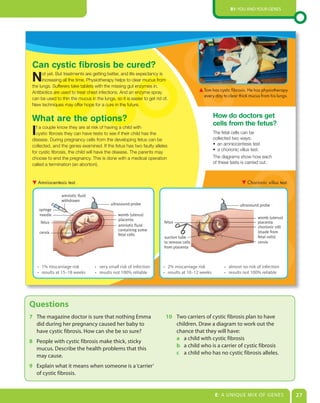
 What are the options?                                                                             cells from the fetus?
 I f a couple know they are at risk of having a child with
   cystic fibrosis they can have tests to see if their child has the
 disease. During pregnancy cells from the developing fetus can be
                                                                                                   The fetal cells can be
                                                                                                   collected two ways:
 collected, and the genes examined. If the fetus has two faulty alleles                            • an amniocentesis test
                                                                                                   • a chorionic villus test.
 for cystic fibrosis, the child will have the disease. The parents may
 choose to end the pregnancy. This is done with a medical operation                                The diagrams show how each
 called a termination (an abortion).                                                               of these tests is carried out.


     Amniocentesis test.                                                                                              Chorionic villus test.

                 amniotic fluid
                 withdrawn
                                           ultrasound probe                                                      ultrasound probe
     syringe
     needle                                    womb (uterus)
                                               placenta                                                                    womb (uterus)
      fetus                                                              fetus                                             placenta
                                               amniotic fluid                                                              chorionic villi
                                               containing some                                                             (made from
      cervix
                                               fetal cells
                                                                         suction tube                                      fetal cells)
                                                                         to remove cells                                   cervix
                                                                         from placenta


     • 1% miscarriage risk         • very small risk of infection       • 2% miscarriage risk            • almost no risk of infection
     • results at 15–18 weeks      • results not 100% reliable          • results at 10–12 weeks         • results not 100% reliable


Questions
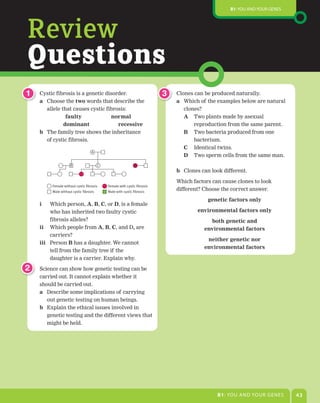
7 The magazine doctor is sure that nothing emma                          10 Two carriers of cystic fibrosis plan to have
  did during her pregnancy caused her baby to                               children. draw a diagram to work out the
  have cystic fibrosis. How can she be so sure?                             chance that they will have:
                                                                            a a child with cystic fibrosis
8 People with cystic fibrosis make thick, sticky
                                                                            b a child who is a carrier of cystic fibrosis
  mucus. describe the health problems that this
                                                                            c a child who has no cystic fibrosis alleles.
  may cause.
9 explain what it means when someone is a ‘carrier’
  of cystic fibrosis.


                                                                                                    E: a unIQue MIX oF genes                   27
F             Making ethical decisions
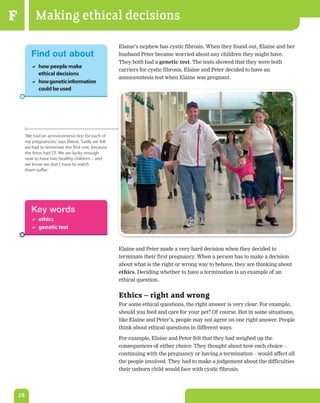
                                                        Elaine’s nephew has cystic fibrosis. When they found out, Elaine and her
            Find out about                              husband Peter became worried about any children they might have.
                                                        They both had a genetic	test. The tests showed that they were both
             how people make
                                                        carriers for cystic fibrosis. Elaine and Peter decided to have an
              ethical decisions
                                                        amniocentesis test when Elaine was pregnant.
             how genetic information
              could be used


         ‘We had an amniocentesis test for each of
         my pregnancies,’ says elaine. ‘sadly we felt
         we had to terminate the first one, because
         the fetus had CF. We are lucky enough
         now to have two healthy children – and
         we know we don't have to watch
         them suffer.’


            Key words
             ethics
             genetic test


                                                        Elaine and Peter made a very hard decision when they decided to
                                                        terminate their first pregnancy. When a person has to make a decision
                                                        about what is the right or wrong way to behave, they are thinking about
                                                        ethics. Deciding whether to have a termination is an example of an
                                                        ethical question.


                                                        Ethics – right and wrong
                                                        For some ethical questions, the right answer is very clear. For example,
                                                        should you feed and care for your pet? Of course. But in some situations,
                                                        like Elaine and Peter’s, people may not agree on one right answer. People
                                                        think about ethical questions in different ways.

                                                        For example, Elaine and Peter felt that they had weighed up the
                                                        consequences of either choice. They thought about how each choice –
                                                        continuing with the pregnancy or having a termination – would affect all
                                                        the people involved. They had to make a judgement about the difficulties
                                                        their unborn child would face with cystic fibrosis.


    28
B1: You and Your genes


In order to consider all the
consequences they also                                                                                                  What are the
                                                                                                                     ethical arguments
had to think about the                                                                                                 for a decision?
effects that an ill child
would have on their lives,
and on the lives of any
other children they might
have. Some people feel that
they could not cope with
                                                                                             The right decision is
the extra responsibility of                                                                the one which leads to
caring for a child with a                                                                   the best outcome for
                                                                                              the most people.
serious genetic disorder.


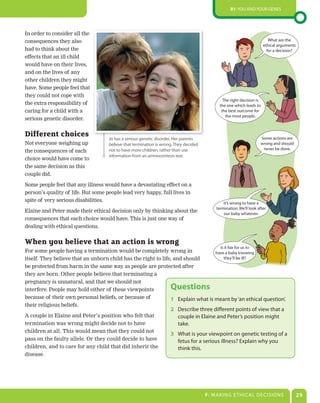
Different choices                   Jo has a serious genetic disorder. Her parents                                 Some actions are
Not everyone weighing up            believe that termination is wrong. They decided                                wrong and should
                                    not to have more children, rather than use                                      never be done.
the consequences of each
                                    information from an amniocentesis test.
choice would have come to
the same decision as this
couple did.

Some people feel that any illness would have a devastating effect on a
person’s quality of life. But some people lead very happy, full lives in
spite of very serious disabilities.
                                                                                              It’s wrong to have a
                                                                                          termination. We’ll look after
Elaine and Peter made their ethical decision only by thinking about the                       our baby whatever.
consequences that each choice would have. This is just one way of
dealing with ethical questions.


When you believe that an action is wrong
                                                                                            Is it fair for us to
For some people having a termination would be completely wrong in                have a baby knowing
itself. They believe that an unborn child has the right to life, and should          they’ll be ill?
be protected from harm in the same way as people are protected after
they are born. Other people believe that terminating a
pregnancy is unnatural, and that we should not
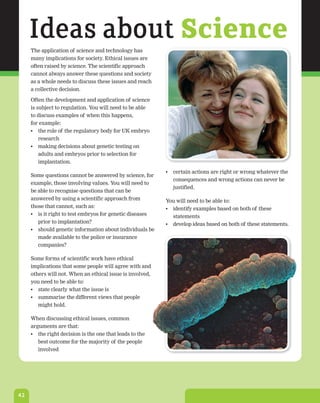
interfere. People may hold either of these viewpoints               Questions
because of their own personal beliefs, or because of           1 explain what is meant by ‘an ethical question’.
their religious beliefs.
                                                                    2 describe three different points of view that a
A couple in Elaine and Peter’s position who felt that                 couple in elaine and Peter’s position might
termination was wrong might decide not to have                        take.
children at all. This would mean that they could not
                                                                    3 What is your viewpoint on genetic testing of a
pass on the faulty allele. Or they could decide to have               fetus for a serious illness? explain why you
children, and to care for any child that did inherit the              think this.
disease.


                                                                                      F: MaKIng e THICaL deCIsIons                       29
G           Genetic testing

                                                     How reliable are genetic tests?
         Find out about                              Genetic testing is used to look for alleles that cause genetic disorders.
          what a genetic test is                    People like Elaine and Peter use this information to make decisions
          what genetic screening is                 about whether to have children. Genetic tests can also be used to make a
                                                     decision about whether a pregnancy should be continued or not.

                                                     So, it is important to realise that the tests are not completely reliable. In a few cases
                                                     only it will not detect CF. This is called a false	negative. The test only
                                                     looks for common DNA errors in the faulty CF gene. False	positive tests
                                                     are not common, but they may happen due to technical failure of the test.


                                                     Why do people have genetic tests?
                                                     Usually people only have a genetic test because they know that a genetic
                                                     disorder runs in their family; they want to know if they are carriers.
                                                     Most parents who have a child with cystic fibrosis did not know that
                                                     they were carriers. So, they would not have had a genetic test
                                                     during pregnancy.

                                                     Every newborn baby in the UK is now screened for cystic fibrosis. They
                                                     have a blood test – this is a biochemical test, not the more expensive
                                                     genetic test. If the biochemical test is positive for CF the baby will be
                                                     genetically tested to confirm the diagnosis. Treatment can start before
                                                     the lungs are too badly damaged. Gentetic testing the whole population
                                                     or large groups for a genetic disease is called genetic	screening.


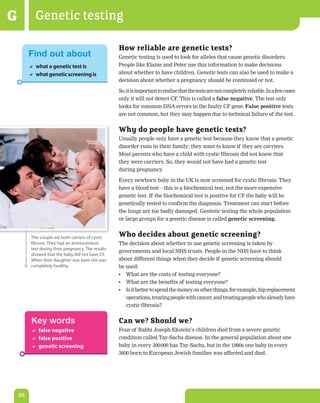
          This couple are both carriers of cystic    Who decides about genetic screening?
          fibrosis. They had an amniocentesis        The decision about whether to use genetic screening is taken by
          test during their pregnancy. The results
                                                     governments and local NHS trusts. People in the NHS have to think
          showed that the baby did not have CF.
          When their daughter was born she was       about different things when they decide if genetic screening should
          completely healthy.                        be used:
                                                     •	 What are the costs of testing everyone?
                                                     •	 What are the benefits of testing everyone?
                                                     •	 Is it better to spend the money on other things, for example, hip replacement
                                                        operations, treating people with cancer, and treating people who already have
                                                        cystic fibrosis?


          Key words                                  Can we? Should we?
           false negative                           Four of Rabbi Joseph Ekstein’s children died from a severe genetic
           false positive                           condition called Tay-Sachs disease. In the general population about one
           genetic screening                        baby in every 300 000 has Tay-Sachs, but in the 1980s one baby in every
                                                     3600 born to European Jewish families was affected and died.


    30
B1: You and Your genes


In 1983 Rabbi Ekstein set up a genetic screening programme. Couples
planning to marry were genetically tested. If they both carried the
recessive allele they were advised either to not marry or to have prenatal
screening and terminate affected pregnancies. As a result of this genetic
screening, Tay-Sachs has almost disappeared from Jewish communities
worldwide.


Testing your genes
If you could have more information about your genes, would you
want it? You can buy a DNA testing kit that tells you if you are carrying
faulty alleles for over 100 rare genetic mutations including cystic fibrosis
and Tay-Sachs. Some scientists hope tests like these will help to prevent
many genetic diseases. Other scientists think that the risk of being
affected by these rare genetic diseases is so low that screening is not
worthwhile. It costs money and may cause people to worry
unnecessarily.


                                                                               Questions
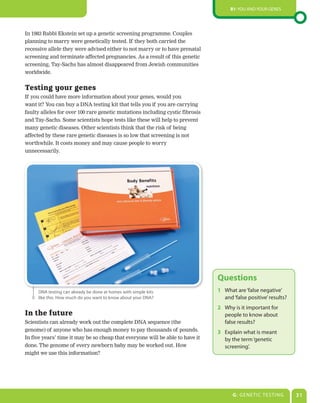
     dna testing can already be done at homes with simple kits                 1 What are ‘false negative’
     like this. How much do you want to know about your dna?                     and ‘false positive’ results?
                                                                               2 Why is it important for
In the future                                                                    people to know about
Scientists can already work out the complete DNA sequence (the                   false results?
genome) of anyone who has enough money to pay thousands of pounds.             3 explain what is meant
In five years’ time it may be so cheap that everyone will be able to have it     by the term ‘genetic
done. The genome of every newborn baby may be worked out. How                    screening’.
might we use this information?


                                                                                     G: gene TIC TesTIng         31
Finding the right medicine
                                           In 2009 Carolyn Major started to take the medicine she hoped would help
                                           cure her cancer. Instead, four days later, she was in an intensive care
                                           ward with her heart struggling to keep going. She is one of a small group
                                           of people whose bodies react very badly to the anti-cancer drug. Carolyn
                                           was lucky. She recovered with no permanent damage done to her heart –
                                           and so far the cancer hasn’t returned either.

                                           In future the genetic testing of adults may make problems like this a
                                           thing of the past. Doctors think that we can use genetic testing to match
                                           medicines to patients. Some people produce enzymes that break down
                                           drugs very quickly, so they need higher doses of a medicine than most of
                                           us. Other people don’t produce enzymes that break down certain drugs
                                           in their body, so they can be poisoned by medicine that is meant to help
                                           them. In future, genetic testing may show if people have the genes for
                                           these enzymes so we can all be given the drugs that work best for our
                                           bodies' genotype.


                                           What can genetic screening tell us?
                                           Full genetic screening will show if you have inherited genes that
                                           increase your risk of a particular problem such as heart disease or
     Carolyn had a dangerous reaction      different types of cancer. But remember that most of these diseases are
     to drugs. genetic testing may help    affected by both your genes and your lifestyle.
     to avoid this.
                                           This information could be very helpful. If you found out that you are
                                           genetically at a higher than average risk of developing heart disease, for
                                           example, you might decide to change your lifestyle. If you don’t smoke,
                                           eat a healthy diet, and always take lots of exercise, you would lower your
                                           environmental risk of heart disease. This would help to balance your
                                           increased genetic risk. And if you know that your genotype means you
                                           have an increased risk of getting a particular type of cancer, you can be
                                           screened regularly to catch the disease as early as possible if it develops.


                                             Questions
                                             4 How can the genetic testing of adults prevent the birth of babies
                                               affected with genetic diseases?
                                             5 What do you think are the advantages and disadvantages of
                                               testing adults?
                                             6 How might genetic testing make medicines more effective and
                                               what problems might it cause?

     In the future, decisions about drug
     treatments may be based on genetic
     test results.


32
B1: You and your genes


Is it right to use genetic screening?
It is easy to see why people may want genetic screening:
•	 when two people decided to have children, they would know if their
    children were at risk of inheriting the disorder
•	 when a disease runs in someone’s family, they would know if they
    were going to develop it.

At first glance, genetic screening may seem like the best course of action
for everyone. But the best decision for the majority is not always the
right decision. There are ethical questions to consider about genetic
screening, including:
•	 Who should know the test results?
•	 What effect could the test result have on people’s future decisions?
•	 Should people be made to have screening, or should they be able to
   opt out? Is it right to interfere?

About 1 in 25 people in the UK carry the allele for cystic fibrosis. Some
people think that having this information is useful, but there are also
good reasons why not everyone agrees. A decision may benefit many
people. But it may not be the right decision if it causes a great amount of
harm to a few people.

                                                           We should give
                        It's very                     people all the information                                 What if my husband
                  dangerous. People                   we can about their health.                               and I both had the faulty
                shouldn't have to worry                Then they can make an          I want to choose       allele? We'd be very worried
                about this information.                  informed decision.        my medical treatments        about having children.
                 There's nothing wrong                                             – not have them forced
                 in having a child with                                                   upon me!
                       an illness.


                         We shouldn't interfere
                       with having children. It's a
                       natural process. So there's
                         no point in testing for
                               a disease.


                                                                                                People have different ideas about
                                                                                                whether genetic screening for cystic
                                                                                                fibrosis would be a good thing.
  Questions
  7	 Give two arguments for and two against genetic screening for
     cystic fibrosis.
  8	 Which argument do you agree with? Explain why.


                                                                                                     G: Gene tic testing                    33
Who should know about your genes?
                                                  If you find out that your genotype suggests you have a higher-than-
                                                  average risk of developing heart disease, who should know about it?
                                                  Your partner? Your family? Your boss? Your insurance company?

                                                  Many people think that only you and your doctor should know
                                                  information about your genes. They are worried that it could affect a
                                                  person’s job prospects and chances of getting life insurance.

                                                  How does life insurance work?
                                                  People with life insurance pay a regular sum of money to an insurance
                                                  company. This is called a premium. In return, when they die, the
                                                  insurance company pays out an agreed sum of money. People buy life
                                                  insurance so that there will be money to support their families when
                                                  they die.

                                                  Condition                              Percentage of deaths from each
                                                                                         disease caused by smoking in 2007
     People use information like this to decide
     the premium each person should pay for                                                    Men              Women
     insurance. The higher the risk, the bigger
     the premium.                                 Cancers
                                                  Lung                                          88                75
                                                  Throat and mouth                              76                56
                                                  Oesophagus                                    70                63
                                                  Heart and circulation diseases                11                15


                                                  Should insurance companies know about
                                                  your genes?
                                                  Insurance companies assess what a person’s risk is of dying earlier than
                                                  average. If they believe that the risk is high, they may choose to charge
                                                  higher premiums than average. Some people think that insurance
                                                  companies might use the results of genetic tests in the wrong way.
                                                  Individual people might do the same. But having a gene that means you
                                                  have a higher risk does not mean that you will definitely die early.
                                                  Here are some of the arguments:
                                                  •	 Insurers may not insure people if a test shows that they are more likely
                                                     to get a particular disease. Or they may charge a very high premium.
                                                  •	 Insurers may say that everyone must have genetic tests for many
                                                     diseases before they can be insured.
                                                  •	 People may not tell insurance companies if they know they have a
                                                     genetic disorder.
                                                  •	 People may refuse to have a genetic test because they fear that they
                                                     will not be able to get insurance. They may miss out on medical
                                                     treatment that could keep them healthy.


34
B1: You and Your genes


In the USA, the 2008 Genetic Information Nondiscrimination Act
means insurance companies can’t stop someone getting health
insurance, or even charge them higher premiums, because of the
results of a genetic test. It also means that employers can’t use genetic
information when they are deciding who should get a job or who
should be fired.

In the UK insurance companies agreed not to collect and use genetic
information about people until the end of 2014. There are also some
concerns about whether the results of genetic testing might affect
employment. Politicians are considering bringing in laws to control how
information about people’s genes can be used. This debate has been
going on for 10 years now and no decisions have been made yet!


What about the police?
Scientists already use information about people’s DNA to help them
solve crimes. They produce DNA profiles from cells left at a crime scene.
There is usually only a 1 in 50 million chance of two people having the
same DNA profile – unless they are identical twins.

Some people think that there should be a national DNA database
recording everyone living in the country. If all babies were to have their
genome sequenced at birth, this will be easily available in the future. At
the moment only DNA from people who have been arrested or convicted
of committing a crime can be stored. Human rights campaigners are
against a database for everyone’s DNA. They think it is an invasion of
privacy and puts innocent people on the same level as criminals.


  Questions
   9 If genetic testing shows you have a higher-than-average risk of
     heart disease, do you think this should affect your application:
     a to be an airline pilot?
     b to take out life insurance?
  10 Write down arguments for and against the government setting
     up a dna database.
  11 do you agree or disagree with the genetic testing of newborn
     babies and the setting up of a dna database? explain your reasons.

                                                                             dna evidence has been used to
                                                                             prove many people guilty – and
                                                                             others innocent.


                                                                                G: gene TIC TesTIng           35
H       Can you choose your child?
                                                   Many people do not agree with termination. If they are at risk of having
      Find out about                               a child with a genetic disease, they may have decided not to have
                                                   children. Now doctors can offer them another treatment. It uses in vitro
       how new techniques
                                                   fertilisation (IVF). In this treatment the mother’s egg cells are fertilised
        can allow people to
                                                   outside her body. This treatment is used to help couples who cannot
        select embryos
                                                   conceive a child naturally. It can also be used to help couples whose
       how people think this
                                                   children are at risk from a serious genetic disorder.
        technology should
        be used
                                                   Pre-implantation genetic diagnosis
                                                   Bob and Sally want children, but Bob has the allele for Huntington’s
     Sally takes a 'fertility drug' so that        disease. Sally has become pregnant twice. Tests showed that both the
     she releases several eggs.                    fetuses had the Huntington’s allele and the pregnancies were
     Fertility drugs contain hormones.
                                                   terminated. Bob and Sally were keen to have a child, so their doctor
                                                   suggested that they should use pre-implantation	genetic	diagnosis	
     In a small operation, the doctor              (PGD). Sally’s treatment is explained in the flow chart. The first use of
     collects the eggs.                            PGD to choose embryos was in the UK in 1989. At the moment, PGD is
                                                   only allowed for families with particular inherited conditions.
     Bob's sperm fertilise the eggs in a
     Petri dish. This is in vitro fertilisation.   New technology – new decisions
                                                   New technologies like PGD often give us new decisions to make. In the
                                                   UK, Parliament makes laws to control research and technologies to do
                                                   with genes. Scientists are not free to do whatever research they may
                                                   wish to do. From time to time Parliament has to update the law.

                                                   But Parliament can’t make decisions case by case. So the Government
                                                   has set up groups of people to decide which cases are within the law on
                                                   reproduction. One of these groups regulates UK fertility clinics and all
     When the embryos reach the eight-cell         UK research involving embryos..
     stage, one cell is removed from each.
                                                   The regulatory body interprets the laws we already have about genetic
                                                   technologies. It also takes into account public opinion, as well as practical and
                                                   ethical considerations. One of its jobs is to decide when PGD can be used.

                                                   If embryos are tested before implantation, no babies need to be born
                                                   with the disease. The embryos with faulty genes are destroyed. However,
                                                   some people are concerned about this.


     The cells are tested for the                    Questions
     Huntington's allele. This is called
     pre-implantation genetic diagnosis              1 explain why everyone who has Pgd has to use IVF treatment in
     (PGD).                                            order to conceive.
                                                     2 Make a list of viewpoints for and against embryo selection.
     Only embryos without the                          a Which viewpoint do you agree with? give your reasons.
     Huntington's allele are
     implanted in Sally's uterus.                      b Which viewpoint do you disagree with? give your reasons.


36
Cloning – science fiction or science fact?                                                                                         I
Cloning: a natural process
Many living things only need one individual to reproduce. This is called                 Find out about
asexual	reproduction. Single-celled organisms like the bacteria in the                    asexual reproduction
picture use asexual reproduction.                                                         cloning and stem cells
The bacterium divides to form two new cells. The two cells’ genes are
identical to each other’s. We call genetically identical organisms clones.
The only variation between them will be caused by differences in
their environment.

Asexual reproduction
Larger plants and animals have different types of cells for different jobs.
As an embryo grows, cells become specialised. Some examples are
blood cells, muscle cells, and nerve cells.

Plants keep some unspecialised cells all their lives. These cells can
become anything that the plant may need. For example, they can make
new stems and leaves if the plant is cut down. These cells can also grow                    a bacterium cell grows and then
whole new plants. So they can be used for asexual reproduction.                             splits into two new cells.
                                                                                            (Mag: ϫ 7500 approx.)
Some simple animals, like the Hydra in the picture opposite, also use
asexual reproduction. But cloning is very uncommon in animals.


Sexual reproduction
Most animals and plants use sexual	reproduction. The new offspring
have two parents so they are not clones. But clones are sometimes
produced – we call them identical twins.

sperm cell
                                                            baby


             fertilisation
                                                   splits
                                                                                            Hydra.
                             fertilised egg cell


                                                            baby
                                                                                         Key words
egg cell
                                                                                          pre-implantation
   Identical twins have the same genes. But their genes came from both parents.            genetic diagnosis
   so they are clones of each other, but not of either parent.
                                                                                           (PGD)
                                                                                          regulates
Cloning Dolly                                                                             asexual reproduction
Scientists can also clone adult animals artificially but this is much more                specialised
difficult. Dolly the sheep was the first cloned sheep to be born.                         sexual reproduction
•	 The nucleus is taken from an unfertilised sheep egg cell.                              clones
•	 The nucleus is taken out of a body cell from a different sheep.


                                                                   I: CLonIng – sCIenCe FIC TIon or sCIenCe FaC T?            37
unfertilised                body cell   •	 This body cell nucleus is put into the empty egg cell.
            egg cell
                                                    •	 The cell grows to produce a new animal. Its genes will be the same as
                                                       those of the animal that donated the nucleus. So it will be a clone of
                                                       that animal.

                                                    Dolly died in 2003, aged 6. The average lifespan for a sheep is 12–14 years.
     nucleus                        body cell       Perhaps Dolly’s illness had nothing to do with her being cloned. She
     is taken                       nucleus is
                                                    might have died early anyway. One case is not enough evidence to decide
     out                            put into the
                                    empty egg       either way.
                                    cell
                                                    Many other cloned animals have suffered unusual illnesses. So scientists
                                                    think that more research needs to be done before cloned mammals will
                 Grow the embryo for                grow into healthy adults.
                 a few days, then put
                 into a sheep's womb.
                                                    Cloning humans
                                                    In the future it may be possible to clone humans. But most scientists
                                                    don’t want to clone adult human beings. However, some scientists do
                                                    want to clone human cells. They think that some cloned cells could be
                                                    used to treat diseases. The useful cells are called stem	cells.

                                                    What are stem cells?
       Key words                                    Stem cells are unspecialised cells. All the cells in an early embryo are
        stem cells                                 stem cells. These embryonic stem cells can grow into any type of cell in
        unspecialised                              the human body. Stem cells can be taken from embryos that are a few
                                                    days old. Researchers use human embryos that are left over from
                                                    fertility treatment.

                                                    Adults also have stem cells in many tissues, for example, in their bone
                                                    marrow, brain, and heart. These unspecialised cells can develop into
                                                    many, but not all, types of cells. Bone marrow stem cells are already
                                                    used in transplants to treat patients with leukaemia.

                                                    Scientists want to grow stem cells to make new cells to treat patients
                                                    with some diseases. For example, new brain cells could be made for
                                                    patients with Parkinson’s disease. But these new cells would need to
                                                    have the same genes as the person getting them as a treatment. When
                                                    someone else’s cells are used in a transplant they are rejected.

                                                    What’s cloning got to do with this?
                                                    Cloning could be used to produce an embryo with the same genes as
                                                    the patient. Stem cells from this embryo would have the same genes as
                                                    the patient. So cells produced from the embryo would not be rejected
                                                    by the patient’s body. Cloning a patient’s own adult stem cells would
                                                    produce cells that could be used to treat their illness. The cells would
       Cells from eight-cell embryos like this
       one can develop into any type of body        not be rejected because they are the same as the patient’s own cells.
       cell. They start to become specialised
       when the embryo is five days old. (Mag:      Doctors are exploring these technologies. Success could benefit millions
       ϫ 500 approx.)                               of people if it is made to work.


38
B1: You and Your genes


Should human embryo cloning be allowed?

                            With some
                   things there’s no argument.                      Research
               Murder is just wrong – in the same                on embryos is
              way that lying and stealing are wrong.               legal up to
               Killing an embryo at any age is as                  14 days. If
                  wrong as killing a child or an                 something is
                              adult.                             ‘legal’ it can’t
                                                                    be wrong.


                    Whether it’s
                                                                   An embryo is human so
                right or not depends
              on how much good it does
                                                                it has human rights. Its age                      James has Parkinson’s disease. His
                                                               doesn’t make any difference.                       brain cells do not communicate
           versus how much harm. If your
                                                                 You can’t experiment on a                        with each other properly. He
           best friend was paralysed in an
                                                                      child or an adult.
          accident, you wouldn’t think it was                                                                     cannot control his movements.
           wrong to sacrifice a five-day-old
            embryo made of 50 cells. Not if
             those cells could be used to
                 make nerve tissue to
                  repair your friend’s
                       damaged
                        nerves.                                                                       Creating
                                                                                         embryos for medical treatments
                                                                                         is wrong. It’s creating a life that
                                                                                          is then destroyed. This lowers
                                                                                                 the value of life.


                               If research on cloning is
                        allowed, it could lead to reproductive
                     cloning. Once the technology to produce a
                   human clone is developed, it will be difficult to
                          stop someone using it to produce
                                a cloned adult human.


 Questions
 1 How are stem cells different from other cells?                             4 For embryo cloning to make stem cells:
                                                                                a describe one viewpoint in favour
 2 explain why scientists think stem cells would
                                                                                b describe two different viewpoints against.
   be useful in treating Parkinson’s disease.
                                                                              5 People often make speculations when they are
 3 For each of these cells, say whether or not your
                                                                                arguing for or against something. This is
   body would reject it:
                                                                                something they think will happen, but may not
   a bone marrow from your identical twin
                                                                                have evidence for. Write down a viewpoint on
   b your own skin cells
                                                                                human cloning that is a speculation.
   c a cloned embryo stem cell.


                                                                         I: CLonIng – sCIenCe FIC TIon or sCIenCe FaC T?                               39
Science
Explanations
In this module, you will learn about inheritance, that genes are the units of
inheritance, the relationship between genes and the environment, and that
sexual reproduction is a source of variation.

                         ow:
           You should kn
 that genes are sections of DNA and form part of chromosomes that are found
  in cells’ nuclei and instruct cells to make proteins
 how single genes can determine some human characteristics, such as
  dimples; several genes working together determine many characteristics,


                                                                                        st r
  such as eye colour; features such as scars are determined by the environment,


                                                                                    uc
                                                                                     pro
  and other characteristics, such as weight, are determined by both genes and


                                                                                       tu
                                                                                         ral
                                                                                          tei
  the environment


                                                                                              ns
                                                                                                          genes
 that a pair of chromosomes carries the same gene in the same place and            proteins as
  alleles are different versions of a gene
                                                                                    enzymes
 about dominant and recessive alleles and why the recessive gene in a
  heterozygous pair will not show its characteristics
 that a person’s genotype is the genes they have, whilst their phenotype
  describes their characteristics
 how sex cells contain one chromosome from each pair and during sexual
  reproduction genes from both parents come together
 why offspring are similar to both parents but are not the same because they
  inherit a different combination of genes
 how a gene on the Y chromosome determines maleness
 that genetic diagrams are used to show inheritance
 how the symptoms of Huntington’s disease appear later in life and include
                                                                                                        gton's
  clumsiness, tremors, memory loss, and mood changes and that it is caused by                  Huntin
  a faulty dominant allele
 how a faulty recessive allele causes cystic fibrosis, a condition where cells
  produce thick mucus that causes chest infections and difficulties breathing
  and digesting food
 how genetic testing is used to screen adults, children, and embryos for faulty                         fibrosis
                                                                                                  cystic
  alleles
 how the information from genetic testing is used to make decisions and why
  this has implications
 that clones are organisms with identical genes
 about unspecialised cells, called stem cells, that can develop into other types
  of cell and how they can be used to treat some illnesses.


40
B1: You and Your genes


                                      mu
                                        lti                                                                                                            n
                                            p                                                                                                    tio
              ht


                                                                                                                                            a
         ig


                                            le


                                                                                                                                          in
      we


                                                                                                                                       erm
                                               ge
                                                                                                                                                                         n


                                                 ne
                                                                                                                                                                      tio


                                                                                                                                    det
                                                                                                                                                                    ma


                                                  s
                                                                                                                                                                for


                                                                                                                                  sex
                     dim
                                                                                                                                                itin        g in
                           ples                                                                                                           inher


        s ca r s
                                                                                                                                                                                     ton's


                                                                                                                 tt
                                                            genetic
                                                                                                                                                                              ting


                                                                                                               ne
                                                                                                                                                                            un


                                                                                                               s
                                                                                                            are
                                                                                                           Pun
                        env                                                                                                                                             H
                              iron


                                                                                                         squ
                                  m en
                                      tal

                                                                                                                                     rees                                       cystic
                                                             varia                                                           family t
                                                                                                                                                                              fibrosis


                                                                                                       tic
                                                                  t
                                                                 ion

                                                                                                             s


                                                                                                     ne

                                                                                                   am
                                                                                                  ge

                                                                                                 gr
                                                                                             dia
                                                        YOU AND
                     dna                               YOUR GENES                                                                                                                  lantation
          es
                                                                                                                             ge
                                                                                                                                  ne                                  r     yo imp
chromosom                                                                                                                           tic                           emb
                                                                                                                     tes
                                                                                                                        tin
                                                                                                                            g
                                                                                                                                                                     predictive testing
                                                                                                                                                                         for disease
                                                                                      n es


                                        identical twin
                                                                               clo


                                                      s
                                                                                                                        ns


                                                                                                                                                                      pr
                                                                                                                                                           ap            es
                                                                                                                    tio


                                                                                                                                                              p             cr i
                                                                                                                                                                                bin
                                                                                                                lica


                                                                                                                                                                  ro
                                                                                                                                                                     pr             g
                                                                                                                                                                        iat
                                                                                                             imp


                                                                                                                                                                           ed
                                                                                                                                                                                 rug
    all


                                                       nd


                                                     sa                                                                                                                              s
                                                                                                         ethical


         s
        el


                                                   lb
       e


                                                 bu
                                                                      icial cloning
                                                            rs
                                                        ne


                                                        n
                                                     ru
           t
     i na n
  dom                                                                                                                                                 access
                                                                                                                                          information
                                                                  artif


                                          g a d u lt
                                  usin                                                                                                    de c
                                                                                                                                                 idin
                 e


                                           m cells                                                                                                         g et
             ssiv


                                        ste                                                                                                                    hical
                                                                                                                                                                            issues
                                                          mbryonic
           e


                                                                                                                                  reg
        rec


                                                                                                                                     ula
                                                                           cells


                                                                                                                                          ry
                                                                                                                                        to


                                                                                                                                               bo
                                                                                                                                                 dy
                                                        ge

                                                                      stem
                                                       sin


                               g
                         atin                           u
                     tre         es
                              ess
                         illn


                                                                                                                                          B1: You and Your genes                               41
Ideas about Science
     The application of science and technology has
     many implications for society. Ethical issues are
     often raised by science. The scientific approach
     cannot always answer these questions and society
     as a whole needs to discuss these issues and reach
     a collective decision.

     Often the development and application of science
     is subject to regulation. You will need to be able
     to discuss examples of when this happens,
     for example:
     •	 the role of the regulatory body for UK embryo
        research
     •	 making decisions about genetic testing on
        adults and embryos prior to selection for
        implantation.
                                                           •	 certain actions are right or wrong whatever the
     Some questions cannot be answered by science, for
                                                              consequences and wrong actions can never be
     example, those involving values. You will need to
                                                              justified.
     be able to recognise questions that can be
     answered by using a scientific approach from          You will need to be able to:
     those that cannot, such as:                           •	 identify examples based on both of these
     •	 is it right to test embryos for genetic diseases      statements
        prior to implantation?                             •	 develop ideas based on both of these statements.
     •	 should genetic information about individuals be
        made available to the police or insurance
        companies?

     Some forms of scientific work have ethical
     implications that some people will agree with and
     others will not. When an ethical issue is involved,
     you need to be able to:
     •	 state clearly what the issue is
     •	 summarise the different views that people
        might hold.

     When discussing ethical issues, common
     arguments are that:
     •	 the right decision is the one that leads to the
        best outcome for the majority of the people
        involved


42
B1: You and Your genes


Review
Questions
1   Cystic fibrosis is a genetic disorder.                                3   Clones can be produced naturally.
    a Choose the two words that describe the                                  a Which of the examples below are natural
      allele that causes cystic fibrosis:                                        clones?
                faulty	            normal                                        A Two plants made by asexual
    	 	    				dominant	 															recessive                                    reproduction from the same parent.
    b The family tree shows the inheritance                                      B Two bacteria produced from one
      of cystic fibrosis.                                                           bacterium.
                                                                                C   Identical twins.
                                   A
                                                                                D   Two sperm cells from the same man.
                    B                   C                    D
                                                                              b Clones can look different.

                                                                              Which factors can cause clones to look
         Female without cystic fibrosis     Female with cystic fibrosis
         Male without cystic fibrosis       Male with cystic fibrosis
                                                                              different? Choose the correct answer.

                                                                                          genetic	factors	only
    i    Which person, A, B, C, or D, is a female
         who has inherited two faulty cystic                                          environmental	factors	only
         fibrosis alleles?                                                                 both	genetic	and
    ii Which people from A, B, C, and D, are                                             environmental	factors
         carriers?
                                                                                          neither	genetic	nor
    iii	 Person B has a daughter. We cannot
                                                                                         environmental	factors
         tell from the family tree if the
         daughter is a carrier. Explain why.

2   Science can show how genetic testing can be
    carried out. It cannot explain whether it
    should be carried out.
    a Describe some implications of carrying
       out genetic testing on human beings.
    b Explain the ethical issues involved in
       genetic testing and the different views that
       might be held.


                                                                                              B1: You and Your genes        43

Gcse sci-h-b1

  • 1.
  • 3.
    Project Directors Editors Angela Hall Emma Palmer Emma Palmer Carol Usher Robin Millar Mary Whitehouse Anne Scott Mary Whitehouse Authors Ann Fullick Andrew Hunt Jacqueline Punter Elizabeth Swinbank Helen Harden Neil Ingram David Sang Vicky Wong
  • 5.
    Contents Contents How to usethis book 4 Making sense of graphs 9 Structure of assessment 6 Controlled assessment 12 Command words 8 B1 You and your genes 14 A Same and different 16 F Making ethical decisions 28 B Same but different 18 G Genetic testing 30 C What makes you the way you are? 20 H Can you choose your child? 36 D Male or female? 22 I Cloning – science fiction or science fact? 37 E A unique mix of genes Summary 24 40 C1 Air quality 44 A The air 46 G Where do all the atoms go? 60 B The story of our atmosphere 48 H How does air quality affect our health? 62 C What are the main air pollutants? 50 I How can air quality be improved? 66 D Measuring an air pollutant 53 Summary 70 E How are air pollutants formed? 56 F What happens during combustion? 58 P1 The Earth in the Universe 74 A Time and space 76 G Continental drift 88 B Seeing stars 78 H The theory of plate tectonics 92 C Beyond the Solar System 80 I Earthquakes and seismic waves 94 D How big is the Universe? 82 J Using seismic waves 98 E How did the Universe begin? 84 Summary 100 F Deep time 86 B2 Keeping healthy 104 A What's up, Doc? 106 F Circulation 120 B Fighting back 108 G Causes of disease – how do we know? 123 C Vaccines 110 H Changing to stay the same 126 D Superbugs 114 I Water homeostasis 128 E Where do new medicines come from? Summary 116 130
  • 6.
    C2 Material choices 134 A Choosing the right stuff 136 G Designer stuff 149 B Using polymers 138 H Designer polymers 152 C Testing times 141 I Making crude oil useful 154 D Zooming in 144 J Nanotechnology 156 E The big new idea 146 K Using nanotechnology 158 F Molecules big and small Summary 148 160 P2 Radiation and life 164 A Taking a chance with the Sun 166 F Climate change 176 B Radiation models 168 G Changing the future 180 C Absorbing electromagnetic radiation 170 H Radiation carries information 184 D Risky side of the rainbow I Is there a health risk? 172 188 E Turn up the heat Summary 174 190 B3 Life on Earth 194 A The variety of life 196 F Life on Earth is still evolving today 208 B Webs of life 198 G The story of Charles Darwin 210 C Depending on the Sun 200 H The birth of species 216 D Systems in balance 202 I Maintaining biodiversity 217 E Life on Earth has evolved Summary 206 220 C3 Chemicals in our lives: Risks & benefits224 A A journey through geological time 226 H Chemicals from salt – a better way 240 B Mineral wealth in Britain 228 I Protecting health and the 242 C Salt: sources and uses 230 environment D Salt in food 232 J Stages in the life of PVC 244 E Alkalis and their uses 234 K Benefits and risks of plasticisers 246 F Chemicals from salt – the foul way 236 L From cradle to grave 248 G Benefits and risks of water treatment 238 Summary 250 P3 Sustainable energy 254 Glossary A Why do we need to know about energy? 256 G What happens in a power station? 270 B How much energy do things use? 258 H What about nuclear power? Index 272 C How much energy does a person use? 260 I Renewables – how do they work? 274 Appendices D A national and global problem 262 J How is mains electricity distributed? 276 E How can we use less energy? 264 K Which energy sources should we use? 278 F What are our sources of energy? 266 Summary 280 Glossary 284 Appendices 293 Index 290
  • 7.
    How to usethis book Welcome to Twenty First Century Science. This book has been specially written by a partnership between OCR, the University of York Science Education Group, the Nuffield Foundation Curriculum Programme, and Oxford University Press. On these two pages you can see the types of page you will find in this book, and the features on them. Everything in the book is designed to provide you with the support you need to help you prepare for your examinations and achieve your best. Module Openers Why study?: This The Science: This explains how what box summarises the you’re about to learn science behind the is relevant to everyday module you’re about life. to study. What you already Find out about: know: This list is a Every module starts summary of the things with a short list of you’ve already learnt the things you’ll be that will come up covering. again in this module. Check through them Ideas about Science: in advance and see if Here you can read there is anything that the key ideas about you need to recap on science covered in this before you get started. module. Find out about: Worked examples: Main Pages For every part of the These help you book you can see a understand how to use list of the key points an equation or to work explored in that through a calculation. section. You can check back whenever you use the calculation in your work to make sure you understand. Key words: The words in these boxes are the terms you need to understand for your exams. You Questions: Use these can look for these questions to see if words in the text in you’ve understood bold or check the the topic. glossary to see what they mean. 4
  • 8.
    Science Explanations You should Visual summary: know: This is a Another way to start summary of the revision is to use main ideas in the a visual summary, unit. You can use linking ideas it as a starting together in groups point for revision, so that you can to check that you see how one topic know about the relates to another. big ideas covered. You can use this page as a starting point for your own summary. Review Questions Ideas about Science and Ideas about Review Science: For Questions: every module this You can begin page summarises to prepare for the ideas about your exams science that by using these you need to questions to understand. test how well you know the topics in this module. 5
  • 9.
    Structure of assessment Matching your course What’s in each module? As you go through the book you should use the module opener pages to understand what you will be learning and why it is important. The table below gives an overview of the main topics each module includes. B1 C1 P1 •  hat are genes and how do they affect the W •  hich chemicals make up air, and which W •  hat do we know about the place of the W way that organisms develop? ones are pollutants? How do I make sense Earth in the Universe? •  hy can people look like their parents, brothers W of data about air pollution? •  What do we know about the the Earth and and sisters, but not be identical to them? •  hat chemical reactions produce air W how it is changing? •  ow can and should genetic information H pollutants? What happens to these be used? How can we use our knowledge of pollutants in the atmosphere? genes to prevent disease? •  hat choices can we make personally, locally, W •  ow is a clone made? H nationally or globally to improve air quality? B2 C2 P2 •  ow do our bodies resist infection? H •  ow do we measure the properties of H •  hat types of electromagnetic radiation W •  hat are vaccines and antibiotics and how W materials and why are the results useful? are there? do they work? •  hy is crude oil important as a source of W •  hich types of electromagnetic radiation W •  hat factors increase the risk of heart W new materials such as plastics and fibres? harm living tissue and why? disease? •  hy does it help to know about the W •  hat is the evidence for global warming, why W •  ow do our bodies keep a healthy water H molecular structure of materials such as might it be occuring? How serious a threat is it? balance? plastics and fibres? •  ow are electromagnetic waves used in H •  hat is nanotechnology and why is it important? W communications? B3 C3 P3 •  ystems in balance – how do different S •  hat were the origins of minerals in Britain W •  ow much energy do we use? H species depend on each other? that contribute to our economic wealth? •  ow can electricity be generated? H •  ow has life on Earth evolved? H •  here does salt come from; why is it important? W •  hich energy sources should we choose? W •  hat is the importance of biodiversity? W •  hy do we need chemicals such as alkalis W and chlorine and how do we make them? •  hat can we do to make our use of W chemicals safe and sustainable? How do the modules fit together? The modules in this book have been GCSE Biology GCSE Chemistry GCSE Physics written to match the specification for GCSE Science. In the diagram to the B1 C1 P1 GCSE Science right you can see that the modules can also be used to study parts of GCSE B2 C2 P2 Biology, GCSE Chemistry, and GCSE Physics courses. B3 C3 P3 GCSE Additional B4 C4 P4 Science B5 C5 P5 B6 C6 P6 B7 C7 P7 6
  • 10.
    GCSE Science assessment Thecontent in the modules of this book matches the modules of the specification. Twenty First Century Science offers two routes to the GCSE Science qualification, which includes different exam papers depending on the route you take. The diagrams below show you which modules are included in each exam paper. They also show you how much of your final mark you will be working towards in each paper. Marks Unit Modules Tested Percentage Type Time Available A161 B1 B2 B3 25% Written Exam 1h 60 Route 1 A171 C1 C2 C3 25% Written Exam 1h 60 A181 P1 P2 P3 25% Written Exam 1h 60 A144 Controlled Assessment 25% 9h 64 A141 B1 C1 P1 25% Written Exam 1h 60 Route 2 A142 B2 C2 P2 25% Written Exam 1h 60 A143 B3 C3 P3 25% Written Exam 1h 60 A144 Controlled Assessment 25% 9h 64 7
  • 11.
    Controlled words Command assessment The list below explains some of the common words you will see used in exam questions. Calculate Justify Work out a number. You can use your calculator Give some evidence or write down an explanation to to help you. You may need to use an equation. tell the examiner why you gave an answer. The question will say if your working must be shown. (Hint: don’t confuse with ‘Estimate’ or Outline ‘Predict’.) Give only the key facts of the topic. You may need to set out the steps of a procedure or process – make Compare sure you write down the steps in the correct order. Write about the similarities and differences between two things. Predict Look at some data and suggest a realistic value or Describe outcome. You may use a calculation to help. Don't Write a detailed answer that covers what guess – look at trends in the data and use your happens, when it happens, and where it happens. knowledge of science. (Hint: don’t confuse with Talk about facts and characteristics. (Hint: don't ‘Calculate’ or ‘Estimate’.) confuse with ‘Explain’.) Show Discuss Write down the details, steps, or calculations needed Write about the issues related to a topic. You may to prove an answer that you have given. need to talk about the opposing sides of a debate, and you may need to show the difference between Suggest ideas, opinions, and facts. Think about what you’ve learnt and apply it to a new situation or context. Use what you have learnt to Estimate suggest sensible answers to the question. Suggest an approximate (rough) value, without performing a full calculation or an accurate Write down measurement. Don't just guess – use your Give a short answer, without a supporting argument. knowledge of science to suggest a realistic value. (Hint: don’t confuse with ‘Calculate’ and ‘Predict’.) Top Tips Explain Always read exam questions carefully, even if you Write a detailed answer that covers how and why recognise the word used. Look at the information in the a thing happens. Talk about mechanisms and question and the number of answer lines to see how reasons. (Hint: don't confuse with ‘Describe’.) much detail the examiner is looking for. You can use bullet points or a diagram if it helps your Evaluate answer. You will be given some facts, data, or other kind If a number needs units you should include them, of information. Write about the data or facts and unless the units are already given on the answer line. provide your own conclusion or opinion on them. 8
  • 12.
    Controlled assessment Making sense of graphs Scientists use graphs and charts to present data clearly and to look for patterns in the data. You will need to plot graphs or draw charts to present data and then describe and explain what the data is showing. Examination questions may also give you a graph and ask you to describe and explain what a graph is telling you. Reading the axes Look at these two charts, which both provide data about daily energy use in several countries. United States United Kingdom Switzerland Kenya India France China 0 10 000 20 000 30 000 40 000 50 000 60 000 70 000 80 000 national daily energy use 2007 (GWh/day) United States United Kingdom Switzerland Kenya India France China 0 50 100 150 200 250 300 daily energy use per person (kWh per person/day) Graphs to show energy use in a range of countries, total and per capita. Why are the charts so different if they both represent information about energy use? Look at the labels on the axes. One shows the energy use per person per day, the other shows the energy use per day by the whole country. For example, the first graph shows that China uses a similar amount of energy to the US. But the population of China is much greater – so the energy use per person is much less. First rule of reading graphs: read the axes and check the units. 9
  • 13.
    Describing the relationshipbetween variables The pattern of points plotted on a graph shows whether two factors are related. Look at this scatter graph. 500 400 300 boiling point (ЊC) 200 100 0 0 5 10 15 20 25 30 35 Ϫ100 Ϫ200 number of carbon atoms in hydrocarbon Graph to show the relationship between the number of carbon atoms in a hydrocarbon and the boiling point. There is a pattern in the data; as the number of carbon atoms increases, the boiling point increases. But it is not a straight line, it is quite a smooth curve, so we can say more than that. When the number of carbon atoms is small the boiling point increases quickly with each extra carbon atom. As the number of carbon atoms gets bigger, the boiling point still increases, but less number of salmonella bacteria in patient’s stomach (millions) quickly. Another way of describing this is to say that the slope of the 5 graph – the gradient – gets less as the number of carbon atoms 4 increases. 3 Look at the graph on the right, which shows how the number of bacteria 2 infecting a patient changes over time. 1 How many different gradients can you see? 0 0 1 2 3 4 5 6 7 There are three phases to the graph, each with a different gradient. So time (days) you should describe each phase, including data if possible: Graph of bacteria population against time. • The number of bacteria increases rapidly for the first day until there are about 4.5 million bacteria. • For about the next three days the number remains steady at about 4.5 million. • After the fourth day the number of bacteria declines to less than a million over the following two to three days. Second rule of reading graphs: describe each phase of the graph, and include ideas about the gradient and data, including units. 10
  • 14.
    Is there acorrelation? 0.6 global temperature anomaly (°C) annual mean 0.4 5-year running mean Sometimes we are interested in whether one thing changes when another does. If a change in one factor 0.2 goes together with a change in something else, we 0 say that the two things are correlated. Ϫ0.2 The two graphs on the right show how global Ϫ0.4 temperatures have changed over time and how levels 1880 1900 1920 1940 1960 1980 2000 of carbon dioxide in the atmosphere have changed year over time. 400 (parts per million) atmospheric samples (Mauna Loa) carbon dioxide Is there a correlation between the two sets of data? ice core (Law Dome) 350 Look at the graphs – why is it difficult to decide if 300 there is a correlation? 0 The two sets of data are over different periods of 1750 1800 1850 1900 1950 2000 time, so although both graphs show a rise with time, year Graphs to show increasing global temperatures and carbon it is difficult to see if there is a correlation. dioxide levels. Source: NASA. It would be easier to identify a correlation if both sets of data were plotted for the same time period and placed one above the other, or on the same axes, like this: carbon dioxide (parts per million) 0.6 global temperature anomaly (°C) 400 annual mean temperature 0.4 5-year running mean temperature CO2 level 350 0.2 0 300 Ϫ0.2 Ϫ0.4 0 1880 1900 1920 1940 1960 1980 2000 year Graph to show the same data as the above two graphs, plotted on one set of axes. When there are two sets of data on the same axes take care to look at which axis relates to which line. Third rule for reading graphs: when looking for a correlation between two sets of data, read the axes carefully. Explaining graphs When a graph shows that there is a correlation between two sets of data, scientists try to find out if a change in one factor causes a change in the other. They use science ideas to look for an underlying mechanism to explain why two factors are related. 11
  • 15.
    Controlled assessment In GCSE Science the controlled assessment counts for 25% of your total grade. Marks are given for a Tip case study and a practical data analysis task. The best advice is 'plan ahead'. Give your work the time it needs and work steadily and evenly Your school or college may give you the mark over the time you are given. Your deadlines will schemes for this. come all too quickly, especially if you have This will help you understand how to get the most coursework to do in other subjects. credit for your work. Case study (12.5%) Selecting information Everyday life has many questions science can help • Collect information from different places – to answer. You may meet these in media reports, books, the Internet, newspapers. for example, on television, radio, in newspapers, • Say where your information has come from. and in magazines. A case study is a report that • Choose only information that is relevant to the weighs up evidence about a scientific question. question you are studying. • Decide how reliable each source of OCR will provide a news sheet with a variety of information is. articles about some of the science topics you have studied in this course. Understanding the question You will choose an issue from the news sheet as the • Use scientific knowledge and understanding to basis for your case study, and identify a question explain the topic you are studying. that you can go on to answer. Your question will • When you report what other people have said, probably fit into one of these categories: say what scientific evidence they used (from • a question where the scientific knowledge is not experiments, surveys, etc.). certain, for example, 'Does using mobile phones Reaching your own conclusion cause brain damage?' • Compare different evidence and points of view. • a question about decision making using • Consider the benefits and risks of different scientific information, for example, 'Should cars courses of action. be banned from a shopping street to reduce air • Say what you think should be done, and link pollution?' or 'Should the government stop this to the evidence you have reported. research into human cloning?' • a question about a personal issue involving Presenting your study science, for example, 'Should my child have the • Make sure your report is laid out clearly in a MMR vaccine?' sensible order – use a table of contents to help organise your ideas. You should find out what different people have said • You may use different presentation styles, for about the issue. Then evaluate this information and example, a written report, newspaper article, reach your own conclusion. PowerPoint presentation, poster or booklet, or You will be awarded marks for: web page. • Use pictures, tables, charts, graphs, and so on to present information. • Take care with your spelling, grammar, and punctuation, and use scientific terms where they are appropriate. 12
  • 16.
    When will Ido my controlled Creating a case study assessment? Your case study will be written in class time over a Where do I start? series of lessons. Read the news sheet • local public library You may also do some research out of class. you are given and think • your science textbook of a question you want Your practical data analysis task will be done in and notes to find the answer to. class time over a series of lessons. • TV Sources of information • radio Your school or college will decide when you do could include: • newspapers and your controlled assessment. If you do more than • Internet magazines one case study or practical data analysis, they will • school library • museums and exhibitions. choose the one with the best marks. Practical data analysis (12.5%) them? Would you get the same results if  you  Scientists collect data from experiments and studies. repeated the experiment? They use this data to explain how something happens. • Comment on the repeatability of your data, You need to be able to assess the methods and data account for any outliers in the data, or explain from scientific experiments. This will help you decide why there are no outliers. how reliable a scientific claim is. • Suggest some improvements or extra data you could collect to be more confident in your conclusions. A practical data analysis task is based on a practical experiment that you carry out. The experiment will be Reviewing the hypothesis designed to test a hypothesis suggested by your • Use your scientific knowledge to decide whether teacher. You may do the experiment alone or work in the hypothesis is supported by your data. groups and pool all your data. Then you interpret and • Suggest what extra data could be collected to evaluate the data. increase confidence in the hypothesis. You will be awarded marks for: Presenting your report • Make sure your report is laid out clearly in a Choosing how to collect the data sensible order. • Carry out the experiment in ways that will give you • Use diagrams, tables, charts, and graphs to high-quality data. present information. • Explain why you chose this method. • Take care with your spelling, grammar, and • Explain how you worked safely. punctuation, and use scientific terms where they Interpreting data are appropriate. • Present your data in tables, charts, or graphs. • Say what conclusions you can reach from your data. • Explain your conclusions using your scientific knowledge and understanding. Evaluating the method and quality of data • Look back at your experiment and say how you could improve the method. • Explain how confident you are in your evidence. Have you got enough results? Do they show a clear  pattern? Have you repeated measurements to check  13
  • 17.
    B1 You and your genes 14
  • 18.
    B1: You andyour genes Why study genes? What makes me the way that I am? Your ancestors probably asked the same question. How are features passed on from parents to children? You may look like your relatives, but you are unique. Only in the last few generations has science been able to answer questions like these. What you already know The Science • In sexual reproduction fertilisation happens when a Your environment has a huge male and female sex cell join together. Information effect on you, for example, on your appearance, your from two parents is mixed to make a new plan for the body, and your health. offspring. The offspring will be similar but not But these features are also identical to their parents. affected by your genes. In • There are variations between members of the same this Module you’ll find out species that are due to environmental as well as how. You’ll discover the story inherited causes. of inheritance. • Clones are individuals with indentical genetic information. • The science of cloning raises ethical issues. Ideas about Science Find out about In the future, science could help you to change your • how genes and your environment make you baby’s genes before it is unique born. Cloned embryos could provide cells to cure diseases. • how and why people find out about their genes But, as new technologies are • how we can use our knowledge of genes developed, we must decide how they should be used. • whether we should allow this. These can be questions of ethics – decisions about what is right and wrong. 15
  • 19.
    A Same and different Plants and animals look a lot like their parents. They have inherited Find out about information from them. This information is in genes and controls how the organisms develop and function.  what makes us all different A lot of information goes into making a human being. So inheritance  what genes are and does a big job pretty well. All people have most features in common. what genes do Children look a lot like their parents. If you look at the people around you, the differences between us are very, very small. But we’re interested in them because they make us unique. Most features are affected by These sisters have some features in common. both the information you inherit and your environment. Environment makes a difference Almost all of your features are affected by the information you inherited from your parents. For example, your blood group depends on this information. Some features are the result of only your environment, such as scars and tattoos. But most of your features are affected by both your genes and your environment. For example, For example, your weight depends on inherited information, but if you eat too much, you become heavier Questions Key words 1 Choose two of the students in the photograph on the left. Write down five ways they look different.  inherited  genes 2 What two things can affect how you develop?  environment 3 explain what is meant by inherited information. 16
  • 20.
    B1: You andYour genes Inheritance – the story of life One important part of this story is where all the information is kept. Living organisms are made up of cells. If you look at cells under a microscope you can see the nuclei. Inside each nucleus are long threads called chromosomes. Each chromosome contains thousands of genes. It is genes that control how you develop. nucleus genes genetic material (chromosomes) cell chromosome 0.25 mm nucleus all the information needed to create a whole human being fits into the nucleus of a cell. The nucleus is just 0.006 mm across! These plant cells have been stained to show up their nuclei. one cell is What are chromosomes made of? dividing and the separating chromosomes can be seen. Chromosomes are made of very long molecules of DNA. DNA is short for deoxyribonucleic acid. A gene is a section of a DNA molecule. enzymes speed up move chemical How do genes control your development? build muscles reactions in A fertilised egg cell has the instructions for making every protein in a the body cells human being. That’s what genes are – instructions for making proteins. Each gene is the instruction for making a different protein. What’s so important about proteins? Proteins are important chemicals for cells. There are many different proteins in the body, and each one does a different job. They may be: fight send • structural proteins – to build the body, eg collagen, the protein found bacteria carry chemical messages in tendons and viruses oxygen in the round the • functional proteins – to take part in the chemical reactions of the blood body body, for example, enzymes such as amylase. There are about 50 000 types of proteins in the human body. Genes control which proteins a cell makes. This is how they control what the cell does and how an organism develops. Key words Questions  nuclei  chromosomes 4 Write these cell parts in order starting with the smallest:  structural chromosome, gene, cell, nucleus  DNA 5 explain how genes control what a cell does.  protein 6 a List two kinds of job that proteins do in the human body.  enzymes b name two proteins in the human body and say what they do.  functional A: saMe and dIFFerenT 17
  • 21.
    B Same but different When a baby is born, who can say how it will grow and develop? Your Find out about genes decide a lot about you. A few characteristics, like having dangly earlobes or dimples, are decided by just one pair of genes. Most of your  why identical twins characteristics, such as your height, your weight, and your eye colour, look like each other are decided by several different genes working together. But your genes  why identical twins do don’t tell the whole story. not stay identical  what a clone is Twins and the environment Identical twins have the same genes but they don‘t look exactly the same. Identical twins are formed when a fertilised egg starts to divide and splits to form two babies instead of one. Each baby has the same genetic information. This means any differences between them are because of the environment. Most identical twins are brought up together in the same family so their environment is very similar. But sometimes twins are separated after birth and adopted by different parents. This allows scientists to find out how much their characteristics are because of their genes, and how Questions much they are affected by the different environments they live in. 1 What are the differences It is often surprising how alike the separated twins are when they meet. between the ways that The influence of the genes is very strong. The different environments do having dimples, having mean that some things, like the weights of the twins, are more different green eyes, and being 2 m than for twins who are brought up together. tall are determined? Identical twins that are separated at birth are not very common. It 2 Why do scientists find studying identical twins would be wrong for scientists to separate babies just to find out how so useful? much effect the environment has on how they grow and develop. For this reason scientists often study plants instead. 18
  • 22.
    B1: You andYour genes Cloning We call any genetically identical organisms clones. So identical twins are human clones! Plant clones are quite common. Strawberry plants and spider plants are just two sorts of plant that make identical plant clones at the end of runners. Bulbs, like daffodils, also produce clones. It is easy for people to clone plants artificially. This can be done by taking cuttings. A piece of the adult plant is cut off. It soon forms new roots and stems to become a small plant genetically identical to the original parent. The new plant is a clone – it has the same genes as the parent plant. You can also make clones from tiny pieces of plants grown in special jelly, called agar. In this way you can make hundreds of clones from a single plant. Once you have some clones, you can look at how the environment affects them. If the parent plant grew very tall, that will be partly down to its each of these baby spider plants is a genes. But what happens if it doesn’t get enough nutrients, or it is short clone of its parent plant and of all the other baby plants. of water? Will it still grow tall? When we look at the effect of different factors on the characteristics of cloned plants, it helps us to understand how genes and the environment interact. Questions 3 What is a clone? 4 Why are cloned plants so useful to scientists? 5 describe how you could use cloned plants to show how the environment affects their appearance. Key word  clone You may make cauliflower clones like these. B: saMe BuT dIFFerenT 19
  • 23.
    C What makes you the way you are? It can be funny to see that people in a family look like each other. Perhaps Find out about you don’t like a feature you’ve inherited – your dad’s big ears or your mum’s freckles. For some people, family likenesses are very serious.  how you inherit genes  Huntington’s disease (an inherited illness) Craig’s story My grandfather’s only 56. He’s always been well but now he’s a bit off colour. He’s been forgetting things – driving my Nan mad. No-one’s said anything to me, but they’re all worried about him. Robert’s story I’m so frustrated with myself. I can’t sit still in a chair. I’m getting more and more forgetful. Now I’ve started falling over for no reason at all. The doctor has said it might be Huntington’s disease. It’s an inherited disorder. She said I can have a blood test to find out, but I’m very worried. Huntington’s disease Huntington’s disease is an inherited disorder. You can’t catch it. The disease is passed on from parents to their children. The symptoms of Huntington’s disease don’t appear until middle age. First the person has problems controlling their muscles. This shows up as twitching. Gradually a sufferer becomes forgetful. They find it harder to understand things and to concentrate. People with Huntington’s often have mood changes. After a few years they can’t control their movements. Sadly, the condition is fatal. Robert, 56 Eileen, 58 I've been Robert’s mum forgetting was just the Craig and his grandfather, robert. things and same. David stumbling. looks just like his father. Key word Sarah, 32 David, 35 Clare, 33  Huntington’s disease I'm definitely I'm not having a David's got the right having the test test. It won't idea, just getting on if Dad's got it. change what with his life. Mind I need to know happens to me. you, I'm really worried so I can plan about him now – and Questions my life. Craig and Hannah. 1 List the symptoms of Craig, 16 Hannah, 14 It's not fair. I want No-one seems to want Huntington’s disease. to find out but they to tell me anything won't let me. They about it at all. 2 explain why Huntington’s think I'm too young disease is called an to understand. inherited disorder. Craig’s family tree. 20
  • 24.
    B1: You andYour genes How do you inherit your genes? same gene Sometimes people in the same family look a lot alike. In other families brothers and sisters look very different. They may also look different from their parents. The key to this mystery lies in our genes. Parents pass on genes in their sex cells. chromosome chromosome In animals these are sperm and egg cells from father from mother (ova). Sex cells have copies of half the parent’s chromosomes. When a sperm chromosome pair cell fertilises an egg cell, the fertilised The fertilised egg cell will have These chromosomes are a pair. egg cell gets a full set of chromosomes. It genes from both parents. is called an embryo. (Mag: ϫ 2000 approx.) How many chromosomes does each cell have? Chromosomes come in pairs. Every human body cell has 23 pairs of Key words chromosomes. The chromosomes in most pairs are the same size and  sex cells shape. They carry the same genes in the same place. This means that  embryo your genes also come in pairs. Sex cells have single chromosomes Sex cells are made with copies of half the parent’s chromosomes, one from each pair. This makes sure that the fertilised egg cell has the right number of chromosomes – 23 pairs. One chromosome from each pair came from the egg cell. The other came from the sperm cell. Each chromosome carries thousands of genes. Each chromosome in a pair carries the same genes along its length. So the fertilised egg cell has a mixture of the parents’ genes. Half of the new baby’s genes are from the mother. Half are from the father. This is Questions why children resemble both their parents. 3 a draw a diagram to show a sperm cell, an egg cell, 46 chromosomes 23 chromosomes and the fertilised egg cell they make. 46 chromosomes b explain why the male body cell sperm cell fertilised egg cell has fertilisation pairs of chromosomes. 46 chromosomes 4 explain why children may fertilised egg cell look a bit like each of their parents. egg cell 23 chromosomes 5 Two sisters with the same female body cell parents won’t look exactly The cells in this diagram are not drawn to scale. a human egg cell is 0.1 mm across. alike. explain why this is. This is 20 times larger than a human sperm cell. C: WHaT MaKes You THe WaY You are? 21
  • 25.
    D Male or female? Ever wondered what it would be like to be the opposite sex? Well, if Find out about you are male there was a time when you were female – just for a short while. Male and female embryos are very alike until they are about  what decides if you are six weeks old. male or female  how a Y chromosome makes a baby male What decides an embryo’s sex? A fertilised human egg cell has 23 pairs of chromosomes. Pair 23 are the sex chromosomes. Males have an X chromosome and a Y chromosome – XY. Females have two X chromosomes – XX. X Y This embryo is six weeks old. Women have two X chromosomes. These chromosomes are from the Men have an X and a Y. nucleus of a woman’s body cell. They have been lined up to show the pairs. What’s the chance of being male or female? Key words A parent’s chromosomes are in pairs. When sex cells are made they only  XY chromosomes get one chromosome from each pair. So half a man’s sperm cells get an  XX chromosomes X chromosome and half get a Y chromosome. All a woman’s egg cells get an X chromosome. male body X female body ALL cell cell egg cells XY OR XX X Y When a sperm cell fertilises an egg cell the chances are 50% that it will be an X or a Y sperm. This means that there is a 50% chance that the baby will be a boy or a girl. 22
  • 26.
    B1: You andYour genes How does the Y chromosome make a baby male? SRY gene A male embryo’s testes develop when it is about six weeks old. This is caused by a gene on the Y chromosome – the SRY gene. SRY stands for ‘sex-determining region of the Y chromosome’. Testes produce male sex hormones called androgens. Androgens make the embryo develop into a male. If there is no male sex hormone present, The Y chromosome the sex organs develop into the ovaries, clitoris, and vagina of a female. What are hormones? Hormones are chemicals that control many processes in the cells. Tiny amounts of hormones are made by different parts of the body. You can read more about hormones in Module B2: Keeping Healthy. Jan’s story At eighteen Jan was studying at college. She was very happy, and was going out with a college football player. She thought her periods hadn’t started because she did a lot of sport. Then in a science class Jan looked at the chromosomes in her cheek cells. She discovered that she had male sex chromosomes – XY. Sometimes a person has X and Y chromosomes but looks female. This is because their body makes androgens but the cells take no notice of it. About 1 in 20 000 people have this condition. They have small internal testes and a short vagina. They can’t have children. Jan had no idea she had this condition. She found it very difficult to come to terms with. But she has now told her boyfriend and they have stayed together. Questions 1 Which sex chromosome(s) would be in the nucleus of: a a man’s body cell? b an egg cell? c a woman’s body cell? d a sperm cell? 2 explain why an embryo needs the Y chromosome to become a boy. 3 Imagine you are Jan or her boyfriend. How would you have felt about her condition? Jan on holiday, aged eighteen. D: MaLe or FeMaLe? 23
  • 27.
    E A unique mix of genes Will this baby be tall and have red Find out about hair? Will she have a talent for music, sport – even science?! Most  how pairs of genes of these features will be affected by control some features both her environment and her  cystic fibrosis (an genes. A few features are controlled inherited illness) by just one gene. We can understand  testing a baby’s genes these more easily. before they are born This baby has inherited a unique mix of genetic information. Genes come in different versions Both chromosomes in a pair carry genes that control the same features. Each pair of genes is in the same place on the chromosomes. But genes in a pair may not be exactly the same. They may be slightly different versions. You can think about it like football strips – often a team’s home and away strips are both based on the same pattern, but they’re slightly different. Different versions of the same genes are called alleles. Dominant alleles – they’re in charge The gene that controls dimples has two alleles. The D allele gives you dimples. The d allele won’t cause dimples. The alleles you inherit is Key words called your genotype.  alleles  phenotype Your phenotype is what you look like, eg dimples or no dimples, your  dominant  genotype characteristics.  recessive The D allele is dominant. You only need one copy of a dominant allele to have its feature. The d allele is recessive. You must have two copies of a recessive allele to have its feature – in this case no dimples. Which alleles can a person inherit? This diagram shows one pair of Sex cells get one chromosome from each pair the parent has. So they chromosomes. The gene only have one allele from each pair. If a parent has two D or two d alleles, controlling dimples is coloured in. they can only pass on a D or a d allele to their children. dimples no dimples dimples D D d d D d This person inherited a d allele from This person inherited a d allele from This person inherited one d and one d both parents. They have dimples. both parents. They don’t have dimples. allele. They have dimples. 24
  • 28.
    B1: You andYour genes But a parent could have one D and one d allele. Then half of their sex cells will get the D allele and half will get the d allele. The human lottery We cannot predict which egg and The allele that gives you straight The allele that gives you hair on the sperm cells will meet at fertilisation. thumbs is dominant (T). The allele middle of your fingers is dominant (r). This genetic diagram (Punnett square) for curved thumbs is recessive (t). The allele for no hair is recessive (r). shows all the possibilities for one couple. A father with d father two d alleles d Key words (no dimples)  homozygous One of the alleles goes  heterozygous in each sperm cell sex cells d d One of the alleles goes in each egg cell Questions D D d D d 1 Write down what is meant mother by the word allele. D d 2 explain how you inherit two alleles for each gene. d d d d d children There is a A mother with 50% chance of a 3 explain the difference one D and one child having dimples d allele (dimples) between a dominant and a recessive allele. Why don’t brothers and sisters look the same? 4 What are the possible pairs Human beings have about 23 000 genes. Each gene has different alleles. of alleles a person could If both of the alleles you inherit are the same you are homozygous for have for: that characteristic. If you inherit different alleles you are heterozygous. a dimples? b straight thumbs? Brothers and sisters are different because they each get a different c no hair on the second mixture of alleles from their parents. Except for identical twins, each part of their ring finger? one of us has a unique set of genes. 5 use a diagram to explain why a couple who have What about the family? dimples could have a child Huntington’s disease is a single-gene disorder caused by a dominant with no dimples. allele. You only need to inherit the allele from one parent to have the 6 use a diagram to work out condition. In Craig’s family, whom we met on page 20, Craig’s the chance that david has grandfather, Robert, has Huntington’s disease. So their dad, David, may inherited the Huntington’s have inherited this faulty allele. At the moment he has decided not to disease allele. have the test to find out. E: a unIQue MIX oF genes 25
  • 29.
    Dear Clare, nd Huw Dear Doctor Please help us. My husba and I have jus t been told that our We’ve had a huge postbag in response to last month’s letter from rosis. No first child has cystic fib Emma. So this month we’re looking in depth at cystic fibrosis, one in our fam ily has ever had a disease that one in twenty-five of us carries in the UK … I do this disease before. Did something wro ng during my pregnancy? I’m so worried . What is cystic fibrosis? Yours sincerely Emma Y ou can’t catch cystic fibrosis. It is a genetic disorder. This means it is passed on from parents to their children. The disease causes big problems for breathing and digestion. Cells that make mucus in the body don’t work properly. Dear Emma, The mucus is much thicker than it should be, so it blocks up the lungs. It also What a difficult time for blocks tubes that take enzymes from the pancreas to the gut. People with cystic you all. First of all, nothing you fibrosis get breathless. They also get lots of chest infections. The shortage of did during your pregnancy enzymes in their gut means that their food isn’t digested properly. So the person could have affected this, so don can be short of nutrients. ’t feel guilty. Cystic fibrosis is an inherited disorder … How do you get cystic fibrosis? Emma’s parents Huw’s parents M ost people with cystic fibrosis (CF) can’t have children. The thick mucus affects their reproductive systems. So babies with CF are usually born to healthy parents. At first glance this seems very strange – how can a parent pass a disease on to their children when they don’t have it themselves? The answer lies with one of the thousands of genes responsible for producing a human being. One of these instructs cells to make mucus. But sometimes there are Emma Huw errors in the DNA, so that it does not do its job. A person who has one dominant, normal-functioning allele (F) and one recessive, faulty allele (f) will not have CF. They can still make normal mucus. But they are a Emma and Huw’s child with cystic fibrosis carrier of the faulty allele. When parents who are carriers make sex cells, half will contain the normal allele – and half will contain the faulty allele. When two sex cells Female with dominant allele F carrying the faulty allele meet at fertilisation, the baby will have CF. One in every 25 Female with recessive allele f people in the UK carries the CF allele. Male with dominant allele F Male with recessive allele f This family tree shows how Emma and Huw's child inherited CF. F f father This diagram shows how healthy parents who are both carriers of the cystic fibrosis allele can have a child affected by the disease. F f sex cells mother f F f f f Key words F f children There is a 25% chance that a child from  cystic fibrosis the carrier parents will F F F f F have cystic fibrosis.  termination  carrier 26
  • 30.
    B1: You andYour genes Can cystic fibrosis be cured? N ot yet. But treatments are getting better, and life expectancy is increasing all the time. Physiotherapy helps to clear mucus from the lungs. Sufferers take tablets with the missing gut enzymes in. Tom has cystic fibrosis. He has physiotherapy Antibiotics are used to treat chest infections. And an enzyme spray every day to clear thick mucus from his lungs. can be used to thin the mucus in the lungs, so it is easier to get rid of. New techniques may offer hope for a cure in the future. How do doctors get What are the options? cells from the fetus? I f a couple know they are at risk of having a child with cystic fibrosis they can have tests to see if their child has the disease. During pregnancy cells from the developing fetus can be The fetal cells can be collected two ways: collected, and the genes examined. If the fetus has two faulty alleles • an amniocentesis test • a chorionic villus test. for cystic fibrosis, the child will have the disease. The parents may choose to end the pregnancy. This is done with a medical operation The diagrams show how each called a termination (an abortion). of these tests is carried out. Amniocentesis test. Chorionic villus test. amniotic fluid withdrawn ultrasound probe ultrasound probe syringe needle womb (uterus) placenta womb (uterus) fetus fetus placenta amniotic fluid chorionic villi containing some (made from cervix fetal cells suction tube fetal cells) to remove cells cervix from placenta • 1% miscarriage risk • very small risk of infection • 2% miscarriage risk • almost no risk of infection • results at 15–18 weeks • results not 100% reliable • results at 10–12 weeks • results not 100% reliable Questions 7 The magazine doctor is sure that nothing emma 10 Two carriers of cystic fibrosis plan to have did during her pregnancy caused her baby to children. draw a diagram to work out the have cystic fibrosis. How can she be so sure? chance that they will have: a a child with cystic fibrosis 8 People with cystic fibrosis make thick, sticky b a child who is a carrier of cystic fibrosis mucus. describe the health problems that this c a child who has no cystic fibrosis alleles. may cause. 9 explain what it means when someone is a ‘carrier’ of cystic fibrosis. E: a unIQue MIX oF genes 27
  • 31.
    F Making ethical decisions Elaine’s nephew has cystic fibrosis. When they found out, Elaine and her Find out about husband Peter became worried about any children they might have. They both had a genetic test. The tests showed that they were both  how people make carriers for cystic fibrosis. Elaine and Peter decided to have an ethical decisions amniocentesis test when Elaine was pregnant.  how genetic information could be used ‘We had an amniocentesis test for each of my pregnancies,’ says elaine. ‘sadly we felt we had to terminate the first one, because the fetus had CF. We are lucky enough now to have two healthy children – and we know we don't have to watch them suffer.’ Key words  ethics  genetic test Elaine and Peter made a very hard decision when they decided to terminate their first pregnancy. When a person has to make a decision about what is the right or wrong way to behave, they are thinking about ethics. Deciding whether to have a termination is an example of an ethical question. Ethics – right and wrong For some ethical questions, the right answer is very clear. For example, should you feed and care for your pet? Of course. But in some situations, like Elaine and Peter’s, people may not agree on one right answer. People think about ethical questions in different ways. For example, Elaine and Peter felt that they had weighed up the consequences of either choice. They thought about how each choice – continuing with the pregnancy or having a termination – would affect all the people involved. They had to make a judgement about the difficulties their unborn child would face with cystic fibrosis. 28
  • 32.
    B1: You andYour genes In order to consider all the consequences they also What are the ethical arguments had to think about the for a decision? effects that an ill child would have on their lives, and on the lives of any other children they might have. Some people feel that they could not cope with The right decision is the extra responsibility of the one which leads to caring for a child with a the best outcome for the most people. serious genetic disorder. Different choices Jo has a serious genetic disorder. Her parents Some actions are Not everyone weighing up believe that termination is wrong. They decided wrong and should not to have more children, rather than use never be done. the consequences of each information from an amniocentesis test. choice would have come to the same decision as this couple did. Some people feel that any illness would have a devastating effect on a person’s quality of life. But some people lead very happy, full lives in spite of very serious disabilities. It’s wrong to have a termination. We’ll look after Elaine and Peter made their ethical decision only by thinking about the our baby whatever. consequences that each choice would have. This is just one way of dealing with ethical questions. When you believe that an action is wrong Is it fair for us to For some people having a termination would be completely wrong in have a baby knowing itself. They believe that an unborn child has the right to life, and should they’ll be ill? be protected from harm in the same way as people are protected after they are born. Other people believe that terminating a pregnancy is unnatural, and that we should not interfere. People may hold either of these viewpoints Questions because of their own personal beliefs, or because of 1 explain what is meant by ‘an ethical question’. their religious beliefs. 2 describe three different points of view that a A couple in Elaine and Peter’s position who felt that couple in elaine and Peter’s position might termination was wrong might decide not to have take. children at all. This would mean that they could not 3 What is your viewpoint on genetic testing of a pass on the faulty allele. Or they could decide to have fetus for a serious illness? explain why you children, and to care for any child that did inherit the think this. disease. F: MaKIng e THICaL deCIsIons 29
  • 33.
    G Genetic testing How reliable are genetic tests? Find out about Genetic testing is used to look for alleles that cause genetic disorders.  what a genetic test is People like Elaine and Peter use this information to make decisions  what genetic screening is about whether to have children. Genetic tests can also be used to make a decision about whether a pregnancy should be continued or not. So, it is important to realise that the tests are not completely reliable. In a few cases only it will not detect CF. This is called a false negative. The test only looks for common DNA errors in the faulty CF gene. False positive tests are not common, but they may happen due to technical failure of the test. Why do people have genetic tests? Usually people only have a genetic test because they know that a genetic disorder runs in their family; they want to know if they are carriers. Most parents who have a child with cystic fibrosis did not know that they were carriers. So, they would not have had a genetic test during pregnancy. Every newborn baby in the UK is now screened for cystic fibrosis. They have a blood test – this is a biochemical test, not the more expensive genetic test. If the biochemical test is positive for CF the baby will be genetically tested to confirm the diagnosis. Treatment can start before the lungs are too badly damaged. Gentetic testing the whole population or large groups for a genetic disease is called genetic screening. This couple are both carriers of cystic Who decides about genetic screening? fibrosis. They had an amniocentesis The decision about whether to use genetic screening is taken by test during their pregnancy. The results governments and local NHS trusts. People in the NHS have to think showed that the baby did not have CF. When their daughter was born she was about different things when they decide if genetic screening should completely healthy. be used: • What are the costs of testing everyone? • What are the benefits of testing everyone? • Is it better to spend the money on other things, for example, hip replacement operations, treating people with cancer, and treating people who already have cystic fibrosis? Key words Can we? Should we?  false negative Four of Rabbi Joseph Ekstein’s children died from a severe genetic  false positive condition called Tay-Sachs disease. In the general population about one  genetic screening baby in every 300 000 has Tay-Sachs, but in the 1980s one baby in every 3600 born to European Jewish families was affected and died. 30
  • 34.
    B1: You andYour genes In 1983 Rabbi Ekstein set up a genetic screening programme. Couples planning to marry were genetically tested. If they both carried the recessive allele they were advised either to not marry or to have prenatal screening and terminate affected pregnancies. As a result of this genetic screening, Tay-Sachs has almost disappeared from Jewish communities worldwide. Testing your genes If you could have more information about your genes, would you want it? You can buy a DNA testing kit that tells you if you are carrying faulty alleles for over 100 rare genetic mutations including cystic fibrosis and Tay-Sachs. Some scientists hope tests like these will help to prevent many genetic diseases. Other scientists think that the risk of being affected by these rare genetic diseases is so low that screening is not worthwhile. It costs money and may cause people to worry unnecessarily. Questions dna testing can already be done at homes with simple kits 1 What are ‘false negative’ like this. How much do you want to know about your dna? and ‘false positive’ results? 2 Why is it important for In the future people to know about Scientists can already work out the complete DNA sequence (the false results? genome) of anyone who has enough money to pay thousands of pounds. 3 explain what is meant In five years’ time it may be so cheap that everyone will be able to have it by the term ‘genetic done. The genome of every newborn baby may be worked out. How screening’. might we use this information? G: gene TIC TesTIng 31
  • 35.
    Finding the rightmedicine In 2009 Carolyn Major started to take the medicine she hoped would help cure her cancer. Instead, four days later, she was in an intensive care ward with her heart struggling to keep going. She is one of a small group of people whose bodies react very badly to the anti-cancer drug. Carolyn was lucky. She recovered with no permanent damage done to her heart – and so far the cancer hasn’t returned either. In future the genetic testing of adults may make problems like this a thing of the past. Doctors think that we can use genetic testing to match medicines to patients. Some people produce enzymes that break down drugs very quickly, so they need higher doses of a medicine than most of us. Other people don’t produce enzymes that break down certain drugs in their body, so they can be poisoned by medicine that is meant to help them. In future, genetic testing may show if people have the genes for these enzymes so we can all be given the drugs that work best for our bodies' genotype. What can genetic screening tell us? Full genetic screening will show if you have inherited genes that increase your risk of a particular problem such as heart disease or Carolyn had a dangerous reaction different types of cancer. But remember that most of these diseases are to drugs. genetic testing may help affected by both your genes and your lifestyle. to avoid this. This information could be very helpful. If you found out that you are genetically at a higher than average risk of developing heart disease, for example, you might decide to change your lifestyle. If you don’t smoke, eat a healthy diet, and always take lots of exercise, you would lower your environmental risk of heart disease. This would help to balance your increased genetic risk. And if you know that your genotype means you have an increased risk of getting a particular type of cancer, you can be screened regularly to catch the disease as early as possible if it develops. Questions 4 How can the genetic testing of adults prevent the birth of babies affected with genetic diseases? 5 What do you think are the advantages and disadvantages of testing adults? 6 How might genetic testing make medicines more effective and what problems might it cause? In the future, decisions about drug treatments may be based on genetic test results. 32
  • 36.
    B1: You andyour genes Is it right to use genetic screening? It is easy to see why people may want genetic screening: • when two people decided to have children, they would know if their children were at risk of inheriting the disorder • when a disease runs in someone’s family, they would know if they were going to develop it. At first glance, genetic screening may seem like the best course of action for everyone. But the best decision for the majority is not always the right decision. There are ethical questions to consider about genetic screening, including: • Who should know the test results? • What effect could the test result have on people’s future decisions? • Should people be made to have screening, or should they be able to opt out? Is it right to interfere? About 1 in 25 people in the UK carry the allele for cystic fibrosis. Some people think that having this information is useful, but there are also good reasons why not everyone agrees. A decision may benefit many people. But it may not be the right decision if it causes a great amount of harm to a few people. We should give It's very people all the information What if my husband dangerous. People we can about their health. and I both had the faulty shouldn't have to worry Then they can make an I want to choose allele? We'd be very worried about this information. informed decision. my medical treatments about having children. There's nothing wrong – not have them forced in having a child with upon me! an illness. We shouldn't interfere with having children. It's a natural process. So there's no point in testing for a disease. People have different ideas about whether genetic screening for cystic fibrosis would be a good thing. Questions 7 Give two arguments for and two against genetic screening for cystic fibrosis. 8 Which argument do you agree with? Explain why. G: Gene tic testing 33
  • 37.
    Who should knowabout your genes? If you find out that your genotype suggests you have a higher-than- average risk of developing heart disease, who should know about it? Your partner? Your family? Your boss? Your insurance company? Many people think that only you and your doctor should know information about your genes. They are worried that it could affect a person’s job prospects and chances of getting life insurance. How does life insurance work? People with life insurance pay a regular sum of money to an insurance company. This is called a premium. In return, when they die, the insurance company pays out an agreed sum of money. People buy life insurance so that there will be money to support their families when they die. Condition Percentage of deaths from each disease caused by smoking in 2007 People use information like this to decide the premium each person should pay for Men Women insurance. The higher the risk, the bigger the premium. Cancers Lung 88 75 Throat and mouth 76 56 Oesophagus 70 63 Heart and circulation diseases 11 15 Should insurance companies know about your genes? Insurance companies assess what a person’s risk is of dying earlier than average. If they believe that the risk is high, they may choose to charge higher premiums than average. Some people think that insurance companies might use the results of genetic tests in the wrong way. Individual people might do the same. But having a gene that means you have a higher risk does not mean that you will definitely die early. Here are some of the arguments: • Insurers may not insure people if a test shows that they are more likely to get a particular disease. Or they may charge a very high premium. • Insurers may say that everyone must have genetic tests for many diseases before they can be insured. • People may not tell insurance companies if they know they have a genetic disorder. • People may refuse to have a genetic test because they fear that they will not be able to get insurance. They may miss out on medical treatment that could keep them healthy. 34
  • 38.
    B1: You andYour genes In the USA, the 2008 Genetic Information Nondiscrimination Act means insurance companies can’t stop someone getting health insurance, or even charge them higher premiums, because of the results of a genetic test. It also means that employers can’t use genetic information when they are deciding who should get a job or who should be fired. In the UK insurance companies agreed not to collect and use genetic information about people until the end of 2014. There are also some concerns about whether the results of genetic testing might affect employment. Politicians are considering bringing in laws to control how information about people’s genes can be used. This debate has been going on for 10 years now and no decisions have been made yet! What about the police? Scientists already use information about people’s DNA to help them solve crimes. They produce DNA profiles from cells left at a crime scene. There is usually only a 1 in 50 million chance of two people having the same DNA profile – unless they are identical twins. Some people think that there should be a national DNA database recording everyone living in the country. If all babies were to have their genome sequenced at birth, this will be easily available in the future. At the moment only DNA from people who have been arrested or convicted of committing a crime can be stored. Human rights campaigners are against a database for everyone’s DNA. They think it is an invasion of privacy and puts innocent people on the same level as criminals. Questions 9 If genetic testing shows you have a higher-than-average risk of heart disease, do you think this should affect your application: a to be an airline pilot? b to take out life insurance? 10 Write down arguments for and against the government setting up a dna database. 11 do you agree or disagree with the genetic testing of newborn babies and the setting up of a dna database? explain your reasons. dna evidence has been used to prove many people guilty – and others innocent. G: gene TIC TesTIng 35
  • 39.
    H Can you choose your child? Many people do not agree with termination. If they are at risk of having Find out about a child with a genetic disease, they may have decided not to have children. Now doctors can offer them another treatment. It uses in vitro  how new techniques fertilisation (IVF). In this treatment the mother’s egg cells are fertilised can allow people to outside her body. This treatment is used to help couples who cannot select embryos conceive a child naturally. It can also be used to help couples whose  how people think this children are at risk from a serious genetic disorder. technology should be used Pre-implantation genetic diagnosis Bob and Sally want children, but Bob has the allele for Huntington’s Sally takes a 'fertility drug' so that disease. Sally has become pregnant twice. Tests showed that both the she releases several eggs. fetuses had the Huntington’s allele and the pregnancies were Fertility drugs contain hormones. terminated. Bob and Sally were keen to have a child, so their doctor suggested that they should use pre-implantation genetic diagnosis In a small operation, the doctor (PGD). Sally’s treatment is explained in the flow chart. The first use of collects the eggs. PGD to choose embryos was in the UK in 1989. At the moment, PGD is only allowed for families with particular inherited conditions. Bob's sperm fertilise the eggs in a Petri dish. This is in vitro fertilisation. New technology – new decisions New technologies like PGD often give us new decisions to make. In the UK, Parliament makes laws to control research and technologies to do with genes. Scientists are not free to do whatever research they may wish to do. From time to time Parliament has to update the law. But Parliament can’t make decisions case by case. So the Government has set up groups of people to decide which cases are within the law on reproduction. One of these groups regulates UK fertility clinics and all When the embryos reach the eight-cell UK research involving embryos.. stage, one cell is removed from each. The regulatory body interprets the laws we already have about genetic technologies. It also takes into account public opinion, as well as practical and ethical considerations. One of its jobs is to decide when PGD can be used. If embryos are tested before implantation, no babies need to be born with the disease. The embryos with faulty genes are destroyed. However, some people are concerned about this. The cells are tested for the Questions Huntington's allele. This is called pre-implantation genetic diagnosis 1 explain why everyone who has Pgd has to use IVF treatment in (PGD). order to conceive. 2 Make a list of viewpoints for and against embryo selection. Only embryos without the a Which viewpoint do you agree with? give your reasons. Huntington's allele are implanted in Sally's uterus. b Which viewpoint do you disagree with? give your reasons. 36
  • 40.
    Cloning – sciencefiction or science fact? I Cloning: a natural process Many living things only need one individual to reproduce. This is called Find out about asexual reproduction. Single-celled organisms like the bacteria in the  asexual reproduction picture use asexual reproduction.  cloning and stem cells The bacterium divides to form two new cells. The two cells’ genes are identical to each other’s. We call genetically identical organisms clones. The only variation between them will be caused by differences in their environment. Asexual reproduction Larger plants and animals have different types of cells for different jobs. As an embryo grows, cells become specialised. Some examples are blood cells, muscle cells, and nerve cells. Plants keep some unspecialised cells all their lives. These cells can become anything that the plant may need. For example, they can make new stems and leaves if the plant is cut down. These cells can also grow a bacterium cell grows and then whole new plants. So they can be used for asexual reproduction. splits into two new cells. (Mag: ϫ 7500 approx.) Some simple animals, like the Hydra in the picture opposite, also use asexual reproduction. But cloning is very uncommon in animals. Sexual reproduction Most animals and plants use sexual reproduction. The new offspring have two parents so they are not clones. But clones are sometimes produced – we call them identical twins. sperm cell baby fertilisation splits Hydra. fertilised egg cell baby Key words egg cell  pre-implantation Identical twins have the same genes. But their genes came from both parents. genetic diagnosis so they are clones of each other, but not of either parent. (PGD)  regulates Cloning Dolly  asexual reproduction Scientists can also clone adult animals artificially but this is much more  specialised difficult. Dolly the sheep was the first cloned sheep to be born.  sexual reproduction • The nucleus is taken from an unfertilised sheep egg cell.  clones • The nucleus is taken out of a body cell from a different sheep. I: CLonIng – sCIenCe FIC TIon or sCIenCe FaC T? 37
  • 41.
    unfertilised body cell • This body cell nucleus is put into the empty egg cell. egg cell • The cell grows to produce a new animal. Its genes will be the same as those of the animal that donated the nucleus. So it will be a clone of that animal. Dolly died in 2003, aged 6. The average lifespan for a sheep is 12–14 years. nucleus body cell Perhaps Dolly’s illness had nothing to do with her being cloned. She is taken nucleus is might have died early anyway. One case is not enough evidence to decide out put into the empty egg either way. cell Many other cloned animals have suffered unusual illnesses. So scientists think that more research needs to be done before cloned mammals will Grow the embryo for grow into healthy adults. a few days, then put into a sheep's womb. Cloning humans In the future it may be possible to clone humans. But most scientists don’t want to clone adult human beings. However, some scientists do want to clone human cells. They think that some cloned cells could be used to treat diseases. The useful cells are called stem cells. What are stem cells? Key words Stem cells are unspecialised cells. All the cells in an early embryo are  stem cells stem cells. These embryonic stem cells can grow into any type of cell in  unspecialised the human body. Stem cells can be taken from embryos that are a few days old. Researchers use human embryos that are left over from fertility treatment. Adults also have stem cells in many tissues, for example, in their bone marrow, brain, and heart. These unspecialised cells can develop into many, but not all, types of cells. Bone marrow stem cells are already used in transplants to treat patients with leukaemia. Scientists want to grow stem cells to make new cells to treat patients with some diseases. For example, new brain cells could be made for patients with Parkinson’s disease. But these new cells would need to have the same genes as the person getting them as a treatment. When someone else’s cells are used in a transplant they are rejected. What’s cloning got to do with this? Cloning could be used to produce an embryo with the same genes as the patient. Stem cells from this embryo would have the same genes as the patient. So cells produced from the embryo would not be rejected by the patient’s body. Cloning a patient’s own adult stem cells would produce cells that could be used to treat their illness. The cells would Cells from eight-cell embryos like this one can develop into any type of body not be rejected because they are the same as the patient’s own cells. cell. They start to become specialised when the embryo is five days old. (Mag: Doctors are exploring these technologies. Success could benefit millions ϫ 500 approx.) of people if it is made to work. 38
  • 42.
    B1: You andYour genes Should human embryo cloning be allowed? With some things there’s no argument. Research Murder is just wrong – in the same on embryos is way that lying and stealing are wrong. legal up to Killing an embryo at any age is as 14 days. If wrong as killing a child or an something is adult. ‘legal’ it can’t be wrong. Whether it’s An embryo is human so right or not depends on how much good it does it has human rights. Its age James has Parkinson’s disease. His doesn’t make any difference. brain cells do not communicate versus how much harm. If your You can’t experiment on a with each other properly. He best friend was paralysed in an child or an adult. accident, you wouldn’t think it was cannot control his movements. wrong to sacrifice a five-day-old embryo made of 50 cells. Not if those cells could be used to make nerve tissue to repair your friend’s damaged nerves. Creating embryos for medical treatments is wrong. It’s creating a life that is then destroyed. This lowers the value of life. If research on cloning is allowed, it could lead to reproductive cloning. Once the technology to produce a human clone is developed, it will be difficult to stop someone using it to produce a cloned adult human. Questions 1 How are stem cells different from other cells? 4 For embryo cloning to make stem cells: a describe one viewpoint in favour 2 explain why scientists think stem cells would b describe two different viewpoints against. be useful in treating Parkinson’s disease. 5 People often make speculations when they are 3 For each of these cells, say whether or not your arguing for or against something. This is body would reject it: something they think will happen, but may not a bone marrow from your identical twin have evidence for. Write down a viewpoint on b your own skin cells human cloning that is a speculation. c a cloned embryo stem cell. I: CLonIng – sCIenCe FIC TIon or sCIenCe FaC T? 39
  • 43.
    Science Explanations In this module,you will learn about inheritance, that genes are the units of inheritance, the relationship between genes and the environment, and that sexual reproduction is a source of variation. ow: You should kn  that genes are sections of DNA and form part of chromosomes that are found in cells’ nuclei and instruct cells to make proteins  how single genes can determine some human characteristics, such as dimples; several genes working together determine many characteristics, st r such as eye colour; features such as scars are determined by the environment, uc pro and other characteristics, such as weight, are determined by both genes and tu ral tei the environment ns genes  that a pair of chromosomes carries the same gene in the same place and proteins as alleles are different versions of a gene enzymes  about dominant and recessive alleles and why the recessive gene in a heterozygous pair will not show its characteristics  that a person’s genotype is the genes they have, whilst their phenotype describes their characteristics  how sex cells contain one chromosome from each pair and during sexual reproduction genes from both parents come together  why offspring are similar to both parents but are not the same because they inherit a different combination of genes  how a gene on the Y chromosome determines maleness  that genetic diagrams are used to show inheritance  how the symptoms of Huntington’s disease appear later in life and include gton's clumsiness, tremors, memory loss, and mood changes and that it is caused by Huntin a faulty dominant allele  how a faulty recessive allele causes cystic fibrosis, a condition where cells produce thick mucus that causes chest infections and difficulties breathing and digesting food  how genetic testing is used to screen adults, children, and embryos for faulty fibrosis cystic alleles  how the information from genetic testing is used to make decisions and why this has implications  that clones are organisms with identical genes  about unspecialised cells, called stem cells, that can develop into other types of cell and how they can be used to treat some illnesses. 40
  • 44.
    B1: You andYour genes mu lti n p tio ht a ig le in we erm ge n ne tio det ma s for sex dim itin g in ples inher s ca r s ton's tt genetic ting ne un s are Pun env H iron squ m en tal rees cystic varia family t fibrosis tic t ion s ne am ge gr dia YOU AND dna YOUR GENES lantation es ge ne r yo imp chromosom tic emb tes tin g predictive testing for disease n es identical twin clo s ns pr ap es tio p cr i bin lica ro pr g iat imp ed rug all nd sa s ethical s el lb e bu icial cloning rs ne n ru t i na n dom access information artif g a d u lt usin de c idin e m cells g et ssiv ste hical issues mbryonic e reg rec ula cells ry to bo dy ge stem sin g atin u tre es ess illn B1: You and Your genes 41
  • 45.
    Ideas about Science The application of science and technology has many implications for society. Ethical issues are often raised by science. The scientific approach cannot always answer these questions and society as a whole needs to discuss these issues and reach a collective decision. Often the development and application of science is subject to regulation. You will need to be able to discuss examples of when this happens, for example: • the role of the regulatory body for UK embryo research • making decisions about genetic testing on adults and embryos prior to selection for implantation. • certain actions are right or wrong whatever the Some questions cannot be answered by science, for consequences and wrong actions can never be example, those involving values. You will need to justified. be able to recognise questions that can be answered by using a scientific approach from You will need to be able to: those that cannot, such as: • identify examples based on both of these • is it right to test embryos for genetic diseases statements prior to implantation? • develop ideas based on both of these statements. • should genetic information about individuals be made available to the police or insurance companies? Some forms of scientific work have ethical implications that some people will agree with and others will not. When an ethical issue is involved, you need to be able to: • state clearly what the issue is • summarise the different views that people might hold. When discussing ethical issues, common arguments are that: • the right decision is the one that leads to the best outcome for the majority of the people involved 42
  • 46.
    B1: You andYour genes Review Questions 1 Cystic fibrosis is a genetic disorder. 3 Clones can be produced naturally. a Choose the two words that describe the a Which of the examples below are natural allele that causes cystic fibrosis: clones? faulty normal A Two plants made by asexual dominant recessive reproduction from the same parent. b The family tree shows the inheritance B Two bacteria produced from one of cystic fibrosis. bacterium. C Identical twins. A D Two sperm cells from the same man. B C D b Clones can look different. Which factors can cause clones to look Female without cystic fibrosis Female with cystic fibrosis Male without cystic fibrosis Male with cystic fibrosis different? Choose the correct answer. genetic factors only i Which person, A, B, C, or D, is a female who has inherited two faulty cystic environmental factors only fibrosis alleles? both genetic and ii Which people from A, B, C, and D, are environmental factors carriers? neither genetic nor iii Person B has a daughter. We cannot environmental factors tell from the family tree if the daughter is a carrier. Explain why. 2 Science can show how genetic testing can be carried out. It cannot explain whether it should be carried out. a Describe some implications of carrying out genetic testing on human beings. b Explain the ethical issues involved in genetic testing and the different views that might be held. B1: You and Your genes 43