C5 Chemicals of the
Natural Environment
Add notes and diagrams to
make it useful
How many
covalent bonds do
these atoms
usually form?
Hydrogen
Chlorine
Oxygen
Nitrogen
Carbon
Silicon
Water has an unusually high boiling point compared with other small molecules. What other
unusual properties does water have, and can you explain why?
Explain, in your own words, why sea water tastes salty and river water does not.
Explain why graphite is relatively
soft and diamond is so hard.
Sodium is extracted by electrolysis of molten sodium
chloride, what is the other product?
Draw the structure of a metal
and explain how it conducts
electricity as a solid.
Name the 2 main methods for extracting metals from their ores
Draw diagrams to
show the electron
arrangements in:
Aluminium atom
Aluminium ion
Write an equation to show what happens at the
negative electrode during electrolysis of aluminium
oxide
Which 2 elements
make up ordinary
table salt?
What mass of Na could be
made from 2 tonnes of NaCl?
What are the energy costs of extracting metals by:
a) Reduction
b) Electrolysis
Explain the difference between relative
atomic mass and relative formula mass..
Which common metal is
extracted from its ore by
electrolysis? Why is it extracted
this way?
What is the relative formula mass of carbon
dioxide?
Calculate the relative formula mass of
iron oxide, Fe2O3
What would form if you mixed together
solutions of potassium carbonate and
calcium nitrate?
Draw diagrams to show the covalent bonding
in these molecules:
a) Hydrogen chloride, HCl
b) Ammonia, NH3
c) Methane, CH4
d) Ethene, C2H4
What are the
main stages in
the life cycle of a
metal?
List 4 different things you use in a typical
day that come from the lithosphere.
What are the 3 most common elements
in living tissue?
Draw a simple diagram of the earth and label
the 3 spheres, lithosphere, atmosphere and
hydrosphere.
Write an equation to show what happens at the
positive electrode during electrolysis of aluminium
oxide

New C5 Broadsheet

  • 1.
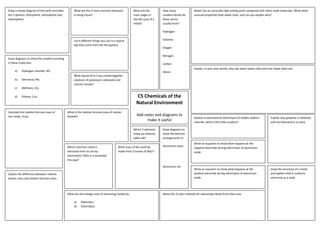
    C5 Chemicals ofthe Natural Environment Add notes and diagrams to make it useful How many covalent bonds do these atoms usually form? Hydrogen Chlorine Oxygen Nitrogen Carbon Silicon Water has an unusually high boiling point compared with other small molecules. What other unusual properties does water have, and can you explain why? Explain, in your own words, why sea water tastes salty and river water does not. Explain why graphite is relatively soft and diamond is so hard. Sodium is extracted by electrolysis of molten sodium chloride, what is the other product? Draw the structure of a metal and explain how it conducts electricity as a solid. Name the 2 main methods for extracting metals from their ores Draw diagrams to show the electron arrangements in: Aluminium atom Aluminium ion Write an equation to show what happens at the negative electrode during electrolysis of aluminium oxide Which 2 elements make up ordinary table salt? What mass of Na could be made from 2 tonnes of NaCl? What are the energy costs of extracting metals by: a) Reduction b) Electrolysis Explain the difference between relative atomic mass and relative formula mass.. Which common metal is extracted from its ore by electrolysis? Why is it extracted this way? What is the relative formula mass of carbon dioxide? Calculate the relative formula mass of iron oxide, Fe2O3 What would form if you mixed together solutions of potassium carbonate and calcium nitrate? Draw diagrams to show the covalent bonding in these molecules: a) Hydrogen chloride, HCl b) Ammonia, NH3 c) Methane, CH4 d) Ethene, C2H4 What are the main stages in the life cycle of a metal? List 4 different things you use in a typical day that come from the lithosphere. What are the 3 most common elements in living tissue? Draw a simple diagram of the earth and label the 3 spheres, lithosphere, atmosphere and hydrosphere. Write an equation to show what happens at the positive electrode during electrolysis of aluminium oxide