 Name : Dhopare Jyoti Tarachand
 Roll No.: R1933305
 Course : S.Y.B.Sc.B.Ed
 Subject : Inorganic Chemistry
 Subject Teacher: Prof. Sudarshan Tapsale
 Topic: Isomerism in coordination complexes
CONTENT
 Introduction
 Types Of Isomerism
 Structural Isomerim
 A) Ionisation Isomerim
 B)Hydrate Isomerism
 C)Ligand Isomerim
 D) Linkage Isomerim
 Summery
INTRODUCTION
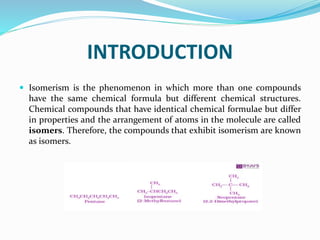
 Isomerism is the phenomenon in which more than one compounds
have the same chemical formula but different chemical structures.
Chemical compounds that have identical chemical formulae but differ
in properties and the arrangement of atoms in the molecule are called
isomers. Therefore, the compounds that exhibit isomerism are known
as isomers.
TYPES OF ISOMERISM
 Structural Isomerism
This type of isomerism is due different possible arrangment of atoms or
groups in their molecules.
 Example : 1-PenteneCH3CH2CH2CH=CH2
2-Pentene CH3CH2CH=CHCH3
 A) Ionisation Isomerism : This name is used to describe isomers that
give different ions in solution.i.e.in other words,two cordination
compound which differ in the distribution of ions between those
directly coordinated and counter ions present in the crystal lattice are
called Ionisation Isomers.
 For example, when pentaamminebromocobalt chloride is dissolved in
water, Cl−ions are generated:
 CoBr(NH3)5Cl(s)→CoBr(NH3)+5(aq)+Cl−(aq)
 whereas when pentaamminechlorocobalt bromide is dissolved, Br ions
are generated:
 CoCl(NH3)5Br(s)→CoCl(NH3)+5(aq)+Br−(aq)
 Notice that both anions are necessary to balance the charge of the
complex, and that they differ in that one ion is directly attached to the
central metal, but the other is not.
 B)Hydrate Isomerism:A very similar type of isomerism results from replacement
of a coordinated group by a solvent molecule (Solvate Isomerism), which in the
case of water is called Hydrate Isomerism. The best known example of this
occurs for chromium chloride (CrCl3⋅6H2O) which may contain 4, 5, or 6
coordinated water molecules (assuming a coordination number of 6). The dot
here is used essentially as an expression of ignorance to indicate that, though
the parts of the molecule separated by the dot are bonded to one another in
some fashion, the exact structural details of that interaction are not fully
expressed in the resulting formula. Using Alfred Werner’s coordination theory
that indicates that several of the water molecules are actually bonded directly
(via coordinate covalent bonds) to the central chromium ion. In fact, there are
several possible compounds that use the brackets to signify bonding in the
complex and the the dots to signify "water molecules that are not bound to the
central metal, but are part of the lattice:
 [CrCl2(H2O)4]Cl⋅2H2O: bright-green colored
 [CrCl(H2O)5]Cl2⋅H2O: grey-green colored
 [Cr(H2O)6]Cl3: violet colored
 These isomers have very different chemical properties and on reaction
with AgNO3 to test for Cl− ions, would find 1, 2, and 3 Cl− ions in
solution, respectively.
 Ligand Isomerism:Isomeric coordination compounds are known in
which the overall isomerism results from isomerism solely within the
ligand groups.
 An example of such isomerism is shown by the ions, bis (1,3
diaminopropane) platinum (2+) and bis (1,2 diaminopropane)
platinum (2+),
 D) Linkage Isomerism:Linkage isomerism occurs with ambidentate
ligands. These ligands are capable of coordinating in more than one
way. The best known cases involve the monodentate ligands SCN- /
NCS- and NO2
- / ONO-.
 For example: [Co(ONO)(NH3)5] Cl the nitrito isomer -O attached
[Co(NO2)(NH3)5] Cl the nitro isomer - N attached.
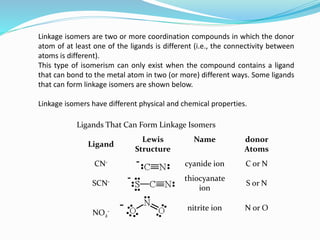
Ligands That Can Form Linkage Isomers
Ligand
Lewis
Structure
Name donor
Atoms
CN- cyanide ion C or N
SCN- thiocyanate
ion
S or N
NO2
- nitrite ion N or O
Linkage isomers are two or more coordination compounds in which the donor
atom of at least one of the ligands is different (i.e., the connectivity between
atoms is different).
This type of isomerism can only exist when the compound contains a ligand
that can bond to the metal atom in two (or more) different ways. Some ligands
that can form linkage isomers are shown below.
Linkage isomers have different physical and chemical properties.
Thank You

Inorganic Chemisrty

  • 1.
     Name :Dhopare Jyoti Tarachand  Roll No.: R1933305  Course : S.Y.B.Sc.B.Ed  Subject : Inorganic Chemistry  Subject Teacher: Prof. Sudarshan Tapsale  Topic: Isomerism in coordination complexes
  • 2.
    CONTENT  Introduction  TypesOf Isomerism  Structural Isomerim  A) Ionisation Isomerim  B)Hydrate Isomerism  C)Ligand Isomerim  D) Linkage Isomerim  Summery
  • 3.
    INTRODUCTION  Isomerism isthe phenomenon in which more than one compounds have the same chemical formula but different chemical structures. Chemical compounds that have identical chemical formulae but differ in properties and the arrangement of atoms in the molecule are called isomers. Therefore, the compounds that exhibit isomerism are known as isomers.
  • 4.
    TYPES OF ISOMERISM Structural Isomerism This type of isomerism is due different possible arrangment of atoms or groups in their molecules.  Example : 1-PenteneCH3CH2CH2CH=CH2 2-Pentene CH3CH2CH=CHCH3
  • 5.
     A) IonisationIsomerism : This name is used to describe isomers that give different ions in solution.i.e.in other words,two cordination compound which differ in the distribution of ions between those directly coordinated and counter ions present in the crystal lattice are called Ionisation Isomers.  For example, when pentaamminebromocobalt chloride is dissolved in water, Cl−ions are generated:  CoBr(NH3)5Cl(s)→CoBr(NH3)+5(aq)+Cl−(aq)  whereas when pentaamminechlorocobalt bromide is dissolved, Br ions are generated:  CoCl(NH3)5Br(s)→CoCl(NH3)+5(aq)+Br−(aq)  Notice that both anions are necessary to balance the charge of the complex, and that they differ in that one ion is directly attached to the central metal, but the other is not.
  • 6.
     B)Hydrate Isomerism:Avery similar type of isomerism results from replacement of a coordinated group by a solvent molecule (Solvate Isomerism), which in the case of water is called Hydrate Isomerism. The best known example of this occurs for chromium chloride (CrCl3⋅6H2O) which may contain 4, 5, or 6 coordinated water molecules (assuming a coordination number of 6). The dot here is used essentially as an expression of ignorance to indicate that, though the parts of the molecule separated by the dot are bonded to one another in some fashion, the exact structural details of that interaction are not fully expressed in the resulting formula. Using Alfred Werner’s coordination theory that indicates that several of the water molecules are actually bonded directly (via coordinate covalent bonds) to the central chromium ion. In fact, there are several possible compounds that use the brackets to signify bonding in the complex and the the dots to signify "water molecules that are not bound to the central metal, but are part of the lattice:  [CrCl2(H2O)4]Cl⋅2H2O: bright-green colored  [CrCl(H2O)5]Cl2⋅H2O: grey-green colored  [Cr(H2O)6]Cl3: violet colored
  • 7.
     These isomershave very different chemical properties and on reaction with AgNO3 to test for Cl− ions, would find 1, 2, and 3 Cl− ions in solution, respectively.  Ligand Isomerism:Isomeric coordination compounds are known in which the overall isomerism results from isomerism solely within the ligand groups.  An example of such isomerism is shown by the ions, bis (1,3 diaminopropane) platinum (2+) and bis (1,2 diaminopropane) platinum (2+),
  • 8.
     D) LinkageIsomerism:Linkage isomerism occurs with ambidentate ligands. These ligands are capable of coordinating in more than one way. The best known cases involve the monodentate ligands SCN- / NCS- and NO2 - / ONO-.  For example: [Co(ONO)(NH3)5] Cl the nitrito isomer -O attached [Co(NO2)(NH3)5] Cl the nitro isomer - N attached.
  • 9.
    Ligands That CanForm Linkage Isomers Ligand Lewis Structure Name donor Atoms CN- cyanide ion C or N SCN- thiocyanate ion S or N NO2 - nitrite ion N or O Linkage isomers are two or more coordination compounds in which the donor atom of at least one of the ligands is different (i.e., the connectivity between atoms is different). This type of isomerism can only exist when the compound contains a ligand that can bond to the metal atom in two (or more) different ways. Some ligands that can form linkage isomers are shown below. Linkage isomers have different physical and chemical properties.
  • 10.