Business aim and activities
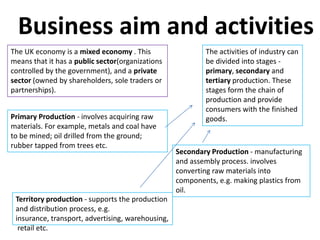
The UK economy is a mixed economy . This                   The activities of industry can
means that it has a public sector(organizations            be divided into stages -
controlled by the government), and a private               primary, secondary and
sector (owned by shareholders, sole traders or             tertiary production. These
partnerships).                                             stages form the chain of
                                                           production and provide
                                                           consumers with the finished
Primary Production - involves acquiring raw                goods.
materials. For example, metals and coal have
to be mined; oil drilled from the ground;
rubber tapped from trees etc.
                                                   Secondary Production - manufacturing
                                                   and assembly process. involves
                                                   converting raw materials into
                                                   components, e.g. making plastics from
                                                   oil.
 Territory production - supports the production
 and distribution process, e.g.
 insurance, transport, advertising, warehousing,
  retail etc.
Limited Companies
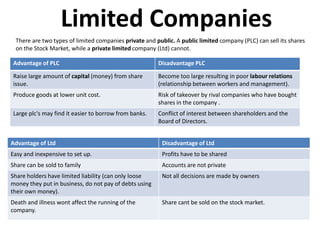
 There are two types of limited companies private and public. A public limited company (PLC) can sell its shares
 on the Stock Market, while a private limited company (Ltd) cannot.

Advantage of PLC                                        Disadvantage PLC

Raise large amount of capital (money) from share        Become too large resulting in poor labour relations
issue.                                                  (relationship between workers and management).
Produce goods at lower unit cost.                       Risk of takeover by rival companies who have bought
                                                        shares in the company .
Large plc's may find it easier to borrow from banks.    Conflict of interest between shareholders and the
                                                        Board of Directors.


Advantage of Ltd                                         Disadvantage of Ltd
Easy and inexpensive to set up.                          Profits have to be shared
Share can be sold to family                              Accounts are not private
Share holders have limited liability (can only loose     Not all decisions are made by owners
money they put in business, do not pay of debts using
their own money).
Death and illness wont affect the running of the         Share cant be sold on the stock market.
company.
Sole Traders
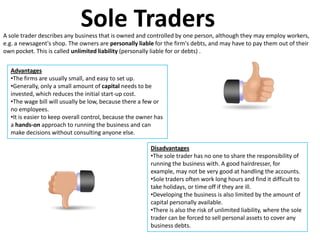
A sole trader describes any business that is owned and controlled by one person, although they may employ workers,
e.g. a newsagent's shop. The owners are personally liable for the firm's debts, and may have to pay them out of their
own pocket. This is called unlimited liability (personally liable for or debts) .


  Advantages
  •The firms are usually small, and easy to set up.
  •Generally, only a small amount of capital needs to be
  invested, which reduces the initial start-up cost.
  •The wage bill will usually be low, because there a few or
  no employees.
  •It is easier to keep overall control, because the owner has
  a hands-on approach to running the business and can
  make decisions without consulting anyone else.

                                                         Disadvantages
                                                         •The sole trader has no one to share the responsibility of
                                                         running the business with. A good hairdresser, for
                                                         example, may not be very good at handling the accounts.
                                                         •Sole traders often work long hours and find it difficult to
                                                         take holidays, or time off if they are ill.
                                                         •Developing the business is also limited by the amount of
                                                         capital personally available.
                                                         •There is also the risk of unlimited liability, where the sole
                                                         trader can be forced to sell personal assets to cover any
                                                         business debts.
Partnership
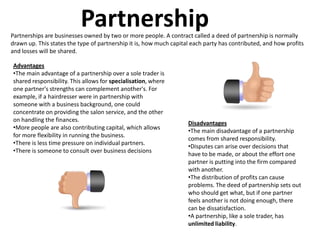
Partnerships are businesses owned by two or more people. A contract called a deed of partnership is normally
drawn up. This states the type of partnership it is, how much capital each party has contributed, and how profits
and losses will be shared.

Advantages
•The main advantage of a partnership over a sole trader is
shared responsibility. This allows for specialisation, where
one partner's strengths can complement another's. For
example, if a hairdresser were in partnership with
someone with a business background, one could
concentrate on providing the salon service, and the other
on handling the finances.
                                                                    Disadvantages
•More people are also contributing capital, which allows
                                                                    •The main disadvantage of a partnership
for more flexibility in running the business.
                                                                    comes from shared responsibility.
•There is less time pressure on individual partners.
                                                                    •Disputes can arise over decisions that
•There is someone to consult over business decisions
                                                                    have to be made, or about the effort one
                                                                    partner is putting into the firm compared
                                                                    with another.
                                                                    •The distribution of profits can cause
                                                                    problems. The deed of partnership sets out
                                                                    who should get what, but if one partner
                                                                    feels another is not doing enough, there
                                                                    can be dissatisfaction.
                                                                    •A partnership, like a sole trader, has
                                                                    unlimited liability.
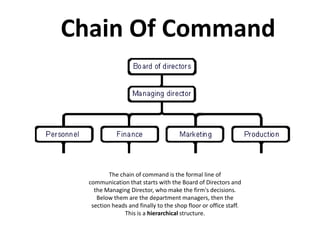
Chain Of Command


          The chain of command is the formal line of
  communication that starts with the Board of Directors and
    the Managing Director, who make the firm's decisions.
     Below them are the department managers, then the
   section heads and finally to the shop floor or office staff.
                This is a hierarchical structure.
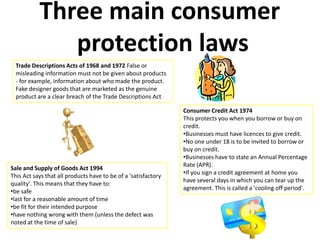
Three main consumer
              protection laws
  Trade Descriptions Acts of 1968 and 1972 False or
  misleading information must not be given about products
  - for example, information about who made the product.
  Fake designer goods that are marketed as the genuine
  product are a clear breach of the Trade Descriptions Act

                                                                Consumer Credit Act 1974
                                                                This protects you when you borrow or buy on
                                                                credit.
                                                                •Businesses must have licences to give credit.
                                                                •No one under 18 is to be invited to borrow or
                                                                buy on credit.
                                                                •Businesses have to state an Annual Percentage
                                                                Rate (APR).
Sale and Supply of Goods Act 1994
                                                                •If you sign a credit agreement at home you
This Act says that all products have to be of a 'satisfactory
                                                                have several days in which you can tear up the
quality'. This means that they have to:
                                                                agreement. This is called a 'cooling off period'.
•be safe
•last for a reasonable amount of time
•be fit for their intended purpose
•have nothing wrong with them (unless the defect was
noted at the time of sale)
Sources Of Finance
                                                             External sources of finance
                                                             •Leasing - renting a piece of equipment
                                                             or machinery
                                                             •Hire Purchase - Business hires the
                                                             equipment for a period of time making
Internal sources of finance
                                                             fixed regular payments. Once payments
• owners funds – savings of people setting up the business
                                                             have finished it then owns the piece of
•Retained profits – when a business has money left over
                                                             equipment.
after all costs have been meant.
                                                             •Trade credit – buying goods now and
•Selling assets – a business can sell something's that it
                                                             paying later for them
currently owns.
                                                             •Loans – a specific amount of money is
•Credit control– chasing customers that owe the business
                                                             borrowed from a bank with regular fixed
money
                                                             repayments with interest.
•Reducing stock – where you try and manage with
                                                             •Bank overdraft - a limit on borrowing
materials you already have.
                                                             on a bank current account.
                                                             •Mortgage – a long type of loan
                                                             •Issuing shares – PLCs or LTDs can sell
                                                             these
                                                             •Government grants - money given to a
                                                             business in some areas of the country
                                                             •Venture capital – financial institutions
                                                             that provide money for growing
                                                             businesses
Budgets & Cash Flow
A budget is a forecast of income and expenditure over a
      given period of time like a week or a year.


                                               As it is only a forecast, many things could happen which
                                              could make the actual spend of allocated monies different
                                                                 from what was budgeted.


          Why do we need budgets?

      •To help plan and allocate finances
    •Budgets are used to help control costs
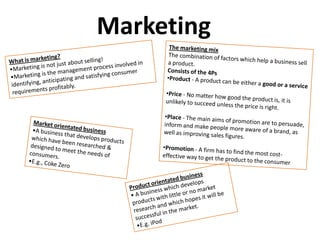
Marketing
Marketing...
Market Segment
•Age - Very young children, teenagers and OAP’s have different wants & needs.
For instance, products to help mobility are sold mainly to older people.

•Gender - Men & woman may have different needs and tastes. Products are
aimed at a specific gender group.

•Income - Low incomes have different spending patterns to those on high
incomes. E.g. car manufactures produce a range of models, aimed at different
income earners

•Area - This considers the religion of the country that consumers live in. Certain
products are traditionally popular in particular areas. E.g.; Haggis in Scotland.

•Culture - Different ethnic, cultural & religious groups can have different buying
patterns. For instance orthodox Jews will only eat “kosher” food, which does
not certain pork products.

•Socio-Economic Groupings
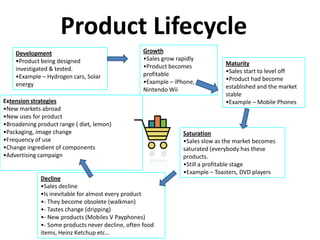
Product Lifecycle
    Development                                    Growth
    •Product being designed                        •Sales grow rapidly
                                                   •Product becomes             Maturity
    investigated & tested.                                                      •Sales start to level off
    •Example – Hydrogen cars, Solar                profitable
                                                   •Example – iPhone,           •Product had become
    energy                                                                      established and the market
                                                   Nintendo Wii
                                                                                stable
Extension strategies                                                            •Example – Mobile Phones
•New markets abroad
•New uses for product
•Broadening product range ( diet, lemon)
•Packaging, image change                                         Saturation
•Frequency of use                                                •Sales slow as the market becomes
•Change ingredient of components                                 saturated (everybody has these
•Advertising campaign                                            products.
                                                                 •Still a profitable stage
                                                                 •Example – Toasters, DVD players
             Decline
             •Sales decline
             •Is inevitable for almost every product
             •- They become obsolete (walkman)
             •- Tastes change (dripping)
             •- New products (Mobiles V Payphones)
             •- Some products never decline, often food
             items, Heinz Ketchup etc…
Product
                                      Product                Product range
                                                             •Businesses may supply the market
•The product in the marketing                                with more than one product. This is
mix is essential.                                            called the range of products.
•It can be either a good or a                                •Nestle sell a wide range of
service.                                                     products including confectionary,
•It includes all the feature of                              breakfast cereals dairy products and
the product and what                                         per food.
functions its carries out.


             Product differentiation
•Companies try to make their products          Brand
stand out from the competition.                •A brand is a name which makes a product
•Any way in which a products is different to   different or stand out compared to similar
its rivals. E.g., coke and Pepsi.              products.
•Name                                          •The opposite of a branded product is a
•Logo                                          generic product, one where customers don’t
•Design                                        see any difference, i.e., coal or potatoes.
•Content                                       •What brands can you think of?
•Packaging                                     •Hoover, sellotape, dairy milk, Heinz baked
                                               beans, PG tips, Mercedes, Sony
Product...
Why do businesses want branded goods?
•Creates customer loyalty.
•Can charge a premium
•It protects the manufacturer from imitations by competitors as it gives
the product its own identity.
•It assists advertising campaigns.


                          Own Brands
                          •Any product which carries the brand of a retailer. E.g. Tesco, Woolworths,
                          Asda, Boots. E.g. Food, drugs, drinks, cosmetics.
                          •Poses a huge threat to manufactures traditional brands.


    Packaging
    • Advertising/promotion i.e. deals
    •Protects the product
    •Keeps food hygienic
    •Provides customers with info.
Pricing
Price
•Most customers consider price when buying something
•Only a few very rich people don’t look at price


Supply and Demand
•When working out what price to charge for a product, businesses first have to look at supply and
demand.


Supply
•The quantity of a product producers are prepared to make for a sale.
•The law of supply: As price increases so does supply. As price decreases, so does supply.
•When price is low, producers loose money they reduce output.


Demand
•What consumers are willing and able to pay
•The law of demand: As price increases, quantity demanded falls. As prices decreases, quantity
demanded rises.
•2 reasons - At lower prices more can afford to buy
•Product becomes cheaper than rivals so people buy it. This is why 2 for 1 are so effective.
Pricing
Equilibrium
•Consumers like low prices & producers like high prices – conflict of interest.
•The point where both are happy is called the equilibrium
•How it works: if prices are too low, there’ll be a shortage, so consumers will pay
more and prices raise encouraging producers to make more. If prices are too
high, consumers won’t buy, creating a surplus. Producers have to lower prices to
get people to buy their unsold goods.

•Pricing- is part of the marketing mix used to persuade customers to but
products.
•The price that is set must be consistent with everything else in the marketing
mix.
•A high priced product needs to have features/benefits that customers feel
justified paying more for.
•Directly influences profits by creating revenue rather than effecting costs.
•Price helps a business “differentiate” its products.
•To make a pricing decision you need to consider: - competitors and their prices,
how a price can be used to increase sale and whether it will cover the
businesses costs.
Pricing Strategies
Competition Based Pricing
• Setting a price close to that of a competitor.
•Competition is then focused on aspects other than
pricing such as advertising.
Advantages
•Product is accurately priced based on competitors –
if it was more expensive it may lose sales, a lot
cheaper and customers may think it has a lower
quality.
Disadvantages
                                                        Penetration Pricing
•Not suitable if there are no similar products in the
                                                        • Set an initial low price to attract customers.
market place.
                                                        •New products, with expected long life cycles
•What about smaller firms?
                                                        •Maximise on early sales
                                                        •Once they have grown market share they can
                                                        increase price.
                                                        •Typical in mass market products.
                                                        Advantages
                                                        •Attract a lot of attention and can help achieve
                                                        long term profit.
                                                        Disadvantages
                                                        •Customers may refuse to buy when the price is
                                                        raised as they may not see an increase value
                                                        •Low initial revenue.
Pricing Strategies...
Creaming / Skimming
•A High initial price is set when a new
product is launched and it is lowered after
a period of time.
•Hi-tech market- where a product is seen
as being unique
•Many people buy as luxury
•Price can be dropped later to attract a
wider market                                  Price Discrimination
•Short life cycles                            •Selling a product at different prices to different segments of the
Advantages                                    market.
•High price = High quality                    •Most common in air and rail travel.
•High initial profits.                        •Tickets at premium during rush hour when trains are full, half
Disadvantages                                 price tickets during week day when not many people want to
•Cuts off a lot of the market.                travel.
•People may wait for the price to lower.      •Student, Child or OAP passes
                                              Advantages
                                              •Gives businesses an opportunity to earn more money.
                                              Disadvantages
                                              Is it fair?
Market Research
•Market research is the collection of information or data to
better understand what is happening in the market place.

•Market research tells us about economic trends as well as
customers’ views.

•This ensures that the product/service developed by the
business is more likely to be successful.


        Secondary or desk research -Existing
        data that has already been collected.
        •Observations
        •Till Receipts                                         Primary or field research - Obtaining
        •Newspapers                                            new data for a specific purpose.
        •Government Statistics                                 •Questionnaire
                                                               •Telephone Surveys
                                                               •Interviews
                                                               •Postal Surveys
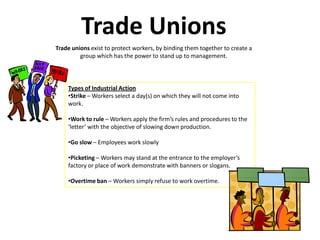
Trade Unions
Trade unions exist to protect workers, by binding them together to create a
         group which has the power to stand up to management.


    Types of Industrial Action
    •Strike – Workers select a day(s) on which they will not come into
    work.

    •Work to rule – Workers apply the firm’s rules and procedures to the
    ‘letter’ with the objective of slowing down production.

    •Go slow – Employees work slowly

    •Picketing – Workers may stand at the entrance to the employer’s
    factory or place of work demonstrate with banners or slogans.

    •Overtime ban – Workers simply refuse to work overtime.
Payment Systems
Time Based
•Wages are based on the amount of time worked
•Often this is hourly e.g., £6.50 p/h

- This method is normally used to pay manual workers         Salaries
- People who do physical work                                •Wages are based on an argument
- E.g., factory workers, fast food                           amount per year for a particular job.
- People often work longer hours (overtime) to earn more £   •E.g., £20,000 a year

                                                             •This method is normally used to pay
                                                             white collar workers (managers) –
                                                             people who don’t perform physical
                                                             work.
                                                             •E.g., Teachers, many office jobs
 Results based
 •Piece rates -People are paid for each item they            •Overtime isn’t paid as workers are
 produce, e.g., artists                                      expected to work for as long as it
                                                             takes to do the job.
 •Commission - Staff are paid a certain amount of
 each sale they make
 E.g., Salespeople

 •Bonus - A reward for a good performance
Motivating workers
•Businesses want their workers to work hard and produce goods and services
of a high standard.

•Workers are more likely to do this if they are motivated.

•Motivated workers are more productive and higher productivity usually
means higher profits.

•In a service industry, workers who are well motivated will provide a better
level of customer service, keeping the customers happy.

•Staffs who are well motivated are more likely to stay with the company. They
grow in experience and become even more valuable to their employer.

•If a business successfully keeps the staff it has, the cost of recruiting and
training new staff is reduced.
Communication
Internal communication – communication which
takes place within the business. E.g.                                  Eternal communication –
management must tell HR about plans to open                            communication which takes place
new branch so HR can recruit staff.                                    outside the business. E.g. Talking to
                                                                       suppliers and customers or borrowing
                                                                       money from banks.


          Channels of communication
          The route along which a message travels is called the :
          “Communication channel”
          Formal & Informal
          Formal: Communication through the official channels of a business.
          Informal: Communication via the grapevine i.e. chats with a friend in sales.
          Horizontal & Vertical communication
          Horizontal: is communication between people of the same level.
          Vertical: is communication is people of different levels.
Exchange rates
The exchange rate is simply the value (or purchasing power) of a currency in terms of what it can
buy of other currencies.
The value of each currency is decided on the foreign exchange markets.


                A rise is the pound means – Exports become more expensive and imports cheaper. This should
                result in a fall in exports and rise in imports.


           A fall in the pound means – exports become cheaper and imports more expensive. This should
           result in a rise in exports and fall in imports.
Franchising
  When a business is given the right by another business to sell its goods and services
                                    under its name.

    Franchisor – a person or business who sells the
    franchise
    Franchisee – a person who buys a franchise


    Government Regulations
•The government has a tremendous influence on
what individuals can and can’t do.
•In the same way it lays out what businesses can and
can’t do.                                                 Laws
•These are laid down as laws or “legislation”.            Discrimination Laws – Race, sex
                                                          Minimum age – Alcohol, Tobacco
                                                          Health and safety laws – Insurance, clean working
                                                          areas
                                                          Consumer protection – Labelling
Ownership
   Sole Trader - Owned financed and controlled by one individual but can
                              employ other staff
Advantages
Easy to set up (Very few forms or procedures required
East to run (Owner is the boss and doesn’t need to work with anyone else)
Tax advantages
Control
Profits are kept by the owner
Privacy (Only HM Revenue and customs (Tax man sees records)
Flexibility

Disadvantages
Unlimited liability (If something goes wrong then the owner is responsible in
court. May lose house and any other assets)
Limited access to capital(money)
Potential for long hours
Pressure of being solely responsible
Lack of continuity- business ceases once owner dies- Too small to have and
IT specialist, lawyer, accountant ECT…,
Ownership...
    Partnerships- Owners, financed and controlled by 2 or more partners

Advantages
Like sole traders
Easy to set up
Profits are kept by owner
Privacy
Also
Greater access to capital (money)
Shared responsibility
Greater opportunity for specialisation (i.e., one partner might know about
IT)

Disadvantages
Unlimited liability
All partners are reliable for the debts of the others
Partnership dissolved on death of one partner
Potential for conflict (arguments between partners)
Limited access to capital
Taxation
Income Tax
•This is a tax on the income or earnings of individuals.
•Income tax is a progressive tax. The more people earn the higher the rate they pay.
Corporation Tax
•This is a tax on the profits of companies.
•National Insurance – Contribution made to pay for future state pension and right to
unemployment benefit.
Value Added Tax (VAT)
•Charges on goods and services which are brought in the UK
•This is made on almost everything we buy apart from, food, children’s clothes, books and
newspapers.
•The amount paid is usually 17.5% of the total value of goods and services. It’s currently 15%
Effect of taxes on Consumers
•Higher tax = + Public services should improve + More public sector jobs
•Consumers have less money to spend on goods and services.
•Lower tax = + Consumers have more money to spend. –Public services will probably decline.
Effect of taxes on Businesses:
•Higher tax = + Good if your business works for supplies the government, i.e., drug or defence
companies
•Less profit for investment etc and less money spent by consumers
•Lower taxes = +More profit, more spent by consumers – Bad news if you work for the
government.

Business revision- AQA

  • 1.
    Business aim andactivities The UK economy is a mixed economy . This The activities of industry can means that it has a public sector(organizations be divided into stages - controlled by the government), and a private primary, secondary and sector (owned by shareholders, sole traders or tertiary production. These partnerships). stages form the chain of production and provide consumers with the finished Primary Production - involves acquiring raw goods. materials. For example, metals and coal have to be mined; oil drilled from the ground; rubber tapped from trees etc. Secondary Production - manufacturing and assembly process. involves converting raw materials into components, e.g. making plastics from oil. Territory production - supports the production and distribution process, e.g. insurance, transport, advertising, warehousing, retail etc.
  • 2.
    Limited Companies Thereare two types of limited companies private and public. A public limited company (PLC) can sell its shares on the Stock Market, while a private limited company (Ltd) cannot. Advantage of PLC Disadvantage PLC Raise large amount of capital (money) from share Become too large resulting in poor labour relations issue. (relationship between workers and management). Produce goods at lower unit cost. Risk of takeover by rival companies who have bought shares in the company . Large plc's may find it easier to borrow from banks. Conflict of interest between shareholders and the Board of Directors. Advantage of Ltd Disadvantage of Ltd Easy and inexpensive to set up. Profits have to be shared Share can be sold to family Accounts are not private Share holders have limited liability (can only loose Not all decisions are made by owners money they put in business, do not pay of debts using their own money). Death and illness wont affect the running of the Share cant be sold on the stock market. company.
  • 3.
    Sole Traders A soletrader describes any business that is owned and controlled by one person, although they may employ workers, e.g. a newsagent's shop. The owners are personally liable for the firm's debts, and may have to pay them out of their own pocket. This is called unlimited liability (personally liable for or debts) . Advantages •The firms are usually small, and easy to set up. •Generally, only a small amount of capital needs to be invested, which reduces the initial start-up cost. •The wage bill will usually be low, because there a few or no employees. •It is easier to keep overall control, because the owner has a hands-on approach to running the business and can make decisions without consulting anyone else. Disadvantages •The sole trader has no one to share the responsibility of running the business with. A good hairdresser, for example, may not be very good at handling the accounts. •Sole traders often work long hours and find it difficult to take holidays, or time off if they are ill. •Developing the business is also limited by the amount of capital personally available. •There is also the risk of unlimited liability, where the sole trader can be forced to sell personal assets to cover any business debts.
  • 4.
    Partnership Partnerships are businessesowned by two or more people. A contract called a deed of partnership is normally drawn up. This states the type of partnership it is, how much capital each party has contributed, and how profits and losses will be shared. Advantages •The main advantage of a partnership over a sole trader is shared responsibility. This allows for specialisation, where one partner's strengths can complement another's. For example, if a hairdresser were in partnership with someone with a business background, one could concentrate on providing the salon service, and the other on handling the finances. Disadvantages •More people are also contributing capital, which allows •The main disadvantage of a partnership for more flexibility in running the business. comes from shared responsibility. •There is less time pressure on individual partners. •Disputes can arise over decisions that •There is someone to consult over business decisions have to be made, or about the effort one partner is putting into the firm compared with another. •The distribution of profits can cause problems. The deed of partnership sets out who should get what, but if one partner feels another is not doing enough, there can be dissatisfaction. •A partnership, like a sole trader, has unlimited liability.
  • 5.
    Chain Of Command The chain of command is the formal line of communication that starts with the Board of Directors and the Managing Director, who make the firm's decisions. Below them are the department managers, then the section heads and finally to the shop floor or office staff. This is a hierarchical structure.
  • 6.
    Three main consumer protection laws Trade Descriptions Acts of 1968 and 1972 False or misleading information must not be given about products - for example, information about who made the product. Fake designer goods that are marketed as the genuine product are a clear breach of the Trade Descriptions Act Consumer Credit Act 1974 This protects you when you borrow or buy on credit. •Businesses must have licences to give credit. •No one under 18 is to be invited to borrow or buy on credit. •Businesses have to state an Annual Percentage Rate (APR). Sale and Supply of Goods Act 1994 •If you sign a credit agreement at home you This Act says that all products have to be of a 'satisfactory have several days in which you can tear up the quality'. This means that they have to: agreement. This is called a 'cooling off period'. •be safe •last for a reasonable amount of time •be fit for their intended purpose •have nothing wrong with them (unless the defect was noted at the time of sale)
  • 7.
    Sources Of Finance External sources of finance •Leasing - renting a piece of equipment or machinery •Hire Purchase - Business hires the equipment for a period of time making Internal sources of finance fixed regular payments. Once payments • owners funds – savings of people setting up the business have finished it then owns the piece of •Retained profits – when a business has money left over equipment. after all costs have been meant. •Trade credit – buying goods now and •Selling assets – a business can sell something's that it paying later for them currently owns. •Loans – a specific amount of money is •Credit control– chasing customers that owe the business borrowed from a bank with regular fixed money repayments with interest. •Reducing stock – where you try and manage with •Bank overdraft - a limit on borrowing materials you already have. on a bank current account. •Mortgage – a long type of loan •Issuing shares – PLCs or LTDs can sell these •Government grants - money given to a business in some areas of the country •Venture capital – financial institutions that provide money for growing businesses
  • 8.
    Budgets & CashFlow A budget is a forecast of income and expenditure over a given period of time like a week or a year. As it is only a forecast, many things could happen which could make the actual spend of allocated monies different from what was budgeted. Why do we need budgets? •To help plan and allocate finances •Budgets are used to help control costs
  • 9.
  • 10.
    Marketing... Market Segment •Age -Very young children, teenagers and OAP’s have different wants & needs. For instance, products to help mobility are sold mainly to older people. •Gender - Men & woman may have different needs and tastes. Products are aimed at a specific gender group. •Income - Low incomes have different spending patterns to those on high incomes. E.g. car manufactures produce a range of models, aimed at different income earners •Area - This considers the religion of the country that consumers live in. Certain products are traditionally popular in particular areas. E.g.; Haggis in Scotland. •Culture - Different ethnic, cultural & religious groups can have different buying patterns. For instance orthodox Jews will only eat “kosher” food, which does not certain pork products. •Socio-Economic Groupings
  • 11.
    Product Lifecycle Development Growth •Product being designed •Sales grow rapidly •Product becomes Maturity investigated & tested. •Sales start to level off •Example – Hydrogen cars, Solar profitable •Example – iPhone, •Product had become energy established and the market Nintendo Wii stable Extension strategies •Example – Mobile Phones •New markets abroad •New uses for product •Broadening product range ( diet, lemon) •Packaging, image change Saturation •Frequency of use •Sales slow as the market becomes •Change ingredient of components saturated (everybody has these •Advertising campaign products. •Still a profitable stage •Example – Toasters, DVD players Decline •Sales decline •Is inevitable for almost every product •- They become obsolete (walkman) •- Tastes change (dripping) •- New products (Mobiles V Payphones) •- Some products never decline, often food items, Heinz Ketchup etc…
  • 12.
    Product Product Product range •Businesses may supply the market •The product in the marketing with more than one product. This is mix is essential. called the range of products. •It can be either a good or a •Nestle sell a wide range of service. products including confectionary, •It includes all the feature of breakfast cereals dairy products and the product and what per food. functions its carries out. Product differentiation •Companies try to make their products Brand stand out from the competition. •A brand is a name which makes a product •Any way in which a products is different to different or stand out compared to similar its rivals. E.g., coke and Pepsi. products. •Name •The opposite of a branded product is a •Logo generic product, one where customers don’t •Design see any difference, i.e., coal or potatoes. •Content •What brands can you think of? •Packaging •Hoover, sellotape, dairy milk, Heinz baked beans, PG tips, Mercedes, Sony
  • 13.
    Product... Why do businesseswant branded goods? •Creates customer loyalty. •Can charge a premium •It protects the manufacturer from imitations by competitors as it gives the product its own identity. •It assists advertising campaigns. Own Brands •Any product which carries the brand of a retailer. E.g. Tesco, Woolworths, Asda, Boots. E.g. Food, drugs, drinks, cosmetics. •Poses a huge threat to manufactures traditional brands. Packaging • Advertising/promotion i.e. deals •Protects the product •Keeps food hygienic •Provides customers with info.
  • 14.
    Pricing Price •Most customers considerprice when buying something •Only a few very rich people don’t look at price Supply and Demand •When working out what price to charge for a product, businesses first have to look at supply and demand. Supply •The quantity of a product producers are prepared to make for a sale. •The law of supply: As price increases so does supply. As price decreases, so does supply. •When price is low, producers loose money they reduce output. Demand •What consumers are willing and able to pay •The law of demand: As price increases, quantity demanded falls. As prices decreases, quantity demanded rises. •2 reasons - At lower prices more can afford to buy •Product becomes cheaper than rivals so people buy it. This is why 2 for 1 are so effective.
  • 15.
    Pricing Equilibrium •Consumers like lowprices & producers like high prices – conflict of interest. •The point where both are happy is called the equilibrium •How it works: if prices are too low, there’ll be a shortage, so consumers will pay more and prices raise encouraging producers to make more. If prices are too high, consumers won’t buy, creating a surplus. Producers have to lower prices to get people to buy their unsold goods. •Pricing- is part of the marketing mix used to persuade customers to but products. •The price that is set must be consistent with everything else in the marketing mix. •A high priced product needs to have features/benefits that customers feel justified paying more for. •Directly influences profits by creating revenue rather than effecting costs. •Price helps a business “differentiate” its products. •To make a pricing decision you need to consider: - competitors and their prices, how a price can be used to increase sale and whether it will cover the businesses costs.
  • 16.
    Pricing Strategies Competition BasedPricing • Setting a price close to that of a competitor. •Competition is then focused on aspects other than pricing such as advertising. Advantages •Product is accurately priced based on competitors – if it was more expensive it may lose sales, a lot cheaper and customers may think it has a lower quality. Disadvantages Penetration Pricing •Not suitable if there are no similar products in the • Set an initial low price to attract customers. market place. •New products, with expected long life cycles •What about smaller firms? •Maximise on early sales •Once they have grown market share they can increase price. •Typical in mass market products. Advantages •Attract a lot of attention and can help achieve long term profit. Disadvantages •Customers may refuse to buy when the price is raised as they may not see an increase value •Low initial revenue.
  • 17.
    Pricing Strategies... Creaming /Skimming •A High initial price is set when a new product is launched and it is lowered after a period of time. •Hi-tech market- where a product is seen as being unique •Many people buy as luxury •Price can be dropped later to attract a wider market Price Discrimination •Short life cycles •Selling a product at different prices to different segments of the Advantages market. •High price = High quality •Most common in air and rail travel. •High initial profits. •Tickets at premium during rush hour when trains are full, half Disadvantages price tickets during week day when not many people want to •Cuts off a lot of the market. travel. •People may wait for the price to lower. •Student, Child or OAP passes Advantages •Gives businesses an opportunity to earn more money. Disadvantages Is it fair?
  • 18.
    Market Research •Market researchis the collection of information or data to better understand what is happening in the market place. •Market research tells us about economic trends as well as customers’ views. •This ensures that the product/service developed by the business is more likely to be successful. Secondary or desk research -Existing data that has already been collected. •Observations •Till Receipts Primary or field research - Obtaining •Newspapers new data for a specific purpose. •Government Statistics •Questionnaire •Telephone Surveys •Interviews •Postal Surveys
  • 19.
    Trade Unions Trade unionsexist to protect workers, by binding them together to create a group which has the power to stand up to management. Types of Industrial Action •Strike – Workers select a day(s) on which they will not come into work. •Work to rule – Workers apply the firm’s rules and procedures to the ‘letter’ with the objective of slowing down production. •Go slow – Employees work slowly •Picketing – Workers may stand at the entrance to the employer’s factory or place of work demonstrate with banners or slogans. •Overtime ban – Workers simply refuse to work overtime.
  • 20.
    Payment Systems Time Based •Wagesare based on the amount of time worked •Often this is hourly e.g., £6.50 p/h - This method is normally used to pay manual workers Salaries - People who do physical work •Wages are based on an argument - E.g., factory workers, fast food amount per year for a particular job. - People often work longer hours (overtime) to earn more £ •E.g., £20,000 a year •This method is normally used to pay white collar workers (managers) – people who don’t perform physical work. •E.g., Teachers, many office jobs Results based •Piece rates -People are paid for each item they •Overtime isn’t paid as workers are produce, e.g., artists expected to work for as long as it takes to do the job. •Commission - Staff are paid a certain amount of each sale they make E.g., Salespeople •Bonus - A reward for a good performance
  • 21.
    Motivating workers •Businesses wanttheir workers to work hard and produce goods and services of a high standard. •Workers are more likely to do this if they are motivated. •Motivated workers are more productive and higher productivity usually means higher profits. •In a service industry, workers who are well motivated will provide a better level of customer service, keeping the customers happy. •Staffs who are well motivated are more likely to stay with the company. They grow in experience and become even more valuable to their employer. •If a business successfully keeps the staff it has, the cost of recruiting and training new staff is reduced.
  • 22.
    Communication Internal communication –communication which takes place within the business. E.g. Eternal communication – management must tell HR about plans to open communication which takes place new branch so HR can recruit staff. outside the business. E.g. Talking to suppliers and customers or borrowing money from banks. Channels of communication The route along which a message travels is called the : “Communication channel” Formal & Informal Formal: Communication through the official channels of a business. Informal: Communication via the grapevine i.e. chats with a friend in sales. Horizontal & Vertical communication Horizontal: is communication between people of the same level. Vertical: is communication is people of different levels.
  • 23.
    Exchange rates The exchangerate is simply the value (or purchasing power) of a currency in terms of what it can buy of other currencies. The value of each currency is decided on the foreign exchange markets. A rise is the pound means – Exports become more expensive and imports cheaper. This should result in a fall in exports and rise in imports. A fall in the pound means – exports become cheaper and imports more expensive. This should result in a rise in exports and fall in imports.
  • 24.
    Franchising Whena business is given the right by another business to sell its goods and services under its name. Franchisor – a person or business who sells the franchise Franchisee – a person who buys a franchise Government Regulations •The government has a tremendous influence on what individuals can and can’t do. •In the same way it lays out what businesses can and can’t do. Laws •These are laid down as laws or “legislation”. Discrimination Laws – Race, sex Minimum age – Alcohol, Tobacco Health and safety laws – Insurance, clean working areas Consumer protection – Labelling
  • 25.
    Ownership Sole Trader - Owned financed and controlled by one individual but can employ other staff Advantages Easy to set up (Very few forms or procedures required East to run (Owner is the boss and doesn’t need to work with anyone else) Tax advantages Control Profits are kept by the owner Privacy (Only HM Revenue and customs (Tax man sees records) Flexibility Disadvantages Unlimited liability (If something goes wrong then the owner is responsible in court. May lose house and any other assets) Limited access to capital(money) Potential for long hours Pressure of being solely responsible Lack of continuity- business ceases once owner dies- Too small to have and IT specialist, lawyer, accountant ECT…,
  • 26.
    Ownership... Partnerships- Owners, financed and controlled by 2 or more partners Advantages Like sole traders Easy to set up Profits are kept by owner Privacy Also Greater access to capital (money) Shared responsibility Greater opportunity for specialisation (i.e., one partner might know about IT) Disadvantages Unlimited liability All partners are reliable for the debts of the others Partnership dissolved on death of one partner Potential for conflict (arguments between partners) Limited access to capital
  • 27.
    Taxation Income Tax •This isa tax on the income or earnings of individuals. •Income tax is a progressive tax. The more people earn the higher the rate they pay. Corporation Tax •This is a tax on the profits of companies. •National Insurance – Contribution made to pay for future state pension and right to unemployment benefit. Value Added Tax (VAT) •Charges on goods and services which are brought in the UK •This is made on almost everything we buy apart from, food, children’s clothes, books and newspapers. •The amount paid is usually 17.5% of the total value of goods and services. It’s currently 15% Effect of taxes on Consumers •Higher tax = + Public services should improve + More public sector jobs •Consumers have less money to spend on goods and services. •Lower tax = + Consumers have more money to spend. –Public services will probably decline. Effect of taxes on Businesses: •Higher tax = + Good if your business works for supplies the government, i.e., drug or defence companies •Less profit for investment etc and less money spent by consumers •Lower taxes = +More profit, more spent by consumers – Bad news if you work for the government.