Quadrilateral
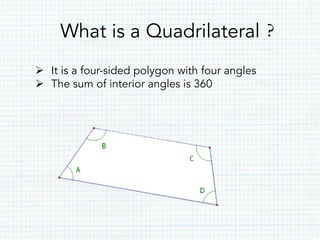
What is a Quadrilateral ?
Ø  It is a four-sided polygon with four angles
Ø  The sum of interior angles is 360
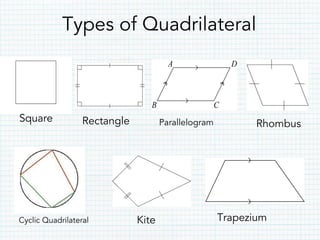
Types of Quadrilateral
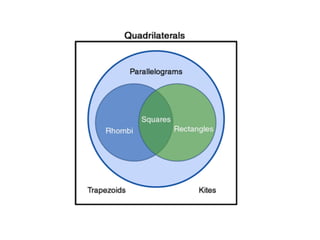
Square Rectangle Parallelogram Rhombus
Kite TrapeziumCyclic Quadrilateral
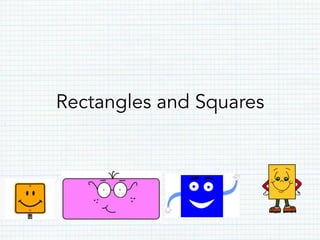
Rectangles and Squares
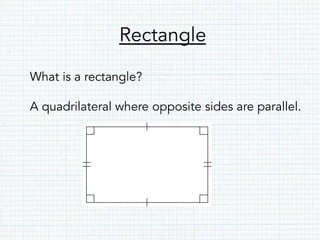
Rectangle
What is a rectangle?
A quadrilateral where opposite sides are parallel.
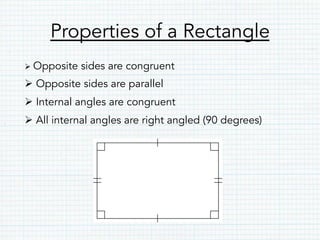
Properties of a Rectangle
Ø Opposite sides are congruent
Ø Opposite sides are parallel
Ø Internal angles are congruent
Ø All internal angles are right angled (90 degrees)
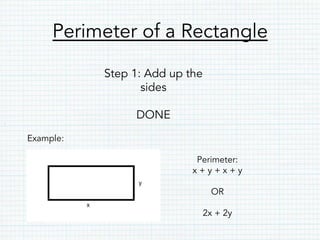
Perimeter of a Rectangle
Step 1: Add up the
sides
DONE
Example:
Perimeter:
x + y + x + y
OR
2x + 2y
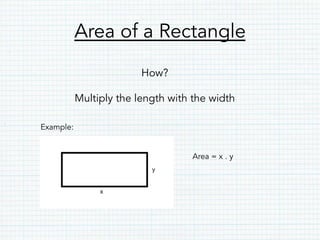
Area of a Rectangle
How?
Multiply the length with the width
Example:
Area = x . y
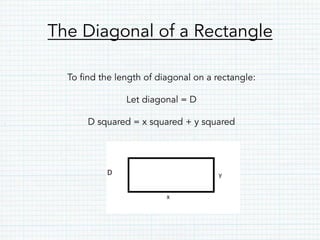
The Diagonal of a Rectangle
To find the length of diagonal on a rectangle:
Let diagonal = D
D squared = x squared + y squared
D
Properties of the Diagonals on
Rectangles
Ø Diagonals do not intersect at right angles
Ø Angles at the intersection can differ
Ø Opposite angles at intersection are
congruent
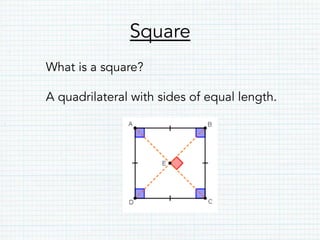
Square
What is a square?
A quadrilateral with sides of equal length.
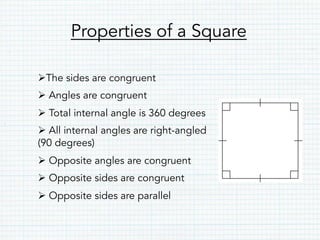
Properties of a Square
Ø The sides are congruent
Ø Angles are congruent
Ø Total internal angle is 360 degrees
Ø All internal angles are right-angled
(90 degrees)
Ø Opposite angles are congruent
Ø Opposite sides are congruent
Ø Opposite sides are parallel
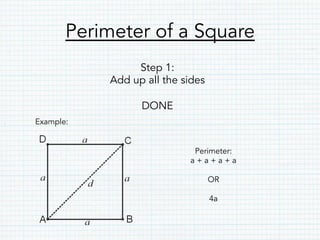
Perimeter of a Square
Step 1:
Add up all the sides
DONE
Example:
Perimeter:
a + a + a + a
OR
4a
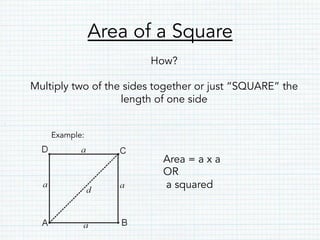
Area of a Square
How?
Multiply two of the sides together or just “SQUARE” the
length of one side
Example:
Area = a x a
OR
a squared
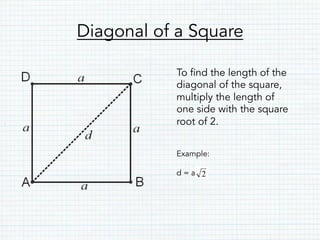
Diagonal of a Square
To find the length of the
diagonal of the square,
multiply the length of
one side with the square
root of 2.
Example:
d = a
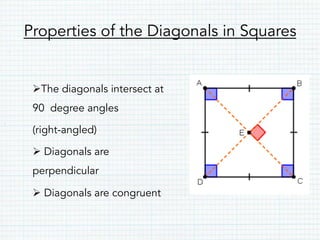
Properties of the Diagonals in Squares
Ø The diagonals intersect at
90 degree angles
(right-angled)
Ø Diagonals are
perpendicular
Ø Diagonals are congruent
Parallelogram
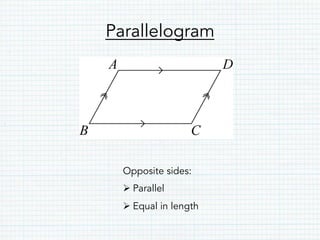
Opposite sides:
Ø Parallel
Ø Equal in length
Parallelogram
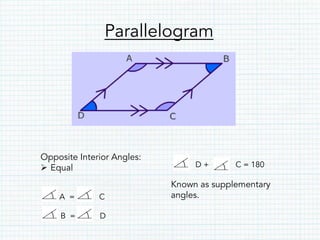
Opposite Interior Angles:
Ø  Equal
Ø  A = C
B = D
D + C = 180
Known as supplementary
angles.
Parallelogram
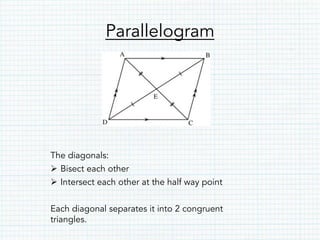
The diagonals:
Ø  Bisect each other
Ø  Intersect each other at the half way point
Each diagonal separates it into 2 congruent
triangles.
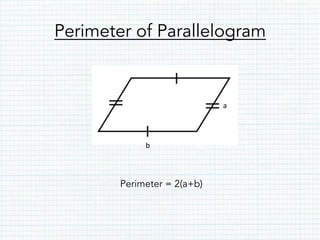
Perimeter of Parallelogram
Perimeter = 2(a+b)
a	
  
b	
  
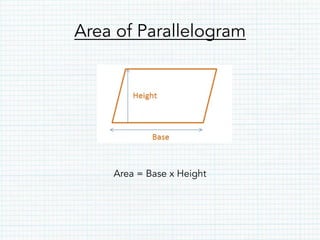
Area of Parallelogram
Area = Base x Height
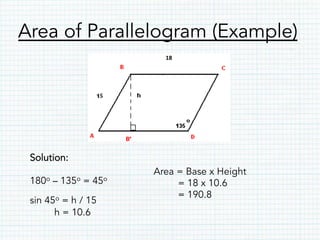
Area of Parallelogram (Example)
Solution:
180o – 135o = 45o
sin 45o = h / 15
h = 10.6
18	
  
Area = Base x Height
= 18 x 10.6
= 190.8
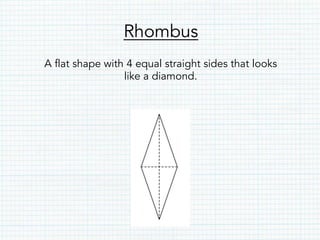
Rhombus
A flat shape with 4 equal straight sides that looks
like a diamond.
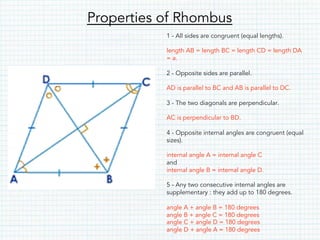
Properties of Rhombus
1 - All sides are congruent (equal lengths).
length AB = length BC = length CD = length DA
= a.
2 - Opposite sides are parallel.
AD is parallel to BC and AB is parallel to DC.
3 - The two diagonals are perpendicular.
AC is perpendicular to BD.
4 - Opposite internal angles are congruent (equal
sizes).
internal angle A = internal angle C
and
internal angle B = internal angle D.
5 - Any two consecutive internal angles are
supplementary : they add up to 180 degrees.
angle A + angle B = 180 degrees
angle B + angle C = 180 degrees
angle C + angle D = 180 degrees
angle D + angle A = 180 degrees
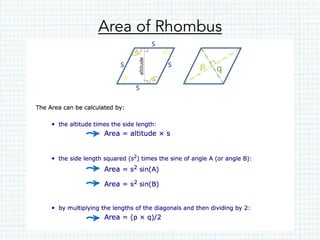
Area of Rhombus
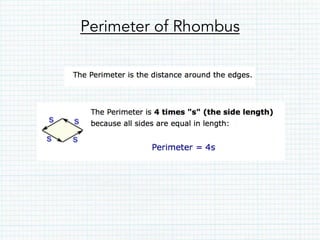
Perimeter of Rhombus
Example :
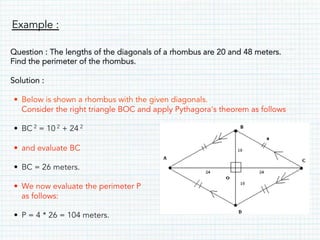
Question : The lengths of the diagonals of a rhombus are 20 and 48 meters.
Find the perimeter of the rhombus.
Solution :
• Below is shown a rhombus with the given diagonals.
Consider the right triangle BOC and apply Pythagora's theorem as follows
• BC 2 = 10 2 + 24 2
• and evaluate BC
• BC = 26 meters.
• We now evaluate the perimeter P
as follows:
• P = 4 * 26 = 104 meters.
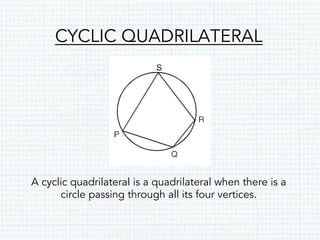
CYCLIC QUADRILATERAL
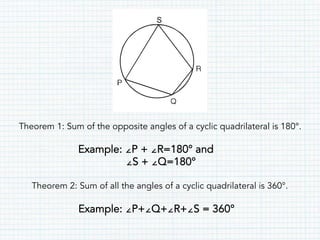
A cyclic quadrilateral is a quadrilateral when there is a
circle passing through all its four vertices.
Theorem 1: Sum of the opposite angles of a cyclic quadrilateral is 180°.
Example: ∠P + ∠R=180° and
∠S + ∠Q=180°
Theorem 2: Sum of all the angles of a cyclic quadrilateral is 360°.
Example: ∠P+∠Q+∠R+∠S = 360°
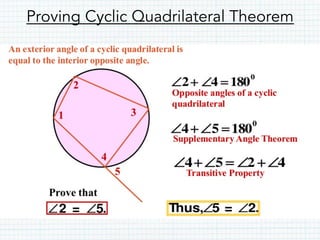
Proving Cyclic Quadrilateral Theorem
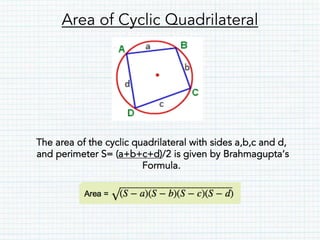
Area of Cyclic Quadrilateral
The area of the cyclic quadrilateral with sides a,b,c and d,
and perimeter S= (a+b+c+d)/2 is given by Brahmagupta’s
Formula.
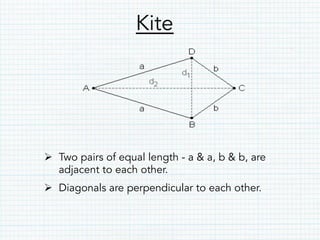
Kite
Ø  Two pairs of equal length - a & a, b & b, are
adjacent to each other.
Ø  Diagonals are perpendicular to each other.
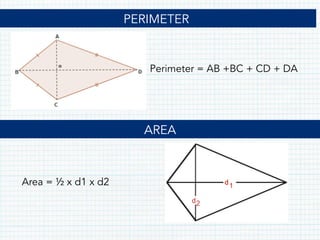
Perimeter = AB +BC + CD + DA
Area = ½ x d1 x d2
PERIMETER
AREA
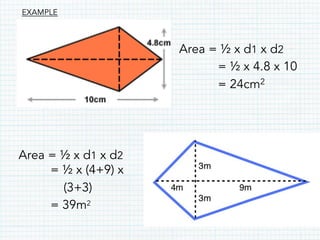
Area = ½ x d1 x d2
= ½ x 4.8 x 10
= 24cm2
Area = ½ x d1 x d2
= ½ x (4+9) x
(3+3)
= 39m2
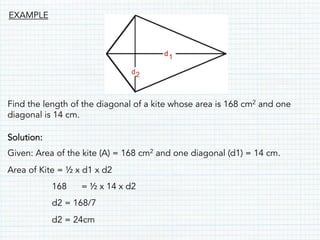
EXAMPLE
Find the length of the diagonal of a kite whose area is 168 cm2 and one
diagonal is 14 cm.
Solution:
Given: Area of the kite (A) = 168 cm2 and one diagonal (d1) = 14 cm.
Area of Kite = ½ x d1 x d2
168 = ½ x 14 x d2
d2 = 168/7
d2 = 24cm
EXAMPLE
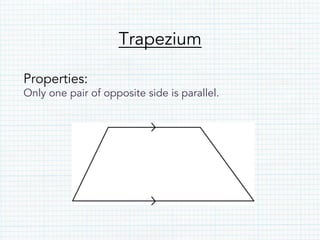
Trapezium
Properties:
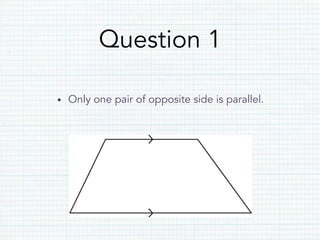
Only one pair of opposite side is parallel.
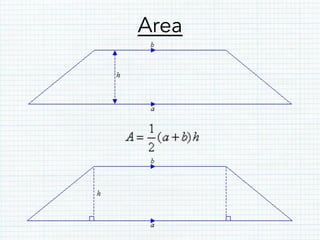
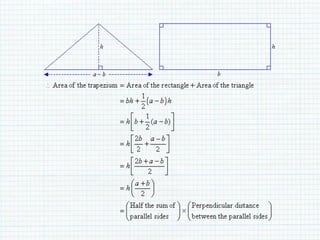
Area
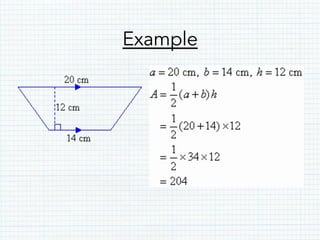
Example
Class Activity
Question 1
•  Only one pair of opposite side is parallel.
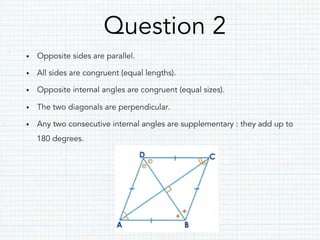
Question 2
•  Opposite sides are parallel.
•  All sides are congruent (equal lengths).
•  Opposite internal angles are congruent (equal sizes).
•  The two diagonals are perpendicular.
•  Any two consecutive internal angles are supplementary : they add up to
180 degrees.
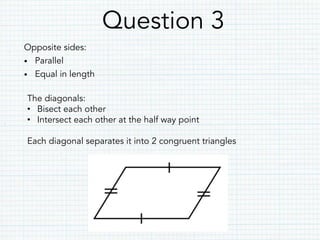
Question 3
Opposite sides:
•  Parallel
•  Equal in length
The diagonals:
•  Bisect each other
•  Intersect each other at the half way point
Each diagonal separates it into 2 congruent triangles
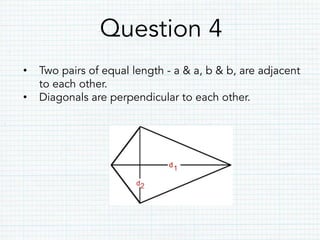
Question 4
•  Two pairs of equal length - a & a, b & b, are adjacent
to each other.
•  Diagonals are perpendicular to each other.
End of Presentation
Thank You.

Maths quadrilateral presentation

  • 1.
  • 2.
    What is aQuadrilateral ? Ø  It is a four-sided polygon with four angles Ø  The sum of interior angles is 360
  • 3.
    Types of Quadrilateral SquareRectangle Parallelogram Rhombus Kite TrapeziumCyclic Quadrilateral
  • 4.
  • 5.
    Rectangle What is arectangle? A quadrilateral where opposite sides are parallel.
  • 6.
    Properties of aRectangle Ø Opposite sides are congruent Ø Opposite sides are parallel Ø Internal angles are congruent Ø All internal angles are right angled (90 degrees)
  • 7.
    Perimeter of aRectangle Step 1: Add up the sides DONE Example: Perimeter: x + y + x + y OR 2x + 2y
  • 8.
    Area of aRectangle How? Multiply the length with the width Example: Area = x . y
  • 9.
    The Diagonal ofa Rectangle To find the length of diagonal on a rectangle: Let diagonal = D D squared = x squared + y squared D
  • 10.
    Properties of theDiagonals on Rectangles Ø Diagonals do not intersect at right angles Ø Angles at the intersection can differ Ø Opposite angles at intersection are congruent
  • 11.
    Square What is asquare? A quadrilateral with sides of equal length.
  • 12.
    Properties of aSquare Ø The sides are congruent Ø Angles are congruent Ø Total internal angle is 360 degrees Ø All internal angles are right-angled (90 degrees) Ø Opposite angles are congruent Ø Opposite sides are congruent Ø Opposite sides are parallel
  • 13.
    Perimeter of aSquare Step 1: Add up all the sides DONE Example: Perimeter: a + a + a + a OR 4a
  • 14.
    Area of aSquare How? Multiply two of the sides together or just “SQUARE” the length of one side Example: Area = a x a OR a squared
  • 15.
    Diagonal of aSquare To find the length of the diagonal of the square, multiply the length of one side with the square root of 2. Example: d = a
  • 16.
    Properties of theDiagonals in Squares Ø The diagonals intersect at 90 degree angles (right-angled) Ø Diagonals are perpendicular Ø Diagonals are congruent
  • 17.
  • 18.
    Parallelogram Opposite Interior Angles: Ø Equal Ø  A = C B = D D + C = 180 Known as supplementary angles.
  • 19.
    Parallelogram The diagonals: Ø  Bisecteach other Ø  Intersect each other at the half way point Each diagonal separates it into 2 congruent triangles.
  • 20.
  • 21.
  • 22.
    Area of Parallelogram(Example) Solution: 180o – 135o = 45o sin 45o = h / 15 h = 10.6 18   Area = Base x Height = 18 x 10.6 = 190.8
  • 23.
    Rhombus A flat shapewith 4 equal straight sides that looks like a diamond.
  • 24.
    Properties of Rhombus 1- All sides are congruent (equal lengths). length AB = length BC = length CD = length DA = a. 2 - Opposite sides are parallel. AD is parallel to BC and AB is parallel to DC. 3 - The two diagonals are perpendicular. AC is perpendicular to BD. 4 - Opposite internal angles are congruent (equal sizes). internal angle A = internal angle C and internal angle B = internal angle D. 5 - Any two consecutive internal angles are supplementary : they add up to 180 degrees. angle A + angle B = 180 degrees angle B + angle C = 180 degrees angle C + angle D = 180 degrees angle D + angle A = 180 degrees
  • 25.
  • 26.
  • 27.
    Example : Question :The lengths of the diagonals of a rhombus are 20 and 48 meters. Find the perimeter of the rhombus. Solution : • Below is shown a rhombus with the given diagonals. Consider the right triangle BOC and apply Pythagora's theorem as follows • BC 2 = 10 2 + 24 2 • and evaluate BC • BC = 26 meters. • We now evaluate the perimeter P as follows: • P = 4 * 26 = 104 meters.
  • 28.
    CYCLIC QUADRILATERAL A cyclicquadrilateral is a quadrilateral when there is a circle passing through all its four vertices.
  • 29.
    Theorem 1: Sumof the opposite angles of a cyclic quadrilateral is 180°. Example: ∠P + ∠R=180° and ∠S + ∠Q=180° Theorem 2: Sum of all the angles of a cyclic quadrilateral is 360°. Example: ∠P+∠Q+∠R+∠S = 360°
  • 30.
  • 31.
    Area of CyclicQuadrilateral The area of the cyclic quadrilateral with sides a,b,c and d, and perimeter S= (a+b+c+d)/2 is given by Brahmagupta’s Formula.
  • 32.
    Kite Ø  Two pairsof equal length - a & a, b & b, are adjacent to each other. Ø  Diagonals are perpendicular to each other.
  • 33.
    Perimeter = AB+BC + CD + DA Area = ½ x d1 x d2 PERIMETER AREA
  • 34.
    Area = ½x d1 x d2 = ½ x 4.8 x 10 = 24cm2 Area = ½ x d1 x d2 = ½ x (4+9) x (3+3) = 39m2 EXAMPLE
  • 35.
    Find the lengthof the diagonal of a kite whose area is 168 cm2 and one diagonal is 14 cm. Solution: Given: Area of the kite (A) = 168 cm2 and one diagonal (d1) = 14 cm. Area of Kite = ½ x d1 x d2 168 = ½ x 14 x d2 d2 = 168/7 d2 = 24cm EXAMPLE
  • 36.
    Trapezium Properties: Only one pairof opposite side is parallel.
  • 37.
  • 39.
  • 41.
  • 42.
    Question 1 •  Onlyone pair of opposite side is parallel.
  • 43.
    Question 2 •  Oppositesides are parallel. •  All sides are congruent (equal lengths). •  Opposite internal angles are congruent (equal sizes). •  The two diagonals are perpendicular. •  Any two consecutive internal angles are supplementary : they add up to 180 degrees.
  • 44.
    Question 3 Opposite sides: • Parallel •  Equal in length The diagonals: •  Bisect each other •  Intersect each other at the half way point Each diagonal separates it into 2 congruent triangles
  • 45.
    Question 4 •  Twopairs of equal length - a & a, b & b, are adjacent to each other. •  Diagonals are perpendicular to each other.
  • 46.