Quadrilateral
Quadrilateral
● It is a four-sided polygon with four
angles
● The sum of interior angles is 360
Types of Quadrilateral
Square Triangle Parallelogram
Rhombus Kite Trapezium
Irregular
Quadrilateral
Cyclic Quadrilateral
SQUARE
3 cm
3 cm
1 2 3
4 5 6
7 8 9
Formula
Area = Side2
= 32
= 9cm2
Rectangular
The formula is:
Area = L x W
L = Length
W = Width
3cm
4cm
we know
L= 4cm , W= 3cm
Area= Length x Width
= L x W
= 4 x 3
= 12cm2
12 cm2
Kite
● Two pairs of equal length - a & a, b & b,
are adjacent to each other
● Diagonals are perpendicular to each other
● Perimeter = 2a + 2b
● Area = ½ x d1 x d2
= ½ x DB x AC
Area of Kite
● Area = ½ x d1 x d2
= ½ x width x length
● The remaining parts of the rectangle can
form another kite
● So, the total area needs to be divided into
half
Area = ½ x d1 x d2
= ½ x 4.8 x 10
= 24cm2
Area = ½ x d1 x d2
= ½ x (4+9) x (3+3)
= 39m2
Find the length of the diagonal of a kite whose area is 168 cm2
and
one diagonal is 14 cm.
Solution:
Given: Area of the kite (A) = 168 cm2
and one diagonal (d1) = 14 cm.
Area of Kite = ½ x d1 x d2
168 = ½ x 14 x d2
d2 = 168/7
d2 = 24cm
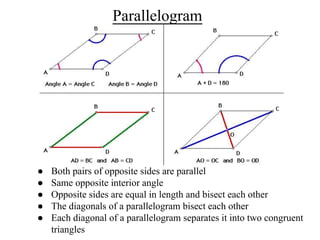
Parallelogram
● Both pairs of opposite sides are parallel
● Same opposite interior angle
● Opposite sides are equal in length and bisect each other
● The diagonals of a parallelogram bisect each other
● Each diagonal of a parallelogram separates it into two congruent
triangles
Parallelogram
Perimeter = 2a + 2b
Area = base x height
= b x h
Not using
value a to
calculate area!
Area of Parallelogram
When adjacent lengths and included angle is given,
From Theorem Hypotenuse ,
sin a = opposite / hypotenuse
sin a = h/b
Rearrange the equation, so h = b sin a
Area of Parallelogram ABCD = base x height
= a x b sin a
= ab sin a
Example : Area of parallelogram
Find the area of a parallelogram, two adjacent sides of which are 17cm
and 20cm and their included angle is 60 degree.
Solution :
Area of parallelogram = ab sin θ
= (17)(20) sin 60
= 340cm2
x 0.866
= 294.44cm2
Rhombus
● Four equal length , A=B=C=D
● Diagonals are unequal , bisect and
perpendicular to each other
● Perimeter = A+B+C+D
● Area - Altitude x Base
- a2
sin θ
- (½) ( d1
x d2
)
How area formula of Rhombus developed?
● Area = Altitude x Base
● Same as the area formula of a square
How area formula of Rhombus developed?
Diagonal AC divides the rhombus into two equal triangle ,
therefore the formula of the rhombus is given as :
Area of the rhombus = 2 x (½) ( a x a sin θ )
= a2
sin θ
Example : Area of rhombus
The side of a rhombus is 120m and two opposite angles are
60 degree each. Find the area.
Solution :
Area of rhombus = a2
sin θ
= (120)(120) sin 60
= 14400m2
x 0.866
= 12470.4m2
How area formula of Rhombus developed?
Diagonal AC & BD divide the rhombus into four equal triangles,
therefore area of rhombus given as :
Area of rhombus = 4 x ( ½ ) x ( AC/2 ) x ( BD/2 )
= ½ ( AC x BD )
= ½ ( d1
x d2
)
Example : Area of rhombus
The diagonal of a rhombus are 20m and 10m. Find its area.
Solution :
Area of rhombus = ½ ( d1
x d2
)
= ½ ( 20m x 10m )
= ½ ( 200m2
)
= 100m2
Trapezium
● 2-dimensional geometric figure with four sides
● at least one set of sides are parallel
● parallel sides are called the bases,
● other sides are called the legs
Properties of Trapezium
1)Perimeter of trapezium
Perimeter= a+b+c+d
2) Area of Trapezium
Area=½ x h x (a+b)
Derivation of the formula of trapezium
Area of Parallelogram= Base x Height
=(b1+b2) x h
Since this is the area of two trapezium we have to divide this by
two, giving
Area of Trapezium=½ (b1+ b2) x h
Example:
Find the area of a trapezoid with bases of 9 centimeters and 7
centimeters, and a height of 3 centimeters.
Solution:
Area = ½ x base x height
= ½ x (9 cm + 7 cm) x 3 cm
= ½ x (16 cm) x (3 cm)
= ½ x 48 cm2
= 24 cm2
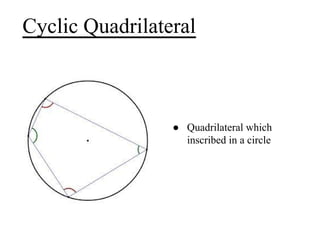
Cyclic Quadrilateral
● Quadrilateral which
inscribed in a circle
Properties of Cyclic
Quadrilateral
● Corresponding angle ● External angle
Since ∠ABC+∠ADC=180°,
∠ABC= ∠ADE
Area of
Cyclic Quadrilateral
The Brahmagupta’s
Formula:
where s = half perimeter of
quadrilateral
How Does the Brahmagupta’s
Formula Derived?
By extending line AB and line DC,
intersection point P is formed.
From the properties of cyclic
quadrilateral, ∠ABC= ∠ADP and
∠BCD= ∠PAD.
Therefore, ΔPBC is similar to ΔPAD.
The ratio of the two triangles:
How Does the Brahmagupta’s
Formula Derived?
How Does the Brahmagupta’s
Formula Derived?
Proof of Heron’s Formula:
http://jwilson.coe.uga.
edu/emt725/Heron/HeronProofAlg.html
How Does the Brahmagupta’s
Formula Derived?
How Does the Brahmagupta’s
Formula Derived?
Then, find s by substitute e
and f.
Then evaluate [s-(e+a)], [s-
(f+c)] and (s-b) in terms of
a,b, c and d
You will find that
[s-(e+a)]
[s-(f+c)] (s-b)
Finally, evaluate the Area of Cyclic Quadrilateral
Therefore,
Example:
Problem 1: Find the area of a cyclic quadrilateral whose sides are 7 cm, 5 cm, 4
cm and 10 cm.
Solution: Given that a = 7 cm, b = 5 cm, c = 4 cm and d = 10 cm
s = (7+5+4+10)/2
s = 13
Using Brahmagupta's formula:
Area of cyclic quadrilateral = √(s−a)(s−b)(s−c)(s−d)
= √(13−7)(13−5)(13−4)(13−10)
= √(6)(8)(9)(3)
= √1296
Problem 2: Find the area of a cyclic quadrilateral with sides 1 m, 300 cm, 2 m
and 1.2 m.
Example:
Solution: Given that a =100 cm, b =300 cm, c =200 cm and d = 120 cm
s = (100+300+200+120)/2
s = 360 cm
Using Brahmagupta's formula:
Area of cyclic quadrilateral = √(s−a)(s−b)(s−c)(s−d)
=√(360−100)(360−300)(360−200)(360−120)
= √(260)(60)(160)(240)
= √599040000
= 224475.3 sq cm
= 22.448 sq m
Irregular Quadrilateral
• Quadrilateral that does not fit into any of
the above is considered as irregular
quadrilateral.
Steps to find the area of an irregular
quadrilateral
Examples
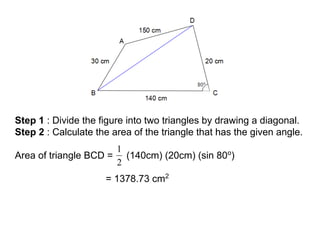
Find the area of a quadrilateral ABCD where AB = 30cm, BC = 140cm,
CD = 20cm and DA = 150cm.
B C
A
D
140 cm
150 cm
30 cm 20 cm
Step 1 : Divide the figure into two triangles by drawing a diagonal.
Step 2 : Calculate the area of the triangle that has the given angle.
Area of triangle BCD = (140cm) (20cm) (sin 80o
)
= 1378.73 cm2
Step 3 : Calculate the length of the diagonal BD using the Law of Cosines.
BD2
= 1402
+ 202
- 2(140)(20) cos 80o
BD = 137.94 cm
Step 5 : Calculate the area of the second triangle using Heron's Formula.
Perimeter of triangle ABD = 30 cm + 150 cm + 137.94 cm
= 317.94 cm
Half of the perimeter, s = 158.97 cm
Area of triangle ABD =
= 1966.61 cm2
1966.61 cm2
Step 6 : Add the two areas of the triangles to determine the area of the
quadrilateral.
Area of Quadrilateral ABCD
= Area of triangle ABD + Area of triangle BCD
= 1966.61 cm2
+ 1378.73 cm2
= 3345.34 cm2

MATHS IN-CLASS ACTIVITY SLIDES

  • 1.
  • 2.
    Quadrilateral ● It isa four-sided polygon with four angles ● The sum of interior angles is 360
  • 3.
    Types of Quadrilateral SquareTriangle Parallelogram Rhombus Kite Trapezium
  • 4.
  • 5.
  • 6.
    3 cm 3 cm 12 3 4 5 6 7 8 9 Formula Area = Side2 = 32 = 9cm2
  • 7.
    Rectangular The formula is: Area= L x W L = Length W = Width
  • 8.
    3cm 4cm we know L= 4cm, W= 3cm Area= Length x Width = L x W = 4 x 3 = 12cm2 12 cm2
  • 9.
    Kite ● Two pairsof equal length - a & a, b & b, are adjacent to each other ● Diagonals are perpendicular to each other ● Perimeter = 2a + 2b ● Area = ½ x d1 x d2 = ½ x DB x AC
  • 10.
    Area of Kite ●Area = ½ x d1 x d2 = ½ x width x length ● The remaining parts of the rectangle can form another kite ● So, the total area needs to be divided into half
  • 11.
    Area = ½x d1 x d2 = ½ x 4.8 x 10 = 24cm2 Area = ½ x d1 x d2 = ½ x (4+9) x (3+3) = 39m2
  • 12.
    Find the lengthof the diagonal of a kite whose area is 168 cm2 and one diagonal is 14 cm. Solution: Given: Area of the kite (A) = 168 cm2 and one diagonal (d1) = 14 cm. Area of Kite = ½ x d1 x d2 168 = ½ x 14 x d2 d2 = 168/7 d2 = 24cm
  • 13.
    Parallelogram ● Both pairsof opposite sides are parallel ● Same opposite interior angle ● Opposite sides are equal in length and bisect each other ● The diagonals of a parallelogram bisect each other ● Each diagonal of a parallelogram separates it into two congruent triangles
  • 14.
    Parallelogram Perimeter = 2a+ 2b Area = base x height = b x h Not using value a to calculate area!
  • 15.
    Area of Parallelogram Whenadjacent lengths and included angle is given, From Theorem Hypotenuse , sin a = opposite / hypotenuse sin a = h/b Rearrange the equation, so h = b sin a Area of Parallelogram ABCD = base x height = a x b sin a = ab sin a
  • 16.
    Example : Areaof parallelogram Find the area of a parallelogram, two adjacent sides of which are 17cm and 20cm and their included angle is 60 degree. Solution : Area of parallelogram = ab sin θ = (17)(20) sin 60 = 340cm2 x 0.866 = 294.44cm2
  • 17.
    Rhombus ● Four equallength , A=B=C=D ● Diagonals are unequal , bisect and perpendicular to each other ● Perimeter = A+B+C+D ● Area - Altitude x Base - a2 sin θ - (½) ( d1 x d2 )
  • 18.
    How area formulaof Rhombus developed? ● Area = Altitude x Base ● Same as the area formula of a square
  • 19.
    How area formulaof Rhombus developed? Diagonal AC divides the rhombus into two equal triangle , therefore the formula of the rhombus is given as : Area of the rhombus = 2 x (½) ( a x a sin θ ) = a2 sin θ
  • 20.
    Example : Areaof rhombus The side of a rhombus is 120m and two opposite angles are 60 degree each. Find the area. Solution : Area of rhombus = a2 sin θ = (120)(120) sin 60 = 14400m2 x 0.866 = 12470.4m2
  • 21.
    How area formulaof Rhombus developed? Diagonal AC & BD divide the rhombus into four equal triangles, therefore area of rhombus given as : Area of rhombus = 4 x ( ½ ) x ( AC/2 ) x ( BD/2 ) = ½ ( AC x BD ) = ½ ( d1 x d2 )
  • 22.
    Example : Areaof rhombus The diagonal of a rhombus are 20m and 10m. Find its area. Solution : Area of rhombus = ½ ( d1 x d2 ) = ½ ( 20m x 10m ) = ½ ( 200m2 ) = 100m2
  • 23.
    Trapezium ● 2-dimensional geometricfigure with four sides ● at least one set of sides are parallel ● parallel sides are called the bases, ● other sides are called the legs
  • 24.
    Properties of Trapezium 1)Perimeterof trapezium Perimeter= a+b+c+d
  • 25.
    2) Area ofTrapezium Area=½ x h x (a+b)
  • 26.
    Derivation of theformula of trapezium Area of Parallelogram= Base x Height =(b1+b2) x h Since this is the area of two trapezium we have to divide this by two, giving Area of Trapezium=½ (b1+ b2) x h
  • 27.
    Example: Find the areaof a trapezoid with bases of 9 centimeters and 7 centimeters, and a height of 3 centimeters. Solution: Area = ½ x base x height = ½ x (9 cm + 7 cm) x 3 cm = ½ x (16 cm) x (3 cm) = ½ x 48 cm2 = 24 cm2
  • 28.
    Cyclic Quadrilateral ● Quadrilateralwhich inscribed in a circle
  • 29.
    Properties of Cyclic Quadrilateral ●Corresponding angle ● External angle Since ∠ABC+∠ADC=180°, ∠ABC= ∠ADE
  • 30.
    Area of Cyclic Quadrilateral TheBrahmagupta’s Formula: where s = half perimeter of quadrilateral
  • 31.
    How Does theBrahmagupta’s Formula Derived? By extending line AB and line DC, intersection point P is formed. From the properties of cyclic quadrilateral, ∠ABC= ∠ADP and ∠BCD= ∠PAD. Therefore, ΔPBC is similar to ΔPAD. The ratio of the two triangles:
  • 32.
    How Does theBrahmagupta’s Formula Derived?
  • 33.
    How Does theBrahmagupta’s Formula Derived? Proof of Heron’s Formula: http://jwilson.coe.uga. edu/emt725/Heron/HeronProofAlg.html
  • 34.
    How Does theBrahmagupta’s Formula Derived?
  • 35.
    How Does theBrahmagupta’s Formula Derived?
  • 36.
    Then, find sby substitute e and f.
  • 37.
    Then evaluate [s-(e+a)],[s- (f+c)] and (s-b) in terms of a,b, c and d You will find that [s-(e+a)] [s-(f+c)] (s-b)
  • 38.
    Finally, evaluate theArea of Cyclic Quadrilateral Therefore,
  • 39.
    Example: Problem 1: Findthe area of a cyclic quadrilateral whose sides are 7 cm, 5 cm, 4 cm and 10 cm. Solution: Given that a = 7 cm, b = 5 cm, c = 4 cm and d = 10 cm s = (7+5+4+10)/2 s = 13 Using Brahmagupta's formula: Area of cyclic quadrilateral = √(s−a)(s−b)(s−c)(s−d) = √(13−7)(13−5)(13−4)(13−10) = √(6)(8)(9)(3) = √1296
  • 40.
    Problem 2: Findthe area of a cyclic quadrilateral with sides 1 m, 300 cm, 2 m and 1.2 m. Example: Solution: Given that a =100 cm, b =300 cm, c =200 cm and d = 120 cm s = (100+300+200+120)/2 s = 360 cm Using Brahmagupta's formula: Area of cyclic quadrilateral = √(s−a)(s−b)(s−c)(s−d) =√(360−100)(360−300)(360−200)(360−120) = √(260)(60)(160)(240) = √599040000 = 224475.3 sq cm = 22.448 sq m
  • 41.
    Irregular Quadrilateral • Quadrilateralthat does not fit into any of the above is considered as irregular quadrilateral.
  • 42.
    Steps to findthe area of an irregular quadrilateral Examples Find the area of a quadrilateral ABCD where AB = 30cm, BC = 140cm, CD = 20cm and DA = 150cm. B C A D 140 cm 150 cm 30 cm 20 cm
  • 43.
    Step 1 :Divide the figure into two triangles by drawing a diagonal. Step 2 : Calculate the area of the triangle that has the given angle. Area of triangle BCD = (140cm) (20cm) (sin 80o ) = 1378.73 cm2
  • 44.
    Step 3 :Calculate the length of the diagonal BD using the Law of Cosines. BD2 = 1402 + 202 - 2(140)(20) cos 80o BD = 137.94 cm
  • 45.
    Step 5 :Calculate the area of the second triangle using Heron's Formula. Perimeter of triangle ABD = 30 cm + 150 cm + 137.94 cm = 317.94 cm Half of the perimeter, s = 158.97 cm Area of triangle ABD = = 1966.61 cm2
  • 46.
    1966.61 cm2 Step 6: Add the two areas of the triangles to determine the area of the quadrilateral. Area of Quadrilateral ABCD = Area of triangle ABD + Area of triangle BCD = 1966.61 cm2 + 1378.73 cm2 = 3345.34 cm2