Area of study 2:
  Minimalism – “Electric
Counterpoint” – Steve Reich
 Minimalism came about shortly after
  Schoenberg’s death in 1951 in the USA.
 Serialism meant that composers could not
  express themselves. Wanted to move back
  before serialism to expressionism
 Minimalism had very simple rhythmic phrases
  and is very repetitive.
 Simple, diatonic harmony.
 Making complex music from very simple ideas.
Counterpoint
 In music, counterpoint is the
relationship between two or more
  voices that are independent in
       melody and rhythm.
Polyphonic
Electric Counterpoint is Polyphonic:


It is made up of 2 or more individual
   parts being played at the same time.
   The parts fit together harmonically.
Steve Reich
 1936 – (Born in NYC)
 He believed in “The process of change” where the
  listener should be aware of gradual changes in music =
  long pieces.

 He introduced the idea of phase shifting in 1966.
 Wrote both instrumental and rhythmic minimalist
  music.

 Rhythmically complex pieces.
 Repetitive music.
Electric Counterpoint -
                Background
 Performed by one guitarist.

 Pat Matheny in 1987.

 Has 3 movements – ours is the 3rd.

 7 electric guitars and 2 electric bass guitars.

 Multitrack recording.

 No titles – just have tempo markings.

 3rd movement is 140 bars long .

 Made of short ostinato patterns.

 Timbre doesn’t change much as it’s only guitars – quite repetative.
Electric Counterpoint
                  The music is built up in layers.

    The 7 Electric Guitars and 2 Bass Guitars enter as follows:

1 – Guitar 1

2 – Live Guitar

3 – Guitar 2

4 – Guitar 3

5 – Guitar 4

6 – Bass Guitars 1 and 2

7 – Guitar 5

8 – Guitar 6

9 – Guitar 7
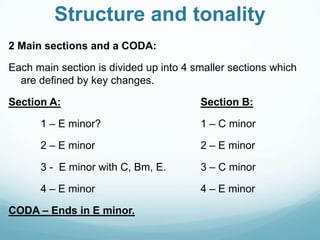
Structure and tonality
2 Main sections and a CODA:

Each main section is divided up into 4 smaller sections which
  are defined by key changes.

Section A:                              Section B:

      1 – E minor?                      1 – C minor

      2 – E minor                       2 – E minor

      3 - E minor with C, Bm, E.        3 – C minor

      4 – E minor                       4 – E minor

CODA – Ends in E minor.
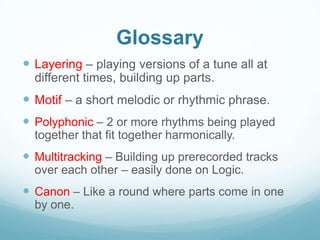
Glossary
 Layering – playing versions of a tune all at
  different times, building up parts.
 Motif – a short melodic or rhythmic phrase.
 Polyphonic – 2 or more rhythms being played
  together that fit together harmonically.
 Multitracking – Building up prerecorded tracks
  over each other – easily done on Logic.
 Canon – Like a round where parts come in one
  by one.
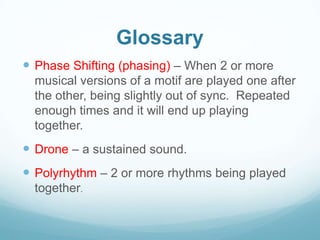
Glossary
 Phase Shifting (phasing) – When 2 or more
  musical versions of a motif are played one after
  the other, being slightly out of sync. Repeated
  enough times and it will end up playing
  together.
 Drone – a sustained sound.
 Polyrhythm – 2 or more rhythms being played
  together.

Minimalism- Everything you need to know!

  • 1.
    Area of study2: Minimalism – “Electric Counterpoint” – Steve Reich
  • 2.
     Minimalism cameabout shortly after Schoenberg’s death in 1951 in the USA.  Serialism meant that composers could not express themselves. Wanted to move back before serialism to expressionism  Minimalism had very simple rhythmic phrases and is very repetitive.  Simple, diatonic harmony.  Making complex music from very simple ideas.
  • 3.
    Counterpoint In music,counterpoint is the relationship between two or more voices that are independent in melody and rhythm.
  • 4.
    Polyphonic Electric Counterpoint isPolyphonic: It is made up of 2 or more individual parts being played at the same time. The parts fit together harmonically.
  • 5.
    Steve Reich  1936– (Born in NYC)  He believed in “The process of change” where the listener should be aware of gradual changes in music = long pieces.  He introduced the idea of phase shifting in 1966.  Wrote both instrumental and rhythmic minimalist music.  Rhythmically complex pieces.  Repetitive music.
  • 6.
    Electric Counterpoint - Background  Performed by one guitarist.  Pat Matheny in 1987.  Has 3 movements – ours is the 3rd.  7 electric guitars and 2 electric bass guitars.  Multitrack recording.  No titles – just have tempo markings.  3rd movement is 140 bars long .  Made of short ostinato patterns.  Timbre doesn’t change much as it’s only guitars – quite repetative.
  • 7.
    Electric Counterpoint The music is built up in layers. The 7 Electric Guitars and 2 Bass Guitars enter as follows: 1 – Guitar 1 2 – Live Guitar 3 – Guitar 2 4 – Guitar 3 5 – Guitar 4 6 – Bass Guitars 1 and 2 7 – Guitar 5 8 – Guitar 6 9 – Guitar 7
  • 8.
    Structure and tonality 2Main sections and a CODA: Each main section is divided up into 4 smaller sections which are defined by key changes. Section A: Section B: 1 – E minor? 1 – C minor 2 – E minor 2 – E minor 3 - E minor with C, Bm, E. 3 – C minor 4 – E minor 4 – E minor CODA – Ends in E minor.
  • 9.
    Glossary  Layering –playing versions of a tune all at different times, building up parts.  Motif – a short melodic or rhythmic phrase.  Polyphonic – 2 or more rhythms being played together that fit together harmonically.  Multitracking – Building up prerecorded tracks over each other – easily done on Logic.  Canon – Like a round where parts come in one by one.
  • 10.
    Glossary  Phase Shifting(phasing) – When 2 or more musical versions of a motif are played one after the other, being slightly out of sync. Repeated enough times and it will end up playing together.  Drone – a sustained sound.  Polyrhythm – 2 or more rhythms being played together.