Download to read offline
![IOSR Journal of Electronics and Communication Engineering (IOSR-JECE)
e-ISSN: 2278-2834,p- ISSN: 2278-8735.Volume 10, Issue 3, Ver. III (May - Jun.2015), PP 20-25
www.iosrjournals.org
DOI: 10.9790/2834-10332025 www.iosrjournals.org 20 | Page
Preparation Of Ferrite Powders Ba Fe (12−X) Ti X O 19, And Its
Structural, Morphological & FTIR Study
Aparna.A.R.a
,Brahmajirao.V b
, & Kartikeyan.T.V. C
a
Ph.D. Research Scholar, Department of Nanoscience and Technology, JNTU, Hyderabad, India
b
(Previously ) Matrix Institute of technology, Cheekatimamidi (V), Bommalaramaram (M),[ Jawaharlal Nehru
Technological University,] HYDERABAD , Pin Code – 508116, &
( at present)MGNIRSA, A Unit of D. Swami Nathan Research Foundation, Hyderabad-500029, A.P. INDIA
c
Scientist „F‟, ASL, DRDO, Hyderabad, India,
Abstract: This paper presents the preparation of Ti-doped barium ferrite powders BaFe(12−x)TixO19 for (x =
0.32 and x=0.36) nanomaterial using sol-gel route followed by the thermal insulation process and heat-
treatment, recently reported by Wangchang Li et.al.,[1]. The pH of the medium and varying ‘x’ values were the
aspects of concentration of our study in this communication. Nanomaterial is synthesized for the value of(x =
0.32 and x=0.36) at 950o
C temperature. The phase structure and morphology were analysed by standard XRD,
FTIR and SEM techniques.
Keywords: Barium ferrite, sol-gel route, Titanium, Nano ferrites, morphology.
I. Introduction
Ferrites have attracted attention over the years as magnetic materials, because they are relatively
inexpensive, stable and have a wide range of technological applications. The physical properties of ferrites are
controlled by the preparation conditions, chemical composition, sintering temperature and time, type and
amount of substitutions [2]. Ferrites exhibit outstanding microwave absorption properties and are widely
employed in military and civil fields due to their high resistivity and severe EM energy attenuation, especially
near the natural resonance frequency of magnetic moments [3-6] .
In recent years, nano sized magnetic particles have drawn outstanding attention due to the unique
mechanical, electrical, optical, and magnetic properties. Also nano sized magnetic particles have properties,
which are drastically different from those of the corresponding bulk materials. Nanocrystalline barium ferrites
are very interesting because of its chemical properties and thermal studies [7].
Due to the development of new technologies for radar and microwave communication, the research on
microwave absorbing materials has increased in recent years. The main applications of these materials intend to
reduce the human exposure to microwaves by means of absorbing coatings [8-10]. Ti-doped barium ferrite
powder is an efficient absorber of electromagnetic waves in the microwave spectrum.
In the present communication the preparation & characterisation nanopowder of BFTO was prepared
using sol-gel method. The prepared powders were characterized using X-ray Diffraction (XRD), Scanning
Electron Microscopy (SEM) and Fourier Transform Infrared Spectroscopy (FTIR).
Experimental procedure
The sol–gel combustion method has the unique advantage for the low costs using simple equipment in
large-scale high-purity. Martirosyan et al. [11, 12] reported vivid contrasts in between Solution Combustion
Synthesis (SCS) and carbon combustion synthesis of oxides (CCSO) in the synthesis of nano ferrites. The sol–
gel combustion synthesis of hexagonal barium ferrite was reported to be especially conspicuous in the process
of converting Fe2O3 into barium ferrite.
M.J.Molaei et,al.,[13(a) and (b)],in his study on Magnetic property enhancement and
characterizationBaFe12O19/Fe3O4 and Fe/Fe3O4magnetic nano-composites, reported the effects of milling time
and heat treatment temperature on the characteristics of powder mixture . The powders were studied by X-ray
diffraction analysis, vibrating sample magnetometry, transmission electron microscopy and Mossbauer
spectroscopy. Phase analysis results showed that Fe2O3 in barium ferrite partially reduced to Fe3O4 during
milling; hence, the reduced phase and remaining barium ferrite formed a nano-composite of BaFe12O19/Fe3O4
after 20 h of milling Fe3O4. Heat treatment of the 40 h milled samples at 750–900 °C resulted in formation of Fe
containing nano-composite
The Flow chart and detailed procedure of the synthesis for the Ti-doped barium ferrite powders
BaFe(12−x)TixO19 had been communicated in our earlier publication[17]](https://image.slidesharecdn.com/c010332025-160805093915/85/C010332025-1-320.jpg)
![IOSR Journal of Electronics and Communication Engineering (IOSR-JECE)
e-ISSN: 2278-2834,p- ISSN: 2278-8735.Volume 10, Issue 3, Ver. III (May - Jun.2015), PP 20-25
www.iosrjournals.org
DOI: 10.9790/2834-10332025 www.iosrjournals.org 20 | Page
Preparation Of Ferrite Powders Ba Fe (12−X) Ti X O 19, And Its
Structural, Morphological & FTIR Study
Aparna.A.R.a
,Brahmajirao.V b
, & Kartikeyan.T.V. C
a
Ph.D. Research Scholar, Department of Nanoscience and Technology, JNTU, Hyderabad, India
b
(Previously ) Matrix Institute of technology, Cheekatimamidi (V), Bommalaramaram (M),[ Jawaharlal Nehru
Technological University,] HYDERABAD , Pin Code – 508116, &
( at present)MGNIRSA, A Unit of D. Swami Nathan Research Foundation, Hyderabad-500029, A.P. INDIA
c
Scientist „F‟, ASL, DRDO, Hyderabad, India,
Abstract: This paper presents the preparation of Ti-doped barium ferrite powders BaFe(12−x)TixO19 for (x =
0.32 and x=0.36) nanomaterial using sol-gel route followed by the thermal insulation process and heat-
treatment, recently reported by Wangchang Li et.al.,[1]. The pH of the medium and varying ‘x’ values were the
aspects of concentration of our study in this communication. Nanomaterial is synthesized for the value of(x =
0.32 and x=0.36) at 950o
C temperature. The phase structure and morphology were analysed by standard XRD,
FTIR and SEM techniques.
Keywords: Barium ferrite, sol-gel route, Titanium, Nano ferrites, morphology.
I. Introduction
Ferrites have attracted attention over the years as magnetic materials, because they are relatively
inexpensive, stable and have a wide range of technological applications. The physical properties of ferrites are
controlled by the preparation conditions, chemical composition, sintering temperature and time, type and
amount of substitutions [2]. Ferrites exhibit outstanding microwave absorption properties and are widely
employed in military and civil fields due to their high resistivity and severe EM energy attenuation, especially
near the natural resonance frequency of magnetic moments [3-6] .
In recent years, nano sized magnetic particles have drawn outstanding attention due to the unique
mechanical, electrical, optical, and magnetic properties. Also nano sized magnetic particles have properties,
which are drastically different from those of the corresponding bulk materials. Nanocrystalline barium ferrites
are very interesting because of its chemical properties and thermal studies [7].
Due to the development of new technologies for radar and microwave communication, the research on
microwave absorbing materials has increased in recent years. The main applications of these materials intend to
reduce the human exposure to microwaves by means of absorbing coatings [8-10]. Ti-doped barium ferrite
powder is an efficient absorber of electromagnetic waves in the microwave spectrum.
In the present communication the preparation & characterisation nanopowder of BFTO was prepared
using sol-gel method. The prepared powders were characterized using X-ray Diffraction (XRD), Scanning
Electron Microscopy (SEM) and Fourier Transform Infrared Spectroscopy (FTIR).
Experimental procedure
The sol–gel combustion method has the unique advantage for the low costs using simple equipment in
large-scale high-purity. Martirosyan et al. [11, 12] reported vivid contrasts in between Solution Combustion
Synthesis (SCS) and carbon combustion synthesis of oxides (CCSO) in the synthesis of nano ferrites. The sol–
gel combustion synthesis of hexagonal barium ferrite was reported to be especially conspicuous in the process
of converting Fe2O3 into barium ferrite.
M.J.Molaei et,al.,[13(a) and (b)],in his study on Magnetic property enhancement and
characterizationBaFe12O19/Fe3O4 and Fe/Fe3O4magnetic nano-composites, reported the effects of milling time
and heat treatment temperature on the characteristics of powder mixture . The powders were studied by X-ray
diffraction analysis, vibrating sample magnetometry, transmission electron microscopy and Mossbauer
spectroscopy. Phase analysis results showed that Fe2O3 in barium ferrite partially reduced to Fe3O4 during
milling; hence, the reduced phase and remaining barium ferrite formed a nano-composite of BaFe12O19/Fe3O4
after 20 h of milling Fe3O4. Heat treatment of the 40 h milled samples at 750–900 °C resulted in formation of Fe
containing nano-composite
The Flow chart and detailed procedure of the synthesis for the Ti-doped barium ferrite powders
BaFe(12−x)TixO19 had been communicated in our earlier publication[17]](https://image.slidesharecdn.com/c010332025-160805093915/75/C010332025-1-2048.jpg)
![Preparation of ferrite powders Ba Fe (12−x) Ti x O 19, and its structural, morphological & FTIR study
DOI: 10.9790/2834-10332025 www.iosrjournals.org 21 | Page
Raw materials
The Synthesis of the chosen Nanomaterial for the study was done at National Chemical Laboratories,
Pune, INDIA. Ti-doped barium ferrite powders were synthesized by the sol–gel method from the starting raw
materials. Barium ferrite (BaFe12O19) and Titanium(IV) butoxide(Ti(OC4H9)4), [complete chemical formula
being Ti(OCH2CH2CH2CH3)4] obtained from Sigma Aldrich. Citric acid, Ammonia, Absolute Ethyl alcohol and
Deionized water were used as ancillary raw materials. These were procured from E-Merck and were eventually
purified using prescribed standard chemical procedure.
Synthesis of the samples
According to the composition of BaFe(12− x)Ti(x)O(19) (x = 0.32 ), three solutions were prepared. Solution
(1) is prepared by dissolving pre estimated amount of metal ferrite and an appropriate amount of citric acid in
the deionized water by stirring for 30 minutes to obtain the clear solution. Solution (2) is prepared by
dissolving specific pre estimated amounts of Ti(OC4H9)4 and citric acid in absolute ethyl alcohol by stirring for
30 minutes to get a clear solution. Solution (2) was very slowly added into solution(1) continuously by keeping
the mixture continuously stirred for three hours. This gave the clear Solution (3). Then ammonia was added
drop by drop to Solution (3), until the pH value was adjusted to 7.0. The system [11] should be acidic to
maintain a clear solution as well as to prevent unwanted precipitation of either one or both the reactants before
the gel formation and before combustion actually starts. The pH was determined using a precise pH meter. The
pH is an important parameter that governs the characteristics of the Nano material. It is reported that as the pH
of the solution increases the particle size also increases [14, 15]. Also as the pH increases, the weight losses are
found to be small according to the literature. The obtained solution was evaporated with continuous stirring to
form viscous sol precursors at 800
C& then dried at 120 0
C, for 24 to 48hrs. Then the viscous sol was heat treated
for 3 hrs, at 9500
C. Same procedure is repeated by varying the „x‟ value (x=0.36) at 9500
C.So obtained BFTO
powder samples were analysed by various characterization techniques.
Characterisation of the Synthesised Samples
The phase identification and grain distribution of the sintered samples were identified using XRD X-
ray Diffarctometer (XRD) (Philips: PW1830), at University of Hyderabad,A.P. India and Scanning Electron
Microscope (SEM) (SEM Hitachi- S520), at O.U.,Hyderabad ,A.P., INDIA .The FTIR (Schimadzu Perkin-
Elmer 1310), at SAIF, IITM, India, was used to ascertain the metal-oxygen and metal-metal bond in the
prepared ferrite sample.
II. Results and Discussion
XRD: In the utilised X-ray powder diffraction (XRD) method, Cu K-alpha radiation (wavelength 1.54178 Å), is
used for the scattering experiments. Figure 1 and 2 shows the XRD patterns of the
BaFe(12− x)TixO19( for x = 0.32 , x = 0.35* and x = 0.36 ) powders sintered at 9500
C for 3 h. Both samples show
single phase tetragonal structure, indicating the doping element has been successfully substituted into the
structure. The average crystalline size was found to be in between 15 to 50 nm and was calculated using
equation (1).
The Average grain size has been calculated using Debye – Scherrer‟s [16] equation (1) as shown below
D = [0.9λ / β ½ cosθ ] ------------(1)
Where
λ = wave length of the x- ray beam
β ½ = Angular width at the half max intensity
θ = Braggs angle
Figure 1: XRD graphs of Ti-doped barim ferrite (‘x’=0.32) at 9500
C temperatures](https://image.slidesharecdn.com/c010332025-160805093915/85/C010332025-2-320.jpg)
![Preparation of ferrite powders Ba Fe (12−x) Ti x O 19, and its structural, morphological & FTIR study
DOI: 10.9790/2834-10332025 www.iosrjournals.org 22 | Page
Figure 2: XRD graphs of Ti-doped barim ferrite (‘x’=0.35*) at 9500
C temperatures
Figure 3: XRD graphs of Ti-doped barim ferrite (‘x’=0.36) at 9500
C temperatures
Table1
x=0.32 x=0.35* x=0.36
2θ(deg) D(nm) 2θ(deg) D(nm) 2θ(deg) D(nm)
33.550 20.735 33.55 39.04 33.55 27.6471
36.0500 20.893 36.05 32.68 36.05 20.877
54.450 29.768 54.45 28.75 54.45 22.326
Table1: Average grain size D and 2θ values for x = 0.32, 0.35 and 0.36 at 950o
c temperatures.(* indicates
this data has been taken from earlier communication by the same author[17])
Analysing the effect of varying the „x‟ value, we can observe from figure(1,2 and 3) that for the sample
(x=0.35*) sintered at 9500
C shows well developed narrow peaks than the sample (x=0.32 and 0.36) sintered at
9500
C, which indicates that formation of nanostate is very nearly complete at x=0.35 value.
SEM:
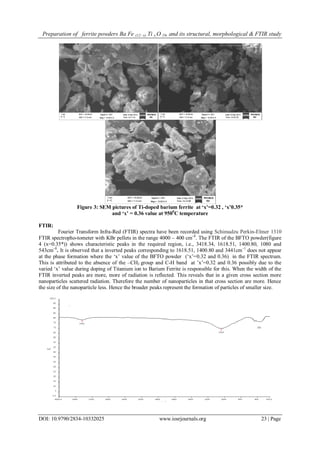
The SEM technique is used to characterize the morphology and size distribution of nanoparticles. The
obtained SEM images of the synthesised barium ferrite samples are shown, in Figure-3. It is to be noticed that
the particles of all samples exhibit plate – like nearly tetragonal shape. The particles are irregular in shape with
compact arrangement and lies in the range of 10nm-40nm(using standard method of calculation). In some
particles flakes of agglomerates are also observed. The samples obtained at different „x‟ value at same
tempering conditions show varying quality of crystallization.](https://image.slidesharecdn.com/c010332025-160805093915/85/C010332025-3-320.jpg)
![Preparation of ferrite powders Ba Fe (12−x) Ti x O 19, and its structural, morphological & FTIR study
DOI: 10.9790/2834-10332025 www.iosrjournals.org 24 | Page
Figure 4: FTIR graphs of Ti-doped barium ferrite at ‘x’=0.32 and 0.36 value at 9500
C temperatures
Stretching Peak at 541cm-1
indicates existence of the metal-oxygen vibrational modes of the spinel compound,
Stretching peak at 1080cm-1
indicates C-O, bending peak at 1400 cm-1
indicates –CH3 [63], stretching peak at
1618 cm-1
indicates remanants of C-H band and stretching peak at 3418 cm-1
indicates O-H[1].
III. Conclusion
In summary, we have successfully synthesized Ti- doped barium ferrite (x=0.32 and x=0.36)
nanopowder by using Sol-gel technique. The formation of Titanium doped Nano ferrites has been con-firmed by
XRD,SEM studies. FTIR studies on the same are also reported. The crystallite size is found to be in the range
15-40 nm.
Acknowledgement
Authors are thankful to the DST and the SAIF, IIT Madras for helping in FTIR analysis.
Authors wish to acknowledge Dr. Moneesha Fernandes , Scientist, department of Organic chemistry, National
Chemical Laboratory, Pune ,India for her constant help and encouragement.](https://image.slidesharecdn.com/c010332025-160805093915/85/C010332025-5-320.jpg)
![Preparation of ferrite powders Ba Fe (12−x) Ti x O 19, and its structural, morphological & FTIR study
DOI: 10.9790/2834-10332025 www.iosrjournals.org 25 | Page
References
[1]. Wangchang Li , Xiaojing Qiao , Mingyu Li, Ting Liu and Peng H X. La and Co substituted M-type barium ferrites processed by
sol–gel combustion synthesis. Materials Research Bulletin 2013; 48: 4449–4453.
[2]. M.M. Costa, G.F.M. Pires Junior, A.S.B. Sombra, “Dielectric and impedance properties‟ Studies of the lead doped (PbO)-Co2Y
type hexaferrite (Ba2Co2Fe12O22 (Co2Y)),” International Journal of Materials Chemistry and Physics, 123, pp 35–39, 2010.
[3]. Chen Q, Du PY, Huang WY, Jin L, Weng WJ and Han GR. Ferrite with extraordinary electric and dielectric properties prepared
from self-combustion technique. Appl Phys Lett 2007; 90: 132907.
[4]. Sun GB, Dong BX, Cao MH, Wei BQ and Hu CW . Hierarchical Dendrite-Like Magnetic Materials of Fe3O4, γ-Fe2O3 and Fe with
High Performance of Microwave Absorption. Chem Mater 2011; 23: 1587–93.
[5]. Ohkoshi S, Kuroki S, Sakurai S, Matsumoto K, Sato K and Sasaki S.A millimeter-wave absorber based on gallium-substituted
epsilon-iron oxide nanomagnets. Angew Chem Int Ed Engl 2007; 46: 8392–8395.
[6]. Zheng H, Dong YL, Wang X, Weng WJ, Han GR, Ma N and Du PY. Super High Threshold Percolative Ferroelectric/Ferrimagnetic
Composite Ceramics with Outstanding Permittivity and Initial Permeability. Angew Chem Int Ed Engl 2009; 48: 8927–8930.
[7]. S. Maensiri, C. Masingboon, B. Boonchom and S. Seraphin, “A Simple Route to Synthesize Nickel Ferrite (NiFe2O4)
Nanoparticles Using Egg White,” Scripta Materialia, Vol. 56, No. 9, 2007, pp. 797-800. doi:10.1016/j.scriptamat.2006.09.033
[8]. Ruan SP, Xu BK, Suo H, Wu FQ and Xiang SQ. Microwave absorptive
behavior of ZnCo-substituted W-type Ba hexaferrite nanocrystalline composite
material. J Magn Magn Mater 2000; 212: 175–177.
[9]. Bernd Halbedel , Dagmar Hülsenberg, Stefan Belau, Uwe Schadewald and Michael Jakob . Synthese und Anwendungen von
maßgeschneiderten BaFe12-2xAIIxBIVxO19-Pulvern. cfi/Ber DKG 2005; 82:182–188.10.
[10]. Rohde & Schwarz. A new dimension in compactness.News 199/09. 2009, p. 70–72.
[11]. Swadesh K Pratihar, Mayank Garg, Supreet Mehra and S. Bhattacharyya. Phase Evolution and Sintering Kinetics of Hydroxyapatite
Synthesized by Solution Combustion Technique. J Mater Sci Mater Med. 2006 Jun;17(6):501-7
[12]. Alamolhoda S , Seyyed Ebrahimi SA and Badiei A. Optimization of the Fe/Sr Ratio in Processing of Ultra-Fine Strontium
Hexaferrite Powders by a Sol-Gel Auto-combustion Method in the Presence of Trimethylamine. Iranian Int J Sci 2004; 5(2):173-
179.
[13]. (a)Molaei MJ, Ataie A, Raygan S, Rahimipour MR, Picken SJ, Tichelaar FD,
[14]. Legarra E and Plazaola F. Magnetic property enhancement and characterization of nano-structured barium ferrite by mechano-
thermal treatment.Materials characterization 2012; 63: 83 – 89.
[15]. 13.(b)Molaei MJ , Ataie A, aygan S, Picken SJ and Tichelaar FD. Investigation on the Effects of
[16]. Milling Atmosphere on Synthesis of Barium Ferrite/Magnetite Nanocomposite. J Supercond
[17]. Nov Magn 2012; 25: 519–524.
[18]. Praveena K, Sadhana K, Srinath S and Murthy SR. Effect of pH on structural and magnetic properties of nanocrystalline Y3Fe5O12
by aqueous co-precipitation method. Material Research Innovations 2013;18:69-75.
[19]. Kim T , Nasu S and Shima M. Growth and magnetic behavior of bismuth substituted yttrium iron garnetnanoparticles. Journal of
Nanoparticle Research 2007; 9(5): 737-743.
[20]. Radek Zboril, Miroslav Mashlan and Dimitris Petridis. Iron(III) Oxides from Thermal
[21]. Processess, Synthesis,Structural and Magnetic Properties, Mossbauer Spectroscopy Characterization, and Applications. Chemistry
of Materials 2002;14: 969-982.
[22]. Aparna AR et.al. Synthesis and Structural, Morphological and FTIR Studies on Ferrite
[23]. Powders BaFe (12−x)Ti xO 19, Using Sol-Gel Method. Part N:Journal of Nanoengineering and Nanosystems 2015;Id: JNN-14-
0052.R1(In Press).](https://image.slidesharecdn.com/c010332025-160805093915/85/C010332025-6-320.jpg)

This document summarizes research on the preparation and characterization of titanium-doped barium ferrite (BFTO) nanopowders. BFTO powders with compositions of BaFe(12-x)TixO19, where x=0.32 and x=0.36, were synthesized using a sol-gel method. The powders were characterized using XRD, SEM, and FTIR. XRD analysis confirmed the formation of a single tetragonal phase and particle sizes ranging from 15-50 nm. SEM images showed irregularly shaped plate-like particles 10-40 nm in size. FTIR spectra exhibited peaks corresponding to metal-oxygen bonds and residual organic groups from the synthesis method.


