MATERIALITY +
CONSTRUCTION
A STUDY IN CONSTRUCTION
HISTORY OF CONSTRUCTION
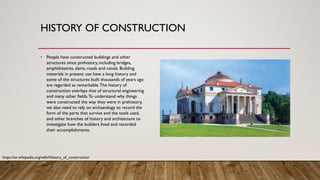
• People have constructed buildings and other
structures since prehistory, including bridges,
amphitheatres, dams, roads and canals. Building
materials in present use have a long history and
some of the structures built thousands of years ago
are regarded as remarkable.The history of
construction overlaps that of structural engineering
and many other fields.To understand why things
were constructed the way they were in prehistory,
we also need to rely on archaeology to record the
form of the parts that survive and the tools used,
and other branches of history and architecture to
investigate how the builders lived and recorded
their accomplishments.
https://en.wikipedia.org/wiki/History_of_construction
CHRONOLOGICAL DEVELOPMENT:
NEOLITHIC CONSTRUCTION
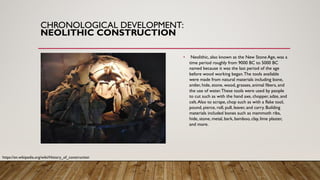
• Neolithic, also known as the New Stone Age, was a
time period roughly from 9000 BC to 5000 BC
named because it was the last period of the age
before wood working began.The tools available
were made from natural materials including bone,
antler, hide, stone, wood, grasses, animal fibers, and
the use of water.These tools were used by people
to cut such as with the hand axe, chopper, adze, and
celt.Also to scrape, chop such as with a flake tool,
pound, pierce, roll, pull, leaver, and carry. Building
materials included bones such as mammoth ribs,
hide, stone, metal, bark, bamboo, clay, lime plaster,
and more.
https://en.wikipedia.org/wiki/History_of_construction
CHRONOLOGICAL DEVELOPMENT:
NEOLITHIC CONSTRUCTION
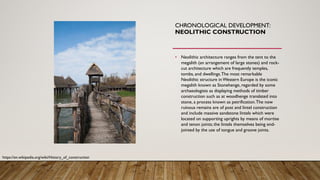
• Neolithic architecture ranges from the tent to the
megalith (an arrangement of large stones) and rock-
cut architecture which are frequently temples,
tombs, and dwellings.The most remarkable
Neolithic structure in Western Europe is the iconic
megalith known as Stonehenge, regarded by some
archaeologists as displaying methods of timber
construction such as at woodhenge translated into
stone, a process known as petrification.The now
ruinous remains are of post and lintel construction
and include massive sandstone lintels which were
located on supporting uprights by means of mortise
and tenon joints; the lintels themselves being end-
jointed by the use of tongue and groove joints.
https://en.wikipedia.org/wiki/History_of_construction
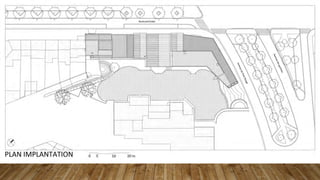
MONS MEMORIAL MUSEUM:
ATELIER D'ARCHITECTURE
PIERRE HEBBELINCK - PIERRE DE
WIT
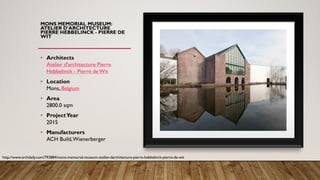
• Architects
Atelier d'architecture Pierre
Hebbelinck - Pierre de Wit
• Location
Mons, Belgium
• Area
2800.0 sqm
• ProjectYear
2015
• Manufacturers
ACH Build,Wienerberger
http://www.archdaily.com/793884/mons-memorial-museum-atelier-darchitecture-pierre-hebbelinck-pierre-de-wit
MONS MEMORIAL MUSEUM:
ATELIER D'ARCHITECTURE
PIERRE HEBBELINCK - PIERRE DE
WIT
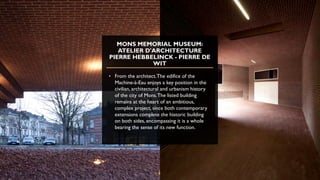
• From the architect.The edifice of the
Machine-à-Eau enjoys a key position in the
civilian, architectural and urbanism history
of the city of Mons.The listed building
remains at the heart of an ambitious,
complex project, since both contemporary
extensions complete the historic building
on both sides, encompassing it is a whole
bearing the sense of its new function.
MONS MEMORIAL MUSEUM:
ATELIER D'ARCHITECTURE
PIERRE HEBBELINCK -
PIERRE DEWIT
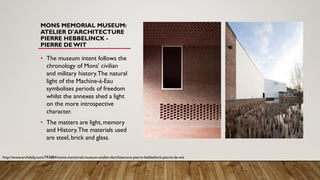
• The museum intent follows the
chronology of Mons' civilian
and military history.The natural
light of the Machine-à-Eau
symbolises periods of freedom
whilst the annexes shed a light
on the more introspective
character.
• The matters are light, memory
and History.The materials used
are steel, brick and glass.
http://www.archdaily.com/793884/mons-memorial-museum-atelier-darchitecture-pierre-hebbelinck-pierre-de-wit
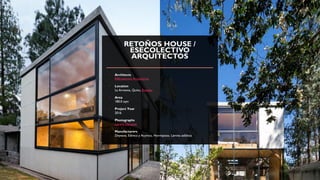
RETOÑOS HOUSE /
ESECOLECTIVO
ARQUITECTOS
• Architects
ESEcolectivo Arquitectos
• Location
La Armenia, Quito, Ecuador
• Area
180.0 sqm
• Project Year
2016
• Photographs
Lorena Darquea
• Manufacturers
Deyesos, Edimca y Acymco, Hormipisos, Lámina asfáltica
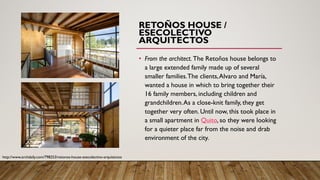
RETOÑOS HOUSE /
ESECOLECTIVO
ARQUITECTOS
• From the architect. The Retoños house belongs to
a large extended family made up of several
smaller families.The clients,Alvaro and María,
wanted a house in which to bring together their
16 family members, including children and
grandchildren.As a close-knit family, they get
together very often. Until now, this took place in
a small apartment in Quito, so they were looking
for a quieter place far from the noise and drab
environment of the city.
http://www.archdaily.com/798253/retonos-house-esecolectivo-arquitectos
RETOÑOS HOUSE /
ESECOLECTIVO
ARQUITECTOS
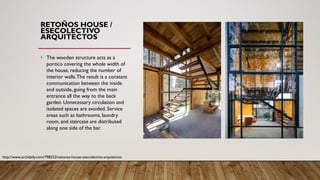
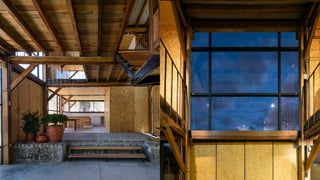
• The wooden structure acts as a
portico covering the whole width of
the house, reducing the number of
interior walls.The result is a constant
communication between the inside
and outside, going from the main
entrance all the way to the back
garden. Unnecessary circulation and
isolated spaces are avoided. Service
areas such as bathrooms, laundry
room, and staircase are distributed
along one side of the bar.
http://www.archdaily.com/798253/retonos-house-esecolectivo-arquitectos
RETOÑOS HOUSE / ESECOLECTIVO
ARQUITECTOS
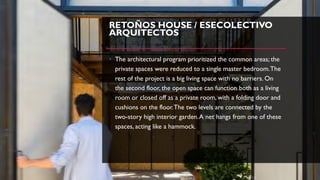
• The architectural program prioritized the common areas; the
private spaces were reduced to a single master bedroom.The
rest of the project is a big living space with no barriers. On
the second floor, the open space can function both as a living
room or closed off as a private room, with a folding door and
cushions on the floor.The two levels are connected by the
two-story high interior garden.A net hangs from one of these
spaces, acting like a hammock.
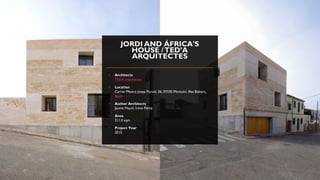
JORDI AND ÁFRICA'S
HOUSE /TED’A
ARQUITECTES
• Architects
TEd’A arquitectes
• Location
Carrer Mestre Josep Porcel, 26, 07230 Montuïri, Illes Balears,
Spain
• Author Architects
Jaume Mayol, Irene Pérez
• Area
311.0 sqm
• Project Year
2015
JORDI AND
ÁFRICA'S HOUSE /
TED’A
ARQUITECTES
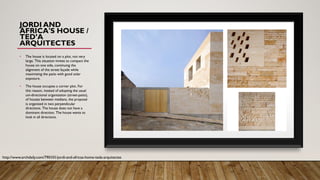
• The house is located on a plot, not very
large. This situation invites to compact the
house on one side, continuing the
alignment of the street façade while
maximizing the patio with good solar
exposure.
• The house occupies a corner plot. For
this reason, instead of adopting the usual
uni-directional organization (street-patio),
of houses between medians, the proposal
is organized in two perpendicular
directions. The house does not have a
dominant direction. The house wants to
look in all directions.
http://www.archdaily.com/790101/jordi-and-africas-home-teda-arquitectes
JORDI AND ÁFRICA'S
HOUSE /TED’A
ARQUITECTES
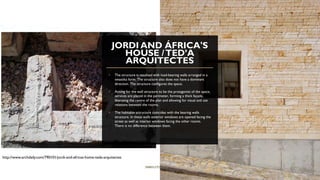
• The structure is resolved with load-bearing walls arranged in a
swastika form. The structure also does not have a dominant
direction. The structure configures the space.
• Aiming for the wall structure to be the protagonist of the space,
services are placed in the perimeter, forming a thick façade,
liberating the centre of the plan and allowing for visual and use
relations between the rooms.
• The habitable sctructure coincides with the bearing walls
structure. In these walls exterior windows are opened facing the
street as well as interior windows facing the other rooms.
There is no difference between them.
http://www.archdaily.com/790101/jordi-and-africas-home-teda-arquitectes
JORDI AND ÁFRICA'S
HOUSE /TED’A
ARQUITECTES
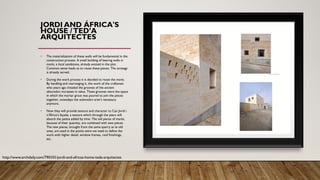
• The materialization of these walls will be fundamental in the
construction process. A small building of bearing walls in
marés, a local sandstone, already existed in the plot.
Common sense leads us to reuse these pieces. The strategy
is already served.
• During the work process it is decided to reuse the marés.
By handling and rearranging it, the work of the craftsman
who years ago chiseled the grooves of the ancient
abeuradors increases in value. These grooves were the space
in which the mortar grout was poured to join the pieces
together, nowadays the auberadors aren’t necessary
anymore.
• Now they will provide texture and character to Can Jordi i
n’África’s façade, a texture which through the years will
absorb the patina added by time. The old pieces of marés,
because of their quantity, are combined with new pieces.
The new pieces, brought from the same quarry as te old
ones, are used in the points were we need to define the
work with higher detail: window frames, roof finishings,
etc.
http://www.archdaily.com/790101/jordi-and-africas-home-teda-arquitectes
JORDI AND ÁFRICA'S HOUSE /
TED’A ARQUITECTES
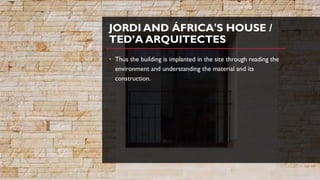
• Thus the building is implanted in the site through reading the
environment and understanding the material and its
construction.
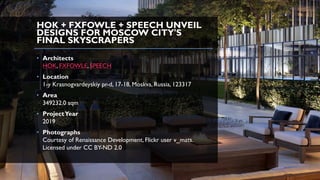
HOK + FXFOWLE + SPEECH UNVEIL
DESIGNS FOR MOSCOW CITY'S
FINAL SKYSCRAPERS
• Architects
HOK, FXFOWLE, SPEECH
• Location
1-y Krasnogvardeyskiy pr-d, 17-18, Moskva, Russia, 123317
• Area
349232.0 sqm
• ProjectYear
2019
• Photographs
Courtesy of Renaissance Development, Flickr user v_mats.
Licensed under CC BY-ND 2.0
HOK + FXFOWLE + SPEECH UNVEIL
DESIGNS FOR MOSCOW CITY'S
FINAL SKYSCRAPERS
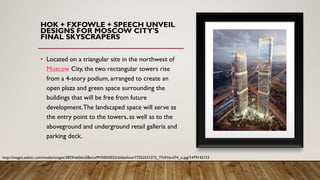
• Located on a triangular site in the northwest of
Moscow City, the two rectangular towers rise
from a 4-story podium, arranged to create an
open plaza and green space surrounding the
buildings that will be free from future
development.The landscaped space will serve as
the entry point to the towers, as well as to the
aboveground and underground retail galleria and
parking deck.
http://images.adsttc.com/media/images/5829/eb0d/e58e/cef9/f300/0032/slideshow/17352531272_77a91bcd74_o.jpg?1479142153
HOK + FXFOWLE + SPEECH UNVEIL
DESIGNS FOR MOSCOW CITY'S
FINAL SKYSCRAPERS
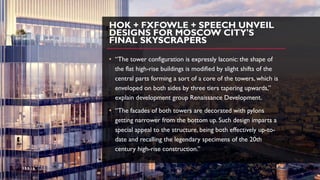
• “The tower configuration is expressly laconic: the shape of
the flat high-rise buildings is modified by slight shifts of the
central parts forming a sort of a core of the towers, which is
enveloped on both sides by three tiers tapering upwards,”
explain development group Renaissance Development.
• “The facades of both towers are decorated with pylons
getting narrower from the bottom up. Such design imparts a
special appeal to the structure, being both effectively up-to-
date and recalling the legendary specimens of the 20th
century high-rise construction.”
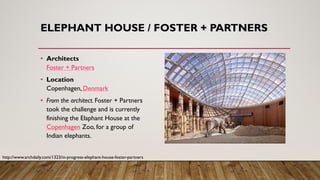
ELEPHANT HOUSE / FOSTER + PARTNERS
• Architects
Foster + Partners
• Location
Copenhagen, Denmark
• From the architect. Foster + Partners
took the challenge and is currently
finishing the Elaphant House at the
Copenhagen Zoo, for a group of
Indian elephants.
http://www.archdaily.com/1323/in-progress-elephant-house-foster-partners
ELEPHANT HOUSE /
FOSTER + PARTNERS
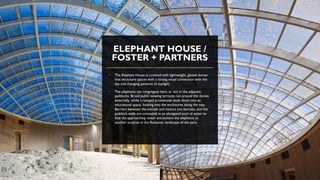
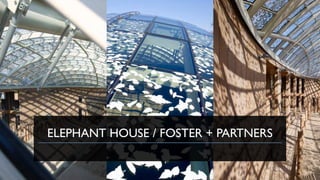
• The Elephant House is covered with lightweight, glazed domes
that enclosure spaces with a strong visual connection with the
sky and changing patterns of daylight.
• The elephants can congregate here, or out in the adjacent
paddocks. Broad public viewing terraces run around the domes
externally, while a ramped promenade leads down into an
educational space, looking into the enclosures along the way.
Barriers between the animals and visitors are discreet, and the
paddock walls are concealed in an elongated pool of water so
that the approaching visitor encounters the elephants as
another surprise in the Romantic landscape of the park.
ELEPHANT HOUSE / FOSTER +
PARTNERS
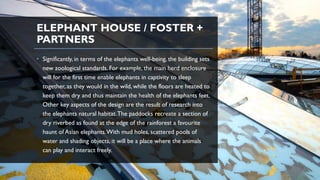
• Significantly, in terms of the elephants well-being, the building sets
new zoological standards. For example, the main herd enclosure
will for the first time enable elephants in captivity to sleep
together, as they would in the wild, while the floors are heated to
keep them dry and thus maintain the health of the elephants feet.
Other key aspects of the design are the result of research into
the elephants natural habitat.The paddocks recreate a section of
dry riverbed as found at the edge of the rainforest a favourite
haunt of Asian elephants.With mud holes, scattered pools of
water and shading objects, it will be a place where the animals
can play and interact freely.
ELEPHANT HOUSE / FOSTER + PARTNERS
REFERENCE
• http://www.archdaily.com/798253/retonos-house-esecolectivo-arquitectos
• https://en.wikipedia.org/wiki/History_of_construction
• http://www.archdaily.com/793884/mons-memorial-museum-atelier-darchitecture-pierre-hebbelinck-pierre-de-wit
• http://www.archdaily.com/476252/infographic-materials-in-architecture-a-history
• http://images.adsttc.com/media/images/5829/eb0d/e58e/cef9/f300/0032/slideshow/17352531272_77a91bcd74_o.jpg?1479142153
• http://www.archdaily.com/1323/in-progress-elephant-house-foster-partners
• http://www.archdaily.com/790101/jordi-and-africas-home-teda-arquitectes

Material

  • 1.
  • 2.
    HISTORY OF CONSTRUCTION •People have constructed buildings and other structures since prehistory, including bridges, amphitheatres, dams, roads and canals. Building materials in present use have a long history and some of the structures built thousands of years ago are regarded as remarkable.The history of construction overlaps that of structural engineering and many other fields.To understand why things were constructed the way they were in prehistory, we also need to rely on archaeology to record the form of the parts that survive and the tools used, and other branches of history and architecture to investigate how the builders lived and recorded their accomplishments. https://en.wikipedia.org/wiki/History_of_construction
  • 3.
    CHRONOLOGICAL DEVELOPMENT: NEOLITHIC CONSTRUCTION •Neolithic, also known as the New Stone Age, was a time period roughly from 9000 BC to 5000 BC named because it was the last period of the age before wood working began.The tools available were made from natural materials including bone, antler, hide, stone, wood, grasses, animal fibers, and the use of water.These tools were used by people to cut such as with the hand axe, chopper, adze, and celt.Also to scrape, chop such as with a flake tool, pound, pierce, roll, pull, leaver, and carry. Building materials included bones such as mammoth ribs, hide, stone, metal, bark, bamboo, clay, lime plaster, and more. https://en.wikipedia.org/wiki/History_of_construction
  • 4.
    CHRONOLOGICAL DEVELOPMENT: NEOLITHIC CONSTRUCTION •Neolithic architecture ranges from the tent to the megalith (an arrangement of large stones) and rock- cut architecture which are frequently temples, tombs, and dwellings.The most remarkable Neolithic structure in Western Europe is the iconic megalith known as Stonehenge, regarded by some archaeologists as displaying methods of timber construction such as at woodhenge translated into stone, a process known as petrification.The now ruinous remains are of post and lintel construction and include massive sandstone lintels which were located on supporting uprights by means of mortise and tenon joints; the lintels themselves being end- jointed by the use of tongue and groove joints. https://en.wikipedia.org/wiki/History_of_construction
  • 7.
    MONS MEMORIAL MUSEUM: ATELIERD'ARCHITECTURE PIERRE HEBBELINCK - PIERRE DE WIT • Architects Atelier d'architecture Pierre Hebbelinck - Pierre de Wit • Location Mons, Belgium • Area 2800.0 sqm • ProjectYear 2015 • Manufacturers ACH Build,Wienerberger http://www.archdaily.com/793884/mons-memorial-museum-atelier-darchitecture-pierre-hebbelinck-pierre-de-wit
  • 8.
    MONS MEMORIAL MUSEUM: ATELIERD'ARCHITECTURE PIERRE HEBBELINCK - PIERRE DE WIT • From the architect.The edifice of the Machine-à-Eau enjoys a key position in the civilian, architectural and urbanism history of the city of Mons.The listed building remains at the heart of an ambitious, complex project, since both contemporary extensions complete the historic building on both sides, encompassing it is a whole bearing the sense of its new function.
  • 9.
    MONS MEMORIAL MUSEUM: ATELIERD'ARCHITECTURE PIERRE HEBBELINCK - PIERRE DEWIT • The museum intent follows the chronology of Mons' civilian and military history.The natural light of the Machine-à-Eau symbolises periods of freedom whilst the annexes shed a light on the more introspective character. • The matters are light, memory and History.The materials used are steel, brick and glass. http://www.archdaily.com/793884/mons-memorial-museum-atelier-darchitecture-pierre-hebbelinck-pierre-de-wit
  • 12.
    RETOÑOS HOUSE / ESECOLECTIVO ARQUITECTOS •Architects ESEcolectivo Arquitectos • Location La Armenia, Quito, Ecuador • Area 180.0 sqm • Project Year 2016 • Photographs Lorena Darquea • Manufacturers Deyesos, Edimca y Acymco, Hormipisos, Lámina asfáltica
  • 13.
    RETOÑOS HOUSE / ESECOLECTIVO ARQUITECTOS •From the architect. The Retoños house belongs to a large extended family made up of several smaller families.The clients,Alvaro and María, wanted a house in which to bring together their 16 family members, including children and grandchildren.As a close-knit family, they get together very often. Until now, this took place in a small apartment in Quito, so they were looking for a quieter place far from the noise and drab environment of the city. http://www.archdaily.com/798253/retonos-house-esecolectivo-arquitectos
  • 14.
    RETOÑOS HOUSE / ESECOLECTIVO ARQUITECTOS •The wooden structure acts as a portico covering the whole width of the house, reducing the number of interior walls.The result is a constant communication between the inside and outside, going from the main entrance all the way to the back garden. Unnecessary circulation and isolated spaces are avoided. Service areas such as bathrooms, laundry room, and staircase are distributed along one side of the bar. http://www.archdaily.com/798253/retonos-house-esecolectivo-arquitectos
  • 15.
    RETOÑOS HOUSE /ESECOLECTIVO ARQUITECTOS • The architectural program prioritized the common areas; the private spaces were reduced to a single master bedroom.The rest of the project is a big living space with no barriers. On the second floor, the open space can function both as a living room or closed off as a private room, with a folding door and cushions on the floor.The two levels are connected by the two-story high interior garden.A net hangs from one of these spaces, acting like a hammock.
  • 20.
    JORDI AND ÁFRICA'S HOUSE/TED’A ARQUITECTES • Architects TEd’A arquitectes • Location Carrer Mestre Josep Porcel, 26, 07230 Montuïri, Illes Balears, Spain • Author Architects Jaume Mayol, Irene Pérez • Area 311.0 sqm • Project Year 2015
  • 21.
    JORDI AND ÁFRICA'S HOUSE/ TED’A ARQUITECTES • The house is located on a plot, not very large. This situation invites to compact the house on one side, continuing the alignment of the street façade while maximizing the patio with good solar exposure. • The house occupies a corner plot. For this reason, instead of adopting the usual uni-directional organization (street-patio), of houses between medians, the proposal is organized in two perpendicular directions. The house does not have a dominant direction. The house wants to look in all directions. http://www.archdaily.com/790101/jordi-and-africas-home-teda-arquitectes
  • 22.
    JORDI AND ÁFRICA'S HOUSE/TED’A ARQUITECTES • The structure is resolved with load-bearing walls arranged in a swastika form. The structure also does not have a dominant direction. The structure configures the space. • Aiming for the wall structure to be the protagonist of the space, services are placed in the perimeter, forming a thick façade, liberating the centre of the plan and allowing for visual and use relations between the rooms. • The habitable sctructure coincides with the bearing walls structure. In these walls exterior windows are opened facing the street as well as interior windows facing the other rooms. There is no difference between them. http://www.archdaily.com/790101/jordi-and-africas-home-teda-arquitectes
  • 23.
    JORDI AND ÁFRICA'S HOUSE/TED’A ARQUITECTES • The materialization of these walls will be fundamental in the construction process. A small building of bearing walls in marés, a local sandstone, already existed in the plot. Common sense leads us to reuse these pieces. The strategy is already served. • During the work process it is decided to reuse the marés. By handling and rearranging it, the work of the craftsman who years ago chiseled the grooves of the ancient abeuradors increases in value. These grooves were the space in which the mortar grout was poured to join the pieces together, nowadays the auberadors aren’t necessary anymore. • Now they will provide texture and character to Can Jordi i n’África’s façade, a texture which through the years will absorb the patina added by time. The old pieces of marés, because of their quantity, are combined with new pieces. The new pieces, brought from the same quarry as te old ones, are used in the points were we need to define the work with higher detail: window frames, roof finishings, etc. http://www.archdaily.com/790101/jordi-and-africas-home-teda-arquitectes
  • 24.
    JORDI AND ÁFRICA'SHOUSE / TED’A ARQUITECTES • Thus the building is implanted in the site through reading the environment and understanding the material and its construction.
  • 26.
    HOK + FXFOWLE+ SPEECH UNVEIL DESIGNS FOR MOSCOW CITY'S FINAL SKYSCRAPERS • Architects HOK, FXFOWLE, SPEECH • Location 1-y Krasnogvardeyskiy pr-d, 17-18, Moskva, Russia, 123317 • Area 349232.0 sqm • ProjectYear 2019 • Photographs Courtesy of Renaissance Development, Flickr user v_mats. Licensed under CC BY-ND 2.0
  • 27.
    HOK + FXFOWLE+ SPEECH UNVEIL DESIGNS FOR MOSCOW CITY'S FINAL SKYSCRAPERS • Located on a triangular site in the northwest of Moscow City, the two rectangular towers rise from a 4-story podium, arranged to create an open plaza and green space surrounding the buildings that will be free from future development.The landscaped space will serve as the entry point to the towers, as well as to the aboveground and underground retail galleria and parking deck. http://images.adsttc.com/media/images/5829/eb0d/e58e/cef9/f300/0032/slideshow/17352531272_77a91bcd74_o.jpg?1479142153
  • 28.
    HOK + FXFOWLE+ SPEECH UNVEIL DESIGNS FOR MOSCOW CITY'S FINAL SKYSCRAPERS • “The tower configuration is expressly laconic: the shape of the flat high-rise buildings is modified by slight shifts of the central parts forming a sort of a core of the towers, which is enveloped on both sides by three tiers tapering upwards,” explain development group Renaissance Development. • “The facades of both towers are decorated with pylons getting narrower from the bottom up. Such design imparts a special appeal to the structure, being both effectively up-to- date and recalling the legendary specimens of the 20th century high-rise construction.”
  • 34.
    ELEPHANT HOUSE /FOSTER + PARTNERS • Architects Foster + Partners • Location Copenhagen, Denmark • From the architect. Foster + Partners took the challenge and is currently finishing the Elaphant House at the Copenhagen Zoo, for a group of Indian elephants. http://www.archdaily.com/1323/in-progress-elephant-house-foster-partners
  • 35.
    ELEPHANT HOUSE / FOSTER+ PARTNERS • The Elephant House is covered with lightweight, glazed domes that enclosure spaces with a strong visual connection with the sky and changing patterns of daylight. • The elephants can congregate here, or out in the adjacent paddocks. Broad public viewing terraces run around the domes externally, while a ramped promenade leads down into an educational space, looking into the enclosures along the way. Barriers between the animals and visitors are discreet, and the paddock walls are concealed in an elongated pool of water so that the approaching visitor encounters the elephants as another surprise in the Romantic landscape of the park.
  • 36.
    ELEPHANT HOUSE /FOSTER + PARTNERS • Significantly, in terms of the elephants well-being, the building sets new zoological standards. For example, the main herd enclosure will for the first time enable elephants in captivity to sleep together, as they would in the wild, while the floors are heated to keep them dry and thus maintain the health of the elephants feet. Other key aspects of the design are the result of research into the elephants natural habitat.The paddocks recreate a section of dry riverbed as found at the edge of the rainforest a favourite haunt of Asian elephants.With mud holes, scattered pools of water and shading objects, it will be a place where the animals can play and interact freely.
  • 37.
    ELEPHANT HOUSE /FOSTER + PARTNERS
  • 45.
    REFERENCE • http://www.archdaily.com/798253/retonos-house-esecolectivo-arquitectos • https://en.wikipedia.org/wiki/History_of_construction •http://www.archdaily.com/793884/mons-memorial-museum-atelier-darchitecture-pierre-hebbelinck-pierre-de-wit • http://www.archdaily.com/476252/infographic-materials-in-architecture-a-history • http://images.adsttc.com/media/images/5829/eb0d/e58e/cef9/f300/0032/slideshow/17352531272_77a91bcd74_o.jpg?1479142153 • http://www.archdaily.com/1323/in-progress-elephant-house-foster-partners • http://www.archdaily.com/790101/jordi-and-africas-home-teda-arquitectes