Group members:
•   Arzoo Nawaz          Roll no.63
•   Syed Ali Kamran.     Roll no.50
•   Mirza Ali Raza.      Roll no.90
•   Syed Hussain Zain.   Roll no.85
•   Zeeshan Buhtta.      Roll no.89
Presentation of Business
Communication:
Topics to be described are:
•   Report Writing.
•   Formal Report.
•   Short Report.
•   Long Report.
•   Technical Report.
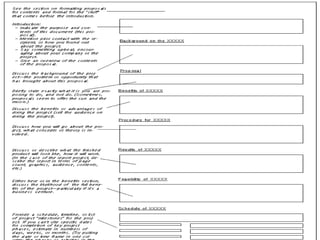
•   Proposals
Topic “Report Writing”
Definition of report
• A report is a document
  characterized by information or other
  content reflective of inquiry or
  investigation, tailored to the context
  of a given situation and audience.
Planning for report
• Five steps involved in planning.
1. Introduction.
2. Structure Of A Report.
3. How To Begin.
4. Layout Of The Report.
5. Conclusions.
1. INTRODUCTION
• The purpose of a report is to convey
  information factually, briefly, and clearly.
  Brevity is important; a report is not an
  essay.
• Clarity is achieved by subdividing the
  report into headed sections each with a
  definite part to play. There is no single
  "best" way to present a report.
2. STRUCTURE OF A
REPORT
 There are five main parts to any
  report, and each of these has a
  different purpose:
• Summary
• Introduction
• Core
• Conclusions
• Appendix
3. HOW TO BEGIN
• Start with the introduction.
• The core of the report may now be
  written, with as much detail as is
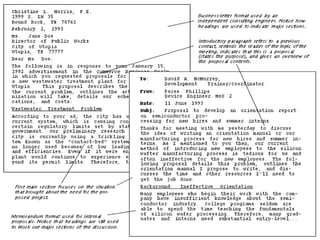
  required for the reader to understand
  everything which was done.
• Conclusion
• Discussion
• Summary
4. LAYOUT OF THE
REPORT
• The purpose of structuring the report is to
  make it accessible to likely readers.
• The purpose of layout is to enhance the
  ease with which the reader can find their
  way about.
• With currently available word processors it
  is possible to use a variety of different
  methods to enhance the report (e.g. bold
  characters and bullet points).
5. CONCLUSIONS
•  Good reporting is very important.
•  The purpose of the report is to inform the reader.
•  Good layout helps the reader.
•  The abstract should be a self-contained guide to the
   contents
• The introduction and conclusion should be sufficient
  to inform the reader of the main outcomes of the
  report.
• The writing of a report is a straight-forward exercise,
  which will occur naturally if the above guidelines are
  followed.
General Formatting Guidelines
• Here are some general formatting guidelines that apply to
  the entire report:
• Use 1- or 1-1/2-inch margins for all four margins of the
  report. You might want to use a 1-1/2-inch margin at the
  top and 1-inch margins for the left, right, and bottom.
• Use a 1-1/2-inch left margin if your binding uses a lot of
  space (for example, brad-type binders that require 2- or 3-
  hole punch).
• Generally use double-spaced typing except in those areas
  where single spacing is shown (for example, in the
  transmittal letter, descriptive abstract, figure titles, short
  vertical lists, and items in the information-sources list).
• Use one side of the paper only.
Formal Reports: Component by
Component
• This section examines each
  component of the formal report and
  points out the key requirements in
  terms of content, design, and format.
  Remember that these are
  requirements, or "specifications."
Covers and
label.
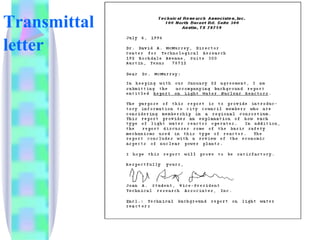
Transmittal
letter
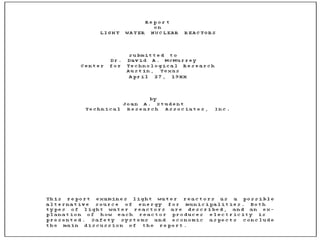
Title page and descriptive
abstract
• This is the first "official" page in the
  report. No page number is displayed
  on this page.
• At the bottom of the title page is the
  descriptive abstract.
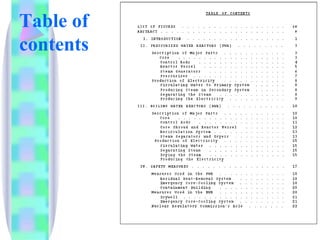
Table of
contents
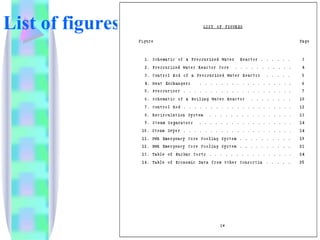
List of figures
Abstract
(informative).
Body of the report:
introduction
• The title of the report is set at the
  top, just above the first-level heading
  and that no page number is
  displayed
Page with headings and
graphics.
• In the body of your report, be sure to
  use the standard format for
  headings, for lists, and for graphics.
  If you are writing instructions, don't
  forget to use the standard format for
  special notices.
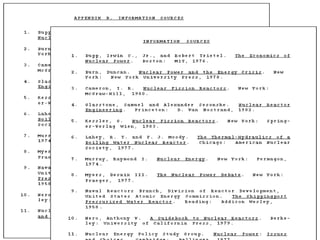
List of information sources
• Remember to put all information
  sources in this list, including no
  printed, no published ones. For style
  and format of these entries.
Appendix
• The appendix is a good place to put
  information that just will not fit in the main
  body of the report, but still needs to be in
  the report. For example, big tables of data,
  large maps, forms used in an organization,
  or background discussion-these are good
  candidates for the appendix. Notice that
  each one is given a letter (A, B, C, and so
  on).
Page-Numbering Style


•   Pages within the front and back
    covers are numbered (except for the
    transmittal letter); but the page
    number is not always displayed.
•   All pages coming before page 1 of
    the introduction use lowercase
    Roman numerals.
Page-Numbering Style


•   All pages beginning with page 1 of
    the introduction use with Arabic
    numerals.
•   Page numbers are not displayed on
    the transmittal letter, title page, first
    page of the table of contents, page 1
    of the introduction, and the appendix
    divider page.
Final Production

•   Make a good printout of your report, on good
    paper, using fresh print supplier. Remember to
    design and type or print your cover label.
•   Make sure your graphics are good quality. If
    they are, tape them down onto the pages. Make
    sure they fit neatly within the margins-top and
    bottom, left and right.
•   Make sure all the component are in place and
    everything looks okay.
Topic “Short Reports”

Syed Hussain Zain ul Abeden Gardezi.
           Roll No. 85
Short Report:
• As the name suggest it’s a short report of two or
  three paragraph usually use as a memorandum in an
  organization to inform and analyze any problem or
  suggestion.


    There are three main Features of Short Report:
• Concise.
• Accurate.
• Unbiased.
For Example:
• President Lincoln of America asked his
  cabinet to write him suggestion in the
  form of short report so that he could
  review them from his busy time, and do
  according to their suggestion.
Developing The Main Sections:
Short Report contains three main section:


3. Introduction.
4. Body (discussion, text).
5. Terminal Section
   (summary, conclusion,
   recommendation).
Introduction:
• Main elements which should be
  included in short reports
  introduction are,
•   Purpose or aim.
•   Authorization.
•   Sources.
•   Scope.
•   Background.
•   Limits.
Body:
The main point which should be
 included in the body of short report:

•   Present all facts accurately and impartially.
•   Emphasize important ideas by showing details.
•   Include visual aids.
•   Use headings.
•   Apply the seven C writing principles.
Terminal Section:
• Remember that a summary condenses the text,
  conclusion      evaluate     the     text, and
  recommendations offer specific course of
  action.
• Do not include any new material in the
  terminal section of the report.
• Usually list summary points in the same order
  as topics are discussed in the report.
Five Cautions Regarding to
Headings & Sub Heading
• Place the most important ideas in the highest
  degree of headings.
• Balance the section according to the number of
  headings.
• Have at least two subheading if you divide any
  topic.
• Use about three to seven main points in a report.
• Avoid using the report title as a section heading.
Short reports are to be completed as
described below.
 • Short reports are not to exceed 1
   page.
 • Your work should be double-spaced
   with 1" margins on all sides.
 • Preferred font is 12-point Times-
   Roman.
Topic “Long Reports”

  Zeeshan Bhutta
   Roll no. 89
Introduction
Introduction
Cover & External Title
Five Suggestions
   i)Remember the W’S questions.
   ii)Keep the title short.
   iii)Consider subtitle with colon
   such as:
   Argentina:Recommendations for
     establishing joint venture.
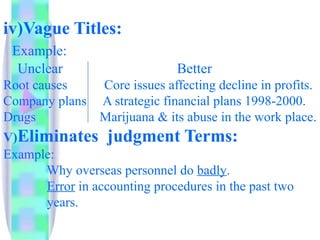
iv)Vague Titles:
 Example:
  Unclear                      Better
Root causes   Core issues affecting decline in profits.
Company plans A strategic financial plans 1998-2000.
Drugs         Marijuana & its abuse in the work place.
V)Eliminates judgment Terms:
Example:
      Why overseas personnel do badly.
      Error in accounting procedures in the past two
      years.
Title Fly & Internal Title

 The four main parts of the title

 page are title,for whom,by
 whom,date.
Example
[Title]
 Industrial water Pollution.
[For Whom]
For the environmental Committee.
  [By Whom]
Prepared by Olga lotz.
[Date]
September 25.199.
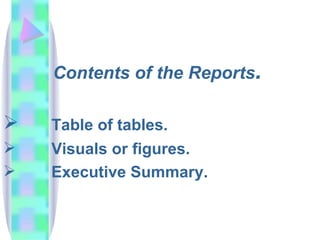
Contents of the Reports.

   Table of tables.
   Visuals or figures.
   Executive Summary.
Supplementary Parts
   Appendix.
   Bibliography.
   Index.
Topic “Technical Reports”


 Mirza Ali Raza   Roll No.90
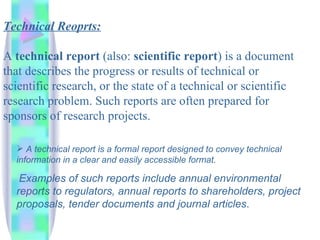
Technical Reoprts:

A technical report (also: scientific report) is a document
that describes the progress or results of technical or
scientific research, or the state of a technical or scientific
research problem. Such reports are often prepared for
sponsors of research projects.

   A technical report is a formal report designed to convey technical
  information in a clear and easily accessible format.

   Examples of such reports include annual environmental
  reports to regulators, annual reports to shareholders, project
  proposals, tender documents and journal articles.
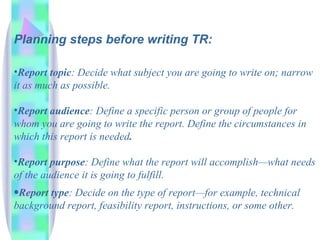
Planning steps before writing TR:

•Report topic: Decide what subject you are going to write on; narrow
it as much as possible.

•Report audience: Define a specific person or group of people for
whom you are going to write the report. Define the circumstances in
which this report is needed.

•Report purpose: Define what the report will accomplish—what needs
of the audience it is going to fulfill.
•Report type: Decide on the type of report—for example, technical
background report, feasibility report, instructions, or some other.
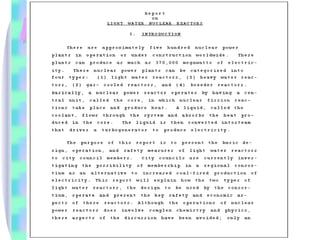
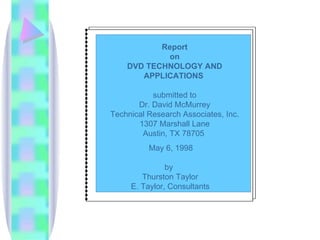
Report
             on
    DVD TECHNOLOGY AND
       APPLICATIONS

           submitted to
       Dr. David McMurrey
Technical Research Associates, Inc.
       1307 Marshall Lane
        Austin, TX 78705
          May 6, 1998

               by
        Thurston Taylor
     E. Taylor, Consultants
Types of Technical Reports:
•   Technical-background report:
    The background report is the hardest to define but the most commonly
    written. This type of technical report provides background on a topic—for
    example, solar energy, global warming, CD-ROM technology, a medical
    problem, or U.S. recycling activity


2) Feasibility, recommendation, and evaluation report:
•    A feasibility report tells whether a project is "feasible"—that is, whether
    it is practical and technologically possible.
•    A recommendation report compares two or more alternatives and
    recommends one (or, if necessary, none).
•   An evaluation or assessment report studies something in terms of its
    worth or value For example, a college might investigate the feasibility of
    giving every student an e-mail address and putting many of the college
    functions online.
3) Primary research report:
Primary research refers to the actual work someone does in a laboratory or
in the field—in other words, experiments and surveys.


4) Technical specifications:
 In this report type, you discuss some new product design in terms of its
construction, materials, functions, features, operation, and market
potential.


5) Report-length proposal:
As you may be aware, proposals can be monster documents of hundreds
or even thousands of pages.Most of the elements are the same, just
bigger. Plus elements from other kinds of reports get imported—such as
feasibility discussion, review of literature, and qualifications; these become
much more elaborate.
6) Business plans:
If you are ambitious to run your own business, you can write a business
plan, which is a plan or proposal to start a new business or to expand
an existing one. It is aimed primarily at potential investors.


7) Technical   Manuals and Instructions :
Here the emphasis is on using appliances, equipment or programs. The
task here is to write step-by-step procedures anyone can understand
and follow.
General Characteristics of Technical Reports :
Graphics: The report should have graphics. If you can't
think of any graphics for your report project, you may not
have a good topic.


Factual detail: The report should be very detailed and
factual. The point of the report is to go into details, the kind
of details your specific audience needs.


Information sources: Your report should make use of
information sources. These may include not only books and
articles that can be found in libraries but also technical
brochures, interviews or correspondence with experts, as
well as first-hand inspections
Documentation: When you use borrowed information in
your technical report, be sure to cite your sources. The style
of citing your sources (also called "documenting" your
sources).
Realistic audience and situation: The report must be defined
for a real or realistic group of readers who exist in a real or
realistic situation.The audience can't merely be something
like "anybody who might be interested in global warming."
Headings and lists: The report should use the format for
headings that is required for the course, as well as various
kinds of lists as appropriate
Special format: The technical report uses a rather involved
format including covers, binding, title page, table of contents,
list of figures, transmittal letter, and appendixes.
Production: The technical report should be typed or
printed out neatly. If graphics are taped in, the whole
report must be photocopied, and the photocopy handed in
(not the original with the taped-in graphics).


Length: The report should be at least 8 doublespaced
typed or printed pages (using 1-inch margins), counting
from introduction to conclusion.


Technical content: You must design your report project in
such a way that your poor technical-writing instructor has a
chance to understand it—in other words, you must write for
the nonspecialist.
How to write Technical Report?
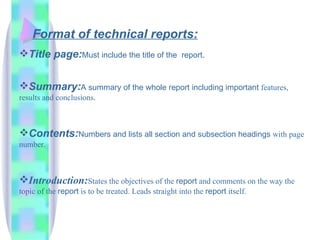
Format of technical reports:
Title page:Must include the title of the             report.


Summary:A summary of the whole report including important features,
results and conclusions.


Contents:Numbers and lists all section and subsection headings with page
number.


Introduction:States the objectives of the report and comments on the way the
topic of the report is to be treated. Leads straight into the report itself.
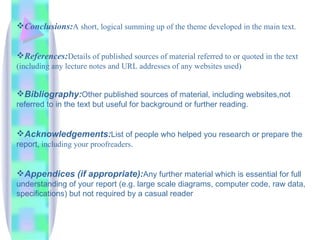
Conclusions:A short, logical summing up of the theme developed in the main text.


References:Details of published sources of material referred to or quoted in the text
(including any lecture notes and URL addresses of any websites used)


Bibliography:Other published sources of material, including websites,not
referred to in the text but useful for background or further reading.


Acknowledgements:List of people who helped you research or prepare the
report, including your proofreaders.


Appendices (if appropriate):Any further material which is essential for full
understanding of your report (e.g. large scale diagrams, computer code, raw data,
specifications) but not required by a casual reader
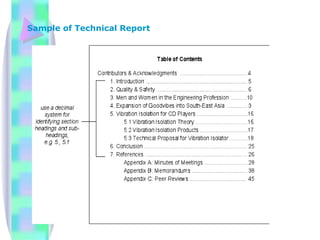
Sample of Technical Report
Topic “Proposals”

Syed Ali Kamran Abidi.
     Roll No. 50
Proposals

Something that is put forward for consideration.

• Like proposals in general,
  documentation proposals can be
  lengthy or they can be a business letter
  under ten pages. For a lengthy
  proposal, use the standard design of
  reports. Use transmittal letter, covers,
  title pages, tables of contents,
  abstracts, headings, lists, tables,
  graphics etc.
Components of a Proposal:
•   Introduction.
•   Background.
•   Benefits and Feasibility.
•   Description.
•   Method or Procedure.
•   Schedule.
•   Qualifications.
•   Costs or Resources required.
•   Conclusions.
Introduction.
• Indicate that the document to follow is a
  proposal.
• Refer to some previous contact with the
  recipient of the proposal or to your source of
  information about the project.
• Find one brief motivating statement that will
  encourage the recipient to read on and to
  consider doing the project.
• Give an overview of the contents of the
  proposal.
Background on the problem,
opportunity, or situation
• It's true that the audience of the
  proposal may know the problem very
  well but writing the background
  section still might be useful,
  however, in demonstrating your
  particular view of the problem.
Benefits and feasibility of the
proposed project.
• Most proposals discuss the
  advantages or benefits of doing the
  proposed project. This acts as an
  argument in favor of approving the
  project. Also, some proposals
  discuss the likelihood of the
  project's success.
Description of the proposal:
• Most proposals must describe the
  finished product of the proposed
  project. In this course, that means
  describing the written document
  you propose to write, the purpose;
  providing an outline; and
  discussing such things as its
  length, graphics, binding etc.
Method or procedure:
• This acts as an additional persuasive
  element; it shows the audience you have a
  sound, well-thought-out approach to the
  project. Remember that the background
  section focused on the problem or need
  that brings about the proposal. However,
  in this section, you discuss the technical
  background relating to the procedures or
  technology you plan to use in the
  proposed work.
Schedule:
• Most proposals contain a section that
  shows not only the projected completion
  date but also key milestones for the
  project. If you are doing a large project
  spreading over many months, the
  timeline would also show dates on which
  you would deliver progress reports. And
  if you can't cite specific dates, cite
  amounts of time or time spans for each
  phase of the project.
Qualifications:
• Most proposals contain a summary
  of the proposing individual's or
  organization's qualifications to do
  the proposed work. Therefore, this
  section lists work experience,
  similar projects, references,
  training, and education that shows
  familiarity with the project.
Costs or resources required:
• Most proposals also contain a section
  detailing the costs of the project, With
  hourly rates, projected hours, costs of
  equipment and supplies etc. and then
  calculate the total cost of the complete
  project.
• For example, hours you will need to
  complete the project, equipment and
  supplies you'll be using, assistance from
  other people in the organization, and so
  on.
Conclusions.
• The final paragraph or section of
  the proposal should bring readers
  back to a focus on the positive
  aspects of the project. In the final
  section, you put in one last plug for
  you or your organization as the
  right choice for the project.
Bussiness communication

Bussiness communication

  • 2.
    Group members: • Arzoo Nawaz Roll no.63 • Syed Ali Kamran. Roll no.50 • Mirza Ali Raza. Roll no.90 • Syed Hussain Zain. Roll no.85 • Zeeshan Buhtta. Roll no.89
  • 3.
  • 4.
    Topics to bedescribed are: • Report Writing. • Formal Report. • Short Report. • Long Report. • Technical Report. • Proposals
  • 5.
  • 6.
    Definition of report •A report is a document characterized by information or other content reflective of inquiry or investigation, tailored to the context of a given situation and audience.
  • 7.
    Planning for report •Five steps involved in planning. 1. Introduction. 2. Structure Of A Report. 3. How To Begin. 4. Layout Of The Report. 5. Conclusions.
  • 8.
    1. INTRODUCTION • Thepurpose of a report is to convey information factually, briefly, and clearly. Brevity is important; a report is not an essay. • Clarity is achieved by subdividing the report into headed sections each with a definite part to play. There is no single "best" way to present a report.
  • 9.
    2. STRUCTURE OFA REPORT There are five main parts to any report, and each of these has a different purpose: • Summary • Introduction • Core • Conclusions • Appendix
  • 10.
    3. HOW TOBEGIN • Start with the introduction. • The core of the report may now be written, with as much detail as is required for the reader to understand everything which was done. • Conclusion • Discussion • Summary
  • 11.
    4. LAYOUT OFTHE REPORT • The purpose of structuring the report is to make it accessible to likely readers. • The purpose of layout is to enhance the ease with which the reader can find their way about. • With currently available word processors it is possible to use a variety of different methods to enhance the report (e.g. bold characters and bullet points).
  • 12.
    5. CONCLUSIONS • Good reporting is very important. • The purpose of the report is to inform the reader. • Good layout helps the reader. • The abstract should be a self-contained guide to the contents • The introduction and conclusion should be sufficient to inform the reader of the main outcomes of the report. • The writing of a report is a straight-forward exercise, which will occur naturally if the above guidelines are followed.
  • 13.
    General Formatting Guidelines •Here are some general formatting guidelines that apply to the entire report: • Use 1- or 1-1/2-inch margins for all four margins of the report. You might want to use a 1-1/2-inch margin at the top and 1-inch margins for the left, right, and bottom. • Use a 1-1/2-inch left margin if your binding uses a lot of space (for example, brad-type binders that require 2- or 3- hole punch). • Generally use double-spaced typing except in those areas where single spacing is shown (for example, in the transmittal letter, descriptive abstract, figure titles, short vertical lists, and items in the information-sources list). • Use one side of the paper only.
  • 14.
    Formal Reports: Componentby Component • This section examines each component of the formal report and points out the key requirements in terms of content, design, and format. Remember that these are requirements, or "specifications."
  • 15.
  • 16.
  • 17.
    Title page anddescriptive abstract • This is the first "official" page in the report. No page number is displayed on this page. • At the bottom of the title page is the descriptive abstract.
  • 19.
  • 20.
  • 21.
  • 22.
    Body of thereport: introduction • The title of the report is set at the top, just above the first-level heading and that no page number is displayed
  • 24.
    Page with headingsand graphics. • In the body of your report, be sure to use the standard format for headings, for lists, and for graphics. If you are writing instructions, don't forget to use the standard format for special notices.
  • 26.
    List of informationsources • Remember to put all information sources in this list, including no printed, no published ones. For style and format of these entries.
  • 27.
    Appendix • The appendixis a good place to put information that just will not fit in the main body of the report, but still needs to be in the report. For example, big tables of data, large maps, forms used in an organization, or background discussion-these are good candidates for the appendix. Notice that each one is given a letter (A, B, C, and so on).
  • 29.
    Page-Numbering Style • Pages within the front and back covers are numbered (except for the transmittal letter); but the page number is not always displayed. • All pages coming before page 1 of the introduction use lowercase Roman numerals.
  • 30.
    Page-Numbering Style • All pages beginning with page 1 of the introduction use with Arabic numerals. • Page numbers are not displayed on the transmittal letter, title page, first page of the table of contents, page 1 of the introduction, and the appendix divider page.
  • 31.
    Final Production • Make a good printout of your report, on good paper, using fresh print supplier. Remember to design and type or print your cover label. • Make sure your graphics are good quality. If they are, tape them down onto the pages. Make sure they fit neatly within the margins-top and bottom, left and right. • Make sure all the component are in place and everything looks okay.
  • 32.
    Topic “Short Reports” SyedHussain Zain ul Abeden Gardezi. Roll No. 85
  • 33.
    Short Report: • Asthe name suggest it’s a short report of two or three paragraph usually use as a memorandum in an organization to inform and analyze any problem or suggestion. There are three main Features of Short Report: • Concise. • Accurate. • Unbiased.
  • 34.
    For Example: • PresidentLincoln of America asked his cabinet to write him suggestion in the form of short report so that he could review them from his busy time, and do according to their suggestion.
  • 35.
    Developing The MainSections: Short Report contains three main section: 3. Introduction. 4. Body (discussion, text). 5. Terminal Section (summary, conclusion, recommendation).
  • 36.
    Introduction: • Main elementswhich should be included in short reports introduction are, • Purpose or aim. • Authorization. • Sources. • Scope. • Background. • Limits.
  • 37.
    Body: The main pointwhich should be included in the body of short report: • Present all facts accurately and impartially. • Emphasize important ideas by showing details. • Include visual aids. • Use headings. • Apply the seven C writing principles.
  • 38.
    Terminal Section: • Rememberthat a summary condenses the text, conclusion evaluate the text, and recommendations offer specific course of action. • Do not include any new material in the terminal section of the report. • Usually list summary points in the same order as topics are discussed in the report.
  • 39.
    Five Cautions Regardingto Headings & Sub Heading • Place the most important ideas in the highest degree of headings. • Balance the section according to the number of headings. • Have at least two subheading if you divide any topic. • Use about three to seven main points in a report. • Avoid using the report title as a section heading.
  • 40.
    Short reports areto be completed as described below. • Short reports are not to exceed 1 page. • Your work should be double-spaced with 1" margins on all sides. • Preferred font is 12-point Times- Roman.
  • 41.
    Topic “Long Reports” Zeeshan Bhutta Roll no. 89
  • 42.
  • 43.
    Cover & ExternalTitle Five Suggestions i)Remember the W’S questions. ii)Keep the title short. iii)Consider subtitle with colon such as: Argentina:Recommendations for establishing joint venture.
  • 44.
    iv)Vague Titles: Example: Unclear Better Root causes Core issues affecting decline in profits. Company plans A strategic financial plans 1998-2000. Drugs Marijuana & its abuse in the work place. V)Eliminates judgment Terms: Example: Why overseas personnel do badly. Error in accounting procedures in the past two years.
  • 45.
    Title Fly &Internal Title The four main parts of the title page are title,for whom,by whom,date.
  • 46.
    Example [Title] Industrial waterPollution. [For Whom] For the environmental Committee. [By Whom] Prepared by Olga lotz. [Date] September 25.199.
  • 47.
    Contents of theReports.  Table of tables.  Visuals or figures.  Executive Summary.
  • 48.
    Supplementary Parts  Appendix.  Bibliography.  Index.
  • 49.
    Topic “Technical Reports” Mirza Ali Raza Roll No.90
  • 50.
    Technical Reoprts: A technicalreport (also: scientific report) is a document that describes the progress or results of technical or scientific research, or the state of a technical or scientific research problem. Such reports are often prepared for sponsors of research projects.  A technical report is a formal report designed to convey technical information in a clear and easily accessible format. Examples of such reports include annual environmental reports to regulators, annual reports to shareholders, project proposals, tender documents and journal articles.
  • 51.
    Planning steps beforewriting TR: •Report topic: Decide what subject you are going to write on; narrow it as much as possible. •Report audience: Define a specific person or group of people for whom you are going to write the report. Define the circumstances in which this report is needed. •Report purpose: Define what the report will accomplish—what needs of the audience it is going to fulfill. •Report type: Decide on the type of report—for example, technical background report, feasibility report, instructions, or some other.
  • 52.
    Report on DVD TECHNOLOGY AND APPLICATIONS submitted to Dr. David McMurrey Technical Research Associates, Inc. 1307 Marshall Lane Austin, TX 78705 May 6, 1998 by Thurston Taylor E. Taylor, Consultants
  • 53.
  • 54.
    Technical-background report: The background report is the hardest to define but the most commonly written. This type of technical report provides background on a topic—for example, solar energy, global warming, CD-ROM technology, a medical problem, or U.S. recycling activity 2) Feasibility, recommendation, and evaluation report: • A feasibility report tells whether a project is "feasible"—that is, whether it is practical and technologically possible. • A recommendation report compares two or more alternatives and recommends one (or, if necessary, none). • An evaluation or assessment report studies something in terms of its worth or value For example, a college might investigate the feasibility of giving every student an e-mail address and putting many of the college functions online.
  • 55.
    3) Primary researchreport: Primary research refers to the actual work someone does in a laboratory or in the field—in other words, experiments and surveys. 4) Technical specifications: In this report type, you discuss some new product design in terms of its construction, materials, functions, features, operation, and market potential. 5) Report-length proposal: As you may be aware, proposals can be monster documents of hundreds or even thousands of pages.Most of the elements are the same, just bigger. Plus elements from other kinds of reports get imported—such as feasibility discussion, review of literature, and qualifications; these become much more elaborate.
  • 56.
    6) Business plans: Ifyou are ambitious to run your own business, you can write a business plan, which is a plan or proposal to start a new business or to expand an existing one. It is aimed primarily at potential investors. 7) Technical Manuals and Instructions : Here the emphasis is on using appliances, equipment or programs. The task here is to write step-by-step procedures anyone can understand and follow.
  • 57.
    General Characteristics ofTechnical Reports : Graphics: The report should have graphics. If you can't think of any graphics for your report project, you may not have a good topic. Factual detail: The report should be very detailed and factual. The point of the report is to go into details, the kind of details your specific audience needs. Information sources: Your report should make use of information sources. These may include not only books and articles that can be found in libraries but also technical brochures, interviews or correspondence with experts, as well as first-hand inspections
  • 58.
    Documentation: When youuse borrowed information in your technical report, be sure to cite your sources. The style of citing your sources (also called "documenting" your sources). Realistic audience and situation: The report must be defined for a real or realistic group of readers who exist in a real or realistic situation.The audience can't merely be something like "anybody who might be interested in global warming." Headings and lists: The report should use the format for headings that is required for the course, as well as various kinds of lists as appropriate Special format: The technical report uses a rather involved format including covers, binding, title page, table of contents, list of figures, transmittal letter, and appendixes.
  • 59.
    Production: The technicalreport should be typed or printed out neatly. If graphics are taped in, the whole report must be photocopied, and the photocopy handed in (not the original with the taped-in graphics). Length: The report should be at least 8 doublespaced typed or printed pages (using 1-inch margins), counting from introduction to conclusion. Technical content: You must design your report project in such a way that your poor technical-writing instructor has a chance to understand it—in other words, you must write for the nonspecialist.
  • 60.
    How to writeTechnical Report?
  • 61.
    Format of technicalreports: Title page:Must include the title of the report. Summary:A summary of the whole report including important features, results and conclusions. Contents:Numbers and lists all section and subsection headings with page number. Introduction:States the objectives of the report and comments on the way the topic of the report is to be treated. Leads straight into the report itself.
  • 62.
    Conclusions:A short, logicalsumming up of the theme developed in the main text. References:Details of published sources of material referred to or quoted in the text (including any lecture notes and URL addresses of any websites used) Bibliography:Other published sources of material, including websites,not referred to in the text but useful for background or further reading. Acknowledgements:List of people who helped you research or prepare the report, including your proofreaders. Appendices (if appropriate):Any further material which is essential for full understanding of your report (e.g. large scale diagrams, computer code, raw data, specifications) but not required by a casual reader
  • 63.
  • 64.
    Topic “Proposals” Syed AliKamran Abidi. Roll No. 50
  • 65.
    Proposals Something that isput forward for consideration. • Like proposals in general, documentation proposals can be lengthy or they can be a business letter under ten pages. For a lengthy proposal, use the standard design of reports. Use transmittal letter, covers, title pages, tables of contents, abstracts, headings, lists, tables, graphics etc.
  • 66.
    Components of aProposal: • Introduction. • Background. • Benefits and Feasibility. • Description. • Method or Procedure. • Schedule. • Qualifications. • Costs or Resources required. • Conclusions.
  • 67.
    Introduction. • Indicate thatthe document to follow is a proposal. • Refer to some previous contact with the recipient of the proposal or to your source of information about the project. • Find one brief motivating statement that will encourage the recipient to read on and to consider doing the project. • Give an overview of the contents of the proposal.
  • 68.
    Background on theproblem, opportunity, or situation • It's true that the audience of the proposal may know the problem very well but writing the background section still might be useful, however, in demonstrating your particular view of the problem.
  • 69.
    Benefits and feasibilityof the proposed project. • Most proposals discuss the advantages or benefits of doing the proposed project. This acts as an argument in favor of approving the project. Also, some proposals discuss the likelihood of the project's success.
  • 70.
    Description of theproposal: • Most proposals must describe the finished product of the proposed project. In this course, that means describing the written document you propose to write, the purpose; providing an outline; and discussing such things as its length, graphics, binding etc.
  • 71.
    Method or procedure: •This acts as an additional persuasive element; it shows the audience you have a sound, well-thought-out approach to the project. Remember that the background section focused on the problem or need that brings about the proposal. However, in this section, you discuss the technical background relating to the procedures or technology you plan to use in the proposed work.
  • 72.
    Schedule: • Most proposalscontain a section that shows not only the projected completion date but also key milestones for the project. If you are doing a large project spreading over many months, the timeline would also show dates on which you would deliver progress reports. And if you can't cite specific dates, cite amounts of time or time spans for each phase of the project.
  • 73.
    Qualifications: • Most proposalscontain a summary of the proposing individual's or organization's qualifications to do the proposed work. Therefore, this section lists work experience, similar projects, references, training, and education that shows familiarity with the project.
  • 74.
    Costs or resourcesrequired: • Most proposals also contain a section detailing the costs of the project, With hourly rates, projected hours, costs of equipment and supplies etc. and then calculate the total cost of the complete project. • For example, hours you will need to complete the project, equipment and supplies you'll be using, assistance from other people in the organization, and so on.
  • 75.
    Conclusions. • The finalparagraph or section of the proposal should bring readers back to a focus on the positive aspects of the project. In the final section, you put in one last plug for you or your organization as the right choice for the project.