"
"
eem
1
2
3
4
5
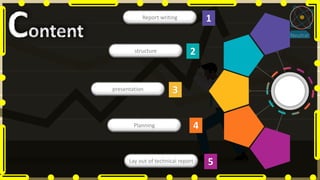
Report writing
structure
presentation
Planning
Lay out of technical report
1. Introduction
What is report writing?
The definition of report writing is creating an account or statement that describes
in detail an event, situation or occurrence, usually as the result of observation or
inquiry. The two most common forms of report writing are news report
writing and academic report writing.
Technical report
A technical report (also scientific report) is
a document that describes the process,
progress, or results of technical or scientific
research or the state of a technical or
scientific research problem
 Title Page
 Summary
 Contents
 Introduction
 The sections which make up
the body of the report
 Conclusions
 References
 Bibliography
 Acknowledgements
 Appendices (if appropriate)
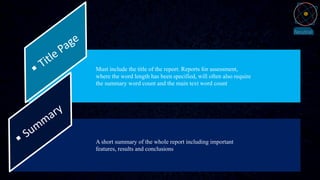
Must include the title of the report. Reports for assessment,
where the word length has been specified, will often also require
the summary word count and the main text word count
A short summary of the whole report including important
features, results and conclusions
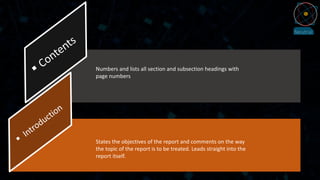
Numbers and lists all section and subsection headings with
page numbers
States the objectives of the report and comments on the way
the topic of the report is to be treated. Leads straight into the
report itself.
Divided into numbered and headed sections. These sections
separate the different main ideas in a logical order
A short, logical summing up of the theme(s) developed in the
main text
Details of published sources of material referred to or quoted
in the text (including any lecture notes and URL addresses of
any websites used)
Other published sources of material, including websites, not
referred to in the text but useful for background or further
reading.
List of people who helped you research or prepare the report,
including your proofreaders
Any further material which is essential for full understanding of
your report (e.g. large scale diagrams, computer code, raw
data, specifications) but not required by a casual reader
• Script
• Margins
• Page numbers
• Binding
Script
The report must be printed
single sided on white A4
paper. Hand written or dot-
matrix printed reports are not
acceptable.
Margins
All four margins must
be at least 2.54 cm
Page
numbers
Do not number the title,
summary or contents pages.
Number all other pages
consecutively starting at 1
Binding
• A single staple in the top left
corner or 3 staples spaced down
the left hand margin. For longer
reports (e.g. year 3 project
report) binders may be used.
Planning the report
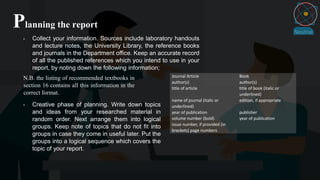
• Collect your information. Sources include laboratory handouts
and lecture notes, the University Library, the reference books
and journals in the Department office. Keep an accurate record
of all the published references which you intend to use in your
report, by noting down the following information;
Journal Article Book
author(s) author(s)
title of article title of book (italic or
underlined)
name of journal (italic or
underlined)
edition, if appropriate
year of publication publisher
volume number (bold)
issue number, if provided (in
brackets) page numbers
year of publication
N.B. the listing of recommended textbooks in
section 16 contains all this information in the
correct format.
• Creative phase of planning. Write down topics
and ideas from your researched material in
random order. Next arrange them into logical
groups. Keep note of topics that do not fit into
groups in case they come in useful later. Put the
groups into a logical sequence which covers the
topic of your report.
 Structuring the report. Using your logical
sequence of grouped ideas, write out a rough
outline of the report with headings and
subheadings.
The report layout
The appearance of a report is no less important than its content. An
attractive, clearly organized report stands a better chance of being read.
Use a standard, font size 12point , such as Times New Roman, for the main
text. Use different font sizes, bold, italic and underline where appropriate

but not to excess. Too many changes of type style can look very fussy.
Equation and tables
Chapter numbering system
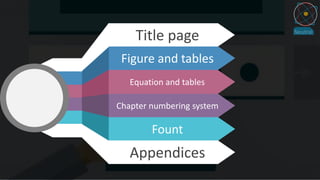
Figure and tables
Fount
Title page
The title page will vary according to style
required your company. Title page should
include
 Name of university
 Name of code of the subject
 Title of the report
 Name of author or authors
 Date of submission
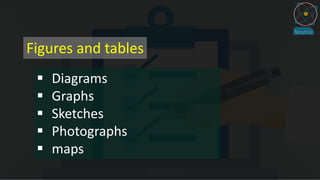
Figures and tables
 Diagrams
 Graphs
 Sketches
 Photographs
 maps
Figures and tables
Tables represent data in columns
All figures and tables should be number and labelled. A
figure must be refer to in tex,indentify by its number ,e.g.
Figure 23.
Avoid using “the figure above”or”the figure bellow "all
figures and tables must be reference
Equation and formulas
.equation should be numbered as they appear in the
text, with a number in brackets on the right hand side
margin
e.g.
𝑥 =
−𝑏± 𝑏2−4𝑎𝑐
2𝑎
(1)
𝑎2
+ 𝑏2
= 𝑐2
(2)
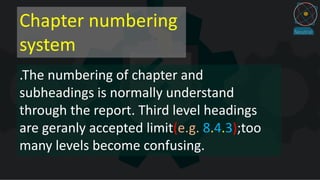
Chapter numbering
system
.The numbering of chapter and
subheadings is normally understand
through the report. Third level headings
are geranly accepted limit(e.g. 8.4.3);too
many levels become confusing.
Fount
.fount that are use easy to read are gernaly
chosen for report. Time NewsRoman,Arial
and Helvetica are ,most popular
For size should be minimum of 12point for a
body text, larger size are use for headings
Appendices
.appendices are supplements to report they are include as separate
section, usually labelled Appendices A, Appendices B etc..
At the back of report.an appendix include
I. Information that is incident to the report
II. Raw data and evidence which support the report
III. Technical data which is too long and or detailed but which support
the report
IV. Maps, folded diagrams, tables of results, letters are some examples.
Conclusion
conclusion
M C Q S
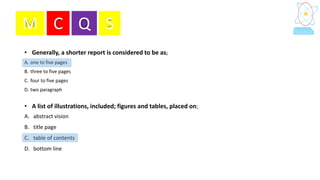
• Generally, a shorter report is considered to be as;
A. one to five pages
B. three to five pages
C. four to five pages
D. two paragraph
M C Q S
• A list of illustrations, included; figures and tables, placed on;
A. abstract vision
B. title page
C. table of contents
D. bottom line
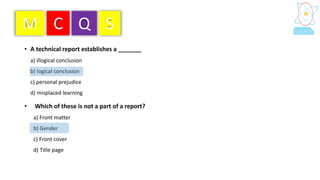
• A technical report establishes a _______
a) illogical conclusion
b) logical conclusion
c) personal prejudice
d) misplaced learning
M C Q S
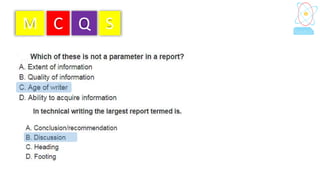
• Which of these is not a part of a report?
a) Front matter
b) Gender
c) Front cover
d) Title page
M C Q S
M C Q S
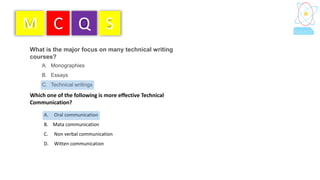
What is the major focus on many technical writing
courses?
A. Monographies
B. Essays
C. Technical writings
M C Q S
Which one of the following is more effective Technical
Communication?
A. Oral communication
B. Mata communication
C. Non verbal communication
D. Witten communication
Thank
you

Report writing

  • 3.
  • 5.
  • 6.
  • 8.
    1. Introduction What isreport writing? The definition of report writing is creating an account or statement that describes in detail an event, situation or occurrence, usually as the result of observation or inquiry. The two most common forms of report writing are news report writing and academic report writing.
  • 10.
    Technical report A technicalreport (also scientific report) is a document that describes the process, progress, or results of technical or scientific research or the state of a technical or scientific research problem
  • 12.
     Title Page Summary  Contents  Introduction  The sections which make up the body of the report  Conclusions  References  Bibliography  Acknowledgements  Appendices (if appropriate)
  • 13.
    Must include thetitle of the report. Reports for assessment, where the word length has been specified, will often also require the summary word count and the main text word count A short summary of the whole report including important features, results and conclusions
  • 14.
    Numbers and listsall section and subsection headings with page numbers States the objectives of the report and comments on the way the topic of the report is to be treated. Leads straight into the report itself.
  • 15.
    Divided into numberedand headed sections. These sections separate the different main ideas in a logical order A short, logical summing up of the theme(s) developed in the main text
  • 16.
    Details of publishedsources of material referred to or quoted in the text (including any lecture notes and URL addresses of any websites used) Other published sources of material, including websites, not referred to in the text but useful for background or further reading.
  • 17.
    List of peoplewho helped you research or prepare the report, including your proofreaders Any further material which is essential for full understanding of your report (e.g. large scale diagrams, computer code, raw data, specifications) but not required by a casual reader
  • 19.
    • Script • Margins •Page numbers • Binding
  • 20.
    Script The report mustbe printed single sided on white A4 paper. Hand written or dot- matrix printed reports are not acceptable.
  • 21.
    Margins All four marginsmust be at least 2.54 cm
  • 22.
    Page numbers Do not numberthe title, summary or contents pages. Number all other pages consecutively starting at 1
  • 23.
    Binding • A singlestaple in the top left corner or 3 staples spaced down the left hand margin. For longer reports (e.g. year 3 project report) binders may be used.
  • 25.
    Planning the report •Collect your information. Sources include laboratory handouts and lecture notes, the University Library, the reference books and journals in the Department office. Keep an accurate record of all the published references which you intend to use in your report, by noting down the following information; Journal Article Book author(s) author(s) title of article title of book (italic or underlined) name of journal (italic or underlined) edition, if appropriate year of publication publisher volume number (bold) issue number, if provided (in brackets) page numbers year of publication N.B. the listing of recommended textbooks in section 16 contains all this information in the correct format. • Creative phase of planning. Write down topics and ideas from your researched material in random order. Next arrange them into logical groups. Keep note of topics that do not fit into groups in case they come in useful later. Put the groups into a logical sequence which covers the topic of your report.
  • 26.
     Structuring thereport. Using your logical sequence of grouped ideas, write out a rough outline of the report with headings and subheadings.
  • 29.
    The report layout Theappearance of a report is no less important than its content. An attractive, clearly organized report stands a better chance of being read. Use a standard, font size 12point , such as Times New Roman, for the main text. Use different font sizes, bold, italic and underline where appropriate but not to excess. Too many changes of type style can look very fussy.
  • 30.
    Equation and tables Chapternumbering system Figure and tables Fount
  • 31.
    Title page The titlepage will vary according to style required your company. Title page should include  Name of university  Name of code of the subject  Title of the report  Name of author or authors  Date of submission
  • 32.
    Figures and tables Diagrams  Graphs  Sketches  Photographs  maps
  • 33.
    Figures and tables Tablesrepresent data in columns All figures and tables should be number and labelled. A figure must be refer to in tex,indentify by its number ,e.g. Figure 23. Avoid using “the figure above”or”the figure bellow "all figures and tables must be reference
  • 34.
    Equation and formulas .equationshould be numbered as they appear in the text, with a number in brackets on the right hand side margin e.g. 𝑥 = −𝑏± 𝑏2−4𝑎𝑐 2𝑎 (1) 𝑎2 + 𝑏2 = 𝑐2 (2)
  • 35.
    Chapter numbering system .The numberingof chapter and subheadings is normally understand through the report. Third level headings are geranly accepted limit(e.g. 8.4.3);too many levels become confusing.

  • 36.
    Fount .fount that areuse easy to read are gernaly chosen for report. Time NewsRoman,Arial and Helvetica are ,most popular For size should be minimum of 12point for a body text, larger size are use for headings
  • 37.
    Appendices .appendices are supplementsto report they are include as separate section, usually labelled Appendices A, Appendices B etc.. At the back of report.an appendix include I. Information that is incident to the report II. Raw data and evidence which support the report III. Technical data which is too long and or detailed but which support the report IV. Maps, folded diagrams, tables of results, letters are some examples.
  • 38.
  • 39.
  • 40.
  • 41.
    • Generally, ashorter report is considered to be as; A. one to five pages B. three to five pages C. four to five pages D. two paragraph M C Q S • A list of illustrations, included; figures and tables, placed on; A. abstract vision B. title page C. table of contents D. bottom line
  • 42.
    • A technicalreport establishes a _______ a) illogical conclusion b) logical conclusion c) personal prejudice d) misplaced learning M C Q S • Which of these is not a part of a report? a) Front matter b) Gender c) Front cover d) Title page
  • 43.
  • 44.
  • 45.
    What is themajor focus on many technical writing courses? A. Monographies B. Essays C. Technical writings M C Q S Which one of the following is more effective Technical Communication? A. Oral communication B. Mata communication C. Non verbal communication D. Witten communication
  • 46.