REPORT WRITING An impartial ,objective, planned presentation of facts to one or more persons for a significant business purpose
Types of Reports  Function:  to inform or to analyze, These could be  interim , quarterly or  annual report Subject matter:  relate to different departments or functions like  marketing, advertising, technical Formality:  Most reports have an introduction , main text &  terminal part . A formal reports also contains, prefatory and supplementary parts Origin:  authorized ,voluntary or  private  Frequency:   periodic or special. Format:  memo ,letter, long report
Preparation before writing: Define the problem, purpose, scope and ask:  What is wanted? How much? Why? When? This will determine the purpose that can be written in one clear statement. E.g. causes of high turnover, choice between two operating styles, etc.
Preparation before writing: Consider who will receive the report. Internal External Overseas Government
Preparation before writing Determine ideas that need to be included: Problem, objectives , scope review of literature Hypothesis theoretical frame Methodology  Data &Analysis  Findings & Conclusions  Organize text  Prepare final report
Types of data Secondary – all published work Primary data - office records, original letters, questionnaires, observations, experiments
Main parts of a written report- Introduction Authorization  Plan of presentation Define problem , objective, & scope Methodology Data source Background (optional) Definition of terms ( optional) Limitations: restrictions of time, money, research, assistance. Brief statement of results/recommendations
Main parts of a written report- main text This is the  longest part of a report and contains details like: elaboration the problem  methodology  data & analysis  result , findings
Main parts of a written report- terminal section Terminal section: Summary of findings Conclusions (no personal opinions) Recommendations Plan of action Proposition – series of assertions
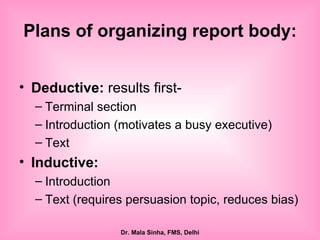
Plans of organizing report body: Deductive:  results first- Terminal section Introduction (motivates a busy executive) Text Inductive: Introduction Text (requires persuasion topic, reduces bias)
Ways of organizing text Topic or Criteria wise Order of Occurrence – Chronological Space/Location Functional - departments Procedure & Process Order of Importance- primary & secondary Order of Difficulty Sources Problem & solution Compare & contrast Case study
Prefatory Section  Cover design and wording of title :  The two are different.  For good titles : Use five W’s – who, why, where, when, what Use title length of 8-10 words avoid articles like ‘a’, ‘the’ or report, survey, etc. avoid vague broad titles avoid evaluations in terms of titles Title fly :  blank sheet of paper between title page and cover. Title page :  consists of title, recipient name, sender’s name, and date (in that order).
Prefatory Section 5. Letter of memorandum of authorization : a letter authorizing and commissioning the formal report writer To: Mr. X From:  XYZ Co. Subject: _______ Date: _______ Request: _______ Details: _______ Courtesy: _______
Prefatory Section 5 . Letter of memorandum of transmittal :  From writer to reader in another organization. In books there is a preface / foreword Generally in letter format with letterhead and inside address omitted).
Table of contents : Prepared after text is typed, use leaders. sub – divisions in contents are permitted. Table of tables:   separate for graphs, visuals, tables, etc. Abstract, synopsis, executive summary:   includes purpose, results, methods – placed between contents and report body. VERY BRIEF. Prefatory Section
Main Section This is the  longest part of a report and contains details like: elaboration the problem  methodology  data & analysis  result , findings
End section Summary condenses the text Conclusions evaluate and infer from the text Recommendations suggest specific course of action based on text
Footnotes & Endnotes These are of two types : those that explain content and those that identify the sources of content , or citations. Use of footnotes improves the credulity o the writer
Any quotation, factual statement, etc., must be based on sources, else it is plagiarizing Cross – reference footnotes directs the reader to another place within the report. Explanatory footnotes discuss, explain, give additional information Superscripts refer the reader to footnotes or the reference section ( use small Arabic nos. placed slightly above the line at the end of the sentence and beginning of foot note) Citations
Citations  Popular method: standard Latin abbreviations ibid. (in the same place) – refers to the immediately preceding footnote, but a different page Op. cit: “in the work cited” – refers to a previously cited footnote that is followed by at least one intervening footnote about another source Loc. Cit: “in the place cited” – refers to the same page in a previously cited footnote
Placement of footnotes:  Bottom of page: where citation has been made, separated from the text by a typed solid line 1.5” to 2” long. Double space below the last line of text, beginning at left margin. Each footnote is typed single space usually indented 3-5 spaces on it’s first line and even with margin successively. Double space between other footnotes. Reference or bibliography should appear at the end of the text. Parenthetical documentation: (popular) – source citation is included within a sentence. * author – date  * number – method * full citation method Citations
Bibliographic citations Determine which format is used in the company Know these facts of the source regardless of format: Author/s Authors capacity- editor , translator ,compiler  Date of publication Title of article or book Edition Page s Volume  Publisher
Language Present facts as they are Paragraph length about 7 type written lines  All paragraphs should have topic sentence as the opening line even if there is a heading Apply the seven Cs  Do not use more than two or three levels of headings in short reports Sentences averaging 16-20 words Concrete nouns Few adverbs & adjectives Generally written in past tense
Formatting Use caps, italics, underscore, boldface, more space , indentation and fonts variety to emphasize Use tables , figures, graphs , pictures where ever they will help to clarify In the introduction section do not give the title introduction , just write the paragraphs about the introduction
Pagination Every page in the report except the cover and title fly are numbered All page number are not typed on the page but are counted For prefatory sheets use Roman  numbers For main text use Arabic Prefatory parts page numbers are centered at the bottom of the page  Cover page and title fly– do not count Title page – count but do not insert Transmittal -count but do not insert Table of contents – count & insert Exec summary – count & insert In the main text all pages are counted and inserted  ( you may not insert the page number on the page of a new chapter or section)
Appendix section Use appendix at the end of the main report to include pamphlets, questionnaires, pictures, maps , exhibits etc Use a title cover to differentiate If appendix is long make a content page in the beginning of the report
PROPOSALS Persuasion lies at the heart of proposal writing
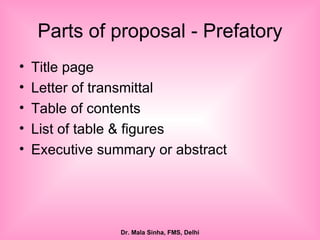
Parts of proposal - Prefatory Title page Letter of transmittal Table of contents List of table & figures Executive summary or abstract
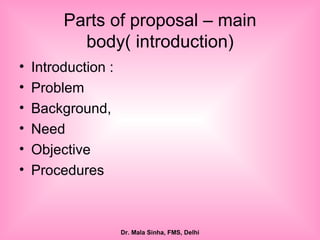
Parts of proposal – main body( introduction) Introduction : Problem Background, Need  Objective Procedures
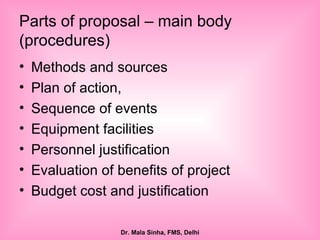
Parts of proposal – main body (procedures) Methods and sources Plan of action, Sequence of events Equipment facilities Personnel justification Evaluation of benefits of project Budget cost and justification
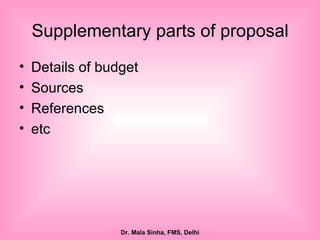
Supplementary parts of proposal Details of budget Sources References etc

Report new

  • 1.
    REPORT WRITING Animpartial ,objective, planned presentation of facts to one or more persons for a significant business purpose
  • 2.
    Types of Reports Function: to inform or to analyze, These could be interim , quarterly or annual report Subject matter: relate to different departments or functions like marketing, advertising, technical Formality: Most reports have an introduction , main text & terminal part . A formal reports also contains, prefatory and supplementary parts Origin: authorized ,voluntary or private Frequency: periodic or special. Format: memo ,letter, long report
  • 3.
    Preparation before writing:Define the problem, purpose, scope and ask: What is wanted? How much? Why? When? This will determine the purpose that can be written in one clear statement. E.g. causes of high turnover, choice between two operating styles, etc.
  • 4.
    Preparation before writing:Consider who will receive the report. Internal External Overseas Government
  • 5.
    Preparation before writingDetermine ideas that need to be included: Problem, objectives , scope review of literature Hypothesis theoretical frame Methodology Data &Analysis Findings & Conclusions Organize text Prepare final report
  • 6.
    Types of dataSecondary – all published work Primary data - office records, original letters, questionnaires, observations, experiments
  • 7.
    Main parts ofa written report- Introduction Authorization Plan of presentation Define problem , objective, & scope Methodology Data source Background (optional) Definition of terms ( optional) Limitations: restrictions of time, money, research, assistance. Brief statement of results/recommendations
  • 8.
    Main parts ofa written report- main text This is the longest part of a report and contains details like: elaboration the problem methodology data & analysis result , findings
  • 9.
    Main parts ofa written report- terminal section Terminal section: Summary of findings Conclusions (no personal opinions) Recommendations Plan of action Proposition – series of assertions
  • 10.
    Plans of organizingreport body: Deductive: results first- Terminal section Introduction (motivates a busy executive) Text Inductive: Introduction Text (requires persuasion topic, reduces bias)
  • 11.
    Ways of organizingtext Topic or Criteria wise Order of Occurrence – Chronological Space/Location Functional - departments Procedure & Process Order of Importance- primary & secondary Order of Difficulty Sources Problem & solution Compare & contrast Case study
  • 12.
    Prefatory Section Cover design and wording of title : The two are different. For good titles : Use five W’s – who, why, where, when, what Use title length of 8-10 words avoid articles like ‘a’, ‘the’ or report, survey, etc. avoid vague broad titles avoid evaluations in terms of titles Title fly : blank sheet of paper between title page and cover. Title page : consists of title, recipient name, sender’s name, and date (in that order).
  • 13.
    Prefatory Section 5.Letter of memorandum of authorization : a letter authorizing and commissioning the formal report writer To: Mr. X From: XYZ Co. Subject: _______ Date: _______ Request: _______ Details: _______ Courtesy: _______
  • 14.
    Prefatory Section 5. Letter of memorandum of transmittal : From writer to reader in another organization. In books there is a preface / foreword Generally in letter format with letterhead and inside address omitted).
  • 15.
    Table of contents: Prepared after text is typed, use leaders. sub – divisions in contents are permitted. Table of tables: separate for graphs, visuals, tables, etc. Abstract, synopsis, executive summary: includes purpose, results, methods – placed between contents and report body. VERY BRIEF. Prefatory Section
  • 16.
    Main Section Thisis the longest part of a report and contains details like: elaboration the problem methodology data & analysis result , findings
  • 17.
    End section Summarycondenses the text Conclusions evaluate and infer from the text Recommendations suggest specific course of action based on text
  • 18.
    Footnotes & EndnotesThese are of two types : those that explain content and those that identify the sources of content , or citations. Use of footnotes improves the credulity o the writer
  • 19.
    Any quotation, factualstatement, etc., must be based on sources, else it is plagiarizing Cross – reference footnotes directs the reader to another place within the report. Explanatory footnotes discuss, explain, give additional information Superscripts refer the reader to footnotes or the reference section ( use small Arabic nos. placed slightly above the line at the end of the sentence and beginning of foot note) Citations
  • 20.
    Citations Popularmethod: standard Latin abbreviations ibid. (in the same place) – refers to the immediately preceding footnote, but a different page Op. cit: “in the work cited” – refers to a previously cited footnote that is followed by at least one intervening footnote about another source Loc. Cit: “in the place cited” – refers to the same page in a previously cited footnote
  • 21.
    Placement of footnotes: Bottom of page: where citation has been made, separated from the text by a typed solid line 1.5” to 2” long. Double space below the last line of text, beginning at left margin. Each footnote is typed single space usually indented 3-5 spaces on it’s first line and even with margin successively. Double space between other footnotes. Reference or bibliography should appear at the end of the text. Parenthetical documentation: (popular) – source citation is included within a sentence. * author – date * number – method * full citation method Citations
  • 22.
    Bibliographic citations Determinewhich format is used in the company Know these facts of the source regardless of format: Author/s Authors capacity- editor , translator ,compiler Date of publication Title of article or book Edition Page s Volume Publisher
  • 23.
    Language Present factsas they are Paragraph length about 7 type written lines All paragraphs should have topic sentence as the opening line even if there is a heading Apply the seven Cs Do not use more than two or three levels of headings in short reports Sentences averaging 16-20 words Concrete nouns Few adverbs & adjectives Generally written in past tense
  • 24.
    Formatting Use caps,italics, underscore, boldface, more space , indentation and fonts variety to emphasize Use tables , figures, graphs , pictures where ever they will help to clarify In the introduction section do not give the title introduction , just write the paragraphs about the introduction
  • 25.
    Pagination Every pagein the report except the cover and title fly are numbered All page number are not typed on the page but are counted For prefatory sheets use Roman numbers For main text use Arabic Prefatory parts page numbers are centered at the bottom of the page Cover page and title fly– do not count Title page – count but do not insert Transmittal -count but do not insert Table of contents – count & insert Exec summary – count & insert In the main text all pages are counted and inserted ( you may not insert the page number on the page of a new chapter or section)
  • 26.
    Appendix section Useappendix at the end of the main report to include pamphlets, questionnaires, pictures, maps , exhibits etc Use a title cover to differentiate If appendix is long make a content page in the beginning of the report
  • 27.
    PROPOSALS Persuasion liesat the heart of proposal writing
  • 28.
    Parts of proposal- Prefatory Title page Letter of transmittal Table of contents List of table & figures Executive summary or abstract
  • 29.
    Parts of proposal– main body( introduction) Introduction : Problem Background, Need Objective Procedures
  • 30.
    Parts of proposal– main body (procedures) Methods and sources Plan of action, Sequence of events Equipment facilities Personnel justification Evaluation of benefits of project Budget cost and justification
  • 31.
    Supplementary parts ofproposal Details of budget Sources References etc