

Presented By:
SHUBHAM
YADAV
TOPIC:-
ESSENTIALS OF WRITING,TYPES OF
REPORTS, PARTS OF REPORT
Flow Of Presentation
•Writing Reports
•Types of Reports
•Parts of a Report
Writing Reports
A Report is a factual account presented in a particular form .
In a report the stress is on facts and objectivity. As
presentation is limited to preset formats there is not much
freedom for a writer to innovate. Therefore, they are likely
to vary in length, content, nature and format.
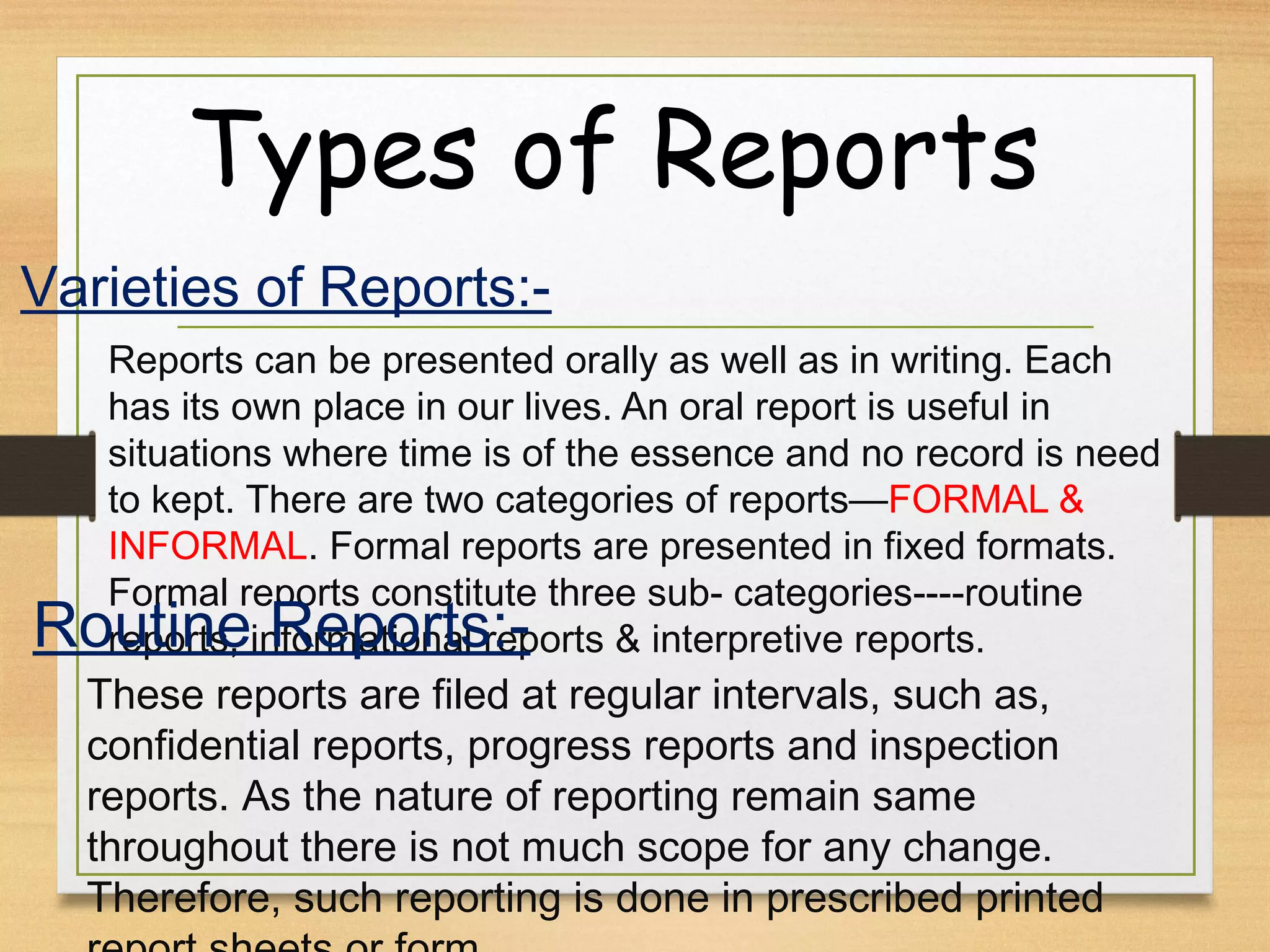
Types of Reports
Reports can be presented orally as well as in writing. Each
has its own place in our lives. An oral report is useful in
situations where time is of the essence and no record is need
to kept. There are two categories of reports—FORMAL &
INFORMAL. Formal reports are presented in fixed formats.
Formal reports constitute three sub- categories----routine
reports, informational reports & interpretive reports.
Varieties of Reports:-
Routine Reports:-
These reports are filed at regular intervals, such as,
confidential reports, progress reports and inspection
reports. As the nature of reporting remain same
throughout there is not much scope for any change.
Therefore, such reporting is done in prescribed printed
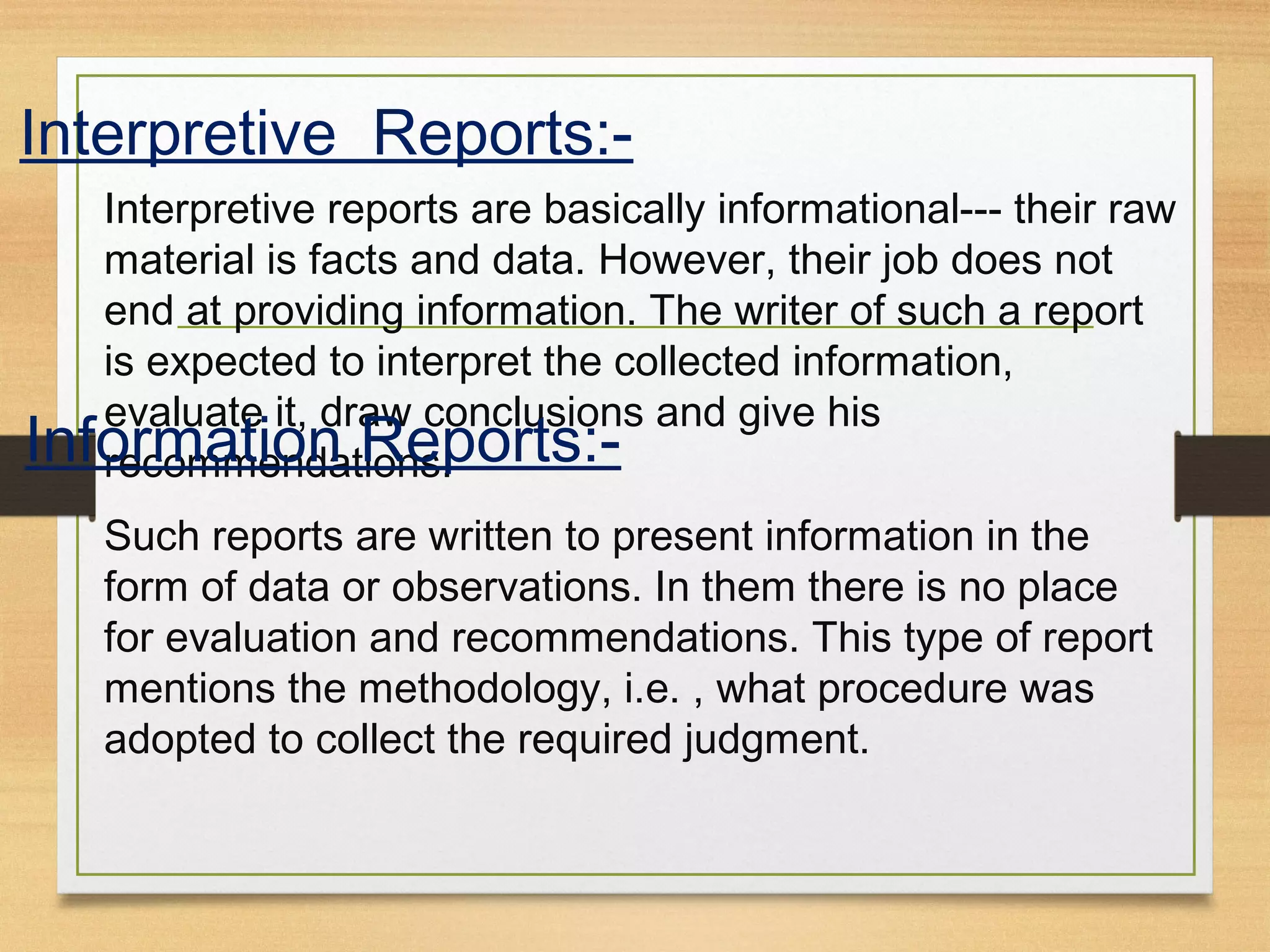
Interpretive Reports:-
Interpretive reports are basically informational--- their raw
material is facts and data. However, their job does not
end at providing information. The writer of such a report
is expected to interpret the collected information,
evaluate it, draw conclusions and give his
recommendations.Information Reports:-
Such reports are written to present information in the
form of data or observations. In them there is no place
for evaluation and recommendations. This type of report
mentions the methodology, i.e. , what procedure was
adopted to collect the required judgment.
Parts of a Report
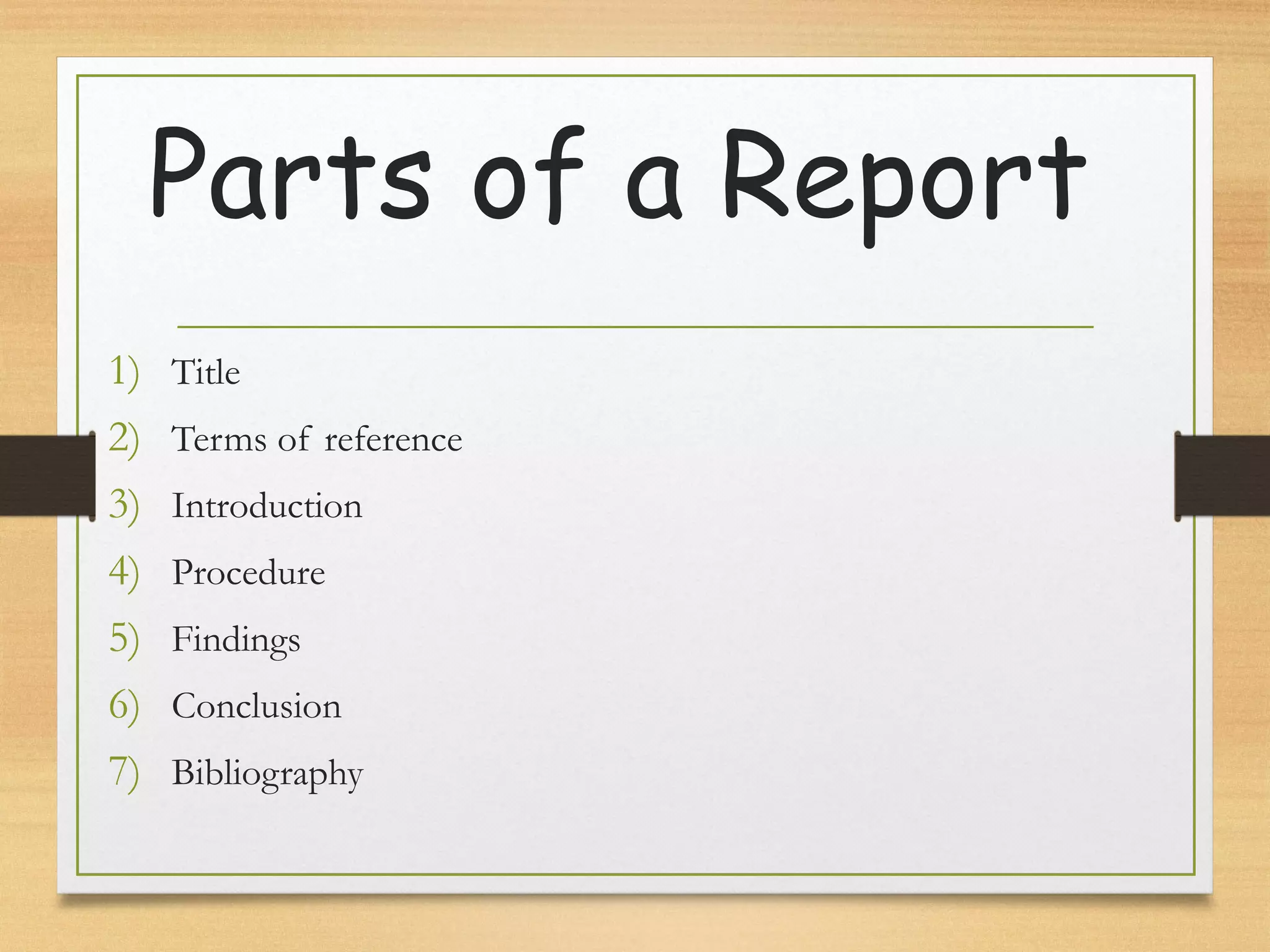
Parts of a Report
1) Title
2) Terms of reference
3) Introduction
4) Procedure
5) Findings
6) Conclusion
7) Bibliography
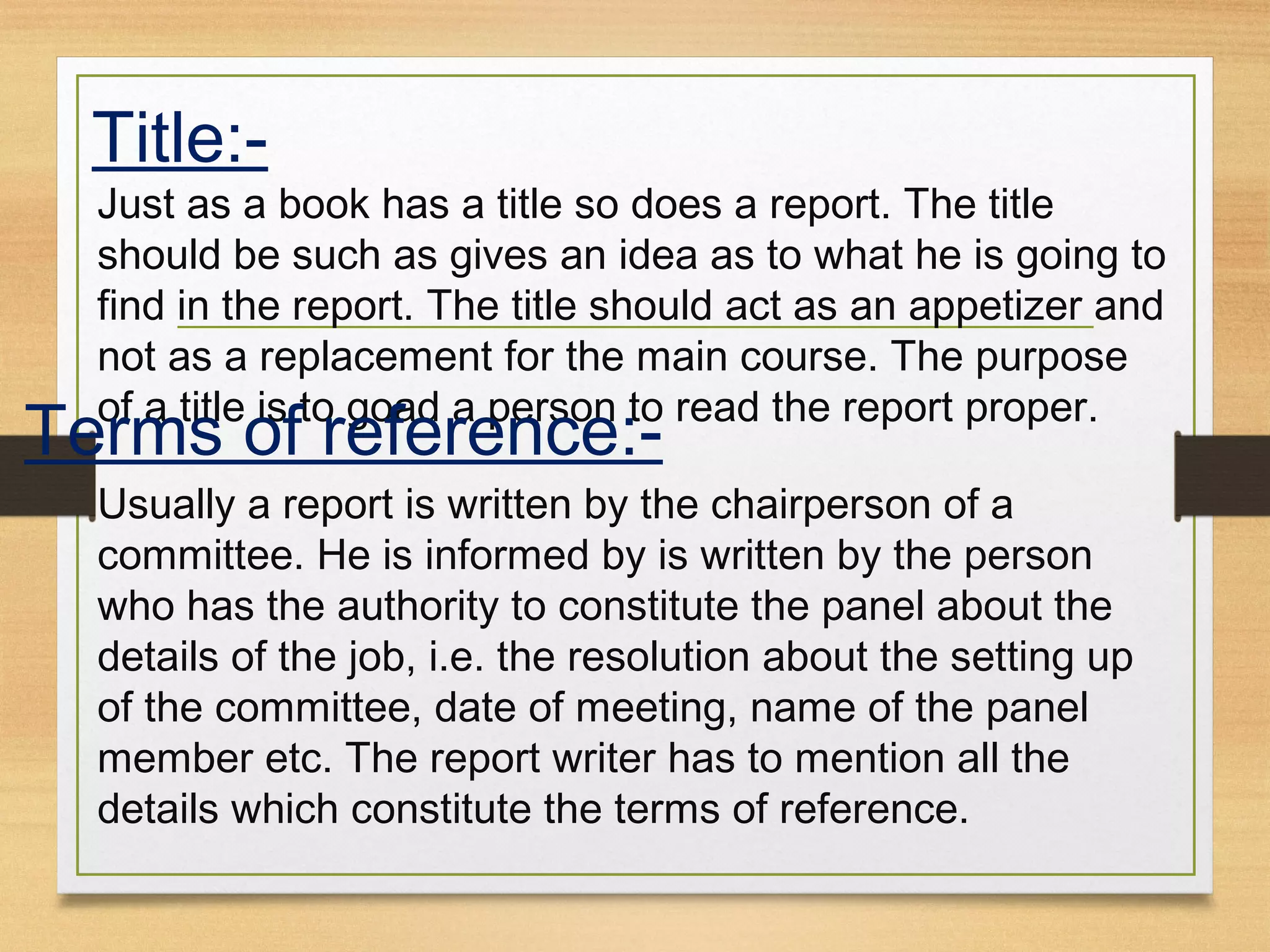
Title:-
Just as a book has a title so does a report. The title
should be such as gives an idea as to what he is going to
find in the report. The title should act as an appetizer and
not as a replacement for the main course. The purpose
of a title is to goad a person to read the report proper.
Terms of reference:-
Usually a report is written by the chairperson of a
committee. He is informed by is written by the person
who has the authority to constitute the panel about the
details of the job, i.e. the resolution about the setting up
of the committee, date of meeting, name of the panel
member etc. The report writer has to mention all the
details which constitute the terms of reference.
Introduction:-
After mentioning the terms of reference the writer
introduces his subject and gives a summary of what is
going to follow. This gives the reader an indication as to
what he will come across in the rest of the report.
Procedure:-
In this part the writer explains how he accomplished the
task he was entrusted with. He may have been
instructed to strictly follow a particular procedure to
complete his task. In both situations he has to apprise
the reader of his methodology, i.e., he may have
conducted interviews and surveys; he a my have
distributed questionnaires; or he may have consulted
books, journals, newspapers etc.
Findings:-
After analyzing the collected data, the writer interprets it,
and finally evaluates it this helps him get to the cause/ s
of the problem he has been asked to analyse. These
cause are his finding
Conclusion:-
Finding the cause/ s is not the end of report writing. Now
the writer makes inferences from what he has found.
Evaluation involves drawing conclusions and making
judgments. Conclusions indicate to the reader that the
discussion is over and the report has come to an end.
Some writers use this part to Acknowledge. Some writers
prefer to have a separate acknowledgement page for this
purpose.
Bibliograph
y:-Many a time a report writer will feel the
need to refer to material, published or
otherwise, to support his findings. These
sources will be Primary and Secondary.
Primary sources will have a direct bearing
on his topic while he will refer to
secondary source to support his thesis.
For Your
Attention

ESSENTIALS OF WRITING,TYPES OF REPORTS,. PARTS OF REPORT

  • 1.
  • 2.
    TOPIC:- ESSENTIALS OF WRITING,TYPESOF REPORTS, PARTS OF REPORT
  • 3.
    Flow Of Presentation •WritingReports •Types of Reports •Parts of a Report
  • 4.
    Writing Reports A Reportis a factual account presented in a particular form . In a report the stress is on facts and objectivity. As presentation is limited to preset formats there is not much freedom for a writer to innovate. Therefore, they are likely to vary in length, content, nature and format.
  • 5.
    Types of Reports Reportscan be presented orally as well as in writing. Each has its own place in our lives. An oral report is useful in situations where time is of the essence and no record is need to kept. There are two categories of reports—FORMAL & INFORMAL. Formal reports are presented in fixed formats. Formal reports constitute three sub- categories----routine reports, informational reports & interpretive reports. Varieties of Reports:- Routine Reports:- These reports are filed at regular intervals, such as, confidential reports, progress reports and inspection reports. As the nature of reporting remain same throughout there is not much scope for any change. Therefore, such reporting is done in prescribed printed
  • 6.
    Interpretive Reports:- Interpretive reportsare basically informational--- their raw material is facts and data. However, their job does not end at providing information. The writer of such a report is expected to interpret the collected information, evaluate it, draw conclusions and give his recommendations.Information Reports:- Such reports are written to present information in the form of data or observations. In them there is no place for evaluation and recommendations. This type of report mentions the methodology, i.e. , what procedure was adopted to collect the required judgment.
  • 7.
    Parts of aReport
  • 8.
    Parts of aReport 1) Title 2) Terms of reference 3) Introduction 4) Procedure 5) Findings 6) Conclusion 7) Bibliography
  • 9.
    Title:- Just as abook has a title so does a report. The title should be such as gives an idea as to what he is going to find in the report. The title should act as an appetizer and not as a replacement for the main course. The purpose of a title is to goad a person to read the report proper. Terms of reference:- Usually a report is written by the chairperson of a committee. He is informed by is written by the person who has the authority to constitute the panel about the details of the job, i.e. the resolution about the setting up of the committee, date of meeting, name of the panel member etc. The report writer has to mention all the details which constitute the terms of reference.
  • 10.
    Introduction:- After mentioning theterms of reference the writer introduces his subject and gives a summary of what is going to follow. This gives the reader an indication as to what he will come across in the rest of the report. Procedure:- In this part the writer explains how he accomplished the task he was entrusted with. He may have been instructed to strictly follow a particular procedure to complete his task. In both situations he has to apprise the reader of his methodology, i.e., he may have conducted interviews and surveys; he a my have distributed questionnaires; or he may have consulted books, journals, newspapers etc.
  • 11.
    Findings:- After analyzing thecollected data, the writer interprets it, and finally evaluates it this helps him get to the cause/ s of the problem he has been asked to analyse. These cause are his finding Conclusion:- Finding the cause/ s is not the end of report writing. Now the writer makes inferences from what he has found. Evaluation involves drawing conclusions and making judgments. Conclusions indicate to the reader that the discussion is over and the report has come to an end. Some writers use this part to Acknowledge. Some writers prefer to have a separate acknowledgement page for this purpose.
  • 12.
    Bibliograph y:-Many a timea report writer will feel the need to refer to material, published or otherwise, to support his findings. These sources will be Primary and Secondary. Primary sources will have a direct bearing on his topic while he will refer to secondary source to support his thesis.
  • 13.