Paragraph StructureWriting ReportsDebbie LahavBusiness EnglishRuppin Academic Center
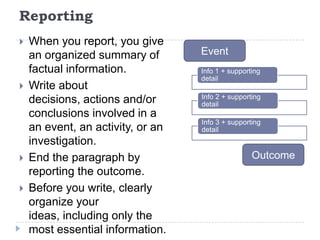
ReportingWhen you report, you give an organized summary of factual information.Write about decisions, actions and/or conclusions involved in a an event, an activity, or an investigation.End the paragraph by reporting the outcome.Before you write, clearly organize your ideas, including only the most essential information.EventOutcome
Organization: Reporting Factual InformationTopic sentence: purpose, outcome, or central idea of an eventBody: organized by chronology or categoryDecision, action, vote, discovery, or conclusionDecision, action, vote, discovery, or conclusionDecision, action, vote, discovery, or conclusionConclusion: recommendation based on information reported
The City Council has taken a number of steps in its attempt to solve the city’s $2 million budget deficit. On July 12, the Council held a public meeting to hear a variety of suggestions from residents. A number of residents offered opinions on possible cuts in services identified in the survey conducted the previous month. However, many residents objected to any cuts in services. Instead, the residents suggested ways that the city could increase revenues. Those suggestions included raising the sales tax from 8.5% to 8.75% or creating new taxes, such as a tax on hotel rooms. The issues will be reviewed by city experts and reported on at the next meeting.
Class Task:Read the paragraph below. What is the event?What factual information is being reported?Prepare a list showing all the pieces of information + supporting detail reported.What is the outcome?
Homework TaskContinue the report:July 31 meeting of the City CouncilDiscussed possible cuts - reducing garbage pickup; reducing bottle and paper recycle pickup –no decision
Discussion of increasing revenues - increase in sales tax or hotel tax or both – decision made to….(complete with your own ideas)Organize your information before writing in a table or list showing the event, the factual information and supporting detail and the outcome.Type your paragraph in Word. When you finish, check your work.Then copy and paste your table showing the organization of information and the paragraph in the text box. Remember to click the icon changing the paragraph direction to left to right.
Writing a Full Report: Beyond the ParagraphA business report is a formal document. It should be concise, well organized, and easy to follow; using headings, sub-headings, sections.Sections should be numbered: - major section 1,2,3 etc. - first level of sub-section 1.1, 1.2 etc., 2.1, 2.2, 2.3 etc. - second level 1.1.1, 1.1.2, ......, 1.2.1, 1.2.2, ..... etc.
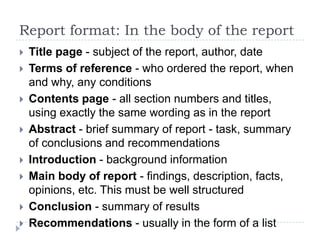
Report format: In the body of the reportTitle page - subject of the report, author, dateTerms of reference - who ordered the report, when and why, any conditionsContents page - all section numbers and titles, using exactly the same wording as in the reportAbstract - brief summary of report - task, summary of conclusions and recommendationsIntroduction - background information Main body of report - findings, description, facts, opinions, etc. This must be well structuredConclusion - summary of resultsRecommendations - usually in the form of a list
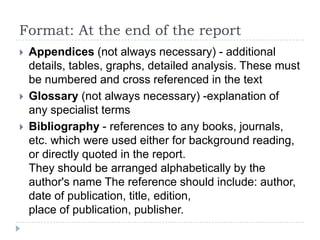
Format: At the end of the reportAppendices (not always necessary) - additional details, tables, graphs, detailed analysis. These must be numbered and cross referenced in the textGlossary (not always necessary) -explanation of any specialist termsBibliography - references to any books, journals, etc. which were used either for background reading, or directly quoted in the report.They should be arranged alphabetically by the author's name The reference should include: author, date of publication, title, edition,place of publication, publisher.

Paragraph Structure Reports

  • 1.
    Paragraph StructureWriting ReportsDebbieLahavBusiness EnglishRuppin Academic Center
  • 2.
    ReportingWhen you report,you give an organized summary of factual information.Write about decisions, actions and/or conclusions involved in a an event, an activity, or an investigation.End the paragraph by reporting the outcome.Before you write, clearly organize your ideas, including only the most essential information.EventOutcome
  • 3.
    Organization: Reporting FactualInformationTopic sentence: purpose, outcome, or central idea of an eventBody: organized by chronology or categoryDecision, action, vote, discovery, or conclusionDecision, action, vote, discovery, or conclusionDecision, action, vote, discovery, or conclusionConclusion: recommendation based on information reported
  • 4.
    The City Councilhas taken a number of steps in its attempt to solve the city’s $2 million budget deficit. On July 12, the Council held a public meeting to hear a variety of suggestions from residents. A number of residents offered opinions on possible cuts in services identified in the survey conducted the previous month. However, many residents objected to any cuts in services. Instead, the residents suggested ways that the city could increase revenues. Those suggestions included raising the sales tax from 8.5% to 8.75% or creating new taxes, such as a tax on hotel rooms. The issues will be reviewed by city experts and reported on at the next meeting.
  • 5.
    Class Task:Read theparagraph below. What is the event?What factual information is being reported?Prepare a list showing all the pieces of information + supporting detail reported.What is the outcome?
  • 6.
    Homework TaskContinue thereport:July 31 meeting of the City CouncilDiscussed possible cuts - reducing garbage pickup; reducing bottle and paper recycle pickup –no decision
  • 7.
    Discussion of increasingrevenues - increase in sales tax or hotel tax or both – decision made to….(complete with your own ideas)Organize your information before writing in a table or list showing the event, the factual information and supporting detail and the outcome.Type your paragraph in Word. When you finish, check your work.Then copy and paste your table showing the organization of information and the paragraph in the text box. Remember to click the icon changing the paragraph direction to left to right.
  • 8.
    Writing a FullReport: Beyond the ParagraphA business report is a formal document. It should be concise, well organized, and easy to follow; using headings, sub-headings, sections.Sections should be numbered: - major section 1,2,3 etc. - first level of sub-section 1.1, 1.2 etc., 2.1, 2.2, 2.3 etc. - second level 1.1.1, 1.1.2, ......, 1.2.1, 1.2.2, ..... etc.
  • 9.
    Report format: Inthe body of the reportTitle page - subject of the report, author, dateTerms of reference - who ordered the report, when and why, any conditionsContents page - all section numbers and titles, using exactly the same wording as in the reportAbstract - brief summary of report - task, summary of conclusions and recommendationsIntroduction - background information Main body of report - findings, description, facts, opinions, etc. This must be well structuredConclusion - summary of resultsRecommendations - usually in the form of a list
  • 10.
    Format: At theend of the reportAppendices (not always necessary) - additional details, tables, graphs, detailed analysis. These must be numbered and cross referenced in the textGlossary (not always necessary) -explanation of any specialist termsBibliography - references to any books, journals, etc. which were used either for background reading, or directly quoted in the report.They should be arranged alphabetically by the author's name The reference should include: author, date of publication, title, edition,place of publication, publisher.
  • 11.
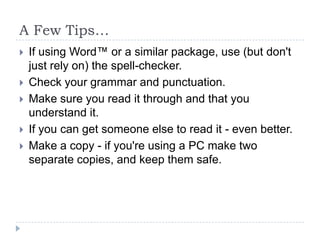
    A Few Tips…Ifusing Word™ or a similar package, use (but don't just rely on) the spell-checker.Check your grammar and punctuation.Make sure you read it through and that you understand it. If you can get someone else to read it - even better. Make a copy - if you're using a PC make two separate copies, and keep them safe.