


WHY?
THE WORLD IS
 CHANGING
but the world IS
  BUSINESS has
always changed
   CHANGING
TECHNOLOGY IS
  CHANGING
technology has
  BUSINESS IS
always changed
   CHANGING
BUSINESS IS
 CHANGING
but business IS
  BUSINESS has
always changed
   CHANGING
itʼs
because
those who canʼt adapt
disappear
ADVERTISING
MUSIC
      AIRLINES
  SHIFTING
 PUBLISHING
INDUSTRIES
      TELECOMS
BANKING
     CLOTHING
BUT         
itʼs also about
VALUE
CREATION
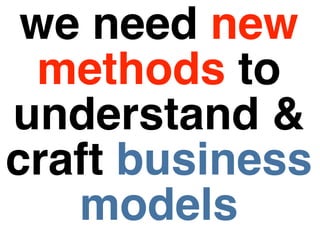
we need new
  methods to
understand &
craft business
   models
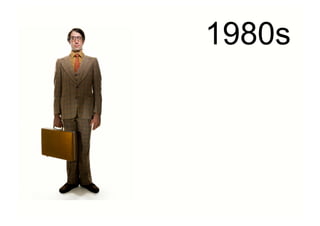
1980s
[source: M.Porter (1980) www.provenmodels.com]
2010s
?
A   approach
what is a
business
 model?
9
BUILDING
BLOCKS
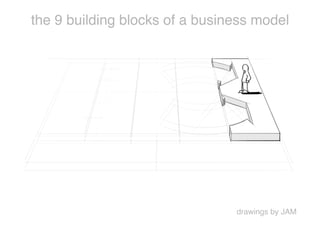
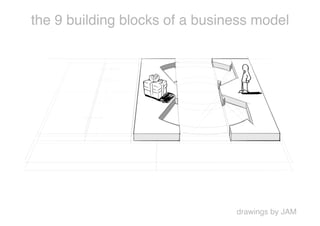
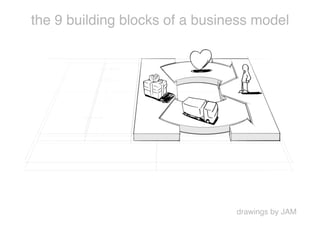
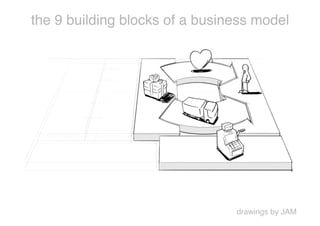
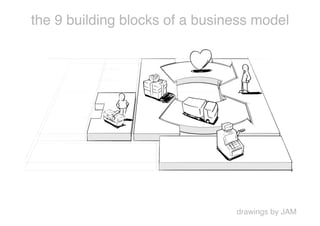
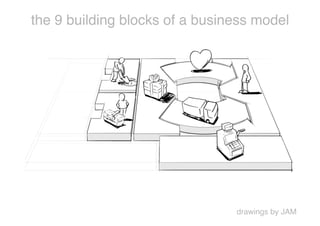
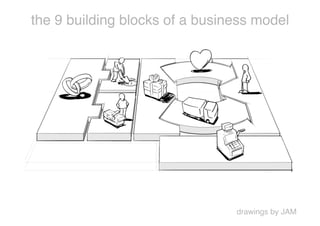
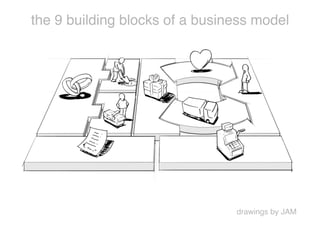
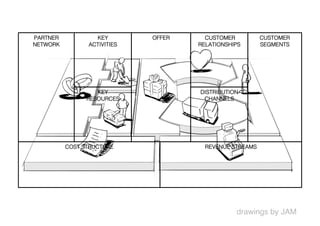
the 9 building blocks of a business model


                                drawings by JAM
the 9 building blocks of a business model


                                drawings by JAM
the 9 building blocks of a business model


                                drawings by JAM
the 9 building blocks of a business model


                                drawings by JAM
the 9 building blocks of a business model


                                drawings by JAM
the 9 building blocks of a business model


                                drawings by JAM
the 9 building blocks of a business model


                                drawings by JAM
the 9 building blocks of a business model


                                drawings by JAM
the 9 building blocks of a business model


                                drawings by JAM
the 9 building blocks of a business model


                                drawings by JAM
PARTNER           KEY        OFFER     CUSTOMER          CUSTOMER
NETWORK         ACTIVITIES           RELATIONSHIPS       SEGMENTS


                   KEY               DISTRIBUTION
                RESOURCES             CHANNELS


          COST STRUCTURE               REVENUE STREAMS


                                                drawings by JAM
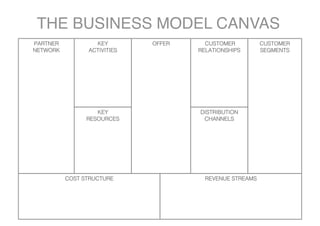
THE BUSINESS MODEL CANVAS
PARTNER           KEY        OFFER     CUSTOMER          CUSTOMER
NETWORK         ACTIVITIES           RELATIONSHIPS       SEGMENTS


                   KEY               DISTRIBUTION
                RESOURCES             CHANNELS


          COST STRUCTURE               REVENUE STREAMS
who has used
 the canvas?
who has used
  what

worked?

 the canvas?
who haswhat

  what
    used
worked?
 didn’t?

 the canvas?
key is: finding
the appropriate
business model
Spinno: Business Model Canvas


   Accelerating Your Business
30.8.2011                          Spinno BMC   A   1
A business model describes

the rationale of how an

organization creates, delivers

and captures value
                     A           2
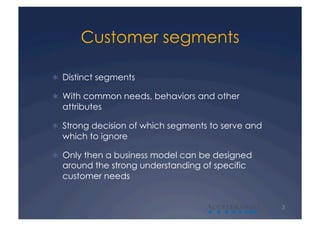
Customer segments

  Distinct segments

  With common needs, behaviors and other
  attributes

  Strong decision of which segments to serve and
  which to ignore

  Only then a business model can be designed
  around the strong understanding of specific
  customer needs


                                    A               3
Value propositions

  Reason for a customer to turn to one company
  instead over another

  Solves a customer problem or satisfies a
  customer need

  ValueProp consists of selected bundle of
  products / services that caters to the
  requirements of a specific customer segment

  Bundle of benefits a company offers to
  customers

                                     A            4
Channels

  Channel describes haw a company
  communicates with and reaches its customer
  segments to deliver a Value Proposition

  Communication, distribution and sales channels
  comprise a company’s interface with customers

  Awareness, evaluation, purchase, delivery,
  aftersales


                                    A               5
Customer relationship

  The customer relationship describes the types of
  relationships a company establishes with specific
  customer segments
    Customer acquisition
    Customer retention
    Boosting sales (upselling)


                                     A                6
Revenue streams
  The revenue represents the cash flow a company
   generates from each customer segment

  Transaction revenue

  Recurring revenue (post purchase support...)

  Fixed pricing vs. dynamic pricing

  Q’s
     For what value are our customers really willing to pay?
     How are they currently paying?
     How would they prefer to pay?
     How much does each revenue stream contribute to overall
      revenues?


                                            A                   7
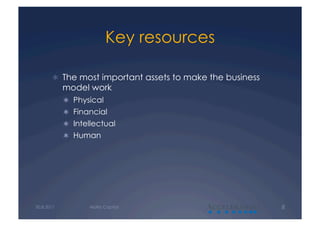
Key resources

         The most important assets to make the business
            model work
              Physical
              Financial
              Intellectual
              Human


30.8.2011          Alalto Capital          A               8
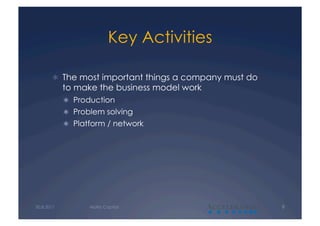
Key Activities

         The most important things a company must do
            to make the business model work
              Production
              Problem solving
              Platform / network


30.8.2011         Alalto Capital              A         9
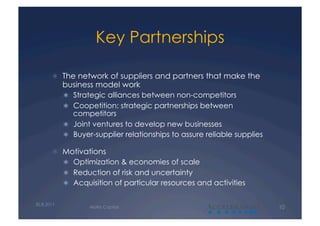
Key Partnerships

         The network of suppliers and partners that make the
            business model work
              Strategic alliances between non-competitors
              Coopetition: strategic partnerships between
               competitors
              Joint ventures to develop new businesses
              Buyer-supplier relationships to assure reliable supplies

         Motivations
              Optimization & economies of scale
              Reduction of risk and uncertainty
              Acquisition of particular resources and activities


30.8.2011
                   Alalto Capital                     A                   10
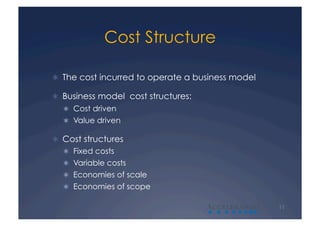
Cost Structure

  The cost incurred to operate a business model

  Business model cost structures:
    Cost driven
    Value driven

  Cost structures
    Fixed costs
    Variable costs
    Economies of scale
    Economies of scope

                                     A             11
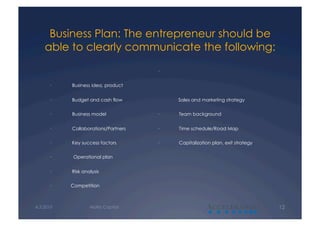
Business Plan: The entrepreneur should be
    able to clearly communicate the following:

                                                 ·            

      ·                Business idea, product


      ·                Budget and cash flow                     Sales and marketing strategy


      ·                Business model            ·               Team background


      ·                Collaborations/Partners   ·               Time schedule/Road Map

      ·                Key success factors       ·               Capitalization plan, exit strategy


      ·                 Operational plan


      ·                Risk analysis

      ·               Competition


4.3.2010                      Alalto Capital                               A                          12
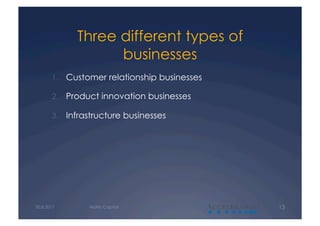
Three different types of
                   businesses
       1.  Customer relationship businesses

       2.  Product innovation businesses

       3.  Infrastructure businesses


30.8.2011       Alalto Capital                A   13
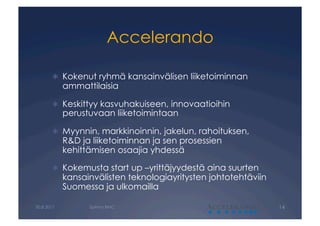
Accelerando

         Kokenut ryhmä kansainvälisen liiketoiminnan
            ammattilaisia

         Keskittyy kasvuhakuiseen, innovaatioihin
            perustuvaan liiketoimintaan

         Myynnin, markkinoinnin, jakelun, rahoituksen,
            R&D ja liiketoiminnan ja sen prosessien
            kehittämisen osaajia yhdessä

         Kokemusta start up –yrittäjyydestä aina suurten
            kansainvälisten teknologiayritysten johtotehtäviin
            Suomessa ja ulkomailla

30.8.2011         Spinno BMC                   A                 14
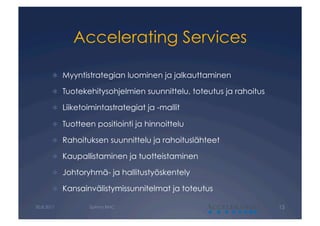
Accelerating Services

         Myyntistrategian luominen ja jalkauttaminen

         Tuotekehitysohjelmien suunnittelu, toteutus ja rahoitus

         Liiketoimintastrategiat ja -mallit

         Tuotteen positiointi ja hinnoittelu

         Rahoituksen suunnittelu ja rahoituslähteet

         Kaupallistaminen ja tuotteistaminen

         Johtoryhmä- ja hallitustyöskentely

         Kansainvälistymissunnitelmat ja toteutus

30.8.2011        Spinno BMC                      A                  15

Insight300811_Business_Model_Canvas_liiketoimintamalli_Osterwalder

  • 1.
  • 2.
    THE WORLD IS CHANGING
  • 3.
    but the worldIS BUSINESS has always changed CHANGING
  • 4.
  • 5.
    technology has BUSINESS IS always changed CHANGING
  • 6.
  • 7.
    but business IS BUSINESS has always changed CHANGING
  • 8.
  • 9.
  • 10.
  • 11.
    ADVERTISING MUSIC AIRLINES SHIFTING PUBLISHING INDUSTRIES TELECOMS BANKING CLOTHING
  • 12.
    BUT itʼs also about
  • 13.
  • 16.
    we need new methods to understand & craft business models
  • 17.
  • 18.
    [source: M.Porter (1980)www.provenmodels.com]
  • 19.
  • 20.
  • 21.
    A approach
  • 22.
  • 23.
  • 24.
    the 9 buildingblocks of a business model drawings by JAM
  • 25.
    the 9 buildingblocks of a business model drawings by JAM
  • 26.
    the 9 buildingblocks of a business model drawings by JAM
  • 27.
    the 9 buildingblocks of a business model drawings by JAM
  • 28.
    the 9 buildingblocks of a business model drawings by JAM
  • 29.
    the 9 buildingblocks of a business model drawings by JAM
  • 30.
    the 9 buildingblocks of a business model drawings by JAM
  • 31.
    the 9 buildingblocks of a business model drawings by JAM
  • 32.
    the 9 buildingblocks of a business model drawings by JAM
  • 33.
    the 9 buildingblocks of a business model drawings by JAM
  • 34.
    PARTNER KEY OFFER CUSTOMER CUSTOMER NETWORK ACTIVITIES RELATIONSHIPS SEGMENTS KEY DISTRIBUTION RESOURCES CHANNELS COST STRUCTURE REVENUE STREAMS drawings by JAM
  • 35.
    THE BUSINESS MODELCANVAS PARTNER KEY OFFER CUSTOMER CUSTOMER NETWORK ACTIVITIES RELATIONSHIPS SEGMENTS KEY DISTRIBUTION RESOURCES CHANNELS COST STRUCTURE REVENUE STREAMS
  • 36.
    who has used the canvas?
  • 37.
    who has used what
 worked?
 the canvas?
  • 38.
    who haswhat
 what
 used worked?
 didn’t?
 the canvas?
  • 39.
    key is: finding theappropriate business model
  • 40.
    Spinno: Business ModelCanvas Accelerating Your Business 30.8.2011 Spinno BMC A 1
  • 41.
    A business modeldescribes the rationale of how an organization creates, delivers and captures value A 2
  • 42.
    Customer segments   Distinctsegments   With common needs, behaviors and other attributes   Strong decision of which segments to serve and which to ignore   Only then a business model can be designed around the strong understanding of specific customer needs A 3
  • 43.
    Value propositions   Reasonfor a customer to turn to one company instead over another   Solves a customer problem or satisfies a customer need   ValueProp consists of selected bundle of products / services that caters to the requirements of a specific customer segment   Bundle of benefits a company offers to customers A 4
  • 44.
    Channels   Channel describeshaw a company communicates with and reaches its customer segments to deliver a Value Proposition   Communication, distribution and sales channels comprise a company’s interface with customers   Awareness, evaluation, purchase, delivery, aftersales A 5
  • 45.
    Customer relationship   Thecustomer relationship describes the types of relationships a company establishes with specific customer segments   Customer acquisition   Customer retention   Boosting sales (upselling) A 6
  • 46.
    Revenue streams   Therevenue represents the cash flow a company generates from each customer segment   Transaction revenue   Recurring revenue (post purchase support...)   Fixed pricing vs. dynamic pricing   Q’s   For what value are our customers really willing to pay?   How are they currently paying?   How would they prefer to pay?   How much does each revenue stream contribute to overall revenues? A 7
  • 47.
    Key resources   The most important assets to make the business model work   Physical   Financial   Intellectual   Human 30.8.2011 Alalto Capital A 8
  • 48.
    Key Activities   The most important things a company must do to make the business model work   Production   Problem solving   Platform / network 30.8.2011 Alalto Capital A 9
  • 49.
    Key Partnerships   The network of suppliers and partners that make the business model work   Strategic alliances between non-competitors   Coopetition: strategic partnerships between competitors   Joint ventures to develop new businesses   Buyer-supplier relationships to assure reliable supplies   Motivations   Optimization & economies of scale   Reduction of risk and uncertainty   Acquisition of particular resources and activities 30.8.2011 Alalto Capital A 10
  • 50.
    Cost Structure   Thecost incurred to operate a business model   Business model cost structures:   Cost driven   Value driven   Cost structures   Fixed costs   Variable costs   Economies of scale   Economies of scope A 11
  • 51.
    Business Plan: Theentrepreneur should be able to clearly communicate the following: ·             ·                Business idea, product ·                Budget and cash flow    Sales and marketing strategy ·                Business model ·               Team background ·                Collaborations/Partners ·               Time schedule/Road Map ·                Key success factors ·               Capitalization plan, exit strategy ·                 Operational plan ·                Risk analysis ·               Competition 4.3.2010 Alalto Capital A 12
  • 52.
    Three different typesof businesses 1.  Customer relationship businesses 2.  Product innovation businesses 3.  Infrastructure businesses 30.8.2011 Alalto Capital A 13
  • 53.
    Accelerando   Kokenut ryhmä kansainvälisen liiketoiminnan ammattilaisia   Keskittyy kasvuhakuiseen, innovaatioihin perustuvaan liiketoimintaan   Myynnin, markkinoinnin, jakelun, rahoituksen, R&D ja liiketoiminnan ja sen prosessien kehittämisen osaajia yhdessä   Kokemusta start up –yrittäjyydestä aina suurten kansainvälisten teknologiayritysten johtotehtäviin Suomessa ja ulkomailla 30.8.2011 Spinno BMC A 14
  • 54.
    Accelerating Services   Myyntistrategian luominen ja jalkauttaminen   Tuotekehitysohjelmien suunnittelu, toteutus ja rahoitus   Liiketoimintastrategiat ja -mallit   Tuotteen positiointi ja hinnoittelu   Rahoituksen suunnittelu ja rahoituslähteet   Kaupallistaminen ja tuotteistaminen   Johtoryhmä- ja hallitustyöskentely   Kansainvälistymissunnitelmat ja toteutus 30.8.2011 Spinno BMC A 15