Dr. R. Muthukrishnaveni
Assistant Professor
 Statistics -Meaning – Functions – Importance
– Limitations
 Data Collection – Sources – primary –
Secondary – Techniques – Census – Sampling
 Classification
 Presentation – Tabulation – Diagrammatic –
Graphic.
In the modern world of computers and
information technology, the importance of
statistics is very well recogonised by all the
disciplines. Statistics has originated as a
science of statehood and found applications
slowly and steadily in Agriculture, Economics,
Commerce, Biology, Medicine, Industry,
planning, education and so on. As on date
there is no other human walk of life, where
statistics cannot be applied.
The word ‘Statistics’ and ‘Statistical’ are all
derived from the Latin word Status, means a
political state. The theory of statistics as a
distinct branch of scientific method is of
comparatively recent growth. Research
particularly into the mathematical theory of
statistics is rapidly proceeding and fresh
discoveries are being made all over the world
Statistics is concerned with scientific
methods for collecting, organising,
summarising, presenting and analysing data
as well as deriving valid conclusions and
making reasonable decisions on the basis of
this analysis
The word ‘statistic’ is used to refer to
1. Numerical facts, such as the
number of people living in particular area.
2. The study of ways of collecting,
analysing and interpreting the facts.
Statistics are numerical statement of facts
in any department of enquiry placed in
relation to each other. - A.L. Bowley
 Condensation
 Comparison
 Forecasting
 Estimation
 Estimation theory
 Tests of Hypothesis
 Non Parametric tests
 Sequential analysis
 Statistics and Industry
 Statistics and Commerce
 Statistics and Agriculture
 Statistics and Economics
 Statistics and Education
 Statistics and Planning
 Statistics and Medicine
 Statistics and Modern applications (Archeology:
Evolution of skull dimensions; Epidemiology: Tuberculosis;
Statistics: Theoretical distributions; Manufacturing: Quality
improvement; Medical research: Clinical investigations;
Geology: Estimation of Uranium reserves from ground
water)
It is the first step and this is the
foundation upon which the entire data set.
Careful planning is essential before collecting
the data. There are different methods of
collection of data such as census, sampling,
primary, secondary, etc., and the investigator
should make use of correct method
 Census Method
 Sampling Method
Population - :- In a statistical enquiry, all
the items, which fall within the purview of
enquiry, are known as Population or Universe.
Finite population and infinite population:
- A population is said to be finite if it consists
of finite number of units. Number of workers
in a factory, production of articles in a
particular day for a company is examples of
finite population. The total number of units in
a population is called population size. A
population is said to be infinite if it has
infinite number of units. For example the
number of stars in the sky, the number of
people seeing the Television programmes etc.
 In census method every element of the
population is included in the investigation.
◦ For example, if we study the average annual income
of the families of a particular village or area, and if
there are 1000 families in that area, we must study
the income of all 1000 families. In this method no
family is left out, as each family is a unit.
1. The data are collected from each and every
item of the population
2. The results are more accurate and reliable,
because every item of the universe is
required.
3. Intensive study is possible.
4. The data collected may be used for various
surveys, analyses etc
1. It requires a large number of enumerators
and it is a costly method
2. It requires more money, labour, time energy
etc.
3. It is not possible in some circumstances
where the universe is infinite
 Statisticians use the word sample to describe
a portion chosen from the population. A finite
subset of statistical individuals defined in a
population is called a sample.
 The number of units in a sample is called the
sample size.
 The constituents of a population which are
individuals to be sampled from the
population and cannot be further subdivided
for the purpose of the sampling at a time are
called sampling units
 For adopting any sampling procedure it is
essential to have a list identifying each
sampling unit by a number. Such a list or
map is called sampling frame
1. Complete enumerations are practically
impossible when the population is infinite.
2. When the results are required in a short
time.
3. When the area of survey is wide.
4. When resources for survey are limited
particularly in respect of money and trained
persons.
5. When the item or unit is destroyed under
investigation
 Principle of statistical regularity
 Principle of Inertia of large numbers
 Principle of Validity
 Principle of Optimisation
Although a sample is a part of population,
it cannot be expected generally to supply full
information about population. So there may
be in most cases difference between statistics
and parameters. The discrepancy between a
parameter and its estimate due to sampling
process is known as sampling error
In all surveys some errors may occur
during collection of actual information. These
errors are called Non-sampling errors
1. Sampling saves time and labour.
2. It results in reduction of cost in terms of
money and man-hour.
3. Sampling ends up with greater accuracy of
results.
4. It has greater scope.
5. It has greater adaptability.
6. If the population is too large, or hypothetical
or destroyable sampling is the only method
to be used.
1. Sampling is to be done by qualified and
experienced persons. Otherwise, the
information will be unbelievable.
2. Sample method may give the extreme values
sometimes instead of the mixed values.
3. There is the possibility of sampling errors.
Census survey is free from sampling error.
The technique of selecting a sample is of
fundamental importance in sampling theory
and it depends upon the nature of
investigation.
1. Probability sampling.
2. Non-probability sampling.
3. Mixed sampling
A probability sample is one where the
selection of units from the population is
made according to known probabilities.
1. Simple random sampling.
2. Stratified random sampling.
3. Systematic random sampling.
A simple random sample from finite
population is a sample selected such that
each possible sample combination has equal
probability of being chosen.
1. Simple random sampling without
replacement
2. Simple random sampling with replacement
 Lottery Method
 Table of Random numbers
1. Tippett’s table
2. Fisher and Yates’ table
3. Kendall and Smith’s table are the three
tables among them
 Random number selections using calculators
or computers
They are proportional and non-
proportional
 A frequently used method of sampling when
a complete list of the population is available
is systematic sampling.
 Also called Quasi-random sampling.
1. To describe the methods of collecting
primary statistical information.
2. To consider the status involved in carrying
out a survey.
3. To analyse the process involved in
observation and interpreting.
4. To define and describe sampling.
5. To analyse the basis of sampling.
6. To describe a variety of sampling methods
1. Time series data – Time
2. Spatial data – Place
3. Spacio-temporal data – Time and Place
1. Primary data
2. Secondary data
Primary data is the one, which is collected
by the investigator himself for the purpose of
a specific inquiry or study.
The primary data can be collected by the
following five methods.
1. Direct personal interviews.
2. Indirect Oral interviews.
3. Information from correspondents.
4. Mailed questionnaire method.
5. Schedules sent through enumerators
Secondary data are those data which have
been already collected and analysed by some
earlier agency for its own use; and later the
same data are used by a different agency.
The collected data, also known as raw
data or ungrouped data are always in an
unorganised form and need to be organized
and presented in meaningful and readily
comprehensible form in order to facilitate
further statistical analysis.
1. It condenses the mass of data in an easily
assimilable form.
2. It eliminates unnecessary details.
3. It facilitates comparison and highlights the
significant aspect of data.
4. It enables one to get a mental picture of the
information and helps in drawing inferences.
5. It helps in the statistical treatment of the
information collected.
a) Chronological classification - Time
b) Geographical classification - Place
c) Qualitative classification - quality like sex,
literacy, religion, employment etc
d) Quantitative classification - height, weight,
etc
Tabulation is the process of summarizing
classified or grouped data in the form of a
table so that it is easily understood and an
investigator is quickly able to locate the
desired information.
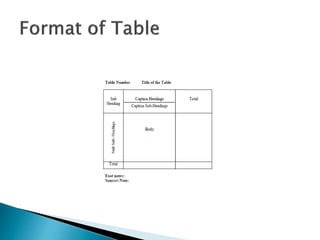
A table is a systematic arrangement of
classified data in columns and rows.
1. Table number
2. Title of the table
3. Captions or column headings
4. Stubs or row designation
5. Body of the table
6. Footnotes
7. Sources of data
 Simple or one-way table
 Two way table
 Manifold table
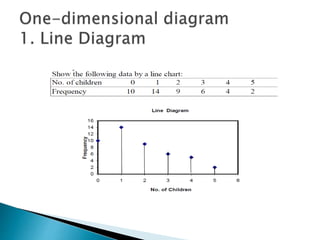
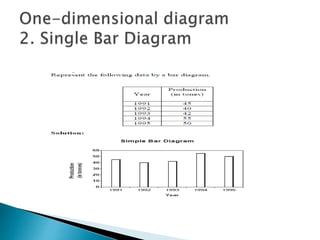
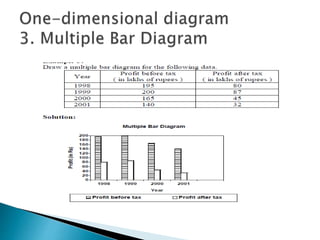
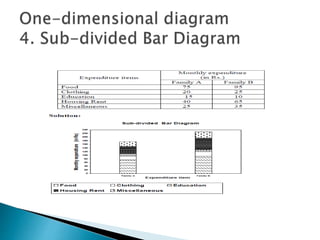
 Diagrams: A diagram is a visual form for
presentation of statistical data, highlighting
their basic facts and relationship.
 Graphs: A graph is a visual form of
presentation of statistical data using graph
sheet. A graph is more attractive than a table
of figure
1. They are attractive and impressive.
2. They make data simple and intelligible.
3. They make comparison possible
4. They save time and labour.
5. They have universal utility.
6. They give more information.
7. They have a great memorizing effect
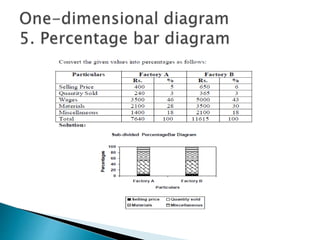
 One-dimensional diagrams
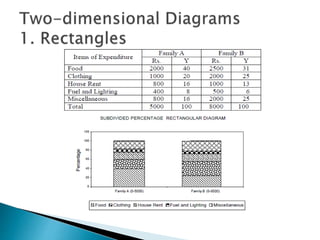
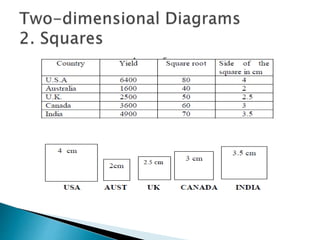
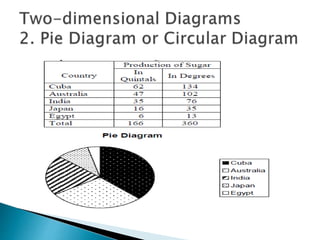
 Two-dimensional diagrams
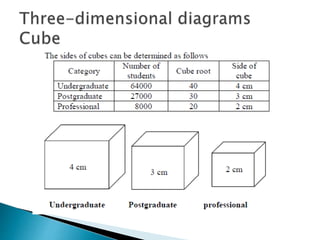
 Three-dimensional diagrams
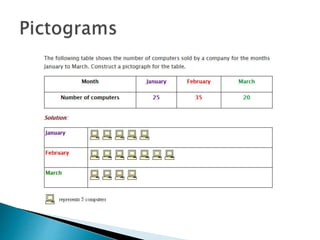
 Pictograms and Cartograms
 A graph is a visual form of presentation of
statistical data.
 A graph is more attractive than a table of
figure.
 Even a common man can understand the
message of data from the graph.
Comparisons can be made between two or
more phenomena very easily with the help of
a graph.
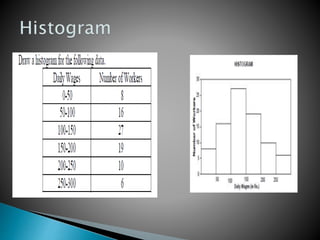
 Histogram
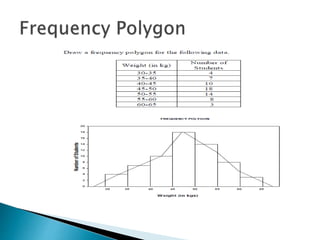
 Frequency Polygon
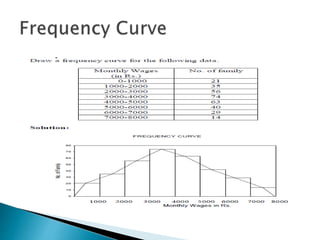
 Frequency Curve
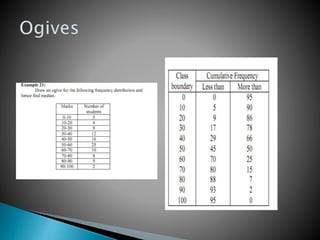
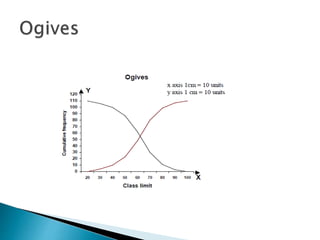
 Ogive
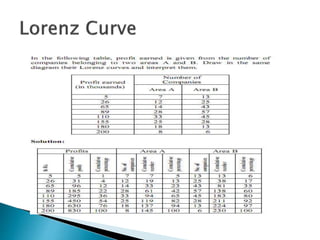
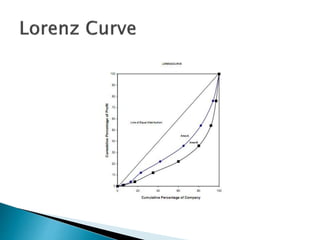
 Lorenz Curve
Business statistics
Business statistics
Business statistics
Business statistics
Business statistics
Business statistics
Business statistics
Business statistics

Business statistics

  • 1.
  • 2.
     Statistics -Meaning– Functions – Importance – Limitations  Data Collection – Sources – primary – Secondary – Techniques – Census – Sampling  Classification  Presentation – Tabulation – Diagrammatic – Graphic.
  • 3.
    In the modernworld of computers and information technology, the importance of statistics is very well recogonised by all the disciplines. Statistics has originated as a science of statehood and found applications slowly and steadily in Agriculture, Economics, Commerce, Biology, Medicine, Industry, planning, education and so on. As on date there is no other human walk of life, where statistics cannot be applied.
  • 4.
    The word ‘Statistics’and ‘Statistical’ are all derived from the Latin word Status, means a political state. The theory of statistics as a distinct branch of scientific method is of comparatively recent growth. Research particularly into the mathematical theory of statistics is rapidly proceeding and fresh discoveries are being made all over the world
  • 5.
    Statistics is concernedwith scientific methods for collecting, organising, summarising, presenting and analysing data as well as deriving valid conclusions and making reasonable decisions on the basis of this analysis
  • 6.
    The word ‘statistic’is used to refer to 1. Numerical facts, such as the number of people living in particular area. 2. The study of ways of collecting, analysing and interpreting the facts.
  • 7.
    Statistics are numericalstatement of facts in any department of enquiry placed in relation to each other. - A.L. Bowley
  • 8.
     Condensation  Comparison Forecasting  Estimation  Estimation theory  Tests of Hypothesis  Non Parametric tests  Sequential analysis
  • 9.
     Statistics andIndustry  Statistics and Commerce  Statistics and Agriculture  Statistics and Economics  Statistics and Education  Statistics and Planning  Statistics and Medicine  Statistics and Modern applications (Archeology: Evolution of skull dimensions; Epidemiology: Tuberculosis; Statistics: Theoretical distributions; Manufacturing: Quality improvement; Medical research: Clinical investigations; Geology: Estimation of Uranium reserves from ground water)
  • 10.
    It is thefirst step and this is the foundation upon which the entire data set. Careful planning is essential before collecting the data. There are different methods of collection of data such as census, sampling, primary, secondary, etc., and the investigator should make use of correct method
  • 11.
     Census Method Sampling Method Population - :- In a statistical enquiry, all the items, which fall within the purview of enquiry, are known as Population or Universe.
  • 12.
    Finite population andinfinite population: - A population is said to be finite if it consists of finite number of units. Number of workers in a factory, production of articles in a particular day for a company is examples of finite population. The total number of units in a population is called population size. A population is said to be infinite if it has infinite number of units. For example the number of stars in the sky, the number of people seeing the Television programmes etc.
  • 13.
     In censusmethod every element of the population is included in the investigation. ◦ For example, if we study the average annual income of the families of a particular village or area, and if there are 1000 families in that area, we must study the income of all 1000 families. In this method no family is left out, as each family is a unit.
  • 14.
    1. The dataare collected from each and every item of the population 2. The results are more accurate and reliable, because every item of the universe is required. 3. Intensive study is possible. 4. The data collected may be used for various surveys, analyses etc
  • 15.
    1. It requiresa large number of enumerators and it is a costly method 2. It requires more money, labour, time energy etc. 3. It is not possible in some circumstances where the universe is infinite
  • 16.
     Statisticians usethe word sample to describe a portion chosen from the population. A finite subset of statistical individuals defined in a population is called a sample.  The number of units in a sample is called the sample size.  The constituents of a population which are individuals to be sampled from the population and cannot be further subdivided for the purpose of the sampling at a time are called sampling units
  • 17.
     For adoptingany sampling procedure it is essential to have a list identifying each sampling unit by a number. Such a list or map is called sampling frame
  • 18.
    1. Complete enumerationsare practically impossible when the population is infinite. 2. When the results are required in a short time. 3. When the area of survey is wide. 4. When resources for survey are limited particularly in respect of money and trained persons. 5. When the item or unit is destroyed under investigation
  • 19.
     Principle ofstatistical regularity  Principle of Inertia of large numbers  Principle of Validity  Principle of Optimisation
  • 20.
    Although a sampleis a part of population, it cannot be expected generally to supply full information about population. So there may be in most cases difference between statistics and parameters. The discrepancy between a parameter and its estimate due to sampling process is known as sampling error
  • 21.
    In all surveyssome errors may occur during collection of actual information. These errors are called Non-sampling errors
  • 22.
    1. Sampling savestime and labour. 2. It results in reduction of cost in terms of money and man-hour. 3. Sampling ends up with greater accuracy of results. 4. It has greater scope. 5. It has greater adaptability. 6. If the population is too large, or hypothetical or destroyable sampling is the only method to be used.
  • 23.
    1. Sampling isto be done by qualified and experienced persons. Otherwise, the information will be unbelievable. 2. Sample method may give the extreme values sometimes instead of the mixed values. 3. There is the possibility of sampling errors. Census survey is free from sampling error.
  • 24.
    The technique ofselecting a sample is of fundamental importance in sampling theory and it depends upon the nature of investigation. 1. Probability sampling. 2. Non-probability sampling. 3. Mixed sampling
  • 25.
    A probability sampleis one where the selection of units from the population is made according to known probabilities. 1. Simple random sampling. 2. Stratified random sampling. 3. Systematic random sampling.
  • 26.
    A simple randomsample from finite population is a sample selected such that each possible sample combination has equal probability of being chosen. 1. Simple random sampling without replacement 2. Simple random sampling with replacement
  • 27.
     Lottery Method Table of Random numbers 1. Tippett’s table 2. Fisher and Yates’ table 3. Kendall and Smith’s table are the three tables among them  Random number selections using calculators or computers
  • 28.
    They are proportionaland non- proportional
  • 29.
     A frequentlyused method of sampling when a complete list of the population is available is systematic sampling.  Also called Quasi-random sampling.
  • 30.
    1. To describethe methods of collecting primary statistical information. 2. To consider the status involved in carrying out a survey. 3. To analyse the process involved in observation and interpreting. 4. To define and describe sampling. 5. To analyse the basis of sampling. 6. To describe a variety of sampling methods
  • 31.
    1. Time seriesdata – Time 2. Spatial data – Place 3. Spacio-temporal data – Time and Place
  • 32.
    1. Primary data 2.Secondary data
  • 33.
    Primary data isthe one, which is collected by the investigator himself for the purpose of a specific inquiry or study. The primary data can be collected by the following five methods. 1. Direct personal interviews. 2. Indirect Oral interviews. 3. Information from correspondents. 4. Mailed questionnaire method. 5. Schedules sent through enumerators
  • 34.
    Secondary data arethose data which have been already collected and analysed by some earlier agency for its own use; and later the same data are used by a different agency.
  • 35.
    The collected data,also known as raw data or ungrouped data are always in an unorganised form and need to be organized and presented in meaningful and readily comprehensible form in order to facilitate further statistical analysis.
  • 36.
    1. It condensesthe mass of data in an easily assimilable form. 2. It eliminates unnecessary details. 3. It facilitates comparison and highlights the significant aspect of data. 4. It enables one to get a mental picture of the information and helps in drawing inferences. 5. It helps in the statistical treatment of the information collected.
  • 37.
    a) Chronological classification- Time b) Geographical classification - Place c) Qualitative classification - quality like sex, literacy, religion, employment etc d) Quantitative classification - height, weight, etc
  • 38.
    Tabulation is theprocess of summarizing classified or grouped data in the form of a table so that it is easily understood and an investigator is quickly able to locate the desired information. A table is a systematic arrangement of classified data in columns and rows.
  • 39.
    1. Table number 2.Title of the table 3. Captions or column headings 4. Stubs or row designation 5. Body of the table 6. Footnotes 7. Sources of data
  • 41.
     Simple orone-way table  Two way table  Manifold table
  • 42.
     Diagrams: Adiagram is a visual form for presentation of statistical data, highlighting their basic facts and relationship.  Graphs: A graph is a visual form of presentation of statistical data using graph sheet. A graph is more attractive than a table of figure
  • 43.
    1. They areattractive and impressive. 2. They make data simple and intelligible. 3. They make comparison possible 4. They save time and labour. 5. They have universal utility. 6. They give more information. 7. They have a great memorizing effect
  • 44.
     One-dimensional diagrams Two-dimensional diagrams  Three-dimensional diagrams  Pictograms and Cartograms
  • 56.
     A graphis a visual form of presentation of statistical data.  A graph is more attractive than a table of figure.  Even a common man can understand the message of data from the graph. Comparisons can be made between two or more phenomena very easily with the help of a graph.
  • 57.
     Histogram  FrequencyPolygon  Frequency Curve  Ogive  Lorenz Curve