DIFFERENCE BETWEEN SHORT
RUN AND LONG RUN
Presented By: Muhammad Riaz
Semester : BBA II
Batch No.: BBA -14-07
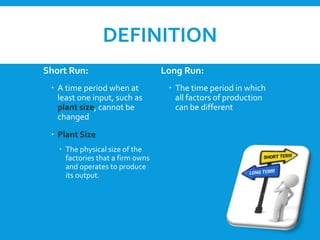
DEFINITION
Long Run:
 The time period in which
all factors of production
can be different
Short Run:
 A time period when at
least one input, such as
plant size, cannot be
changed
 Plant Size
 The physical size of the
factories that a firm owns
and operates to produce
its output.
DIFFERENCE
Long Run:
 All recourses are fixed
 Long-run decisions are
not easily reversed.
Short Run:
 Other resources used by the
firm (such as labor, raw
materials, and energy) can
be changed in the short run.
 Short-run decisions are easily
reversed.
SHORT RUN DEMAND
VS.
LONG RUN DEMAND
 Short run demand is the demand with its immediate
reaction to price changes, income fluctuations and so on.
 Long run demand is that demand which will ultimately
exist as a result of the changes in pricing, promotion or
product improvement, after enough time is allowed to let
the market adjust itself to the given solution.
LONG RUN AND SHORT RUN COST
 Long run costs have no fixed factors of production
 Short run costs have fixed factors and variables that impact production.
 Variable cost A cost that changes with the change in volume of activity of
an organization.
 Examples variable costs include raw materials, packaging, and labor.
Which are directly involved with company's manufacturing process.
 Fixed cost Business expenses that are not dependent on the level of goods
or services produced by the business.
 Examples Fixed costs often include land, capital,
entrepreneur, etc.
SHORT RUNVS. LONG RUN
SUPPLY CURVES
 Long Run response to change in price is much greater than
Short Run response.
 The Long Run supply curves is much flatter than the short run
curve, means that the quantity of “apple” is increases by a
larger amount in the long run.
 The Short Run supply curve is much steeper than the long run
supply curve because there are diminishing returns in the
short run.
Presented By: Muhammad Riaz
Semester: BBA II
Batch No.: BBA -14-07

Difference between short run and long run

  • 1.
    DIFFERENCE BETWEEN SHORT RUNAND LONG RUN Presented By: Muhammad Riaz Semester : BBA II Batch No.: BBA -14-07
  • 2.
    DEFINITION Long Run:  Thetime period in which all factors of production can be different Short Run:  A time period when at least one input, such as plant size, cannot be changed  Plant Size  The physical size of the factories that a firm owns and operates to produce its output.
  • 3.
    DIFFERENCE Long Run:  Allrecourses are fixed  Long-run decisions are not easily reversed. Short Run:  Other resources used by the firm (such as labor, raw materials, and energy) can be changed in the short run.  Short-run decisions are easily reversed.
  • 4.
    SHORT RUN DEMAND VS. LONGRUN DEMAND  Short run demand is the demand with its immediate reaction to price changes, income fluctuations and so on.  Long run demand is that demand which will ultimately exist as a result of the changes in pricing, promotion or product improvement, after enough time is allowed to let the market adjust itself to the given solution.
  • 5.
    LONG RUN ANDSHORT RUN COST  Long run costs have no fixed factors of production  Short run costs have fixed factors and variables that impact production.  Variable cost A cost that changes with the change in volume of activity of an organization.  Examples variable costs include raw materials, packaging, and labor. Which are directly involved with company's manufacturing process.  Fixed cost Business expenses that are not dependent on the level of goods or services produced by the business.  Examples Fixed costs often include land, capital, entrepreneur, etc.
  • 6.
    SHORT RUNVS. LONGRUN SUPPLY CURVES  Long Run response to change in price is much greater than Short Run response.  The Long Run supply curves is much flatter than the short run curve, means that the quantity of “apple” is increases by a larger amount in the long run.  The Short Run supply curve is much steeper than the long run supply curve because there are diminishing returns in the short run.
  • 7.
    Presented By: MuhammadRiaz Semester: BBA II Batch No.: BBA -14-07