Course Title: Business Statistics
BBA (Hons)
2nd
Semester
Course Instructor: Atiq ur Rehman Shah
Lecturer, Federal Urdu University of Arts,
Science & Technology, Islamabad
+92-345-5271959
aatresh@gmail.com
Learning Objectives
• Define statistics
• Become aware of a wide range of
applications of statistics in business
• Differentiate between descriptive and
inferential statistics
• Learn about population and samples
• Collection of data
• Types of data
What is Statistics?
• Statistics is the science of conducting
studies to collect, organize, summarize,
analyze and draw conclusions from data.
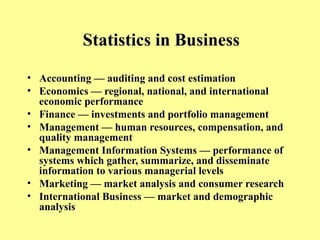
Statistics in Business
• Accounting — auditing and cost estimation
• Economics — regional, national, and international
economic performance
• Finance — investments and portfolio management
• Management — human resources, compensation, and
quality management
• Management Information Systems — performance of
systems which gather, summarize, and disseminate
information to various managerial levels
• Marketing — market analysis and consumer research
• International Business — market and demographic
analysis
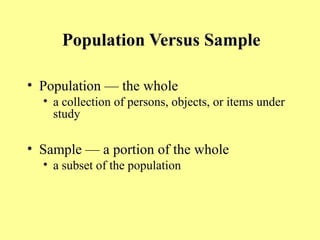
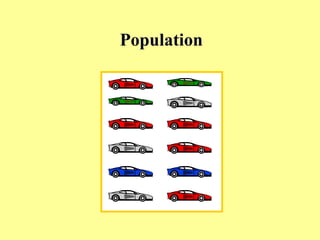
Population Versus Sample
• Population — the whole
• a collection of persons, objects, or items under
study
• Sample — a portion of the whole
• a subset of the population
Population
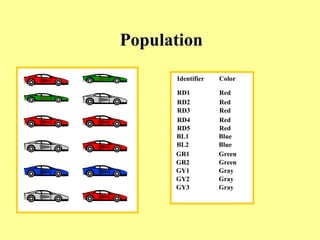
Population
Identifier Color
RD1 Red
RD2 Red
RD3 Red
RD4 Red
RD5 Red
BL1 Blue
BL2 Blue
GR1 Green
GR2 Green
GY1 Gray
GY2 Gray
GY3 Gray
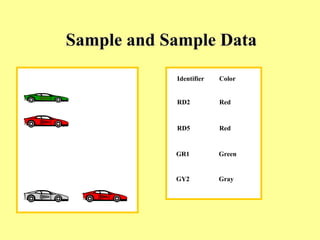
Sample and Sample Data
Identifier Color
RD2 Red
RD5 Red
GR1 Green
GY2 Gray
Branches of Statistics
• Descriptive statistics
• Inferential statistics
Descriptive statistics
• Descriptive statistics consists of the
collection, organization, summarization and
presentation of data.
• In descriptive statistics the statistician tries
to describe a situation.
Inferential statistics
• Inferential statistics consists of the
generalizing from samples to population,
performing estimations and hypothesis test,
determining relationships among variables,
and make predictions.
• In inferential statistics, the statistician tries
to make inferences from sample to
population
Collection of data- Levels of Data
Measurement
• Nominal
• Ordinal
• Interval
• Ratio
Nominal Level Data
• Numbers representing nominal level data
are used only to classify or categorize.
Example: Gender
1. Male
2. Female
Example: Geographic location
1. Punjab
2. Sindh
3. KPK
4. Baluchistan
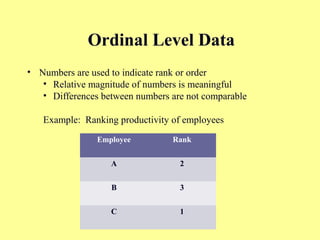
Ordinal Level Data
• Numbers are used to indicate rank or order
• Relative magnitude of numbers is meaningful
• Differences between numbers are not comparable
Example: Ranking productivity of employees
Employee Rank
A 2
B 3
C 1
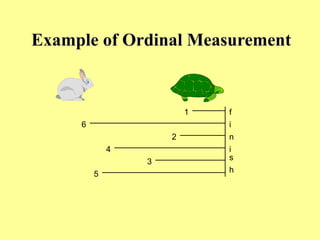
Example of Ordinal Measurement
f
i
n
i
s
h
1
2
3
4
5
6
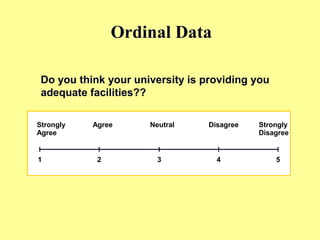
Ordinal Data
Do you think your university is providing you
adequate facilities??
1 2 3 4 5
Strongly
Agree
Agree Strongly
Disagree
DisagreeNeutral
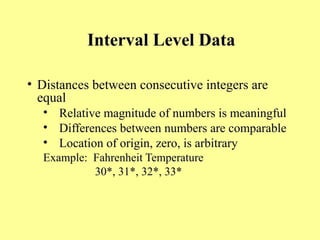
Interval Level Data
• Distances between consecutive integers are
equal
• Relative magnitude of numbers is meaningful
• Differences between numbers are comparable
• Location of origin, zero, is arbitrary
Example: Fahrenheit Temperature
30*, 31*, 32*, 33*
Ratio Level Data
• Highest level of measurement
• Relative magnitude of numbers is meaningful
• Differences between numbers are comparable
• Location of origin, zero, is absolute (natural)
Examples: Height, Weight etc
Types of data
• Primary data
• Original data collected for a specific research goal.
• Secondary data
• Data originally collected for a different purpose and
reused for another research question.
Activity
What are the sources of primary and
secondary data????

Introduction to Business Statistics

  • 1.
    Course Title: BusinessStatistics BBA (Hons) 2nd Semester Course Instructor: Atiq ur Rehman Shah Lecturer, Federal Urdu University of Arts, Science & Technology, Islamabad +92-345-5271959 aatresh@gmail.com
  • 2.
    Learning Objectives • Definestatistics • Become aware of a wide range of applications of statistics in business • Differentiate between descriptive and inferential statistics • Learn about population and samples • Collection of data • Types of data
  • 3.
    What is Statistics? •Statistics is the science of conducting studies to collect, organize, summarize, analyze and draw conclusions from data.
  • 4.
    Statistics in Business •Accounting — auditing and cost estimation • Economics — regional, national, and international economic performance • Finance — investments and portfolio management • Management — human resources, compensation, and quality management • Management Information Systems — performance of systems which gather, summarize, and disseminate information to various managerial levels • Marketing — market analysis and consumer research • International Business — market and demographic analysis
  • 5.
    Population Versus Sample •Population — the whole • a collection of persons, objects, or items under study • Sample — a portion of the whole • a subset of the population
  • 6.
  • 7.
    Population Identifier Color RD1 Red RD2Red RD3 Red RD4 Red RD5 Red BL1 Blue BL2 Blue GR1 Green GR2 Green GY1 Gray GY2 Gray GY3 Gray
  • 8.
    Sample and SampleData Identifier Color RD2 Red RD5 Red GR1 Green GY2 Gray
  • 9.
    Branches of Statistics •Descriptive statistics • Inferential statistics
  • 10.
    Descriptive statistics • Descriptivestatistics consists of the collection, organization, summarization and presentation of data. • In descriptive statistics the statistician tries to describe a situation.
  • 11.
    Inferential statistics • Inferentialstatistics consists of the generalizing from samples to population, performing estimations and hypothesis test, determining relationships among variables, and make predictions. • In inferential statistics, the statistician tries to make inferences from sample to population
  • 12.
    Collection of data-Levels of Data Measurement • Nominal • Ordinal • Interval • Ratio
  • 13.
    Nominal Level Data •Numbers representing nominal level data are used only to classify or categorize. Example: Gender 1. Male 2. Female Example: Geographic location 1. Punjab 2. Sindh 3. KPK 4. Baluchistan
  • 14.
    Ordinal Level Data •Numbers are used to indicate rank or order • Relative magnitude of numbers is meaningful • Differences between numbers are not comparable Example: Ranking productivity of employees Employee Rank A 2 B 3 C 1
  • 15.
    Example of OrdinalMeasurement f i n i s h 1 2 3 4 5 6
  • 16.
    Ordinal Data Do youthink your university is providing you adequate facilities?? 1 2 3 4 5 Strongly Agree Agree Strongly Disagree DisagreeNeutral
  • 17.
    Interval Level Data •Distances between consecutive integers are equal • Relative magnitude of numbers is meaningful • Differences between numbers are comparable • Location of origin, zero, is arbitrary Example: Fahrenheit Temperature 30*, 31*, 32*, 33*
  • 18.
    Ratio Level Data •Highest level of measurement • Relative magnitude of numbers is meaningful • Differences between numbers are comparable • Location of origin, zero, is absolute (natural) Examples: Height, Weight etc
  • 19.
    Types of data •Primary data • Original data collected for a specific research goal. • Secondary data • Data originally collected for a different purpose and reused for another research question.
  • 20.
    Activity What are thesources of primary and secondary data????