Business Process
Re-engineering
Prachi Singla | Prajjwal Vij
MBA HR (2021-23)
Definition
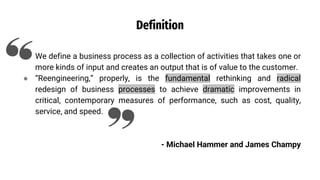
● We define a business process as a collection of activities that takes one or
more kinds of input and creates an output that is of value to the customer.
● “Reengineering,” properly, is the fundamental rethinking and radical
redesign of business processes to achieve dramatic improvements in
critical, contemporary measures of performance, such as cost, quality,
service, and speed.
- Michael Hammer and James Champy
Why BPR?
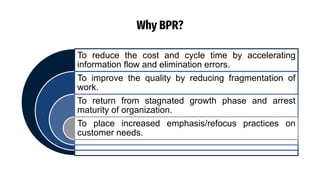
To reduce the cost and cycle time by accelerating
information flow and elimination errors.
To improve the quality by reducing fragmentation of
work.
To return from stagnated growth phase and arrest
maturity of organization.
To place increased emphasis/refocus practices on
customer needs.
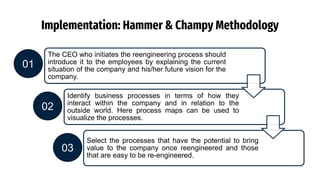
Implementation: Hammer & Champy Methodology
The CEO who initiates the reengineering process should
introduce it to the employees by explaining the current
situation of the company and his/her future vision for the
company.
Identify business processes in terms of how they
interact within the company and in relation to the
outside world. Here process maps can be used to
visualize the processes.
Select the processes that have the potential to bring
value to the company once reengineered and those
that are easy to be re-engineered.
01
02
03
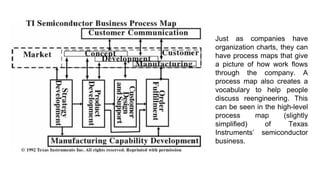
Just as companies have
organization charts, they can
have process maps that give
a picture of how work flows
through the company. A
process map also creates a
vocabulary to help people
discuss reengineering. This
can be seen in the high-level
process map (slightly
simplified) of Texas
Instruments’ semiconductor
business.
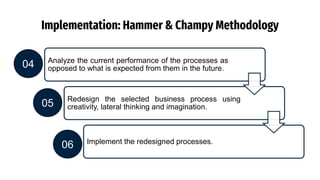
Implementation: Hammer & Champy Methodology
Analyze the current performance of the processes as
opposed to what is expected from them in the future.
Redesign the selected business process using
creativity, lateral thinking and imagination.
Implement the redesigned processes.
04
05
06
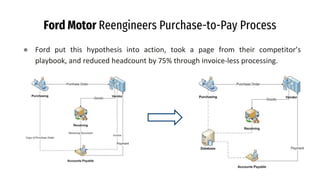
Ford Motor Reengineers Purchase-to-Pay Process
● The American automotive giant was probably
web by the news that Japanese competitor
Mazda had operated with an Accounts
Payable team of 5. Ford had a whopping
headcount of 500 for the same department.
● Ford formulated a hypothesis — if we rethink
how Accounts Payable, part of the Procure-
to-Pay process, creates value, then we can
restructure our entire approach to invoicing,
and thus, save a lot of money.
Ford Motor Reengineers Purchase-to-Pay Process
● Ford put this hypothesis into action, took a page from their competitor’s
playbook, and reduced headcount by 75% through invoice-less processing.
Taco Bell – A Reengineered Come Back
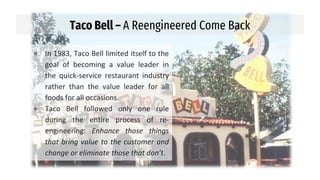
● In 1983, Taco Bell limited itself to the
goal of becoming a value leader in
the quick-service restaurant industry
rather than the value leader for all
foods for all occasions.
● Taco Bell followed only one rule
during the entire process of re-
engineering: Enhance those things
that bring value to the customer and
change or eliminate those that don’t.
Taco Bell – A Reengineered Come Back
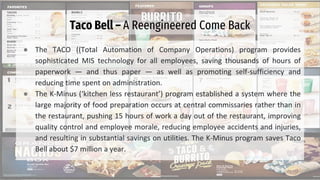
● The TACO ((Total Automation of Company Operations) program provides
sophisticated MIS technology for all employees, saving thousands of hours of
paperwork — and thus paper — as well as promoting self-sufficiency and
reducing time spent on administration.
● The K-Minus (‘kitchen less restaurant’) program established a system where the
large majority of food preparation occurs at central commissaries rather than in
the restaurant, pushing 15 hours of work a day out of the restaurant, improving
quality control and employee morale, reducing employee accidents and injuries,
and resulting in substantial savings on utilities. The K-Minus program saves Taco
Bell about $7 million a year.
Thank you!
References
● Ford Case: https://bprford.wordpress.com/2014/03/12/business-process-
reengineering-fords-accounts-payable-case-study/
● Re-engineering the Corporation by Michael Hammer and James Champy.
● Article by Bain and Company:
https://www.bain.com/insights/management-tools-business-process-
reengineering/#:~:text=Business%20Process%20Reengineering%20reduce
s%20costs,Improve%20quality

Business Process Re-engineering

  • 1.
    Business Process Re-engineering Prachi Singla| Prajjwal Vij MBA HR (2021-23)
  • 2.
    Definition ● We definea business process as a collection of activities that takes one or more kinds of input and creates an output that is of value to the customer. ● “Reengineering,” properly, is the fundamental rethinking and radical redesign of business processes to achieve dramatic improvements in critical, contemporary measures of performance, such as cost, quality, service, and speed. - Michael Hammer and James Champy
  • 3.
    Why BPR? To reducethe cost and cycle time by accelerating information flow and elimination errors. To improve the quality by reducing fragmentation of work. To return from stagnated growth phase and arrest maturity of organization. To place increased emphasis/refocus practices on customer needs.
  • 4.
    Implementation: Hammer &Champy Methodology The CEO who initiates the reengineering process should introduce it to the employees by explaining the current situation of the company and his/her future vision for the company. Identify business processes in terms of how they interact within the company and in relation to the outside world. Here process maps can be used to visualize the processes. Select the processes that have the potential to bring value to the company once reengineered and those that are easy to be re-engineered. 01 02 03
  • 5.
    Just as companieshave organization charts, they can have process maps that give a picture of how work flows through the company. A process map also creates a vocabulary to help people discuss reengineering. This can be seen in the high-level process map (slightly simplified) of Texas Instruments’ semiconductor business.
  • 6.
    Implementation: Hammer &Champy Methodology Analyze the current performance of the processes as opposed to what is expected from them in the future. Redesign the selected business process using creativity, lateral thinking and imagination. Implement the redesigned processes. 04 05 06
  • 7.
    Ford Motor ReengineersPurchase-to-Pay Process ● The American automotive giant was probably web by the news that Japanese competitor Mazda had operated with an Accounts Payable team of 5. Ford had a whopping headcount of 500 for the same department. ● Ford formulated a hypothesis — if we rethink how Accounts Payable, part of the Procure- to-Pay process, creates value, then we can restructure our entire approach to invoicing, and thus, save a lot of money.
  • 8.
    Ford Motor ReengineersPurchase-to-Pay Process ● Ford put this hypothesis into action, took a page from their competitor’s playbook, and reduced headcount by 75% through invoice-less processing.
  • 9.
    Taco Bell –A Reengineered Come Back ● In 1983, Taco Bell limited itself to the goal of becoming a value leader in the quick-service restaurant industry rather than the value leader for all foods for all occasions. ● Taco Bell followed only one rule during the entire process of re- engineering: Enhance those things that bring value to the customer and change or eliminate those that don’t.
  • 10.
    Taco Bell –A Reengineered Come Back ● The TACO ((Total Automation of Company Operations) program provides sophisticated MIS technology for all employees, saving thousands of hours of paperwork — and thus paper — as well as promoting self-sufficiency and reducing time spent on administration. ● The K-Minus (‘kitchen less restaurant’) program established a system where the large majority of food preparation occurs at central commissaries rather than in the restaurant, pushing 15 hours of work a day out of the restaurant, improving quality control and employee morale, reducing employee accidents and injuries, and resulting in substantial savings on utilities. The K-Minus program saves Taco Bell about $7 million a year.
  • 11.
  • 12.
    References ● Ford Case:https://bprford.wordpress.com/2014/03/12/business-process- reengineering-fords-accounts-payable-case-study/ ● Re-engineering the Corporation by Michael Hammer and James Champy. ● Article by Bain and Company: https://www.bain.com/insights/management-tools-business-process- reengineering/#:~:text=Business%20Process%20Reengineering%20reduce s%20costs,Improve%20quality