PROFESSIONAL
RIGHTS
PRACHI SINGLA (17)
MBA HR – 4TH SEMESTER
MEANING
• Professional rights refer to the specific privileges, protections, and
entitlements that are granted to individuals who have specialized
knowledge or expertise in a particular field or profession.
• The specific rights that professionals have can vary depending on their field and
the laws and regulations that apply to them. These rights are designed to help
ensure that professionals are able to perform their jobs effectively and without
undue interference.
• They may include things like the ability to make independent decisions, access to
confidential information, and protections against retaliation.
KEY PRINCIPLES
• Expertise: Professionals are expected to have a high level of knowledge, skill, and
expertise in their field, and are often granted certain privileges as a result. For
example, doctors may be granted the right to prescribe medication or
perform surgery, while lawyers may be granted the right to provide legal
advice or represent clients in court.
• Autonomy: Professionals are typically granted a high degree of autonomy and
independence in their work. This means that they are able to make independent
decisions based on their professional judgment, without undue interference or
influence from others.
KEY PRINCIPLES
• Accountability: Professionals are also held to a high standard of accountability,
both to their clients and to society at large. This may include things like
maintaining confidentiality, adhering to ethical standards, and providing high-
quality services.
• Professionalism: Professionals are expected to conduct themselves in a
professional manner at all times, including being respectful and courteous to
clients and colleagues, maintaining appropriate boundaries, and upholding the
values and principles of their profession.
IMPLEMENTATION OF PROFESSIONAL RIGHTS
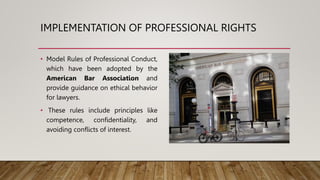
• Model Rules of Professional Conduct,
which have been adopted by the
American Bar Association and
provide guidance on ethical behavior
for lawyers.
• These rules include principles like
competence, confidentiality, and
avoiding conflicts of interest.
IMPLEMENTATION OF PROFESSIONAL RIGHTS
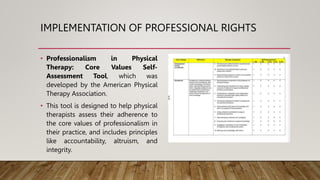
• Professionalism in Physical
Therapy: Core Values Self-
Assessment Tool, which was
developed by the American Physical
Therapy Association.
• This tool is designed to help physical
therapists assess their adherence to
the core values of professionalism in
their practice, and includes principles
like accountability, altruism, and
integrity.
VISHAKA AND OTHERS V/S STATE OF RAJASTHAN
• Vishaka and Others v. State of Rajasthan (1997), the Supreme Court of India held
that sexual harassment is a violation of a woman's fundamental right to equality
under Article 14 of the Constitution of India, and that it is the duty of employers
to prevent and address such harassment in the workplace.
• The court also outlined a set of guidelines for preventing sexual harassment,
which were later incorporated into the Sexual Harassment of Women at
Workplace Act of 2013.
• These guidelines include the establishment of a complaints committee to receive
and investigate complaints of sexual harassment, the creation of an environment
in which women feel comfortable reporting harassment, and the provision of
training and education on sexual harassment for all employees.
VISHAKA AND OTHERS V/S STATE OF RAJASTHAN
• The case is relevant to professional
rights because it recognizes the
importance of creating a safe and
respectful workplace for all
professionals, and emphasizes the
duty of employers to protect the
rights of their employees. It also
highlights the need for professionals
to be aware of their rights and to
advocate for their own safety and
well-being in the workplace.
REFERENCES
• American Medical Association. (n.d.). Code of Medical Ethics. Retrieved from https://www.ama-assn.org/delivering-
care/ethics/code-medical-ethics-overview
• American Physical Therapy Association. (n.d.). Professionalism in Physical Therapy: Core Values Self-Assessment Tool.
Retrieved from https://www.apta.org/contentassets/204e1c256f7b4d2db4e4a4f49cf38469/professionalism-in-
physical-therapy--core-values-self-assessment-tool.pdf
• American Bar Association. (2021). Model Rules of Professional Conduct. Retrieved from
https://www.americanbar.org/groups/professional_responsibility/publications/model_rules_of_professional_conduct/
model_rules_of_professional_conduct_table_of_contents/
• Vishaka and Others v. State of Rajasthan, (1997) 6 SCC 241.
• Sexual Harassment of Women at Workplace (Prevention, Prohibition and Redressal) Act, 2013. Retrieved from
https://wcd.nic.in/sites/default/files/SHW%20%28PPR%29%20Act%202013_0.pdf
• Page 133 of textbook

Professional Rights

  • 1.
  • 2.
    MEANING • Professional rightsrefer to the specific privileges, protections, and entitlements that are granted to individuals who have specialized knowledge or expertise in a particular field or profession. • The specific rights that professionals have can vary depending on their field and the laws and regulations that apply to them. These rights are designed to help ensure that professionals are able to perform their jobs effectively and without undue interference. • They may include things like the ability to make independent decisions, access to confidential information, and protections against retaliation.
  • 3.
    KEY PRINCIPLES • Expertise:Professionals are expected to have a high level of knowledge, skill, and expertise in their field, and are often granted certain privileges as a result. For example, doctors may be granted the right to prescribe medication or perform surgery, while lawyers may be granted the right to provide legal advice or represent clients in court. • Autonomy: Professionals are typically granted a high degree of autonomy and independence in their work. This means that they are able to make independent decisions based on their professional judgment, without undue interference or influence from others.
  • 4.
    KEY PRINCIPLES • Accountability:Professionals are also held to a high standard of accountability, both to their clients and to society at large. This may include things like maintaining confidentiality, adhering to ethical standards, and providing high- quality services. • Professionalism: Professionals are expected to conduct themselves in a professional manner at all times, including being respectful and courteous to clients and colleagues, maintaining appropriate boundaries, and upholding the values and principles of their profession.
  • 5.
    IMPLEMENTATION OF PROFESSIONALRIGHTS • Model Rules of Professional Conduct, which have been adopted by the American Bar Association and provide guidance on ethical behavior for lawyers. • These rules include principles like competence, confidentiality, and avoiding conflicts of interest.
  • 6.
    IMPLEMENTATION OF PROFESSIONALRIGHTS • Professionalism in Physical Therapy: Core Values Self- Assessment Tool, which was developed by the American Physical Therapy Association. • This tool is designed to help physical therapists assess their adherence to the core values of professionalism in their practice, and includes principles like accountability, altruism, and integrity.
  • 7.
    VISHAKA AND OTHERSV/S STATE OF RAJASTHAN • Vishaka and Others v. State of Rajasthan (1997), the Supreme Court of India held that sexual harassment is a violation of a woman's fundamental right to equality under Article 14 of the Constitution of India, and that it is the duty of employers to prevent and address such harassment in the workplace. • The court also outlined a set of guidelines for preventing sexual harassment, which were later incorporated into the Sexual Harassment of Women at Workplace Act of 2013. • These guidelines include the establishment of a complaints committee to receive and investigate complaints of sexual harassment, the creation of an environment in which women feel comfortable reporting harassment, and the provision of training and education on sexual harassment for all employees.
  • 8.
    VISHAKA AND OTHERSV/S STATE OF RAJASTHAN • The case is relevant to professional rights because it recognizes the importance of creating a safe and respectful workplace for all professionals, and emphasizes the duty of employers to protect the rights of their employees. It also highlights the need for professionals to be aware of their rights and to advocate for their own safety and well-being in the workplace.
  • 9.
    REFERENCES • American MedicalAssociation. (n.d.). Code of Medical Ethics. Retrieved from https://www.ama-assn.org/delivering- care/ethics/code-medical-ethics-overview • American Physical Therapy Association. (n.d.). Professionalism in Physical Therapy: Core Values Self-Assessment Tool. Retrieved from https://www.apta.org/contentassets/204e1c256f7b4d2db4e4a4f49cf38469/professionalism-in- physical-therapy--core-values-self-assessment-tool.pdf • American Bar Association. (2021). Model Rules of Professional Conduct. Retrieved from https://www.americanbar.org/groups/professional_responsibility/publications/model_rules_of_professional_conduct/ model_rules_of_professional_conduct_table_of_contents/ • Vishaka and Others v. State of Rajasthan, (1997) 6 SCC 241. • Sexual Harassment of Women at Workplace (Prevention, Prohibition and Redressal) Act, 2013. Retrieved from https://wcd.nic.in/sites/default/files/SHW%20%28PPR%29%20Act%202013_0.pdf • Page 133 of textbook

Editor's Notes

  • #4 Some of the key principles that underpin professional rights include: Expertise: Professionals are expected to have a high level of knowledge, skill, and expertise in their field, and are often granted certain privileges as a result. For example, doctors may be granted the right to prescribe medication or perform surgery, while lawyers may be granted the right to provide legal advice or represent clients in court. Autonomy: Professionals are typically granted a high degree of autonomy and independence in their work. This means that they are able to make independent decisions based on their professional judgment, without undue interference or influence from others. Accountability: Professionals are also held to a high standard of accountability, both to their clients and to society at large. This may include things like maintaining confidentiality, adhering to ethical standards, and providing high-quality services. Professionalism: Professionals are expected to conduct themselves in a professional manner at all times, including being respectful and courteous to clients and colleagues, maintaining appropriate boundaries, and upholding the values and principles of their profession.
  • #5 Some of the key principles that underpin professional rights include: Expertise: Professionals are expected to have a high level of knowledge, skill, and expertise in their field, and are often granted certain privileges as a result. For example, doctors may be granted the right to prescribe medication or perform surgery, while lawyers may be granted the right to provide legal advice or represent clients in court. Autonomy: Professionals are typically granted a high degree of autonomy and independence in their work. This means that they are able to make independent decisions based on their professional judgment, without undue interference or influence from others. Accountability: Professionals are also held to a high standard of accountability, both to their clients and to society at large. This may include things like maintaining confidentiality, adhering to ethical standards, and providing high-quality services. Professionalism: Professionals are expected to conduct themselves in a professional manner at all times, including being respectful and courteous to clients and colleagues, maintaining appropriate boundaries, and upholding the values and principles of their profession.