Target and Life
Cycle Costing
Instructor: Ms Ankita
By Ankita Choudhary & Prachi Singla
Target Costing
Target costing is a structural
approach to determine the cost at
which a proposed product with
specified function and quality
must be produced, to generate a
desired level of profitability at its
anticipated selling price.
Concept
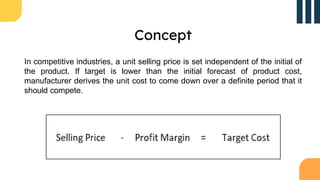
In competitive industries, a unit selling price is set independent of the initial of
the product. If target is lower than the initial forecast of product cost,
manufacturer derives the unit cost to come down over a definite period that it
should compete.
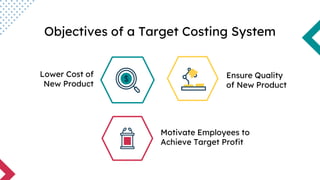
Objectives of a Target Costing System
Lower Cost of
New Product
Motivate Employees to
Achieve Target Profit
Ensure Quality
of New Product
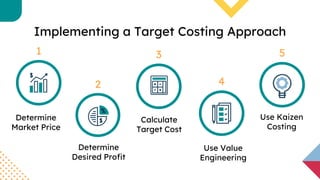
Implementing a Target Costing Approach
Determine
Market Price
1
Calculate
Target Cost
3
Use Kaizen
Costing
5
Use Value
Engineering
4
Determine
Desired Profit
2
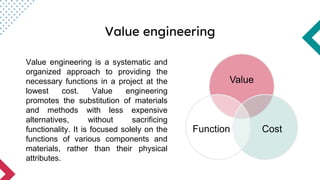
Value engineering
Value engineering is a systematic and
organized approach to providing the
necessary functions in a project at the
lowest cost. Value engineering
promotes the substitution of materials
and methods with less expensive
alternatives, without sacrificing
functionality. It is focused solely on the
functions of various components and
materials, rather than their physical
attributes.
Value
Cost
Function
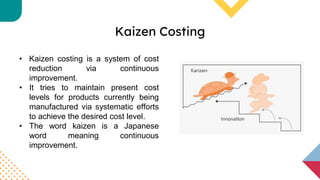
Kaizen Costing
• Kaizen costing is a system of cost
reduction via continuous
improvement.
• It tries to maintain present cost
levels for products currently being
manufactured via systematic efforts
to achieve the desired cost level.
• The word kaizen is a Japanese
word meaning continuous
improvement.
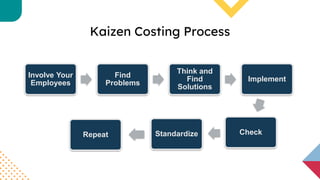
Kaizen Costing Process
Involve Your
Employees
Find
Problems
Think and
Find
Solutions
Implement
Check
Standardize
Repeat
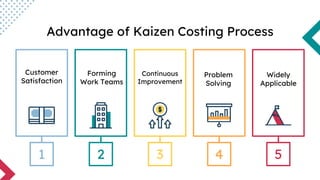
Advantage of Kaizen Costing Process
1
Customer
Satisfaction
2
Forming
Work Teams
3
Continuous
Improvement
5
Widely
Applicable
4
Problem
Solving
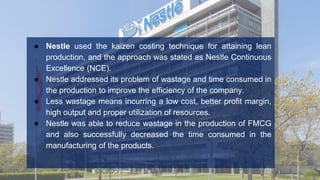
● Nestle used the kaizen costing technique for attaining lean
production, and the approach was stated as Nestle Continuous
Excellence (NCE).
● Nestle addressed its problem of wastage and time consumed in
the production to improve the efficiency of the company.
● Less wastage means incurring a low cost, better profit margin,
high output and proper utilization of resources.
● Nestle was able to reduce wastage in the production of FMCG
and also successfully decreased the time consumed in the
manufacturing of the products.
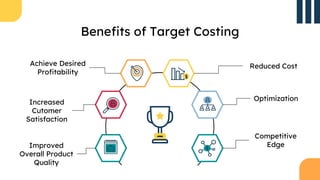
Benefits of Target Costing
Achieve Desired
Profitability
Increased
Cutomer
Satisfaction
Improved
Overall Product
Quality
Reduced Cost
Optimization
Competitive
Edge
● Toyota is among the world’s most successful automakers.
● The reason for Toyota’s success is that it is able to consistently produce
high-quality cars with attractive features at competitive prices.
● Target costing, a method Toyota pioneered in the 1960s, is one method it
uses to achieve high quality and desirable features at a competitive price.
● The balancing of costs, features, and quality takes place throughout the
design, manufacturing, sale and service of the car but has the strongest
influence in the first phase, design.
● When design alternatives are being examined and selected, Toyota has
the maximum flexibility for choosing options that affect manufacturing and
all other product costs such as customer service and warranty work.
● Once the design is complete and manufacturing has begun, the cost
consequences of thechoice of features and manufacturing methods are set
until the next model change.
● As a result, the development of a good, cost-effective design is critical.
Target costing places a strong focus on using the design process to
improve the product and reduce its cost.
● For example, in the redesign of the Camry, Toyota made the running
lamps part of the headlamp assembly and made the grill part of the
bumper, which saves time and materials in manufacturing and produces a
more crash-resistant bumper—a win/win for Toyota and the car buyer.
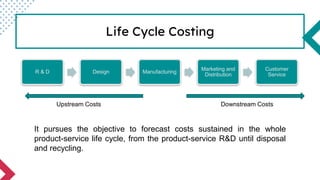
R & D Design Manufacturing
Marketing and
Distribution
Customer
Service
Upstream Costs Downstream Costs
It pursues the objective to forecast costs sustained in the whole
product-service life cycle, from the product-service R&D until disposal
and recycling.
Life Cycle Costing
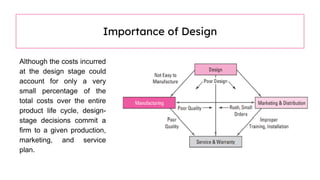
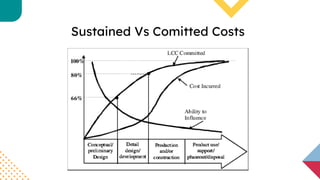
Although the costs incurred
at the design stage could
account for only a very
small percentage of the
total costs over the entire
product life cycle, design-
stage decisions commit a
firm to a given production,
marketing, and service
plan.
Importance of Design
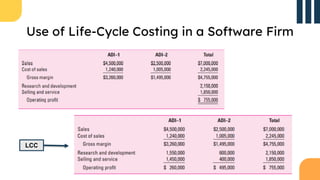
Use of Life-Cycle Costing in a Software Firm
LCC
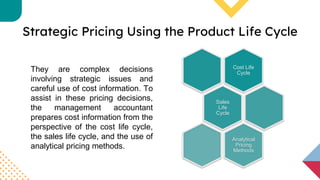
Strategic Pricing Using the Product Life Cycle
They are complex decisions
involving strategic issues and
careful use of cost information. To
assist in these pricing decisions,
the management accountant
prepares cost information from the
perspective of the cost life cycle,
the sales life cycle, and the use of
analytical pricing methods.
Cost Life
Cycle
Sales
Life
Cycle
Analytical
Pricing
Methods
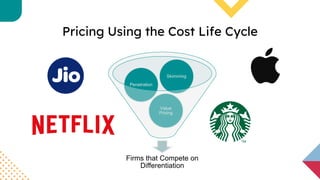
Pricing Using the Cost Life Cycle
Firms that Compete on
Differentiation
Value
Pricing
Penetration
Skimming
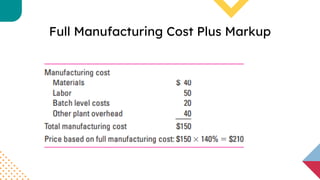
Full Manufacturing Cost Plus Markup
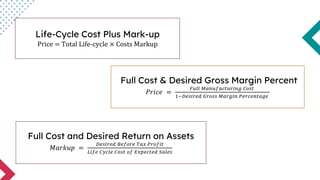
Life-Cycle Cost Plus Mark-up
Price = Total Life-cycle × Costs Markup
Full Cost & Desired Gross Margin Percent
𝑃𝑟𝑖𝑐𝑒 =
𝐹𝑢𝑙𝑙 𝑀𝑎𝑛𝑢𝑓𝑎𝑐𝑡𝑢𝑟𝑖𝑛𝑔 𝐶𝑜𝑠𝑡
1−𝐷𝑒𝑠𝑖𝑟𝑒𝑑 𝐺𝑟𝑜𝑠𝑠 𝑀𝑎𝑟𝑔𝑖𝑛 𝑃𝑒𝑟𝑐𝑒𝑛𝑡𝑎𝑔𝑒
Full Cost and Desired Return on Assets
𝑀𝑎𝑟𝑘𝑢𝑝 =
𝐷𝑒𝑠𝑖𝑟𝑒𝑑 𝐵𝑒𝑓𝑜𝑟𝑒 𝑇𝑎𝑥 𝑃𝑟𝑜𝑓𝑖𝑡
𝐿𝑖𝑓𝑒 𝐶𝑦𝑐𝑙𝑒 𝐶𝑜𝑠𝑡 𝑜𝑓 𝐸𝑥𝑝𝑒𝑐𝑡𝑒𝑑 𝑆𝑎𝑙𝑒𝑠
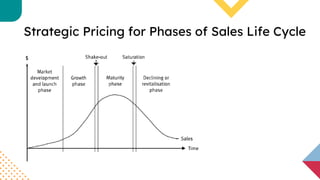
Strategic Pricing for Phases of Sales Life Cycle
Strategic Pricing: Analytical Pricing Methods
Sustained Vs Comitted Costs
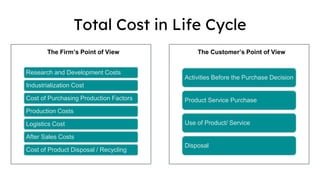
Total Cost in Life Cycle
The Firm’s Point of View The Customer’s Point of View
Research and Development Costs
Industrialization Cost
Cost of Purchasing Production Factors
Production Costs
Logistics Cost
After Sales Costs
Cost of Product Disposal / Recycling
Activities Before the Purchase Decision
Product Service Purchase
Use of Product/ Service
Disposal
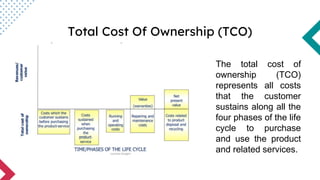
Total Cost Of Ownership (TCO)
The total cost of
ownership (TCO)
represents all costs
that the customer
sustains along all the
four phases of the life
cycle to purchase
and use the product
and related services.
TCO: Data from Different Industries
(Reference 2).
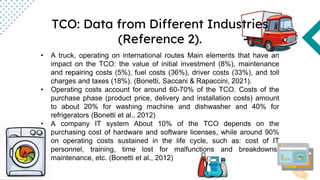
• A truck, operating on international routes Main elements that have an
impact on the TCO: the value of initial investment (8%), maintenance
and repairing costs (5%), fuel costs (36%), driver costs (33%), and toll
charges and taxes (18%). (Bonetti, Saccani & Rapaccini, 2021).
• Operating costs account for around 60-70% of the TCO. Costs of the
purchase phase (product price, delivery and installation costs) amount
to about 20% for washing machine and dishwasher and 40% for
refrigerators (Bonetti et al., 2012)
• A company IT system About 10% of the TCO depends on the
purchasing cost of hardware and software licenses, while around 90%
on operating costs sustained in the life cycle, such as: cost of IT
personnel, training, time lost for malfunctions and breakdowns,
maintenance, etc. (Bonetti et al., 2012)
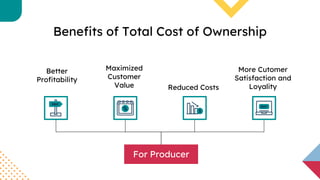
Benefits of Total Cost of Ownership
Better
Profitability
For Producer
Maximized
Customer
Value Reduced Costs
More Cutomer
Satisfaction and
Loyality
Thank you
References
1. Bonetti et al., 2012: https://www.sciencedirect.com/science/article/pii/S2212827116300397
2. Servitization Strategy and Managerial Control by Anna Pistoni, Lucrezia Songini Page
131 (https://books.google.co.in/books?id=ZJJADwAAQBAJ&lpg=PA131&ots=V_5-
30G2AY&dq=A%20truck%2C%20operating%20on%20international%20routes%20Main%
20elements%20that%20have%20an%20impact%20on%20the%20TCO%3A%20the%20v
alue%20of%20initial%20investment%20(8%25)%2C%20maintenance%20and%20repairin
g%20costs%20(5%25)%2C%20fuel%20costs%20(36%25)%2C%20driver%20costs%20(3
3%25)%2C%20and%20toll%20charges%20and%20taxes%20(18%25).&pg=PA131#v=on
epage&q=A%20truck,%20operating%20on%20international%20routes%20Main%20eleme
nts%20that%20have%20an%20impact%20on%20the%20TCO:%20the%20value%20of%
20initial%20investment%20(8%25),%20maintenance%20and%20repairing%20costs%20(
5%25),%20fuel%20costs%20(36%25),%20driver%20costs%20(33%25),%20and%20toll%
20charges%20and%20taxes%20(18%25).&f=false)
3. Cost Management_ a strategic emphasis by Blocher, Stout and Cokins.

Target Costing and Life Cycle Costing

  • 1.
    Target and Life CycleCosting Instructor: Ms Ankita By Ankita Choudhary & Prachi Singla
  • 2.
    Target Costing Target costingis a structural approach to determine the cost at which a proposed product with specified function and quality must be produced, to generate a desired level of profitability at its anticipated selling price.
  • 3.
    Concept In competitive industries,a unit selling price is set independent of the initial of the product. If target is lower than the initial forecast of product cost, manufacturer derives the unit cost to come down over a definite period that it should compete.
  • 4.
    Objectives of aTarget Costing System Lower Cost of New Product Motivate Employees to Achieve Target Profit Ensure Quality of New Product
  • 5.
    Implementing a TargetCosting Approach Determine Market Price 1 Calculate Target Cost 3 Use Kaizen Costing 5 Use Value Engineering 4 Determine Desired Profit 2
  • 6.
    Value engineering Value engineeringis a systematic and organized approach to providing the necessary functions in a project at the lowest cost. Value engineering promotes the substitution of materials and methods with less expensive alternatives, without sacrificing functionality. It is focused solely on the functions of various components and materials, rather than their physical attributes. Value Cost Function
  • 7.
    Kaizen Costing • Kaizencosting is a system of cost reduction via continuous improvement. • It tries to maintain present cost levels for products currently being manufactured via systematic efforts to achieve the desired cost level. • The word kaizen is a Japanese word meaning continuous improvement.
  • 8.
    Kaizen Costing Process InvolveYour Employees Find Problems Think and Find Solutions Implement Check Standardize Repeat
  • 9.
    Advantage of KaizenCosting Process 1 Customer Satisfaction 2 Forming Work Teams 3 Continuous Improvement 5 Widely Applicable 4 Problem Solving
  • 10.
    ● Nestle usedthe kaizen costing technique for attaining lean production, and the approach was stated as Nestle Continuous Excellence (NCE). ● Nestle addressed its problem of wastage and time consumed in the production to improve the efficiency of the company. ● Less wastage means incurring a low cost, better profit margin, high output and proper utilization of resources. ● Nestle was able to reduce wastage in the production of FMCG and also successfully decreased the time consumed in the manufacturing of the products.
  • 11.
    Benefits of TargetCosting Achieve Desired Profitability Increased Cutomer Satisfaction Improved Overall Product Quality Reduced Cost Optimization Competitive Edge
  • 12.
    ● Toyota isamong the world’s most successful automakers. ● The reason for Toyota’s success is that it is able to consistently produce high-quality cars with attractive features at competitive prices. ● Target costing, a method Toyota pioneered in the 1960s, is one method it uses to achieve high quality and desirable features at a competitive price. ● The balancing of costs, features, and quality takes place throughout the design, manufacturing, sale and service of the car but has the strongest influence in the first phase, design. ● When design alternatives are being examined and selected, Toyota has the maximum flexibility for choosing options that affect manufacturing and all other product costs such as customer service and warranty work.
  • 13.
    ● Once thedesign is complete and manufacturing has begun, the cost consequences of thechoice of features and manufacturing methods are set until the next model change. ● As a result, the development of a good, cost-effective design is critical. Target costing places a strong focus on using the design process to improve the product and reduce its cost. ● For example, in the redesign of the Camry, Toyota made the running lamps part of the headlamp assembly and made the grill part of the bumper, which saves time and materials in manufacturing and produces a more crash-resistant bumper—a win/win for Toyota and the car buyer.
  • 14.
    R & DDesign Manufacturing Marketing and Distribution Customer Service Upstream Costs Downstream Costs It pursues the objective to forecast costs sustained in the whole product-service life cycle, from the product-service R&D until disposal and recycling. Life Cycle Costing
  • 15.
    Although the costsincurred at the design stage could account for only a very small percentage of the total costs over the entire product life cycle, design- stage decisions commit a firm to a given production, marketing, and service plan. Importance of Design
  • 16.
    Use of Life-CycleCosting in a Software Firm LCC
  • 17.
    Strategic Pricing Usingthe Product Life Cycle They are complex decisions involving strategic issues and careful use of cost information. To assist in these pricing decisions, the management accountant prepares cost information from the perspective of the cost life cycle, the sales life cycle, and the use of analytical pricing methods. Cost Life Cycle Sales Life Cycle Analytical Pricing Methods
  • 18.
    Pricing Using theCost Life Cycle Firms that Compete on Differentiation Value Pricing Penetration Skimming
  • 19.
  • 20.
    Life-Cycle Cost PlusMark-up Price = Total Life-cycle × Costs Markup Full Cost & Desired Gross Margin Percent 𝑃𝑟𝑖𝑐𝑒 = 𝐹𝑢𝑙𝑙 𝑀𝑎𝑛𝑢𝑓𝑎𝑐𝑡𝑢𝑟𝑖𝑛𝑔 𝐶𝑜𝑠𝑡 1−𝐷𝑒𝑠𝑖𝑟𝑒𝑑 𝐺𝑟𝑜𝑠𝑠 𝑀𝑎𝑟𝑔𝑖𝑛 𝑃𝑒𝑟𝑐𝑒𝑛𝑡𝑎𝑔𝑒 Full Cost and Desired Return on Assets 𝑀𝑎𝑟𝑘𝑢𝑝 = 𝐷𝑒𝑠𝑖𝑟𝑒𝑑 𝐵𝑒𝑓𝑜𝑟𝑒 𝑇𝑎𝑥 𝑃𝑟𝑜𝑓𝑖𝑡 𝐿𝑖𝑓𝑒 𝐶𝑦𝑐𝑙𝑒 𝐶𝑜𝑠𝑡 𝑜𝑓 𝐸𝑥𝑝𝑒𝑐𝑡𝑒𝑑 𝑆𝑎𝑙𝑒𝑠
  • 21.
    Strategic Pricing forPhases of Sales Life Cycle
  • 22.
  • 23.
  • 24.
    Total Cost inLife Cycle The Firm’s Point of View The Customer’s Point of View Research and Development Costs Industrialization Cost Cost of Purchasing Production Factors Production Costs Logistics Cost After Sales Costs Cost of Product Disposal / Recycling Activities Before the Purchase Decision Product Service Purchase Use of Product/ Service Disposal
  • 25.
    Total Cost OfOwnership (TCO) The total cost of ownership (TCO) represents all costs that the customer sustains along all the four phases of the life cycle to purchase and use the product and related services.
  • 26.
    TCO: Data fromDifferent Industries (Reference 2). • A truck, operating on international routes Main elements that have an impact on the TCO: the value of initial investment (8%), maintenance and repairing costs (5%), fuel costs (36%), driver costs (33%), and toll charges and taxes (18%). (Bonetti, Saccani & Rapaccini, 2021). • Operating costs account for around 60-70% of the TCO. Costs of the purchase phase (product price, delivery and installation costs) amount to about 20% for washing machine and dishwasher and 40% for refrigerators (Bonetti et al., 2012) • A company IT system About 10% of the TCO depends on the purchasing cost of hardware and software licenses, while around 90% on operating costs sustained in the life cycle, such as: cost of IT personnel, training, time lost for malfunctions and breakdowns, maintenance, etc. (Bonetti et al., 2012)
  • 27.
    Benefits of TotalCost of Ownership Better Profitability For Producer Maximized Customer Value Reduced Costs More Cutomer Satisfaction and Loyality
  • 28.
  • 29.
    References 1. Bonetti etal., 2012: https://www.sciencedirect.com/science/article/pii/S2212827116300397 2. Servitization Strategy and Managerial Control by Anna Pistoni, Lucrezia Songini Page 131 (https://books.google.co.in/books?id=ZJJADwAAQBAJ&lpg=PA131&ots=V_5- 30G2AY&dq=A%20truck%2C%20operating%20on%20international%20routes%20Main% 20elements%20that%20have%20an%20impact%20on%20the%20TCO%3A%20the%20v alue%20of%20initial%20investment%20(8%25)%2C%20maintenance%20and%20repairin g%20costs%20(5%25)%2C%20fuel%20costs%20(36%25)%2C%20driver%20costs%20(3 3%25)%2C%20and%20toll%20charges%20and%20taxes%20(18%25).&pg=PA131#v=on epage&q=A%20truck,%20operating%20on%20international%20routes%20Main%20eleme nts%20that%20have%20an%20impact%20on%20the%20TCO:%20the%20value%20of% 20initial%20investment%20(8%25),%20maintenance%20and%20repairing%20costs%20( 5%25),%20fuel%20costs%20(36%25),%20driver%20costs%20(33%25),%20and%20toll% 20charges%20and%20taxes%20(18%25).&f=false) 3. Cost Management_ a strategic emphasis by Blocher, Stout and Cokins.