Current Scenario of National
Stock Exchange
Current Scenario of National
Stock Exchange
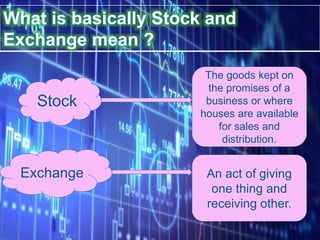
Stock
Exchange An act of giving
one thing and
receiving other.
The goods kept on
the promises of a
business or where
houses are available
for sales and
distribution.
A place where securities are brought and
sold is known as stock exchange.
NATIONAL STOCK EXCHANGE
TYPE STOCK EXCHNGE
LOCATION MUMBAI, INDIA
FOUNDED 1992
OWNER NATIONAL STOCK EXCHANGE OF INDIA
LTD.
CURRENCY INDIAN RUPEE ( ₹ )
INDICES S&P CNX NIFTY
CNX NIFTY JUNIOR
S&P CNX 500
WEBSITE www.nseindia.com
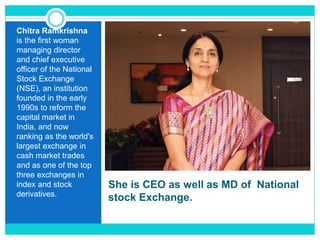
MANAGING DIRECTOR CHITRA RAMKRISHNAN
She is CEO as well as MD of National
stock Exchange.
Chitra Ramkrishna
is the first woman
managing director
and chief executive
officer of the National
Stock Exchange
(NSE), an institution
founded in the early
1990s to reform the
capital market in
India, and now
ranking as the world's
largest exchange in
cash market trades
and as one of the top
three exchanges in
index and stock
derivatives.
History
HISTORY
 At present there are 24 stock exchanges in the country, 21 of
them being regional ones with allotted areas. Two others set
up in the reform era, viz., the National Stock Exchange (NSE)
and Over the Counter Exchange of India (OTCEI), have
mandate to have nation-wise trading.
 The Stock Exchanges are being administered by their
governing boards and executive chiefs. Policies relating to
their regulation and control are laid down by the Ministry of
Finance. Government also Constituted Securities and
Exchange Board of India (SEBI) in April 1988 for orderly
development and regulation of securities industry and stock
exchanges.
REGULATORY AUTHORITY
Regulatory authority is the one which is under the
government surveillance.
A few stock exchanges companies follow the rules
which are laid down by the government of India.
1) SEBI ( securities and exchange Board of India)
2) RBI ( Reserve Bank Of India)
SEBI
 The Securities and Exchange Board of India (SEBI)
is the regulatory authority established under the
SEBI Act 1992 and is the principal regulator for
Stock Exchanges in India.
 SEBI protects the interests of investors in securities and
promotes the development of securities market.
 The board helps in making registration and regulate
the functioning.
 SEBI conducts inspection and thus prohibits fraudulent
practices.
RBI
 RBI is the appex bank of India.
 RBI is also known as banker’s banks.
 Maintains price stability.
 Provides cost effective banking services to the public.
Role Of Stock Exchange
 Raising capital for businesses
 Mobilizing savings for investment
 Facilitating company growth
 Profit sharing
 Creating investment opportunities for small investors
 Government capital-raising for development projects
 Barometer of the economy
Market Segments of NSE
 NSEI trades in the following two segments:
 1. Whole Sale Debt Market Segment:
This segment refers to the trading platform for a wide range of
fixed income securities like central government securities, bonds
issued by public sector undertakings, zero coupon bonds,
treasury bills, commercial papers, certificates of deposit, mutual
funds, corporate debentures etc.
 2. Capital Market System:
This segment of NSEI provides a platform for transparent and
fair trading of equity, preference shares, debentures, exchange
traded funds as well as retail Government securities.
Markets Of NSE
Equities :-
 Equities
 Indices
 Mutual Funds
 Initial Public Offerings
 Security Lending and Borrowing Scheme
Cont…………
Derivatives:-
 Equity Derivatives
 Currency Derivatives
 Interest Rate Futures
Debt:-
 Corporate Bonds
Groups Of NSE
 National Securities Clearing Corporation Limited
(NSCCL) 1995
 NSE InfoTech Services Limited (NSETECH)
 India Index Services & Products Ltd. (IISL)
1998
 DotEx International. Ltd. (DotEx)
ASSOCIATE / AFFILIATE COMPANIES
 National Securities Depository Ltd. (NSDL)
 National Commodity & Derivatives Exchange Ltd.
(NCDEX)
 Power Exchange India Limited (PXIL)
Objectives Of NSE
 The important objectives of the NSE are given below:
 (i) To provide a fair, transparent and efficient securities
market to investors using electronic trading system.
 (ii) To establish nationwide trading facility for equities and
debt instruments.
 (iii) To ensure equal access to investors all over the
country through an appropriate communication network.
 (iv) To improve the standard of securities market to
international level.
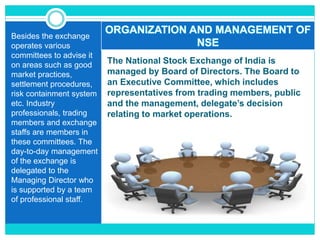
The National Stock Exchange of India is
managed by Board of Directors. The Board to
an Executive Committee, which includes
representatives from trading members, public
and the management, delegate’s decision
relating to market operations.
Besides the exchange
operates various
committees to advise it
on areas such as good
market practices,
settlement procedures,
risk containment system
etc. Industry
professionals, trading
members and exchange
staffs are members in
these committees. The
day-to-day management
of the exchange is
delegated to the
Managing Director who
is supported by a team
of professional staff.
ORGANIZATION AND MANAGEMENT OF
NSE
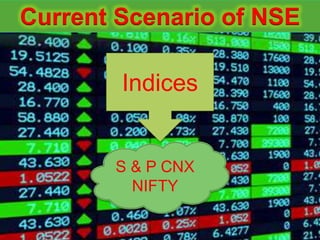
Current Scenario of NSE
Indices
S & P CNX
NIFTY
CNX stands for CRISIL NSE INDICES.
CNX ensure common branding of indices, to reflect
the identities of both promoters i.e. NSE and CRISIL.
Thus, C stands for CRISIL, N stands for NSE, X
stands for EXCHANGE or INDEX.
The S&P prefix belongs to the US-based standard
and poor’s Financial Information Services.
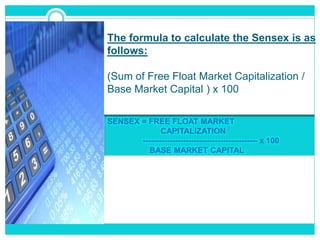
The formula to calculate the Sensex is as
follows:
(Sum of Free Float Market Capitalization /
Base Market Capital ) x 100
SENSEX = FREE FLOAT MARKET
CAPITALIZATION
------------------------------------------- x 100
BASE MARKET CAPITAL
NIFTY CALCULATION
Just like the Sensex which was introduced by the
Bombay stock exchange, Nifty is a major stock index in
India introduced by the National stock exchange.
Nifty is calculated using the same methodology adopted
by the BSE in calculating the Sensex – but with three
differences. They are:
The base year is taken as 1995.
The base value is set to 1000.
Nifty is calculated on 50 stocks actively traded in the
NSE.
50 top stocks are selected from 24 sectors.
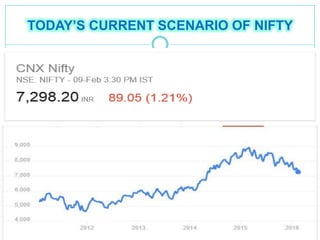
TODAY’S CURRENT SCENARIO OF NIFTY
https://en.wikipedia.org/wiki/Stock_exchange
http://www.yourarticlelibrary.com/stock-exchange/history-
of-stock-exchange-in-india/23488/
https://en.wikipedia.org/wiki/National_Stock_Exchange_o
f_India
http://www.nseindia.com/global/content/about_us/our_gro
up.htm
http://www.yourarticlelibrary.com/stock-
exchange/national-stock-exchange-of-india-objectives-
organisation-and-management/23484/
https://en.wikipedia.org/wiki/CNX_Nifty
http://in.investing.com/indices/s-p-cnx-nifty-historical-data
http://taxguru.in/sebi/easy-understand-nifty-sensex-
calculation.html
CURRENT SCENARIO OF NSE

CURRENT SCENARIO OF NSE

  • 1.
    Current Scenario ofNational Stock Exchange Current Scenario of National Stock Exchange
  • 2.
    Stock Exchange An actof giving one thing and receiving other. The goods kept on the promises of a business or where houses are available for sales and distribution.
  • 3.
    A place wheresecurities are brought and sold is known as stock exchange.
  • 4.
  • 5.
    TYPE STOCK EXCHNGE LOCATIONMUMBAI, INDIA FOUNDED 1992 OWNER NATIONAL STOCK EXCHANGE OF INDIA LTD. CURRENCY INDIAN RUPEE ( ₹ ) INDICES S&P CNX NIFTY CNX NIFTY JUNIOR S&P CNX 500 WEBSITE www.nseindia.com MANAGING DIRECTOR CHITRA RAMKRISHNAN
  • 6.
    She is CEOas well as MD of National stock Exchange. Chitra Ramkrishna is the first woman managing director and chief executive officer of the National Stock Exchange (NSE), an institution founded in the early 1990s to reform the capital market in India, and now ranking as the world's largest exchange in cash market trades and as one of the top three exchanges in index and stock derivatives.
  • 7.
  • 8.
    HISTORY  At presentthere are 24 stock exchanges in the country, 21 of them being regional ones with allotted areas. Two others set up in the reform era, viz., the National Stock Exchange (NSE) and Over the Counter Exchange of India (OTCEI), have mandate to have nation-wise trading.  The Stock Exchanges are being administered by their governing boards and executive chiefs. Policies relating to their regulation and control are laid down by the Ministry of Finance. Government also Constituted Securities and Exchange Board of India (SEBI) in April 1988 for orderly development and regulation of securities industry and stock exchanges.
  • 9.
    REGULATORY AUTHORITY Regulatory authorityis the one which is under the government surveillance. A few stock exchanges companies follow the rules which are laid down by the government of India. 1) SEBI ( securities and exchange Board of India) 2) RBI ( Reserve Bank Of India)
  • 10.
    SEBI  The Securitiesand Exchange Board of India (SEBI) is the regulatory authority established under the SEBI Act 1992 and is the principal regulator for Stock Exchanges in India.  SEBI protects the interests of investors in securities and promotes the development of securities market.  The board helps in making registration and regulate the functioning.  SEBI conducts inspection and thus prohibits fraudulent practices.
  • 11.
    RBI  RBI isthe appex bank of India.  RBI is also known as banker’s banks.  Maintains price stability.  Provides cost effective banking services to the public.
  • 12.
    Role Of StockExchange  Raising capital for businesses  Mobilizing savings for investment  Facilitating company growth  Profit sharing  Creating investment opportunities for small investors  Government capital-raising for development projects  Barometer of the economy
  • 13.
    Market Segments ofNSE  NSEI trades in the following two segments:  1. Whole Sale Debt Market Segment: This segment refers to the trading platform for a wide range of fixed income securities like central government securities, bonds issued by public sector undertakings, zero coupon bonds, treasury bills, commercial papers, certificates of deposit, mutual funds, corporate debentures etc.  2. Capital Market System: This segment of NSEI provides a platform for transparent and fair trading of equity, preference shares, debentures, exchange traded funds as well as retail Government securities.
  • 14.
    Markets Of NSE Equities:-  Equities  Indices  Mutual Funds  Initial Public Offerings  Security Lending and Borrowing Scheme
  • 15.
    Cont………… Derivatives:-  Equity Derivatives Currency Derivatives  Interest Rate Futures Debt:-  Corporate Bonds
  • 16.
    Groups Of NSE National Securities Clearing Corporation Limited (NSCCL) 1995  NSE InfoTech Services Limited (NSETECH)  India Index Services & Products Ltd. (IISL) 1998  DotEx International. Ltd. (DotEx)
  • 17.
    ASSOCIATE / AFFILIATECOMPANIES  National Securities Depository Ltd. (NSDL)  National Commodity & Derivatives Exchange Ltd. (NCDEX)  Power Exchange India Limited (PXIL)
  • 18.
    Objectives Of NSE The important objectives of the NSE are given below:  (i) To provide a fair, transparent and efficient securities market to investors using electronic trading system.  (ii) To establish nationwide trading facility for equities and debt instruments.  (iii) To ensure equal access to investors all over the country through an appropriate communication network.  (iv) To improve the standard of securities market to international level.
  • 19.
    The National StockExchange of India is managed by Board of Directors. The Board to an Executive Committee, which includes representatives from trading members, public and the management, delegate’s decision relating to market operations. Besides the exchange operates various committees to advise it on areas such as good market practices, settlement procedures, risk containment system etc. Industry professionals, trading members and exchange staffs are members in these committees. The day-to-day management of the exchange is delegated to the Managing Director who is supported by a team of professional staff. ORGANIZATION AND MANAGEMENT OF NSE
  • 20.
    Current Scenario ofNSE Indices S & P CNX NIFTY
  • 21.
    CNX stands forCRISIL NSE INDICES. CNX ensure common branding of indices, to reflect the identities of both promoters i.e. NSE and CRISIL. Thus, C stands for CRISIL, N stands for NSE, X stands for EXCHANGE or INDEX. The S&P prefix belongs to the US-based standard and poor’s Financial Information Services.
  • 22.
    The formula tocalculate the Sensex is as follows: (Sum of Free Float Market Capitalization / Base Market Capital ) x 100 SENSEX = FREE FLOAT MARKET CAPITALIZATION ------------------------------------------- x 100 BASE MARKET CAPITAL
  • 23.
    NIFTY CALCULATION Just likethe Sensex which was introduced by the Bombay stock exchange, Nifty is a major stock index in India introduced by the National stock exchange. Nifty is calculated using the same methodology adopted by the BSE in calculating the Sensex – but with three differences. They are: The base year is taken as 1995. The base value is set to 1000. Nifty is calculated on 50 stocks actively traded in the NSE. 50 top stocks are selected from 24 sectors.
  • 24.
  • 26.