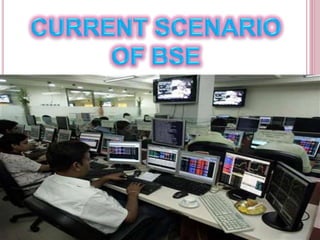
CURRENT SCENARIO
OF BOMBAY STOCK
EXCHANGE
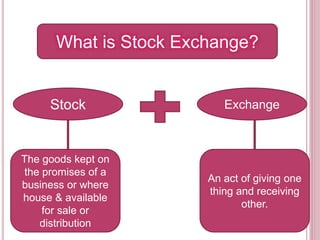
What is Stock Exchange?
Stock Exchange
The goods kept on
the promises of a
business or where
house & available
for sale or
distribution
An act of giving one
thing and receiving
other.
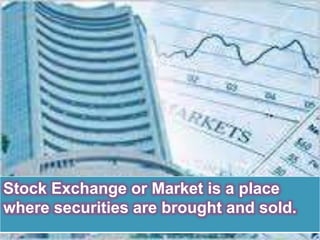
Stock Exchange or Market is a place
where securities are brought and sold.
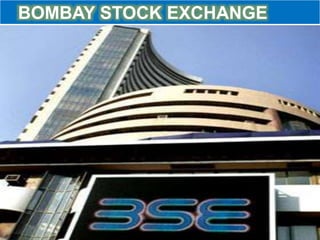
BOMBAY STOCK EXCHANGE
 Located in MUMBAI.
 Established in 1875.
 It is Asia’s first stock exchange.
 World’s fastest stock exchange.
 It is 11th largest stock exchanges which trades in 6
microseconds.
 Market capitalization with 1.7$ trillion as on 23rd
January 2015.
 More than 5500 companies are publicly listed on
the BSE.
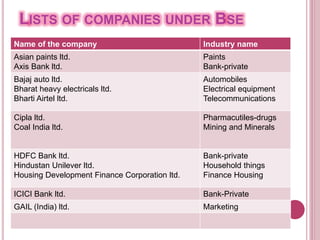
LISTS OF COMPANIES UNDER BSE
Name of the company Industry name
Asian paints ltd.
Axis Bank ltd.
Paints
Bank-private
Bajaj auto ltd.
Bharat heavy electricals ltd.
Bharti Airtel ltd.
Automobiles
Electrical equipment
Telecommunications
Cipla ltd.
Coal India ltd.
Pharmacutiles-drugs
Mining and Minerals
HDFC Bank ltd.
Hindustan Unilever ltd.
Housing Development Finance Corporation ltd.
Bank-private
Household things
Finance Housing
ICICI Bank ltd. Bank-Private
GAIL (India) ltd. Marketing
GUIDELINES TO LISTED COMPANIES BY
SEBI
 Listing means admission of securities to dealings
on a recognized stock exchange. The securities
may be of any public limited company, Central or
State Government, quasi governmental and other
financial institutions/corporations, municipalities,
etc.
The objectives of listing are mainly to :
 provide liquidity to securities;
 mobilize savings for economic development;
 protect interest of investors by ensuring full
disclosures
 The BSE Limited has a dedicated Listing Department to
grant approval for listing of securities of companies in
accordance with the provisions of the Securities Contracts
(Regulation) Act, 1956, Securities Contracts (Regulation)
Rules, 1957, Companies Act, 1956, Guidelines issued by
SEBI and Rules, Bye-laws and Regulations of BSE.
BSE has set various guidelines and forms that need to be
adhered to and submitted by the companies. These
guidelines will help companies to expedite the fulfillment of
the various formalities and disclosure requirements that are
required at various stages of
Public Issues
 Initial Public Offering
 Further Public Offering
 Preferential Issues
 Amalgamation
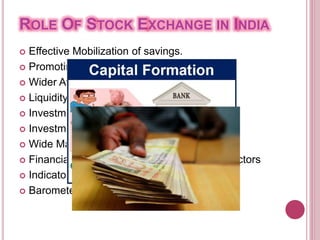
ROLE OF STOCK EXCHANGE IN INDIA
 Effective Mobilization of savings.
 Promoting Capital formation
 Wider Avenues of investment
 Liquidity of investment
 Investment priorities
 Investment safety
 Wide Marketability to Securities
 Financial resources for public and private sectors
 Indicator of Industrial Development
 Barometer of National Economy
BSE MANAGEMENT
Bombay Stock Exchange is managed
professionally by Board of Directors. It comprises of
eminent professionals, representatives of Trading
Members and the Managing Director. The Board is
an inclusive one and is shaped to benefit from the
market intermediaries participation.
The Board exercises complete control and
formulates larger policy issues.
BSE NETWORK
 The Exchange reaches physically to 417 cities and
towns in the country. The framework of it has been
designed to safeguard market integrity and to
operate with transparency. It provides an efficient
market for the trading in equity, debt instruments
and derivatives.
 Its online trading system, popularly known as BOLT,
is a proprietary system and it is BS 7799-2-2002
certified. The BOLT network was expanded,
nationwide, in 1997. The surveillance and clearing
& settlement functions of the Exchange are ISO
9001:2000 certified.
BSE FACTS AND FIGURES:
 1.In 2009, the average volume of business conducted
on the BSE was approximately $40 billion each month.
 2. The number of shares traded each month on the
BSE is in the range of 40 – 50 million.
 3. The total market capitalization for the companies
traded on the BSE is in the area of $1.1 trillion. All of
the above dollar values are stated in USD.
 4. First in India to introduce Equity Derivatives.
 5. First in India to launch a Free Float Index.
 6. First in India to launch US$ version of BSE Sensex.
 7. First in India to launch Exchange Enabled Internet
Trading Platform.
CONT…………..
 8. First in India to obtain ISO certification for
Surveillance, Clearing & Settlement.
 9. BSE On-Line Trading System (BOLT) has been
awarded the globally recognized the Information
Security Management System standard BS7799-
2:2O02.
 10. First to have an exclusive facility for financial
training.
Mission :-
1. As a centre of learning, our mission is to promote an open learning
environment that brings together people, cultures and ideas from
around the world, changing lives and helping transform organizations
through innovative learning programs.
2. Through our learning programs, we develop responsible, thoughtful
leaders and entrepreneurs who create value for their organizations
and their communities.
VISION
The vision of BSE is to be
the most sought after
learning provider in the world
in areas of financial and
leadership learning, by
pioneering the generation
and dissemination of
knowledge for the
enhancement of skills and
capabilities of professionals
and aspiring professionals.
OBJECTIVES OF BSE
 To get a basic understanding of the products, players
and functioning of financial markets, particularly the
capital market.
 To understand the terms and jargons used in the
financial newspapers and periodicals.
 To understand the various products, participants and the
functions of the securities market.
 To know the regulatory framework for the Indian
securities market.
 To understand the concept of mutual funds.
 To know about the roles of different players viz.,
custodians, asset management companies, sponsor etc.
in the mutual fund industry.
 To learn about the tax and regulatory issues related to
mutual funds.
 To understand the fundamentals of Net Asset Value
(NAV) computation and various investment plans.
CONT……………..
 To understand the concept of derivative.
 To learn the types of derivative products and their
application.
 To learn about the the trading of derivatives on the stock
exchanges.
 To understand the capital market trading operations.
 To learn the other important regulatory aspects.
 To learn the basics of the derivatives market
 To understand the use of derivative products in
speculating, hedging and arbitraging
 To learn the trading, clearing, settlement and risk
management in equity derivatives
 To have a practical orientation towards the principles of
investment, pricing and valuation.
 To learn the various methodologies of financial analysis.
FUNCTIONS OF STOCK EXCHANGE
 1. Economic Barometer
 2. Pricing of Securities
 3. Safety of Transactions
 4. Contributes to Economic Growth
 5. Spreading of Equity Cult
 6. Providing Scope for Speculation
 7. Liquidity
 8. Better Allocation of Capital
 9. Promotes the Habits of Savings and Investment
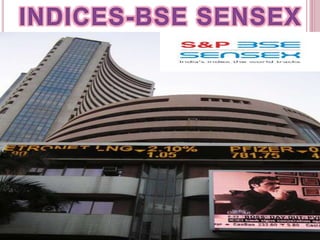
 The S&P BSE SENSEX (S&P Bombay Stock Exchange
Sensitive Index), also-called the BSE 30 or simply the
SENSEX, is a free-float market-weighted stock market
index of 30 well-established and financially sound
companies listed on Bombay Stock Exchange. The 30
component companies which are some of the largest
and most actively traded stocks, are representative of
various industrial sectors of the Indian economy.
Published since 1 January 1986, the S&P BSE SENSEX
is regarded as the pulse of the domestic stock markets in
India. The base value of the S&P BSE SENSEX is taken
as 100 on 1 April 1979, and its base year as 1978–79.
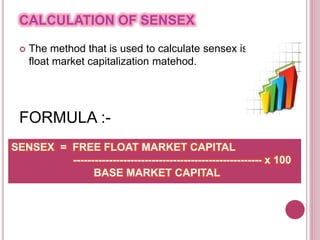
CALCULATION OF SENSEX
 The method that is used to calculate sensex is free
float market capitalization matehod.
FORMULA :-
SENSEX = FREE FLOAT MARKET CAPITAL
----------------------------------------------------- x 100
BASE MARKET CAPITAL
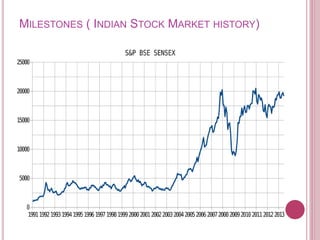
MILESTONES ( INDIAN STOCK MARKET HISTORY)
REFRENCE :-
 https://en.wikipedia.org/wiki/Stock_exchange
 https://en.wikipedia.org/wiki/Bombay_Stock_Exchange
 http://kalyan-city.blogspot.in/2010/11/role-of-stock-exchanges-in-
capital.html
 http://www.yourarticlelibrary.com/stock-exchange/bombay-stock-
exchange-bse-management-network-and-facts/23489/
 http://kalyan-city.blogspot.in/2010/11/role-of-stock-exchanges-in-
capital.html
 http://www.bsebti.com/about_bti/vision_mission.html
 http://www.iism.co.in/objectives.html
 http://www.moneyworks4me.com/best-index/bse-stocks/top-
bse30-companies-list/
 http://www.yourarticlelibrary.com/economics/market/9-most-
important-functions-of-stock-exchangesecondary-market/8766/
 https://en.wikipedia.org/wiki/BSE_SENSEX
 http://www.bseindia.com/Static/about/listsec.aspx?expandable=2
------------------------------------------------------------ VIA INTERNET
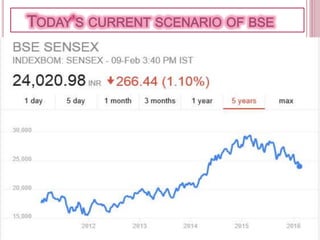
CURRENT SCENARIO OF BSE

CURRENT SCENARIO OF BSE

  • 1.
  • 2.
    What is StockExchange? Stock Exchange The goods kept on the promises of a business or where house & available for sale or distribution An act of giving one thing and receiving other.
  • 3.
    Stock Exchange orMarket is a place where securities are brought and sold.
  • 4.
  • 5.
    BOMBAY STOCK EXCHANGE Located in MUMBAI.  Established in 1875.  It is Asia’s first stock exchange.  World’s fastest stock exchange.  It is 11th largest stock exchanges which trades in 6 microseconds.  Market capitalization with 1.7$ trillion as on 23rd January 2015.  More than 5500 companies are publicly listed on the BSE.
  • 7.
    LISTS OF COMPANIESUNDER BSE Name of the company Industry name Asian paints ltd. Axis Bank ltd. Paints Bank-private Bajaj auto ltd. Bharat heavy electricals ltd. Bharti Airtel ltd. Automobiles Electrical equipment Telecommunications Cipla ltd. Coal India ltd. Pharmacutiles-drugs Mining and Minerals HDFC Bank ltd. Hindustan Unilever ltd. Housing Development Finance Corporation ltd. Bank-private Household things Finance Housing ICICI Bank ltd. Bank-Private GAIL (India) ltd. Marketing
  • 8.
    GUIDELINES TO LISTEDCOMPANIES BY SEBI  Listing means admission of securities to dealings on a recognized stock exchange. The securities may be of any public limited company, Central or State Government, quasi governmental and other financial institutions/corporations, municipalities, etc. The objectives of listing are mainly to :  provide liquidity to securities;  mobilize savings for economic development;  protect interest of investors by ensuring full disclosures
  • 9.
     The BSELimited has a dedicated Listing Department to grant approval for listing of securities of companies in accordance with the provisions of the Securities Contracts (Regulation) Act, 1956, Securities Contracts (Regulation) Rules, 1957, Companies Act, 1956, Guidelines issued by SEBI and Rules, Bye-laws and Regulations of BSE. BSE has set various guidelines and forms that need to be adhered to and submitted by the companies. These guidelines will help companies to expedite the fulfillment of the various formalities and disclosure requirements that are required at various stages of Public Issues  Initial Public Offering  Further Public Offering  Preferential Issues  Amalgamation
  • 10.
    ROLE OF STOCKEXCHANGE IN INDIA  Effective Mobilization of savings.  Promoting Capital formation  Wider Avenues of investment  Liquidity of investment  Investment priorities  Investment safety  Wide Marketability to Securities  Financial resources for public and private sectors  Indicator of Industrial Development  Barometer of National Economy
  • 11.
    BSE MANAGEMENT Bombay StockExchange is managed professionally by Board of Directors. It comprises of eminent professionals, representatives of Trading Members and the Managing Director. The Board is an inclusive one and is shaped to benefit from the market intermediaries participation. The Board exercises complete control and formulates larger policy issues.
  • 12.
    BSE NETWORK  TheExchange reaches physically to 417 cities and towns in the country. The framework of it has been designed to safeguard market integrity and to operate with transparency. It provides an efficient market for the trading in equity, debt instruments and derivatives.  Its online trading system, popularly known as BOLT, is a proprietary system and it is BS 7799-2-2002 certified. The BOLT network was expanded, nationwide, in 1997. The surveillance and clearing & settlement functions of the Exchange are ISO 9001:2000 certified.
  • 13.
    BSE FACTS ANDFIGURES:  1.In 2009, the average volume of business conducted on the BSE was approximately $40 billion each month.  2. The number of shares traded each month on the BSE is in the range of 40 – 50 million.  3. The total market capitalization for the companies traded on the BSE is in the area of $1.1 trillion. All of the above dollar values are stated in USD.  4. First in India to introduce Equity Derivatives.  5. First in India to launch a Free Float Index.  6. First in India to launch US$ version of BSE Sensex.  7. First in India to launch Exchange Enabled Internet Trading Platform.
  • 14.
    CONT…………..  8. Firstin India to obtain ISO certification for Surveillance, Clearing & Settlement.  9. BSE On-Line Trading System (BOLT) has been awarded the globally recognized the Information Security Management System standard BS7799- 2:2O02.  10. First to have an exclusive facility for financial training.
  • 15.
    Mission :- 1. Asa centre of learning, our mission is to promote an open learning environment that brings together people, cultures and ideas from around the world, changing lives and helping transform organizations through innovative learning programs. 2. Through our learning programs, we develop responsible, thoughtful leaders and entrepreneurs who create value for their organizations and their communities.
  • 16.
    VISION The vision ofBSE is to be the most sought after learning provider in the world in areas of financial and leadership learning, by pioneering the generation and dissemination of knowledge for the enhancement of skills and capabilities of professionals and aspiring professionals.
  • 17.
    OBJECTIVES OF BSE To get a basic understanding of the products, players and functioning of financial markets, particularly the capital market.  To understand the terms and jargons used in the financial newspapers and periodicals.  To understand the various products, participants and the functions of the securities market.  To know the regulatory framework for the Indian securities market.  To understand the concept of mutual funds.  To know about the roles of different players viz., custodians, asset management companies, sponsor etc. in the mutual fund industry.  To learn about the tax and regulatory issues related to mutual funds.  To understand the fundamentals of Net Asset Value (NAV) computation and various investment plans.
  • 18.
    CONT……………..  To understandthe concept of derivative.  To learn the types of derivative products and their application.  To learn about the the trading of derivatives on the stock exchanges.  To understand the capital market trading operations.  To learn the other important regulatory aspects.  To learn the basics of the derivatives market  To understand the use of derivative products in speculating, hedging and arbitraging  To learn the trading, clearing, settlement and risk management in equity derivatives  To have a practical orientation towards the principles of investment, pricing and valuation.  To learn the various methodologies of financial analysis.
  • 19.
    FUNCTIONS OF STOCKEXCHANGE  1. Economic Barometer  2. Pricing of Securities  3. Safety of Transactions  4. Contributes to Economic Growth  5. Spreading of Equity Cult  6. Providing Scope for Speculation  7. Liquidity  8. Better Allocation of Capital  9. Promotes the Habits of Savings and Investment
  • 22.
     The S&PBSE SENSEX (S&P Bombay Stock Exchange Sensitive Index), also-called the BSE 30 or simply the SENSEX, is a free-float market-weighted stock market index of 30 well-established and financially sound companies listed on Bombay Stock Exchange. The 30 component companies which are some of the largest and most actively traded stocks, are representative of various industrial sectors of the Indian economy. Published since 1 January 1986, the S&P BSE SENSEX is regarded as the pulse of the domestic stock markets in India. The base value of the S&P BSE SENSEX is taken as 100 on 1 April 1979, and its base year as 1978–79.
  • 23.
    CALCULATION OF SENSEX The method that is used to calculate sensex is free float market capitalization matehod. FORMULA :- SENSEX = FREE FLOAT MARKET CAPITAL ----------------------------------------------------- x 100 BASE MARKET CAPITAL
  • 24.
    MILESTONES ( INDIANSTOCK MARKET HISTORY)
  • 27.
    REFRENCE :-  https://en.wikipedia.org/wiki/Stock_exchange https://en.wikipedia.org/wiki/Bombay_Stock_Exchange  http://kalyan-city.blogspot.in/2010/11/role-of-stock-exchanges-in- capital.html  http://www.yourarticlelibrary.com/stock-exchange/bombay-stock- exchange-bse-management-network-and-facts/23489/  http://kalyan-city.blogspot.in/2010/11/role-of-stock-exchanges-in- capital.html  http://www.bsebti.com/about_bti/vision_mission.html  http://www.iism.co.in/objectives.html  http://www.moneyworks4me.com/best-index/bse-stocks/top- bse30-companies-list/  http://www.yourarticlelibrary.com/economics/market/9-most- important-functions-of-stock-exchangesecondary-market/8766/  https://en.wikipedia.org/wiki/BSE_SENSEX  http://www.bseindia.com/Static/about/listsec.aspx?expandable=2 ------------------------------------------------------------ VIA INTERNET