The
Budget Constraint
By Marco Giusti
1. Budget Constraint definition
Agenda/Outline
1. Budget Constraint definition
2. Budget Line
Agenda/Outline
1. Budget Constraint definition
2. Budget Line
3. Budget Set
Agenda/Outline
1. Budget Constraint definition
2. Budget Line
3. Budget Set
4. Variables Affecting Budget Constraint:
 Increasing Income
 Decreasing Income
 Increasing Prices of goods
 Decreasing Prices of goods
Agenda/Outline
1. Budget Constraint definition
2. Budget Line
3. Budget Set
4. Variables Affecting Budget Constraint:
 Increasing Income
 Decreasing Income
 Increasing Prices of goods
 Decreasing Prices of goods
5. Conclusion
Agenda/Outline
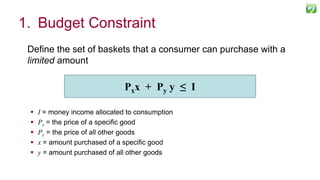
1. Budget Constraint
Define the set of baskets that a consumer can purchase with a
limited amount
 I = money income allocated to consumption
 Px = the price of a specific good
 Py = the price of all other goods
 x = amount purchased of a specific good
 y = amount purchased of all other goods
Pxx + Py y ≤ I
1. Budget Constraint
It’ s composed by:
 Budget Line
8
1. Budget Constraint
It’ s composed by:
 Budget Line
 Budget Set
9
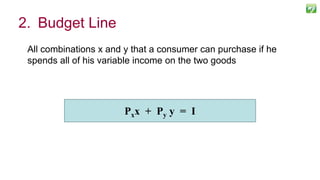
2. Budget Line
All combinations x and y that a consumer can purchase if he
spends all of his variable income on the two goods
10
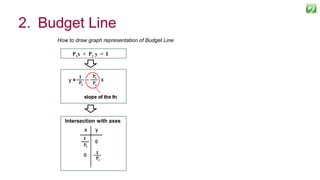
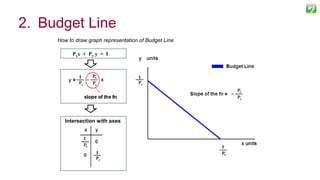
Pxx + Py y = I
2. Budget Line
11
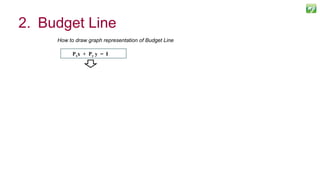
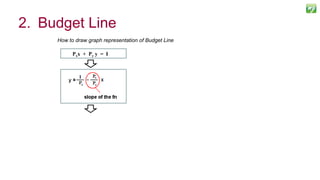
Pxx + Py y = I
How to draw graph representation of Budget Line
12
Pxx + Py y = I
How to draw graph representation of Budget Line
2. Budget Line
13
Pxx + Py y = I
Intersection with axes
How to draw graph representation of Budget Line
2. Budget Line
14
Pxx + Py y = I
Intersection with axes
How to draw graph representation of Budget Line
2. Budget Line
15
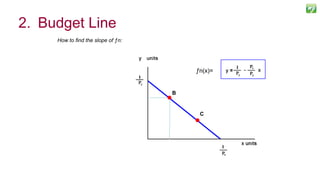
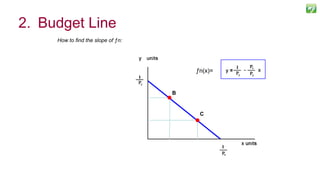
C
ƒn(x)=
B
2. Budget Line
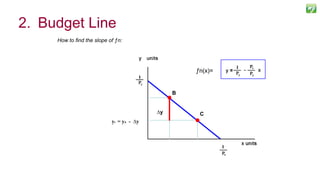
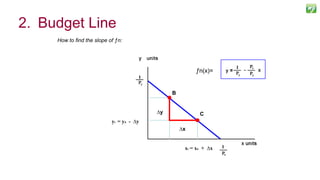
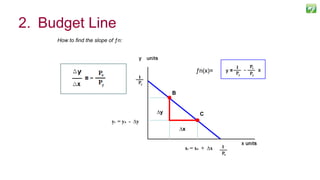
How to find the slope of ƒn:
16
C
ƒn(x)=
B
2. Budget Line
How to find the slope of ƒn:
17
∆y
yC = yB - ∆y
C
ƒn(x)=
B
2. Budget Line
How to find the slope of ƒn:
18
∆y
∆x
yC = yB - ∆y
xC = xB + ∆x
C
ƒn(x)=
B
2. Budget Line
How to find the slope of ƒn:
19
∆y
∆x
yC = yB - ∆y
xC = xB + ∆x
C
ƒn(x)=
B
2. Budget Line
How to find the slope of ƒn:
3. Budget Set
20
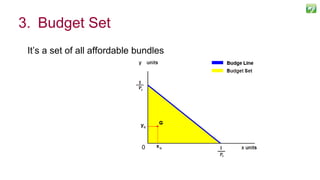
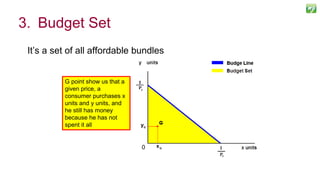
It’s a set of all affordable bundles
0
21
It’s a set of all affordable bundles
G point show us that a
given price, a
consumer purchases x
units and y units, and
he still has money
because he has not
spent it all
0
3. Budget Set
22
4. Variables Affecting Budget Constraint
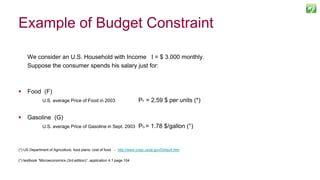
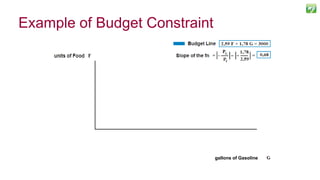
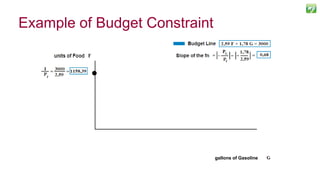
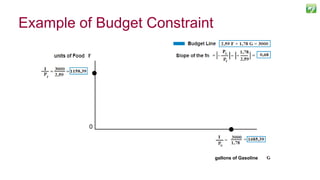
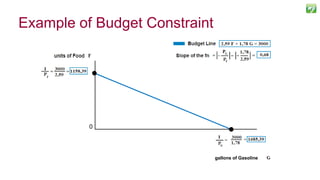
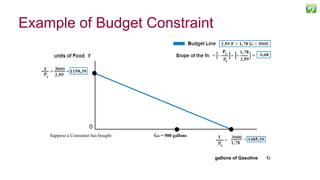
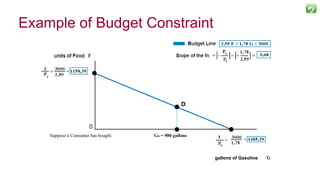
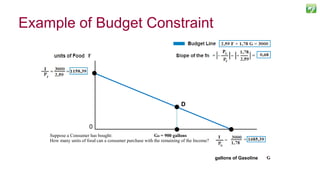
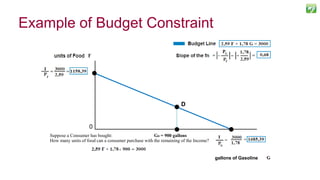
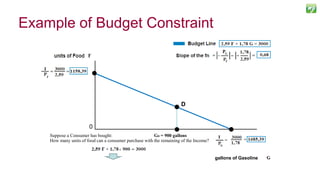
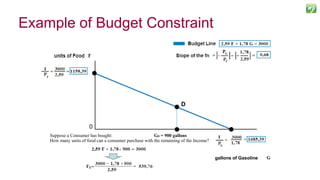
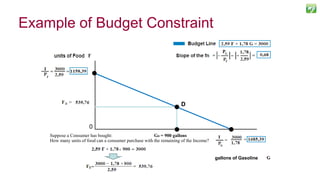
We consider an U.S. Household with Income I = $ 3.000 monthly.
Suppose the consumer spends his salary just for:
 Food (F)
U.S. average Price of Food in 2003 PF = 2,59 $ per units (*)
 Gasoline (G)
U.S. average Price of Gasoline in Sept. 2003 PG = 1.78 $/gallon (°)
(*) US Department of Agricolture, food plans: cost of food - http://www.cnpp.usda.gov/Default.htm
(°) textbook “Microeconomics (3rd edition)”, application 4.1 page 104
23
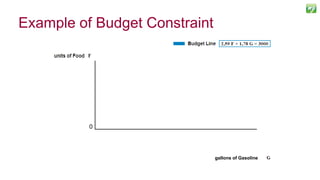
Example of Budget Constraint
24
gallons of Gasoline
0
Example of Budget Constraint
25
gallons of Gasoline
Example of Budget Constraint
26
gallons of Gasoline
Example of Budget Constraint
27
gallons of Gasoline
0
Example of Budget Constraint
28
gallons of Gasoline
0
Example of Budget Constraint
29
Suppose a Consumer has bought: GD = 900 gallons
gallons of Gasoline
0
Example of Budget Constraint
30
D
Suppose a Consumer has bought: GD = 900 gallons
gallons of Gasoline
0
Example of Budget Constraint
31
D
Suppose a Consumer has bought: GD = 900 gallons
gallons of Gasoline
How many units of food can a consumer purchase with the remaining of the Income?
0
Example of Budget Constraint
32
D
Suppose a Consumer has bought: GD = 900 gallons
gallons of Gasoline
How many units of food can a consumer purchase with the remaining of the Income?
0
Example of Budget Constraint
33
D
Suppose a Consumer has bought: GD = 900 gallons
gallons of Gasoline
How many units of food can a consumer purchase with the remaining of the Income?
0
Example of Budget Constraint
34
D
Suppose a Consumer has bought: GD = 900 gallons
gallons of Gasoline
How many units of food can a consumer purchase with the remaining of the Income?
0
Example of Budget Constraint
35
D
Suppose a Consumer has bought: GD = 900 gallons
gallons of Gasoline
How many units of food can a consumer purchase with the remaining of the Income?
0
Example of Budget Constraint
36
D
Suppose a Consumer has bought: GD = 900 gallons
gallons of Gasoline
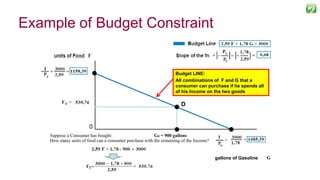
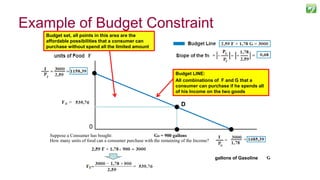
Budget LINE:
All combinations of F and G that a
consumer can purchase if he spends all
of his Income on the two goods
How many units of food can a consumer purchase with the remaining of the Income?
0
Example of Budget Constraint
37
D
Suppose a Consumer has bought: GD = 900 gallons
gallons of Gasoline
Budget LINE:
All combinations of F and G that a
consumer can purchase if he spends all
of his Income on the two goods
Budget set, all points in this area are the
affordable possibilities that a consumer can
purchase without spend all the limited amount
How many units of food can a consumer purchase with the remaining of the Income?
0
Properties of Budget Constraint
 What happens if INCOME Increase / Decrease?
38
Properties of Budget Constraint
 What happens if INCOME Increase / Decrease?
 What happens if PRICE Increase / Decrease?
39
4040
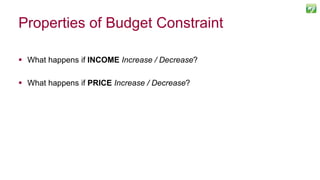
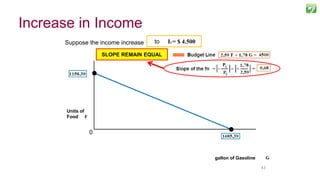
Suppose the income increase from I = $3.000to I2 = $ 4.500
Units of
Food F
gallon of Gasoline
0
Increase in Income
4141
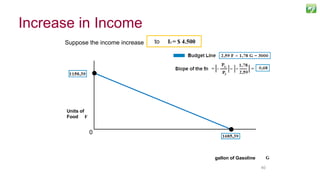
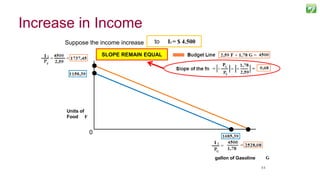
Suppose the income increase from I = $3.000to I2 = $ 4.500
Units of
Food F
gallon of Gasoline
0
Increase in Income
4242
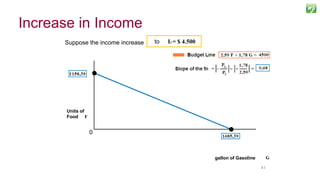
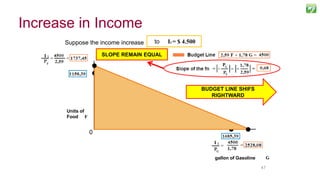
Suppose the income increase from I = $3.000to I2 = $ 4.500
Units of
Food F
gallon of Gasoline
0
Increase in Income
4343
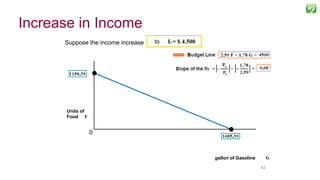
Suppose the income increase from I = $3.000to I2 = $ 4.500
SLOPE REMAIN EQUAL
Units of
Food F
gallon of Gasoline
0
Increase in Income
4444
Suppose the income increase from I = $3.000to I2 = $ 4.500
SLOPE REMAIN EQUAL
Units of
Food F
gallon of Gasoline
0
Increase in Income
4545
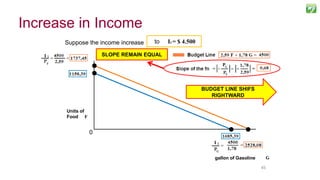
Suppose the income increase from I = $3.000to I2 = $ 4.500
BUDGET LINE SHIFS
RIGHTWARD
SLOPE REMAIN EQUAL
Units of
Food F
gallon of Gasoline
0
Increase in Income
4646
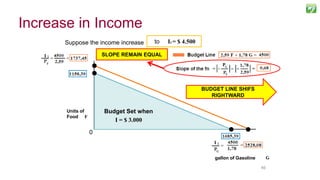
Suppose the income increase from I = $3.000to I2 = $ 4.500
BUDGET LINE SHIFS
RIGHTWARD
SLOPE REMAIN EQUAL
Budget Set when
I = $ 3.000
Units of
Food F
gallon of Gasoline
0
Increase in Income
4747
Suppose the income increase from I = $3.000to I2 = $ 4.500
BUDGET LINE SHIFS
RIGHTWARD
SLOPE REMAIN EQUAL
Budget Set when
I = $ 3.000
Units of
Food F
gallon of Gasoline
0
Increase in Income
4848
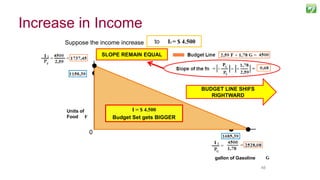
Suppose the income increase from I = $3.000to I2 = $ 4.500
BUDGET LINE SHIFS
RIGHTWARD
SLOPE REMAIN EQUAL
Budget Set when
I = $ 3.000
Units of
Food F
I = $ 4.500
Budget Set gets BIGGER
gallon of Gasoline
0
Increase in Income
4949
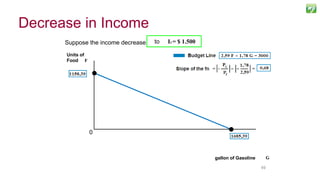
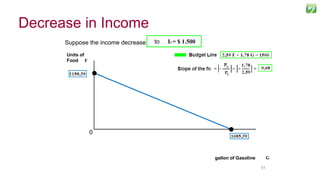
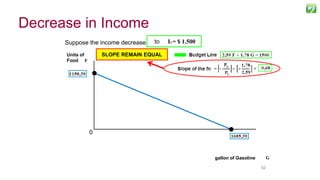
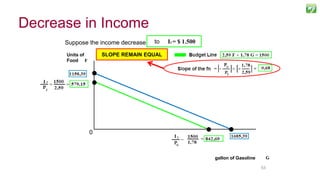
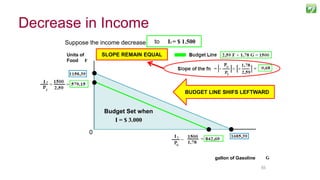
Suppose the income decrease from I = $3.000to I3 = $ 1.500
Units of
Food F
gallon of Gasoline
0
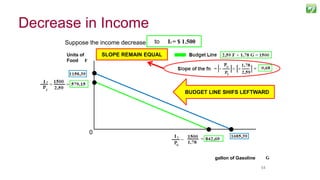
Decrease in Income
5050
Suppose the income decrease from I = $3.000to I3 = $ 1.500
Units of
Food F
gallon of Gasoline
0
Decrease in Income
5151
Suppose the income decrease from I = $3.000to I3 = $ 1.500
Units of
Food F
gallon of Gasoline
0
Decrease in Income
5252
Suppose the income decrease from I = $3.000to I3 = $ 1.500
SLOPE REMAIN EQUALUnits of
Food F
gallon of Gasoline
0
Decrease in Income
5353
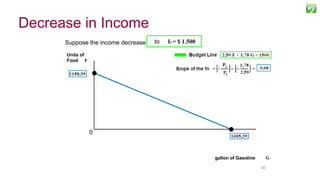
Suppose the income decrease from I = $3.000to I3 = $ 1.500
SLOPE REMAIN EQUALUnits of
Food F
gallon of Gasoline
0
Decrease in Income
5454
Suppose the income decrease from I = $3.000to I3 = $ 1.500
BUDGET LINE SHIFS LEFTWARD
SLOPE REMAIN EQUALUnits of
Food F
gallon of Gasoline
0
Decrease in Income
5555
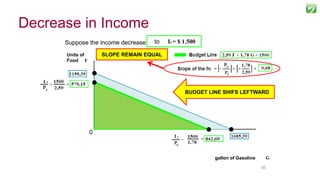
Suppose the income decrease from I = $3.000to I3 = $ 1.500
BUDGET LINE SHIFS LEFTWARD
SLOPE REMAIN EQUALUnits of
Food F
Budget Set when
I = $ 3.000
gallon of Gasoline
0
Decrease in Income
5656
Suppose the income decrease from I = $3.000to I3 = $ 1.500
BUDGET LINE SHIFS LEFTWARD
SLOPE REMAIN EQUALUnits of
Food F
Budget Set when
I = $ 3.000
gallon of Gasoline
0
Decrease in Income
5757
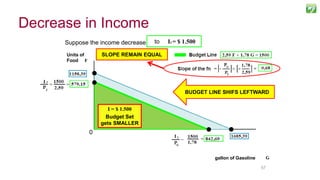
Suppose the income decrease from I = $3.000to I3 = $ 1.500
BUDGET LINE SHIFS LEFTWARD
SLOPE REMAIN EQUALUnits of
Food F
Budget Set when
I = $ 3.000
I = $ 1.500
Budget Set
gets SMALLER
gallon of Gasoline
0
Decrease in Income
Change in Income
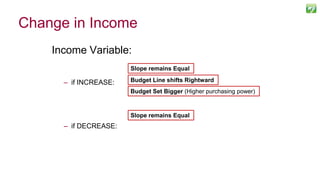
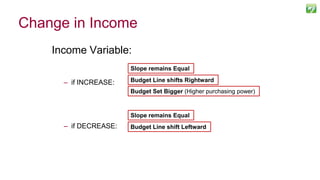
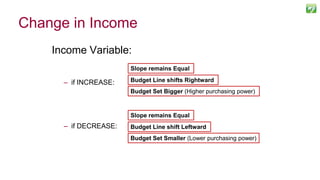
Income Variable:
– if INCREASE:
58
Change in Income
Income Variable:
– if INCREASE:
59
Slope remains Equal
Change in Income
Income Variable:
– if INCREASE:
60
Slope remains Equal
Budget Line shifts Rightward
Change in Income
Income Variable:
– if INCREASE:
61
Slope remains Equal
Budget Set Bigger (Higher purchasing power)
Budget Line shifts Rightward
Change in Income
Income Variable:
– if INCREASE:
– if DECREASE:
62
Slope remains Equal
Budget Set Bigger (Higher purchasing power)
Budget Line shifts Rightward
Change in Income
Income Variable:
– if INCREASE:
– if DECREASE:
63
Slope remains Equal
Budget Set Bigger (Higher purchasing power)
Budget Line shifts Rightward
Slope remains Equal
Change in Income
Income Variable:
– if INCREASE:
– if DECREASE:
64
Slope remains Equal
Budget Set Bigger (Higher purchasing power)
Budget Line shifts Rightward
Slope remains Equal
Budget Line shift Leftward
Change in Income
Income Variable:
– if INCREASE:
– if DECREASE:
65
Slope remains Equal
Budget Set Bigger (Higher purchasing power)
Budget Line shifts Rightward
Slope remains Equal
Budget Set Smaller (Lower purchasing power)
Budget Line shift Leftward
6666
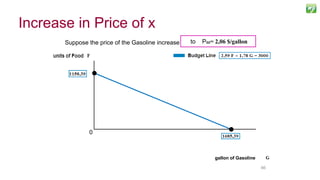
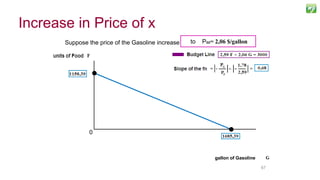
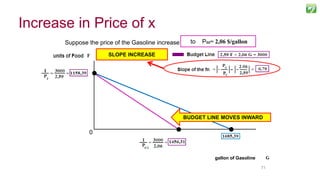
Suppose the price of the Gasoline increase from PG= 1,78 $/gallonto PG2= 2,06 $/gallon
gallon of Gasoline
0
Increase in Price of x
6767
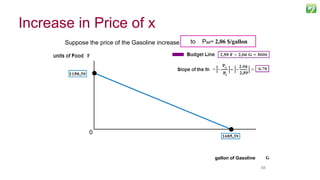
Suppose the price of the Gasoline increase from PG= 1,78 $/gallonto PG2= 2,06 $/gallon
gallon of Gasoline
0
Increase in Price of x
6868
Suppose the price of the Gasoline increase from PG= 1,78 $/gallonto PG2= 2,06 $/gallon
gallon of Gasoline
0
Increase in Price of x
6969
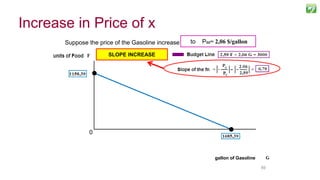
Suppose the price of the Gasoline increase from PG= 1,78 $/gallonto PG2= 2,06 $/gallon
SLOPE INCREASE
gallon of Gasoline
0
Increase in Price of x
7070
Suppose the price of the Gasoline increase from PG= 1,78 $/gallonto PG2= 2,06 $/gallon
SLOPE INCREASE
gallon of Gasoline
0
Increase in Price of x
7171
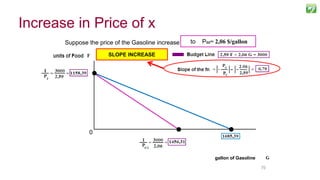
Suppose the price of the Gasoline increase from PG= 1,78 $/gallonto PG2= 2,06 $/gallon
SLOPE INCREASE
gallon of Gasoline
BUDGET LINE MOVES INWARD
0
Increase in Price of x
7272
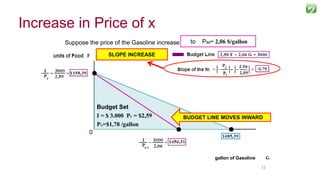
Suppose the price of the Gasoline increase from PG= 1,78 $/gallonto PG2= 2,06 $/gallon
SLOPE INCREASE
Budget Set
I = $ 3.000 PF = $2,59
PG=$1,78 /gallon
gallon of Gasoline
BUDGET LINE MOVES INWARD
0
Increase in Price of x
7373
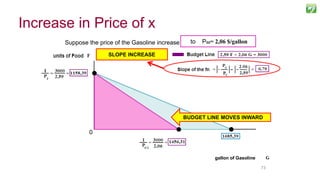
Suppose the price of the Gasoline increase from PG= 1,78 $/gallonto PG2= 2,06 $/gallon
SLOPE INCREASE
Budget Set
I = $ 3.000 PF = $2,59
PG=$1,78 /gallon
gallon of Gasoline
BUDGET LINE MOVES INWARD
0
Increase in Price of x
7474
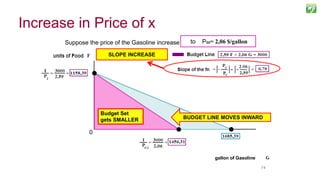
Suppose the price of the Gasoline increase from PG= 1,78 $/gallonto PG2= 2,06 $/gallon
SLOPE INCREASE
Budget Set
I = $ 3.000 PF = $2,59
PG=$1,78 /gallon
Budget Set
gets SMALLER
gallon of Gasoline
BUDGET LINE MOVES INWARD
0
Increase in Price of x
7575
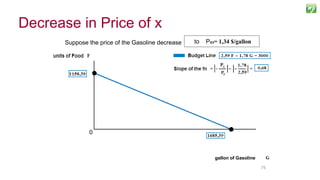
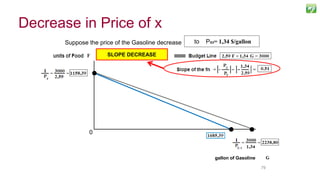
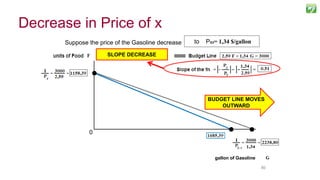
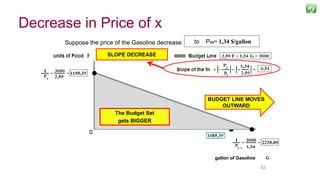
Suppose the price of the Gasoline decrease from PG= 1,78 $/gallonto PG3= 1,34 $/gallon
gallon of Gasoline
0
Decrease in Price of x
7676
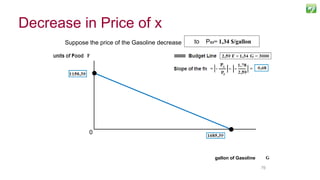
Suppose the price of the Gasoline decrease from PG= 1,78 $/gallonto PG3= 1,34 $/gallon
gallon of Gasoline
0
Decrease in Price of x
7777
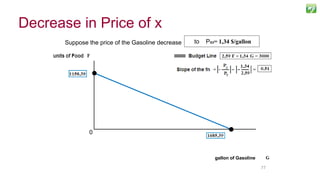
Suppose the price of the Gasoline decrease from PG= 1,78 $/gallonto PG3= 1,34 $/gallon
gallon of Gasoline
0
Decrease in Price of x
7878
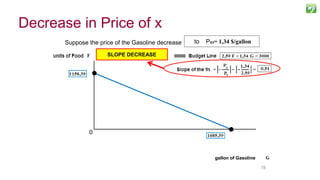
Suppose the price of the Gasoline decrease from PG= 1,78 $/gallonto PG3= 1,34 $/gallon
SLOPE DECREASE
gallon of Gasoline
0
Decrease in Price of x
7979
Suppose the price of the Gasoline decrease from PG= 1,78 $/gallonto PG3= 1,34 $/gallon
SLOPE DECREASE
gallon of Gasoline
0
Decrease in Price of x
8080
Suppose the price of the Gasoline decrease from PG= 1,78 $/gallonto PG3= 1,34 $/gallon
SLOPE DECREASE
gallon of Gasoline
BUDGET LINE MOVES
OUTWARD
0
Decrease in Price of x
8181
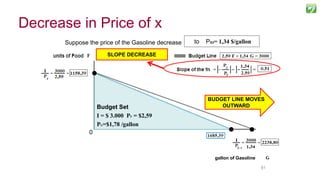
Suppose the price of the Gasoline decrease from PG= 1,78 $/gallonto PG3= 1,34 $/gallon
SLOPE DECREASE
Budget Set
I = $ 3.000 PF = $2,59
PG=$1,78 /gallon
gallon of Gasoline
BUDGET LINE MOVES
OUTWARD
0
Decrease in Price of x
8282
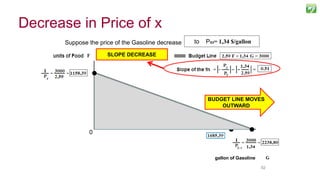
Suppose the price of the Gasoline decrease from PG= 1,78 $/gallonto PG3= 1,34 $/gallon
SLOPE DECREASE
Budget Set
I = $ 3.000 PF = $2,59
PG=$1,78 /gallon
gallon of Gasoline
BUDGET LINE MOVES
OUTWARD
0
Decrease in Price of x
8383
Suppose the price of the Gasoline decrease from PG= 1,78 $/gallonto PG3= 1,34 $/gallon
SLOPE DECREASE
Budget Set
I = $ 3.000 PF = $2,59
PG=$1,78 /gallon
The Budget Set
gets BIGGER
gallon of Gasoline
BUDGET LINE MOVES
OUTWARD
0
Decrease in Price of x
Change in Price
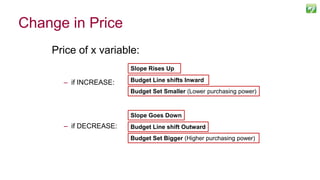
Price of x variable:
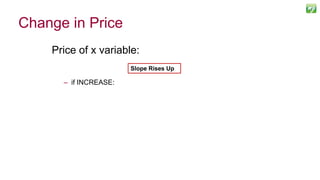
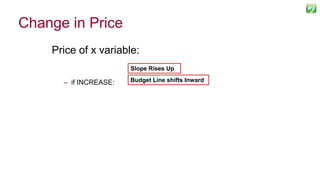
– if INCREASE:
84
Change in Price
Price of x variable:
– if INCREASE:
85
Slope Rises Up
Change in Price
Price of x variable:
– if INCREASE:
86
Slope Rises Up
Budget Line shifts Inward
Change in Price
Price of x variable:
– if INCREASE:
87
Slope Rises Up
Budget Set Smaller (Lower purchasing power)
Budget Line shifts Inward
Change in Price
Price of x variable:
– if INCREASE:
– if DECREASE:
88
Slope Rises Up
Budget Set Smaller (Lower purchasing power)
Budget Line shifts Inward
Change in Price
Price of x variable:
– if INCREASE:
– if DECREASE:
89
Slope Rises Up
Budget Set Smaller (Lower purchasing power)
Budget Line shifts Inward
Slope Goes Down
Change in Price
Price of x variable:
– if INCREASE:
– if DECREASE:
90
Slope Rises Up
Budget Set Smaller (Lower purchasing power)
Budget Line shifts Inward
Slope Goes Down
Budget Line shift Outward
Change in Price
Price of x variable:
– if INCREASE:
– if DECREASE:
91
Slope Rises Up
Budget Set Smaller (Lower purchasing power)
Budget Line shifts Inward
Slope Goes Down
Budget Set Bigger (Higher purchasing power)
Budget Line shift Outward
9292
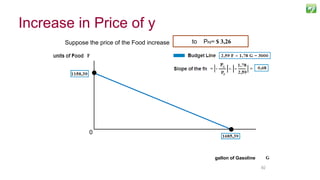
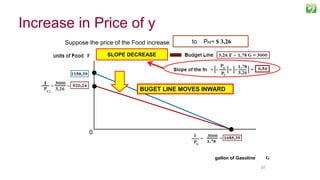
Suppose the price of the Food increase from PG= $ 2,59to PF2= $ 3,26
gallon of Gasoline
0
Increase in Price of y
9393
Suppose the price of the Food increase from PG= $ 2,59to PF2= $ 3,26
gallon of Gasoline
0
Increase in Price of y
9494
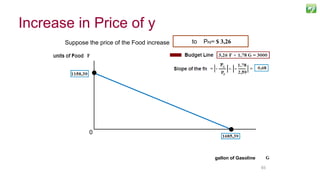
Suppose the price of the Food increase from PG= $ 2,59to PF2= $ 3,26
gallon of Gasoline
0
Increase in Price of y
9595
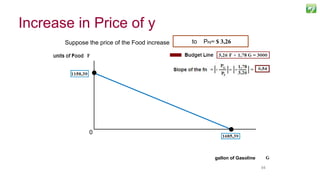
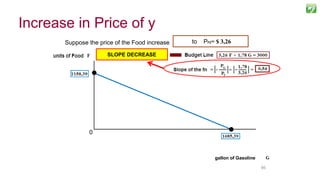
Suppose the price of the Food increase from PG= $ 2,59to PF2= $ 3,26
SLOPE DECREASE
gallon of Gasoline
0
Increase in Price of y
9696
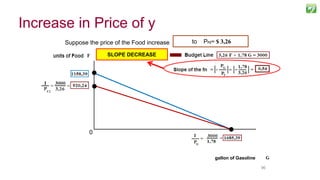
Suppose the price of the Food increase from PG= $ 2,59to PF2= $ 3,26
SLOPE DECREASE
gallon of Gasoline
0
Increase in Price of y
9797
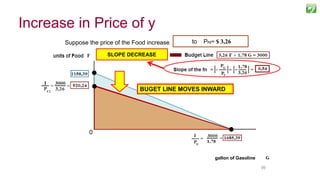
Suppose the price of the Food increase from PG= $ 2,59to PF2= $ 3,26
SLOPE DECREASE
gallon of Gasoline
0
BUGET LINE MOVES INWARD
Increase in Price of y
9898
Suppose the price of the Food increase from PG= $ 2,59to PF2= $ 3,26
SLOPE DECREASE
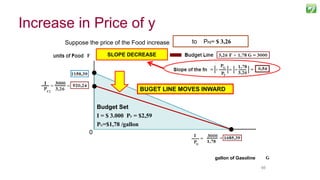
Budget Set
I = $ 3.000 PF = $2,59
PG=$1,78 /gallon
gallon of Gasoline
0
BUGET LINE MOVES INWARD
Increase in Price of y
9999
Suppose the price of the Food increase from PG= $ 2,59to PF2= $ 3,26
SLOPE DECREASE
Budget Set
I = $ 3.000 PF = $2,59
PG=$1,78 /gallon
gallon of Gasoline
0
BUGET LINE MOVES INWARD
Increase in Price of y
100100
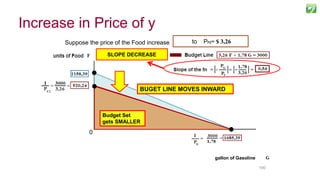
Suppose the price of the Food increase from PG= $ 2,59to PF2= $ 3,26
SLOPE DECREASE
Budget Set
I = $ 3.000 PF = $2,59
PG=$1,78 /gallon
Budget Set
gets SMALLER
gallon of Gasoline
0
BUGET LINE MOVES INWARD
Increase in Price of y
101101
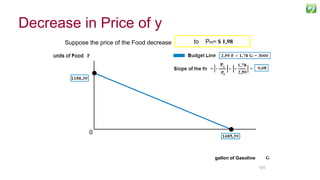
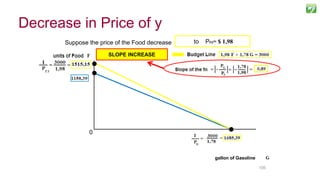
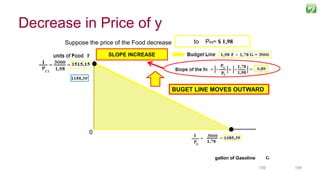
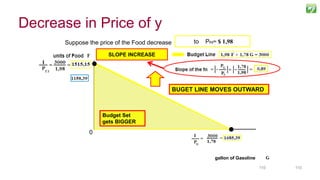
Suppose the price of the Food decrease from PG= $ 2,59to PF3= $ 1,98
gallon of Gasoline
0
Decrease in Price of y
102102
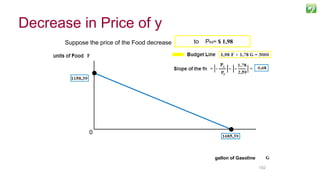
Suppose the price of the Food decrease from PG= $ 2,59to PF3= $ 1,98
gallon of Gasoline
0
Decrease in Price of y
103103
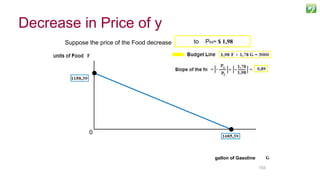
Suppose the price of the Food decrease from PG= $ 2,59to PF3= $ 1,98
gallon of Gasoline
0
Decrease in Price of y
104104
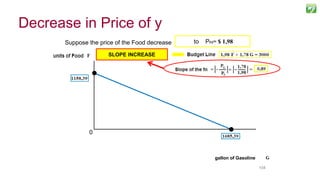
Suppose the price of the Food decrease from PG= $ 2,59to PF3= $ 1,98
SLOPE INCREASE
gallon of Gasoline
0
Decrease in Price of y
105105
Suppose the price of the Food decrease from PG= $ 2,59to PF3= $ 1,98
SLOPE INCREASE
gallon of Gasoline
0
Decrease in Price of y
106106
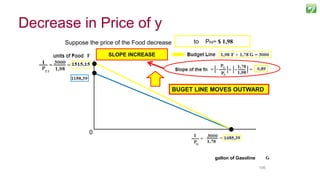
Suppose the price of the Food decrease from PG= $ 2,59to PF3= $ 1,98
SLOPE INCREASE
gallon of Gasoline
0
BUGET LINE MOVES OUTWARD
Decrease in Price of y
107107
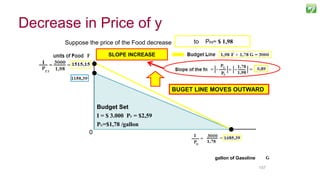
Suppose the price of the Food decrease from PG= $ 2,59to PF3= $ 1,98
SLOPE INCREASE
Budget Set
I = $ 3.000 PF = $2,59
PG=$1,78 /gallon
gallon of Gasoline
0
BUGET LINE MOVES OUTWARD
Decrease in Price of y
108108
Suppose the price of the Food decrease from PG= $ 2,59to PF3= $ 1,98
SLOPE INCREASE
Budget Set
I = $ 3.000 PF = $2,59
PG=$1,78 /gallon
gallon of Gasoline
0
BUGET LINE MOVES OUTWARD
Decrease in Price of y
109109
Suppose the price of the Food decrease from PG= $ 2,59to PF3= $ 1,98
SLOPE INCREASE
Budget Set
I = $ 3.000 PF = $2,59
PG=$1,78 /gallon
gallon of Gasoline
0
BUGET LINE MOVES OUTWARD
Decrease in Price of y
110110
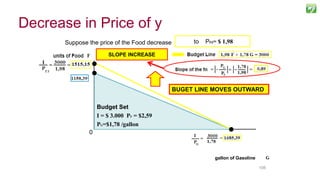
Suppose the price of the Food decrease from PG= $ 2,59to PF3= $ 1,98
SLOPE INCREASE
Budget Set
I = $ 3.000 PF = $2,59
PG=$1,78 /gallon
Budget Set
gets BIGGER
gallon of Gasoline
0
BUGET LINE MOVES OUTWARD
Decrease in Price of y
Change in Price
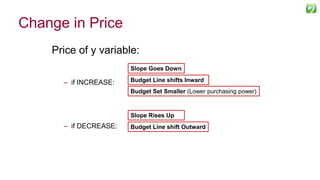
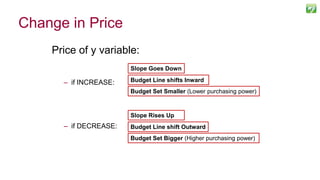
Price of y variable:
– if INCREASE:
111
Change in Price
Price of y variable:
– if INCREASE:
112
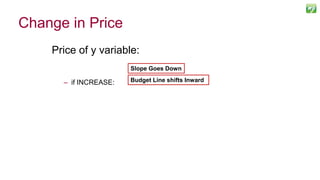
Slope Goes Down
Change in Price
Price of y variable:
– if INCREASE:
113
Slope Goes Down
Budget Line shifts Inward
Change in Price
Price of y variable:
– if INCREASE:
114
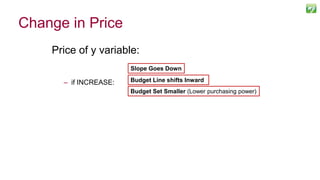
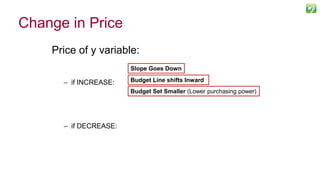
Slope Goes Down
Budget Set Smaller (Lower purchasing power)
Budget Line shifts Inward
Change in Price
Price of y variable:
– if INCREASE:
– if DECREASE:
115
Slope Goes Down
Budget Set Smaller (Lower purchasing power)
Budget Line shifts Inward
Change in Price
Price of y variable:
– if INCREASE:
– if DECREASE:
116
Slope Goes Down
Budget Set Smaller (Lower purchasing power)
Budget Line shifts Inward
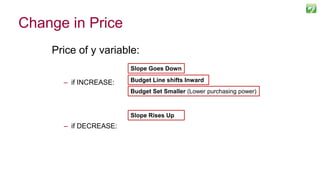
Slope Rises Up
Change in Price
Price of y variable:
– if INCREASE:
– if DECREASE:
117
Slope Goes Down
Budget Set Smaller (Lower purchasing power)
Budget Line shifts Inward
Slope Rises Up
Budget Line shift Outward
Change in Price
Price of y variable:
– if INCREASE:
– if DECREASE:
118
Slope Goes Down
Budget Set Smaller (Lower purchasing power)
Budget Line shifts Inward
Slope Rises Up
Budget Set Bigger (Higher purchasing power)
Budget Line shift Outward
 The Budget Constraint is useful to:
– Find the best solution to satisfy a need to purchase two different goods
with a limited amount
119
5. Conclusion
 The Budget Constraint is useful to:
– Find the best solution to satisfy a need to purchase two different goods
with a limited amount
– Understand the purchasing power and how it can be affected by:
120
5. Conclusion
 The Budget Constraint is useful to:
– Find the best solution to satisfy a need to purchase two different goods
with a limited amount
– Understand the purchasing power and how it can be affected by:
 INCOME CHANGES
121
5. Conclusion
 The Budget Constraint is useful to:
– Find the best solution to satisfy a need to purchase two different goods
with a limited amount
– Understand the purchasing power and how it can be affected by:
 INCOME CHANGES
 PRICE CHANGES
122
5. Conclusion
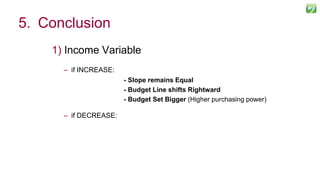
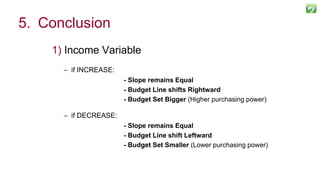
1) Income Variable
– if INCREASE:
123
5. Conclusion
1) Income Variable
– if INCREASE:
- Slope remains Equal
- Budget Line shifts Rightward
- Budget Set Bigger (Higher purchasing power)
124
5. Conclusion
1) Income Variable
– if INCREASE:
- Slope remains Equal
- Budget Line shifts Rightward
- Budget Set Bigger (Higher purchasing power)
– if DECREASE:
125
5. Conclusion
1) Income Variable
– if INCREASE:
- Slope remains Equal
- Budget Line shifts Rightward
- Budget Set Bigger (Higher purchasing power)
– if DECREASE:
- Slope remains Equal
- Budget Line shift Leftward
- Budget Set Smaller (Lower purchasing power)
126
5. Conclusion
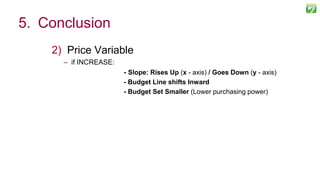
2) Price Variable
– if INCREASE:
127
5. Conclusion
2) Price Variable
– if INCREASE:
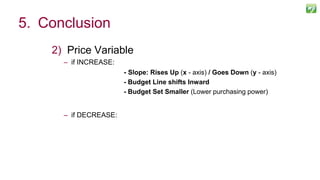
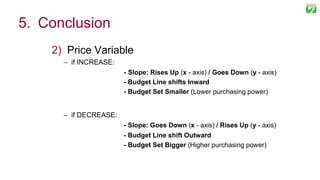
- Slope: Rises Up (x - axis) / Goes Down (y - axis)
- Budget Line shifts Inward
- Budget Set Smaller (Lower purchasing power)
128
5. Conclusion
2) Price Variable
– if INCREASE:
- Slope: Rises Up (x - axis) / Goes Down (y - axis)
- Budget Line shifts Inward
- Budget Set Smaller (Lower purchasing power)
– if DECREASE:
129
5. Conclusion
5. Conclusion
2) Price Variable
– if INCREASE:
- Slope: Rises Up (x - axis) / Goes Down (y - axis)
- Budget Line shifts Inward
- Budget Set Smaller (Lower purchasing power)
– if DECREASE:
- Slope: Goes Down (x - axis) / Rises Up (y - axis)
- Budget Line shift Outward
- Budget Set Bigger (Higher purchasing power)
130
Thank You!
marcogiustiexecutive.com
linkedin.com/in/giustimarco
@MarcoGiusti_IT
marco.giusti1988@gmail.com
131

Budget Constraint | How does it Work

  • 1.
  • 2.
    1. Budget Constraintdefinition Agenda/Outline
  • 3.
    1. Budget Constraintdefinition 2. Budget Line Agenda/Outline
  • 4.
    1. Budget Constraintdefinition 2. Budget Line 3. Budget Set Agenda/Outline
  • 5.
    1. Budget Constraintdefinition 2. Budget Line 3. Budget Set 4. Variables Affecting Budget Constraint:  Increasing Income  Decreasing Income  Increasing Prices of goods  Decreasing Prices of goods Agenda/Outline
  • 6.
    1. Budget Constraintdefinition 2. Budget Line 3. Budget Set 4. Variables Affecting Budget Constraint:  Increasing Income  Decreasing Income  Increasing Prices of goods  Decreasing Prices of goods 5. Conclusion Agenda/Outline
  • 7.
    1. Budget Constraint Definethe set of baskets that a consumer can purchase with a limited amount  I = money income allocated to consumption  Px = the price of a specific good  Py = the price of all other goods  x = amount purchased of a specific good  y = amount purchased of all other goods Pxx + Py y ≤ I
  • 8.
    1. Budget Constraint It’s composed by:  Budget Line 8
  • 9.
    1. Budget Constraint It’s composed by:  Budget Line  Budget Set 9
  • 10.
    2. Budget Line Allcombinations x and y that a consumer can purchase if he spends all of his variable income on the two goods 10 Pxx + Py y = I
  • 11.
    2. Budget Line 11 Pxx+ Py y = I How to draw graph representation of Budget Line
  • 12.
    12 Pxx + Pyy = I How to draw graph representation of Budget Line 2. Budget Line
  • 13.
    13 Pxx + Pyy = I Intersection with axes How to draw graph representation of Budget Line 2. Budget Line
  • 14.
    14 Pxx + Pyy = I Intersection with axes How to draw graph representation of Budget Line 2. Budget Line
  • 15.
    15 C ƒn(x)= B 2. Budget Line Howto find the slope of ƒn:
  • 16.
    16 C ƒn(x)= B 2. Budget Line Howto find the slope of ƒn:
  • 17.
    17 ∆y yC = yB- ∆y C ƒn(x)= B 2. Budget Line How to find the slope of ƒn:
  • 18.
    18 ∆y ∆x yC = yB- ∆y xC = xB + ∆x C ƒn(x)= B 2. Budget Line How to find the slope of ƒn:
  • 19.
    19 ∆y ∆x yC = yB- ∆y xC = xB + ∆x C ƒn(x)= B 2. Budget Line How to find the slope of ƒn:
  • 20.
    3. Budget Set 20 It’sa set of all affordable bundles 0
  • 21.
    21 It’s a setof all affordable bundles G point show us that a given price, a consumer purchases x units and y units, and he still has money because he has not spent it all 0 3. Budget Set
  • 22.
    22 4. Variables AffectingBudget Constraint
  • 23.
    We consider anU.S. Household with Income I = $ 3.000 monthly. Suppose the consumer spends his salary just for:  Food (F) U.S. average Price of Food in 2003 PF = 2,59 $ per units (*)  Gasoline (G) U.S. average Price of Gasoline in Sept. 2003 PG = 1.78 $/gallon (°) (*) US Department of Agricolture, food plans: cost of food - http://www.cnpp.usda.gov/Default.htm (°) textbook “Microeconomics (3rd edition)”, application 4.1 page 104 23 Example of Budget Constraint
  • 24.
    Example of BudgetConstraint 24 gallons of Gasoline 0
  • 25.
    Example of BudgetConstraint 25 gallons of Gasoline
  • 26.
    Example of BudgetConstraint 26 gallons of Gasoline
  • 27.
    Example of BudgetConstraint 27 gallons of Gasoline 0
  • 28.
    Example of BudgetConstraint 28 gallons of Gasoline 0
  • 29.
    Example of BudgetConstraint 29 Suppose a Consumer has bought: GD = 900 gallons gallons of Gasoline 0
  • 30.
    Example of BudgetConstraint 30 D Suppose a Consumer has bought: GD = 900 gallons gallons of Gasoline 0
  • 31.
    Example of BudgetConstraint 31 D Suppose a Consumer has bought: GD = 900 gallons gallons of Gasoline How many units of food can a consumer purchase with the remaining of the Income? 0
  • 32.
    Example of BudgetConstraint 32 D Suppose a Consumer has bought: GD = 900 gallons gallons of Gasoline How many units of food can a consumer purchase with the remaining of the Income? 0
  • 33.
    Example of BudgetConstraint 33 D Suppose a Consumer has bought: GD = 900 gallons gallons of Gasoline How many units of food can a consumer purchase with the remaining of the Income? 0
  • 34.
    Example of BudgetConstraint 34 D Suppose a Consumer has bought: GD = 900 gallons gallons of Gasoline How many units of food can a consumer purchase with the remaining of the Income? 0
  • 35.
    Example of BudgetConstraint 35 D Suppose a Consumer has bought: GD = 900 gallons gallons of Gasoline How many units of food can a consumer purchase with the remaining of the Income? 0
  • 36.
    Example of BudgetConstraint 36 D Suppose a Consumer has bought: GD = 900 gallons gallons of Gasoline Budget LINE: All combinations of F and G that a consumer can purchase if he spends all of his Income on the two goods How many units of food can a consumer purchase with the remaining of the Income? 0
  • 37.
    Example of BudgetConstraint 37 D Suppose a Consumer has bought: GD = 900 gallons gallons of Gasoline Budget LINE: All combinations of F and G that a consumer can purchase if he spends all of his Income on the two goods Budget set, all points in this area are the affordable possibilities that a consumer can purchase without spend all the limited amount How many units of food can a consumer purchase with the remaining of the Income? 0
  • 38.
    Properties of BudgetConstraint  What happens if INCOME Increase / Decrease? 38
  • 39.
    Properties of BudgetConstraint  What happens if INCOME Increase / Decrease?  What happens if PRICE Increase / Decrease? 39
  • 40.
    4040 Suppose the incomeincrease from I = $3.000to I2 = $ 4.500 Units of Food F gallon of Gasoline 0 Increase in Income
  • 41.
    4141 Suppose the incomeincrease from I = $3.000to I2 = $ 4.500 Units of Food F gallon of Gasoline 0 Increase in Income
  • 42.
    4242 Suppose the incomeincrease from I = $3.000to I2 = $ 4.500 Units of Food F gallon of Gasoline 0 Increase in Income
  • 43.
    4343 Suppose the incomeincrease from I = $3.000to I2 = $ 4.500 SLOPE REMAIN EQUAL Units of Food F gallon of Gasoline 0 Increase in Income
  • 44.
    4444 Suppose the incomeincrease from I = $3.000to I2 = $ 4.500 SLOPE REMAIN EQUAL Units of Food F gallon of Gasoline 0 Increase in Income
  • 45.
    4545 Suppose the incomeincrease from I = $3.000to I2 = $ 4.500 BUDGET LINE SHIFS RIGHTWARD SLOPE REMAIN EQUAL Units of Food F gallon of Gasoline 0 Increase in Income
  • 46.
    4646 Suppose the incomeincrease from I = $3.000to I2 = $ 4.500 BUDGET LINE SHIFS RIGHTWARD SLOPE REMAIN EQUAL Budget Set when I = $ 3.000 Units of Food F gallon of Gasoline 0 Increase in Income
  • 47.
    4747 Suppose the incomeincrease from I = $3.000to I2 = $ 4.500 BUDGET LINE SHIFS RIGHTWARD SLOPE REMAIN EQUAL Budget Set when I = $ 3.000 Units of Food F gallon of Gasoline 0 Increase in Income
  • 48.
    4848 Suppose the incomeincrease from I = $3.000to I2 = $ 4.500 BUDGET LINE SHIFS RIGHTWARD SLOPE REMAIN EQUAL Budget Set when I = $ 3.000 Units of Food F I = $ 4.500 Budget Set gets BIGGER gallon of Gasoline 0 Increase in Income
  • 49.
    4949 Suppose the incomedecrease from I = $3.000to I3 = $ 1.500 Units of Food F gallon of Gasoline 0 Decrease in Income
  • 50.
    5050 Suppose the incomedecrease from I = $3.000to I3 = $ 1.500 Units of Food F gallon of Gasoline 0 Decrease in Income
  • 51.
    5151 Suppose the incomedecrease from I = $3.000to I3 = $ 1.500 Units of Food F gallon of Gasoline 0 Decrease in Income
  • 52.
    5252 Suppose the incomedecrease from I = $3.000to I3 = $ 1.500 SLOPE REMAIN EQUALUnits of Food F gallon of Gasoline 0 Decrease in Income
  • 53.
    5353 Suppose the incomedecrease from I = $3.000to I3 = $ 1.500 SLOPE REMAIN EQUALUnits of Food F gallon of Gasoline 0 Decrease in Income
  • 54.
    5454 Suppose the incomedecrease from I = $3.000to I3 = $ 1.500 BUDGET LINE SHIFS LEFTWARD SLOPE REMAIN EQUALUnits of Food F gallon of Gasoline 0 Decrease in Income
  • 55.
    5555 Suppose the incomedecrease from I = $3.000to I3 = $ 1.500 BUDGET LINE SHIFS LEFTWARD SLOPE REMAIN EQUALUnits of Food F Budget Set when I = $ 3.000 gallon of Gasoline 0 Decrease in Income
  • 56.
    5656 Suppose the incomedecrease from I = $3.000to I3 = $ 1.500 BUDGET LINE SHIFS LEFTWARD SLOPE REMAIN EQUALUnits of Food F Budget Set when I = $ 3.000 gallon of Gasoline 0 Decrease in Income
  • 57.
    5757 Suppose the incomedecrease from I = $3.000to I3 = $ 1.500 BUDGET LINE SHIFS LEFTWARD SLOPE REMAIN EQUALUnits of Food F Budget Set when I = $ 3.000 I = $ 1.500 Budget Set gets SMALLER gallon of Gasoline 0 Decrease in Income
  • 58.
    Change in Income IncomeVariable: – if INCREASE: 58
  • 59.
    Change in Income IncomeVariable: – if INCREASE: 59 Slope remains Equal
  • 60.
    Change in Income IncomeVariable: – if INCREASE: 60 Slope remains Equal Budget Line shifts Rightward
  • 61.
    Change in Income IncomeVariable: – if INCREASE: 61 Slope remains Equal Budget Set Bigger (Higher purchasing power) Budget Line shifts Rightward
  • 62.
    Change in Income IncomeVariable: – if INCREASE: – if DECREASE: 62 Slope remains Equal Budget Set Bigger (Higher purchasing power) Budget Line shifts Rightward
  • 63.
    Change in Income IncomeVariable: – if INCREASE: – if DECREASE: 63 Slope remains Equal Budget Set Bigger (Higher purchasing power) Budget Line shifts Rightward Slope remains Equal
  • 64.
    Change in Income IncomeVariable: – if INCREASE: – if DECREASE: 64 Slope remains Equal Budget Set Bigger (Higher purchasing power) Budget Line shifts Rightward Slope remains Equal Budget Line shift Leftward
  • 65.
    Change in Income IncomeVariable: – if INCREASE: – if DECREASE: 65 Slope remains Equal Budget Set Bigger (Higher purchasing power) Budget Line shifts Rightward Slope remains Equal Budget Set Smaller (Lower purchasing power) Budget Line shift Leftward
  • 66.
    6666 Suppose the priceof the Gasoline increase from PG= 1,78 $/gallonto PG2= 2,06 $/gallon gallon of Gasoline 0 Increase in Price of x
  • 67.
    6767 Suppose the priceof the Gasoline increase from PG= 1,78 $/gallonto PG2= 2,06 $/gallon gallon of Gasoline 0 Increase in Price of x
  • 68.
    6868 Suppose the priceof the Gasoline increase from PG= 1,78 $/gallonto PG2= 2,06 $/gallon gallon of Gasoline 0 Increase in Price of x
  • 69.
    6969 Suppose the priceof the Gasoline increase from PG= 1,78 $/gallonto PG2= 2,06 $/gallon SLOPE INCREASE gallon of Gasoline 0 Increase in Price of x
  • 70.
    7070 Suppose the priceof the Gasoline increase from PG= 1,78 $/gallonto PG2= 2,06 $/gallon SLOPE INCREASE gallon of Gasoline 0 Increase in Price of x
  • 71.
    7171 Suppose the priceof the Gasoline increase from PG= 1,78 $/gallonto PG2= 2,06 $/gallon SLOPE INCREASE gallon of Gasoline BUDGET LINE MOVES INWARD 0 Increase in Price of x
  • 72.
    7272 Suppose the priceof the Gasoline increase from PG= 1,78 $/gallonto PG2= 2,06 $/gallon SLOPE INCREASE Budget Set I = $ 3.000 PF = $2,59 PG=$1,78 /gallon gallon of Gasoline BUDGET LINE MOVES INWARD 0 Increase in Price of x
  • 73.
    7373 Suppose the priceof the Gasoline increase from PG= 1,78 $/gallonto PG2= 2,06 $/gallon SLOPE INCREASE Budget Set I = $ 3.000 PF = $2,59 PG=$1,78 /gallon gallon of Gasoline BUDGET LINE MOVES INWARD 0 Increase in Price of x
  • 74.
    7474 Suppose the priceof the Gasoline increase from PG= 1,78 $/gallonto PG2= 2,06 $/gallon SLOPE INCREASE Budget Set I = $ 3.000 PF = $2,59 PG=$1,78 /gallon Budget Set gets SMALLER gallon of Gasoline BUDGET LINE MOVES INWARD 0 Increase in Price of x
  • 75.
    7575 Suppose the priceof the Gasoline decrease from PG= 1,78 $/gallonto PG3= 1,34 $/gallon gallon of Gasoline 0 Decrease in Price of x
  • 76.
    7676 Suppose the priceof the Gasoline decrease from PG= 1,78 $/gallonto PG3= 1,34 $/gallon gallon of Gasoline 0 Decrease in Price of x
  • 77.
    7777 Suppose the priceof the Gasoline decrease from PG= 1,78 $/gallonto PG3= 1,34 $/gallon gallon of Gasoline 0 Decrease in Price of x
  • 78.
    7878 Suppose the priceof the Gasoline decrease from PG= 1,78 $/gallonto PG3= 1,34 $/gallon SLOPE DECREASE gallon of Gasoline 0 Decrease in Price of x
  • 79.
    7979 Suppose the priceof the Gasoline decrease from PG= 1,78 $/gallonto PG3= 1,34 $/gallon SLOPE DECREASE gallon of Gasoline 0 Decrease in Price of x
  • 80.
    8080 Suppose the priceof the Gasoline decrease from PG= 1,78 $/gallonto PG3= 1,34 $/gallon SLOPE DECREASE gallon of Gasoline BUDGET LINE MOVES OUTWARD 0 Decrease in Price of x
  • 81.
    8181 Suppose the priceof the Gasoline decrease from PG= 1,78 $/gallonto PG3= 1,34 $/gallon SLOPE DECREASE Budget Set I = $ 3.000 PF = $2,59 PG=$1,78 /gallon gallon of Gasoline BUDGET LINE MOVES OUTWARD 0 Decrease in Price of x
  • 82.
    8282 Suppose the priceof the Gasoline decrease from PG= 1,78 $/gallonto PG3= 1,34 $/gallon SLOPE DECREASE Budget Set I = $ 3.000 PF = $2,59 PG=$1,78 /gallon gallon of Gasoline BUDGET LINE MOVES OUTWARD 0 Decrease in Price of x
  • 83.
    8383 Suppose the priceof the Gasoline decrease from PG= 1,78 $/gallonto PG3= 1,34 $/gallon SLOPE DECREASE Budget Set I = $ 3.000 PF = $2,59 PG=$1,78 /gallon The Budget Set gets BIGGER gallon of Gasoline BUDGET LINE MOVES OUTWARD 0 Decrease in Price of x
  • 84.
    Change in Price Priceof x variable: – if INCREASE: 84
  • 85.
    Change in Price Priceof x variable: – if INCREASE: 85 Slope Rises Up
  • 86.
    Change in Price Priceof x variable: – if INCREASE: 86 Slope Rises Up Budget Line shifts Inward
  • 87.
    Change in Price Priceof x variable: – if INCREASE: 87 Slope Rises Up Budget Set Smaller (Lower purchasing power) Budget Line shifts Inward
  • 88.
    Change in Price Priceof x variable: – if INCREASE: – if DECREASE: 88 Slope Rises Up Budget Set Smaller (Lower purchasing power) Budget Line shifts Inward
  • 89.
    Change in Price Priceof x variable: – if INCREASE: – if DECREASE: 89 Slope Rises Up Budget Set Smaller (Lower purchasing power) Budget Line shifts Inward Slope Goes Down
  • 90.
    Change in Price Priceof x variable: – if INCREASE: – if DECREASE: 90 Slope Rises Up Budget Set Smaller (Lower purchasing power) Budget Line shifts Inward Slope Goes Down Budget Line shift Outward
  • 91.
    Change in Price Priceof x variable: – if INCREASE: – if DECREASE: 91 Slope Rises Up Budget Set Smaller (Lower purchasing power) Budget Line shifts Inward Slope Goes Down Budget Set Bigger (Higher purchasing power) Budget Line shift Outward
  • 92.
    9292 Suppose the priceof the Food increase from PG= $ 2,59to PF2= $ 3,26 gallon of Gasoline 0 Increase in Price of y
  • 93.
    9393 Suppose the priceof the Food increase from PG= $ 2,59to PF2= $ 3,26 gallon of Gasoline 0 Increase in Price of y
  • 94.
    9494 Suppose the priceof the Food increase from PG= $ 2,59to PF2= $ 3,26 gallon of Gasoline 0 Increase in Price of y
  • 95.
    9595 Suppose the priceof the Food increase from PG= $ 2,59to PF2= $ 3,26 SLOPE DECREASE gallon of Gasoline 0 Increase in Price of y
  • 96.
    9696 Suppose the priceof the Food increase from PG= $ 2,59to PF2= $ 3,26 SLOPE DECREASE gallon of Gasoline 0 Increase in Price of y
  • 97.
    9797 Suppose the priceof the Food increase from PG= $ 2,59to PF2= $ 3,26 SLOPE DECREASE gallon of Gasoline 0 BUGET LINE MOVES INWARD Increase in Price of y
  • 98.
    9898 Suppose the priceof the Food increase from PG= $ 2,59to PF2= $ 3,26 SLOPE DECREASE Budget Set I = $ 3.000 PF = $2,59 PG=$1,78 /gallon gallon of Gasoline 0 BUGET LINE MOVES INWARD Increase in Price of y
  • 99.
    9999 Suppose the priceof the Food increase from PG= $ 2,59to PF2= $ 3,26 SLOPE DECREASE Budget Set I = $ 3.000 PF = $2,59 PG=$1,78 /gallon gallon of Gasoline 0 BUGET LINE MOVES INWARD Increase in Price of y
  • 100.
    100100 Suppose the priceof the Food increase from PG= $ 2,59to PF2= $ 3,26 SLOPE DECREASE Budget Set I = $ 3.000 PF = $2,59 PG=$1,78 /gallon Budget Set gets SMALLER gallon of Gasoline 0 BUGET LINE MOVES INWARD Increase in Price of y
  • 101.
    101101 Suppose the priceof the Food decrease from PG= $ 2,59to PF3= $ 1,98 gallon of Gasoline 0 Decrease in Price of y
  • 102.
    102102 Suppose the priceof the Food decrease from PG= $ 2,59to PF3= $ 1,98 gallon of Gasoline 0 Decrease in Price of y
  • 103.
    103103 Suppose the priceof the Food decrease from PG= $ 2,59to PF3= $ 1,98 gallon of Gasoline 0 Decrease in Price of y
  • 104.
    104104 Suppose the priceof the Food decrease from PG= $ 2,59to PF3= $ 1,98 SLOPE INCREASE gallon of Gasoline 0 Decrease in Price of y
  • 105.
    105105 Suppose the priceof the Food decrease from PG= $ 2,59to PF3= $ 1,98 SLOPE INCREASE gallon of Gasoline 0 Decrease in Price of y
  • 106.
    106106 Suppose the priceof the Food decrease from PG= $ 2,59to PF3= $ 1,98 SLOPE INCREASE gallon of Gasoline 0 BUGET LINE MOVES OUTWARD Decrease in Price of y
  • 107.
    107107 Suppose the priceof the Food decrease from PG= $ 2,59to PF3= $ 1,98 SLOPE INCREASE Budget Set I = $ 3.000 PF = $2,59 PG=$1,78 /gallon gallon of Gasoline 0 BUGET LINE MOVES OUTWARD Decrease in Price of y
  • 108.
    108108 Suppose the priceof the Food decrease from PG= $ 2,59to PF3= $ 1,98 SLOPE INCREASE Budget Set I = $ 3.000 PF = $2,59 PG=$1,78 /gallon gallon of Gasoline 0 BUGET LINE MOVES OUTWARD Decrease in Price of y
  • 109.
    109109 Suppose the priceof the Food decrease from PG= $ 2,59to PF3= $ 1,98 SLOPE INCREASE Budget Set I = $ 3.000 PF = $2,59 PG=$1,78 /gallon gallon of Gasoline 0 BUGET LINE MOVES OUTWARD Decrease in Price of y
  • 110.
    110110 Suppose the priceof the Food decrease from PG= $ 2,59to PF3= $ 1,98 SLOPE INCREASE Budget Set I = $ 3.000 PF = $2,59 PG=$1,78 /gallon Budget Set gets BIGGER gallon of Gasoline 0 BUGET LINE MOVES OUTWARD Decrease in Price of y
  • 111.
    Change in Price Priceof y variable: – if INCREASE: 111
  • 112.
    Change in Price Priceof y variable: – if INCREASE: 112 Slope Goes Down
  • 113.
    Change in Price Priceof y variable: – if INCREASE: 113 Slope Goes Down Budget Line shifts Inward
  • 114.
    Change in Price Priceof y variable: – if INCREASE: 114 Slope Goes Down Budget Set Smaller (Lower purchasing power) Budget Line shifts Inward
  • 115.
    Change in Price Priceof y variable: – if INCREASE: – if DECREASE: 115 Slope Goes Down Budget Set Smaller (Lower purchasing power) Budget Line shifts Inward
  • 116.
    Change in Price Priceof y variable: – if INCREASE: – if DECREASE: 116 Slope Goes Down Budget Set Smaller (Lower purchasing power) Budget Line shifts Inward Slope Rises Up
  • 117.
    Change in Price Priceof y variable: – if INCREASE: – if DECREASE: 117 Slope Goes Down Budget Set Smaller (Lower purchasing power) Budget Line shifts Inward Slope Rises Up Budget Line shift Outward
  • 118.
    Change in Price Priceof y variable: – if INCREASE: – if DECREASE: 118 Slope Goes Down Budget Set Smaller (Lower purchasing power) Budget Line shifts Inward Slope Rises Up Budget Set Bigger (Higher purchasing power) Budget Line shift Outward
  • 119.
     The BudgetConstraint is useful to: – Find the best solution to satisfy a need to purchase two different goods with a limited amount 119 5. Conclusion
  • 120.
     The BudgetConstraint is useful to: – Find the best solution to satisfy a need to purchase two different goods with a limited amount – Understand the purchasing power and how it can be affected by: 120 5. Conclusion
  • 121.
     The BudgetConstraint is useful to: – Find the best solution to satisfy a need to purchase two different goods with a limited amount – Understand the purchasing power and how it can be affected by:  INCOME CHANGES 121 5. Conclusion
  • 122.
     The BudgetConstraint is useful to: – Find the best solution to satisfy a need to purchase two different goods with a limited amount – Understand the purchasing power and how it can be affected by:  INCOME CHANGES  PRICE CHANGES 122 5. Conclusion
  • 123.
    1) Income Variable –if INCREASE: 123 5. Conclusion
  • 124.
    1) Income Variable –if INCREASE: - Slope remains Equal - Budget Line shifts Rightward - Budget Set Bigger (Higher purchasing power) 124 5. Conclusion
  • 125.
    1) Income Variable –if INCREASE: - Slope remains Equal - Budget Line shifts Rightward - Budget Set Bigger (Higher purchasing power) – if DECREASE: 125 5. Conclusion
  • 126.
    1) Income Variable –if INCREASE: - Slope remains Equal - Budget Line shifts Rightward - Budget Set Bigger (Higher purchasing power) – if DECREASE: - Slope remains Equal - Budget Line shift Leftward - Budget Set Smaller (Lower purchasing power) 126 5. Conclusion
  • 127.
    2) Price Variable –if INCREASE: 127 5. Conclusion
  • 128.
    2) Price Variable –if INCREASE: - Slope: Rises Up (x - axis) / Goes Down (y - axis) - Budget Line shifts Inward - Budget Set Smaller (Lower purchasing power) 128 5. Conclusion
  • 129.
    2) Price Variable –if INCREASE: - Slope: Rises Up (x - axis) / Goes Down (y - axis) - Budget Line shifts Inward - Budget Set Smaller (Lower purchasing power) – if DECREASE: 129 5. Conclusion
  • 130.
    5. Conclusion 2) PriceVariable – if INCREASE: - Slope: Rises Up (x - axis) / Goes Down (y - axis) - Budget Line shifts Inward - Budget Set Smaller (Lower purchasing power) – if DECREASE: - Slope: Goes Down (x - axis) / Rises Up (y - axis) - Budget Line shift Outward - Budget Set Bigger (Higher purchasing power) 130
  • 131.